Blog
Tutorials
Best Restaurant Website Builder 2026: Top 3
We compared CatDoes, Wix and Squarespace on menus, online ordering, reservations, apps and real 12-month cost. See which restaurant website builder wins.

Nafis Amiri
Co-Founder of CatDoes

TL;DR: The best restaurant website builder depends on whether you just need a menu online or you want to own your ordering channel. We compared CatDoes, Wix, and Squarespace on the five things a restaurant actually needs: menus, online ordering, table reservations, a mobile app, and real 12-month cost. CatDoes wins overall because it ships a real website and a native iOS and Android app from the same project, with a database included and no lock-in. Wix is the best value if you only need a website, since ordering and reservations are built in for $348 a year. Squarespace has the nicest templates but no native ordering or reservations at all, and a working setup runs past $6,500 a year.
Table of Contents
What a Restaurant Website Actually Needs
How We Evaluated These Builders
Restaurant Website Builders Compared at a Glance
The 3 Best Restaurant Website Builders in 2026
What Online Ordering Really Costs You
Should Your Restaurant Have an App Too?
How to Choose the Right Restaurant Website Builder
Frequently Asked Questions
The Bottom Line
Ask around and you will hear the same story: a four-figure quote for a website that turns out to be a menu and a phone number. It stings, because you know the menu changes every week and you will still be emailing someone to swap out a PDF.
Picking the best restaurant website builder is really a question about what happens after launch: who owns the site, what it costs to take an order, and whether you can change Tuesday's specials yourself. This guide compares CatDoes, Wix, and Squarespace on those terms, with every price checked against the vendor's own pricing page in September 2026.
What a Restaurant Website Actually Needs
A restaurant site has a narrower job than most small business websites. It needs to answer four questions fast: what do you serve, are you open, can I order, and can I book a table.
A 2023 US Foods survey of 1,003 diners found 83% review a restaurant's menu before visiting, and half of those had already decided what to order before walking in. Your menu page is doing more selling than your dining room.
Ordering matters even more. The National Restaurant Association's 2024 Technology Landscape Report found that 84% of delivery customers would order through a restaurant's own website, compared with 71% through a third-party app. Diners are not loyal to the delivery apps. They use them because most restaurants never gave them another option.
Search behaviour has shifted too. Google data presented in January 2025 showed searches for "food near me" up 99% year over year, and "food near me open now" up 875%. Accurate hours and a fast mobile page are not housekeeping any more, they are the whole game.
So the five criteria that matter, in order:
Menu management you can update yourself in two minutes, not a PDF
Online ordering, and what each order costs you in fees
Table reservations, native or bolted on
Mobile app capability, for regulars and loyalty
Real 12-month cost, including every add-on you are forced to buy
How We Evaluated These Builders
We scored each platform against those five criteria using evidence you can go and check yourself.
Pricing was read off each vendor's own pricing page in September 2026 and cross-checked against their help documentation. Feature claims come from each company's official support articles, which is where the limitations are usually admitted. Where a vendor does not publish a price, we say so instead of guessing.
Total cost is calculated over 12 months on annual billing, including the third-party subscriptions a restaurant is forced to add when the platform has no native option. Most comparisons stop at the sticker price. That is exactly where the real differences hide.
One note on speed, since it comes up constantly. Both Wix and Squarespace perform well on Core Web Vitals in Google's field data, so we did not treat page speed as a differentiator here. The old "Wix is slow" reputation is out of date.
Restaurant Website Builders Compared at a Glance
Feature | CatDoes | Wix | Squarespace |
|---|---|---|---|
Entry price for a real restaurant site | $17/mo annual (Core) | $29/mo annual (Core) | $29/mo annual (Core) |
Free plan | Yes, 15 credits, no custom domain | Yes, Wix branding | No, 14-day trial only |
Native online ordering | Built to your spec | Yes, commission-free | No, third-party required |
Native table reservations | Built to your spec | Yes | No, third-party required |
Native iOS and Android app | Yes, included on Starter | Separate paid plan, price not published | No customer-facing app |
Database and backend included | Yes, on every plan | No | No |
Switch template after launch | Yes, just ask again | No | No, on version 7.1 |
Export your code and leave | Yes, on Pro | No | Partial, no CSS or styles |
12-month cost, site + ordering + reservations | $504 | $348 | $6,564 |
Costs are annual-billing list prices verified in September 2026. The Squarespace figure adds the third-party ordering and reservation subscriptions its own documentation tells you to use.
The 3 Best Restaurant Website Builders in 2026
1. CatDoes: Best Restaurant Website Builder Overall
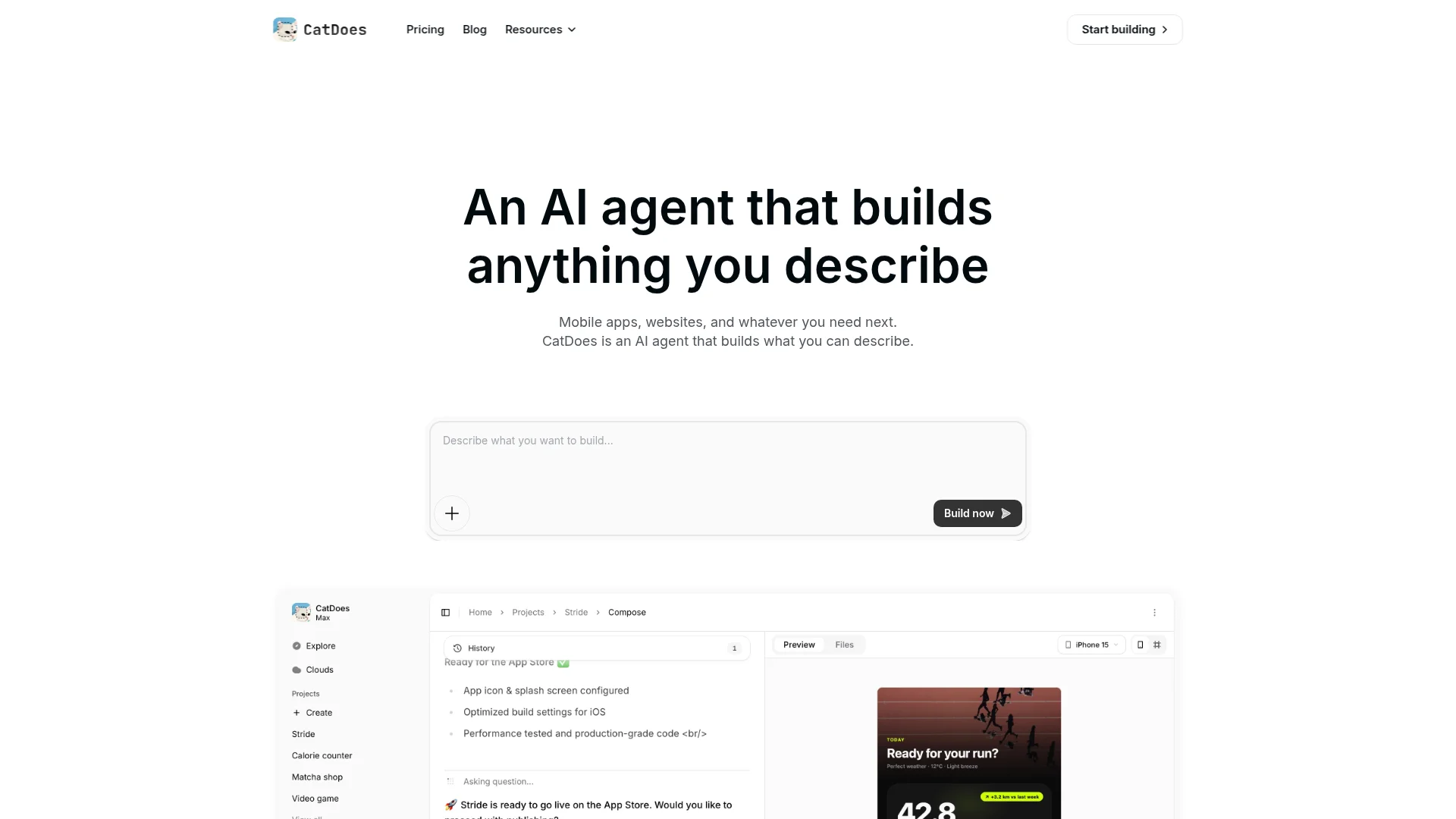
CatDoes is an AI agent that builds and deploys real software from a description. You tell it what your restaurant needs, and it builds the pages, the menu structure, the ordering flow, and the database behind them, then deploys to your own domain.
The difference from a traditional builder is what you get at the end. A Wix or Squarespace site is a hosted page you rent. A CatDoes project is an actual application, with a database, authentication, and file storage included on every plan through CatDoes Cloud. That is why the ordering flow can match how your kitchen works instead of how a plugin was designed.
It is also the only one of the three that turns the same project into a native iOS and Android app. App Store and Google Play releases are included from the Starter plan at $42 a month on annual billing, which is the cheapest plan that also supports a custom domain.
Best for: restaurants that want to own their ordering channel, run a loyalty app, or avoid being locked into one vendor.
If you want to see how the prompt-to-site approach compares outside the restaurant category, we ranked ten of them in our guide to the best AI website builders.
2. Wix: Best Built-In Ordering and Reservations
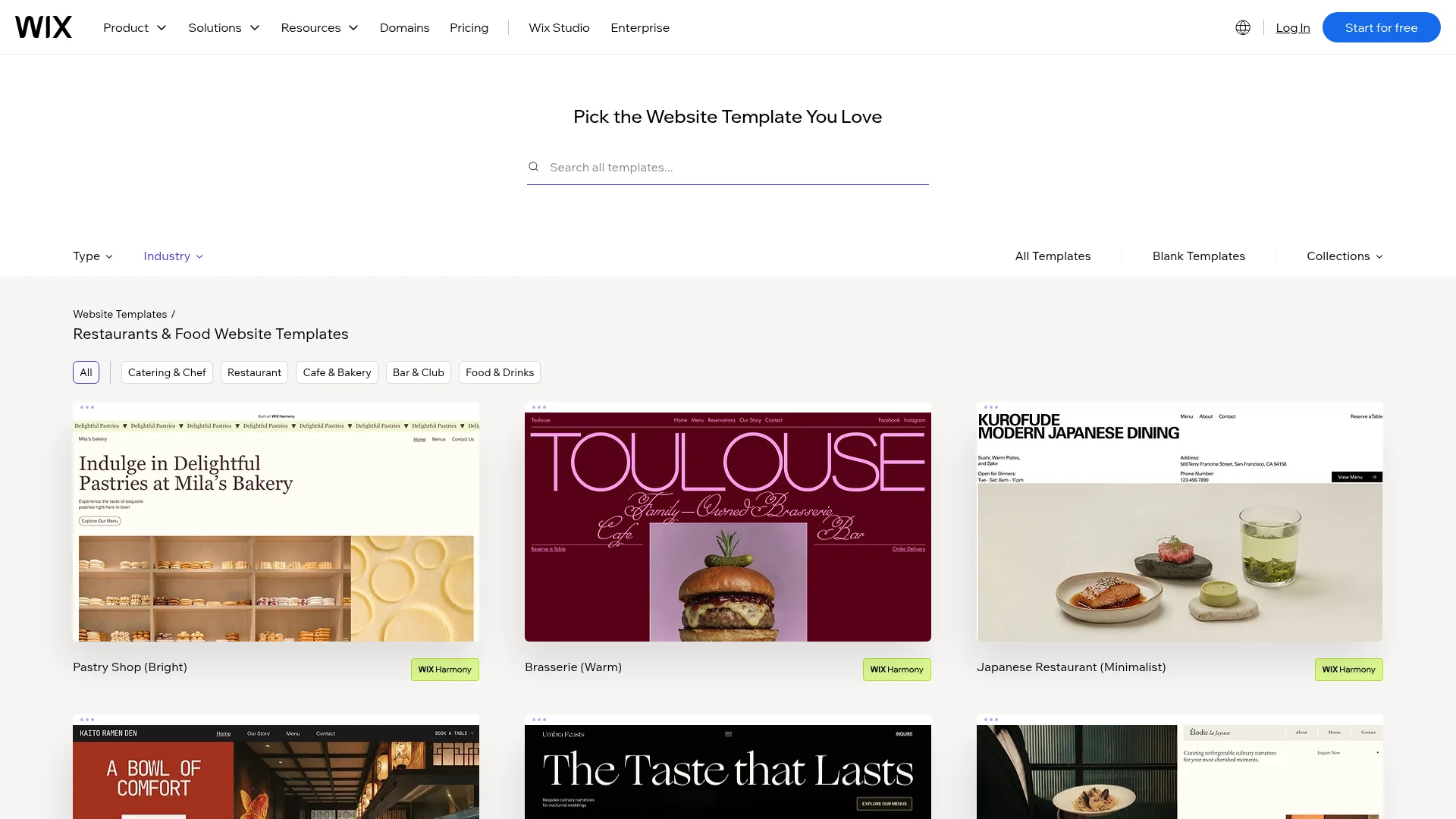
Wix is the strongest traditional builder for restaurants, and it is not close. Three first-party products cover the core jobs: Wix Restaurant Menus, Wix Restaurant Orders, and Wix Table Reservations. All three are free to install, and Wix takes 0% commission on orders placed through your site.
That combination at $29 a month on annual billing is genuinely good value. Ordering supports pickup, delivery, and dine-in, with prep times, modifiers, and up to five separate ordering pages. Reservations handle party sizes, turnover times, and deposits for large groups. You will still pay card processing at 2.9% plus $0.30, but there is no platform cut on top.
Wix's AI builder is now called Wix Harmony, launched in January 2026 with an agent named Aria that stays available inside the editor rather than generating once and stopping. The older Wix ADI was retired in November 2024.
Where it costs you: the lock-in is real and Wix documents it plainly. You cannot switch templates once a site exists, and Wix states that a site "needs to be hosted and operated on Wix's servers", so there is no code export. The point-of-sale story is weaker than it looks: Wix's own help centre confirms the Wix POS Register tablet cannot be used with Wix Restaurants, and that Toast and Clover integrations are unsupported open feature requests. A branded mobile app is a separate subscription whose price Wix does not publish, and if you cancel it, your app is removed from the stores.
3. Squarespace: Best Templates for Restaurants
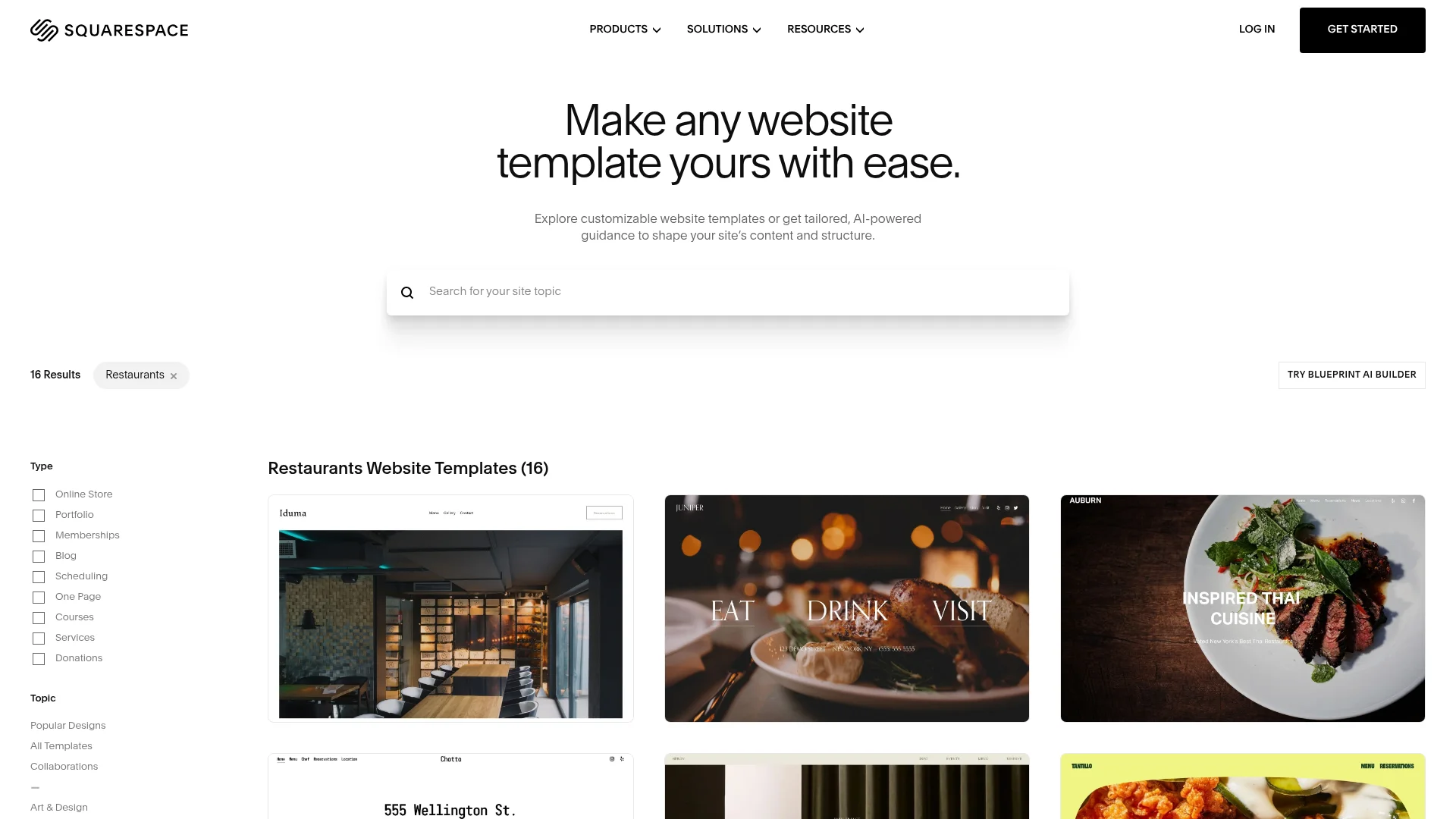
Squarespace makes the best-looking restaurant sites of the three, and for a certain kind of venue that matters. Its restaurant template gallery carries 16 designs, and the native menu block is the one restaurant feature it does properly: it is styled to match your site, and the text stays indexable by search engines, unlike a PDF.
Then you hit the wall. Squarespace has no native online ordering and no native table reservations. This is not an inference, it is what Squarespace's own restaurant documentation says: you use third-party integrations or extensions to set up reservations, online orders, or both. Squarespace also notes that extensions fall outside its scope of support.
In practice that means stacking subscriptions. Ordering runs through ChowNow, which starts around $229 a month on annual billing. Reservations run through OpenTable or Resy, with Resy's flat plans starting at $289 a month. Add those to Squarespace Core and you are at roughly $6,564 a year, where Squarespace itself is only about 5% of the bill.
There is an awkward footnote too. Squarespace bought Tock for $400 million in 2021 and sold it to American Express for the same figure in 2024. Tock was folded into Resy in August 2026, yet Squarespace's help docs still point restaurants at the Tock block, and Resy has no native Squarespace block.
Where it costs you: the Basic plan at $19 a month blocks JavaScript and iframes, which kills most ordering embeds, so Core is the real entry price. You cannot switch templates on version 7.1. The export is close to useless for portability, since it excludes custom CSS, style settings, and store pages. Prices also rose in July 2026, with Core up 26%.
What Online Ordering Really Costs You

This is the number that decides whether a restaurant website pays for itself, and it has almost nothing to do with the monthly subscription.
Third-party delivery marketplaces publish their commission rates openly. DoorDash charges 15%, 25%, or 30% of each delivery order depending on tier. Uber Eats charges 20%, 25%, or 30%. Those are commissions on the food, not delivery fees paid by the customer.
Run that against a modest volume. At an average order of $50 and 100 orders a week, a restaurant does $260,000 a year through that channel:
Channel | Rate | Annual cost on $260,000 |
|---|---|---|
DoorDash Premier | 30% | $78,000 |
Uber Eats Premium | 30% | $78,000 |
Uber Eats Lite | 20% | $52,000 |
DoorDash Basic | 15% | $39,000 |
Your own website | 2.9% + $0.30 | $9,100 |
Moving that volume to your own site saves roughly $68,900 a year against DoorDash's top tier, and about $29,900 against its cheapest. The website subscription, whichever platform you pick, is a rounding error next to that gap.
Two honest caveats. The delivery apps bring new customers you would not otherwise reach, so the realistic move is shifting your repeat customers to your own channel rather than leaving the marketplaces entirely. And you still have to get the food to the door, whether that is your own driver or a flat-fee courier service.
All three builders here beat the marketplaces on fees. Wix and CatDoes both take 0% of your orders, and a Squarespace stack does too once you have paid for the third-party tools. The commission argument is a reason to own a website at all, not a reason to pick one of these three over another.
Should Your Restaurant Have an App Too?
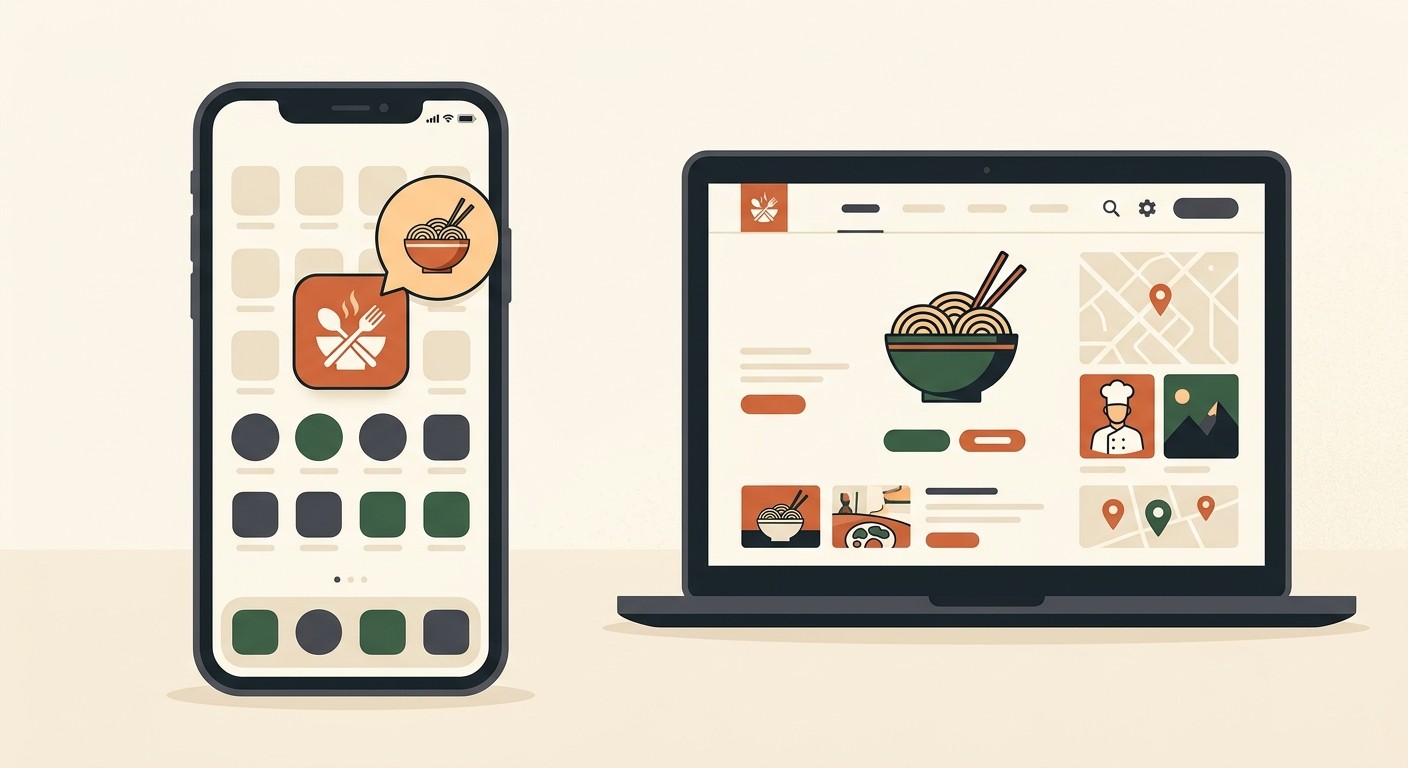
For most restaurants a website is enough. An app earns its keep when you have regulars, because it puts your menu on the home screen and lets you send a push notification instead of paying to reach people.
The National Restaurant Association's 2024 data supports this: 63% of full-service customers and 70% of limited-service customers said they would place an order using a smartphone app. The appetite is there for venues with repeat traffic.
The three platforms split hard here. Squarespace cannot do it: its mobile apps are admin tools for owners, and there is no customer-facing app product. Wix can, through a separate Mobile App Premium subscription on top of your site plan, but Wix does not publish that price anywhere public, and its own documentation lists real limits including no offline mode, no multilingual support, and no custom App Store screenshots. Cancel the plan and the app is pulled from the stores.
CatDoes builds the app from the same project as the site, with App Store and Google Play releases included on the Starter plan. You still pay Apple's $99 a year developer fee and Google's $25 one-time fee, as you would on any platform.
If you already have a site and are weighing this up, we cover the options in more depth in our guide to turning your website into an app.
How to Choose the Right Restaurant Website Builder
Match the platform to what you actually do, not to the longest feature list.
Pick Wix if you want ordering and reservations live quickly at the lowest monthly price, you only need a website, and you are comfortable never moving the site elsewhere.
Pick Squarespace if design is the priority, bookings come by phone, and you do not need online ordering. Price the third-party add-ons before you commit, because they cost several times the subscription.
Pick CatDoes if you want to own what you build, need an ordering flow that matches your kitchen, want a native app alongside the site, or want the option to export the code and leave.
Whichever you choose, the fundamentals are the same: a mobile-first menu in real text rather than a PDF, accurate opening hours, and a Google Business Profile that matches your site. Our checklist of what every small business website needs covers the rest.
Frequently Asked Questions
How much does a restaurant website cost?
Using a builder, expect $348 to $600 a year for a site with ordering and reservations, plus card processing at roughly 2.9% plus $0.30 per order. Hiring it out costs far more: WebFX puts freelance web design at $500 to $10,000 and agency work at $3,000 to $30,000, before ongoing maintenance.
Can I build a restaurant website for free?
You can build and preview one for free on CatDoes or Wix, but not run a real one. Free tiers do not allow a custom domain, and Wix's free plan cannot accept payments. Squarespace has no free plan, only a 14-day trial. Budget for a paid plan the moment you want your own domain name.
Do I need online ordering on my restaurant website?
If you already take takeout or delivery orders, yes. The National Restaurant Association found 84% of delivery customers would order through a restaurant's own website versus 71% through a third-party app, and every order you move in-house avoids a 15% to 30% marketplace commission.
Should I use Wix or Squarespace for my restaurant website?
Wix, in almost every case. Wix includes commission-free online ordering and table reservations as first-party products, while Squarespace has neither and requires paid third-party tools that can push the yearly total past $6,500. Choose Squarespace only if design matters more than ordering.
Can AI build a restaurant website with online ordering?
Yes. An AI website builder for restaurants like CatDoes can generate the menu pages, ordering flow, and the database behind them from a description, then deploy to your domain. Because it builds real software rather than filling in a template, the ordering logic can match your prep times, modifiers, and pickup windows.
Can I add online ordering to an existing restaurant website?
Usually yes, through an embedded third-party ordering widget, though some plans block the JavaScript and iframes required. Squarespace's Basic plan is one example. Check that your plan allows code embeds before paying for an ordering service.
The Bottom Line
The best restaurant website builder in 2026 comes down to how much of your business you want to own.
Wix is the best value on sticker price, with commission-free ordering and reservations built in for $348 a year, as long as you accept that you can never switch templates or move the site. Squarespace makes the prettiest sites but has no native ordering or reservations, and the third-party stack it points you toward costs more than ten times the subscription.
CatDoes takes the top spot because it is the only one that ends with something you own: a real site with a database behind it, an ordering flow built to your operation, a native iOS and Android app from the same project, and the ability to export the code and walk away. At $504 a year that is $156 more than Wix, which is a fair price for not renting your restaurant's front door.
Describe your restaurant, and watch it get built. Start free with CatDoes, no credit card required.
Nafis Amiri
Co-Founder of CatDoes