Blog
Insights
Codex vs Claude Code 2026: Pricing, Limits, Speed
Codex vs Claude Code after GPT-6.1 Sol: pricing, usage limits, speed, and independent benchmarks against Claude Opus 5.5 and Sonnet 5.5. Pick your agent.

Nafis Amiri
Co-Founder of CatDoes

OpenAI released GPT-6.1 Sol on September 29, 2026, one week after GPT-6 Sol, and the Codex CLI made it the default model on October 7. Anthropic answered with Claude Sonnet 5.5 on September 28 and Claude Haiku 5.5 on October 7, while Claude Opus 5.5 stayed the Claude Code default. For the first time, the Codex vs Claude Code price list lines up tier for tier.
This guide compares Claude Code vs Codex on what ships today: pricing, usage limits, speed, independent benchmarks, and workflow. Every figure comes from vendor documentation or a named third party. Where Anthropic and OpenAI report different numbers for the same model, we say so instead of picking one.
TL;DR
Codex now defaults to GPT-6.1 Sol at $2 per million input tokens and $10 output, with cached input at $0.10, half what GPT-6 Sol charged. OpenAI says it comes close to GPT-6 Astra at a fifth of Astra’s price.
Claude Code still defaults to Claude Opus 5.5 at $4/$20 on every paid plan. Anthropic’s cheaper models now match OpenAI price for price: Sonnet 5.5 costs exactly what GPT-6.1 Sol does, and Haiku 5.5 matches GPT-6 Luna at $0.10/$0.50.
On Artificial Analysis’s independent runs, Opus 5.5 at its default effort beats GPT-6.1 Sol at its default (51.2 vs 47.8 on the Intelligence Index) but costs about 6x more per task. Sol at max effort matches that default score for $0.72 a task, but it can’t reach Opus 5.5’s ceiling of 57.6.
Codex limits changed. Pro now comes in $100, $200, and $500 tiers with no five-hour cap, and the $200 tier drops from 20x to 10x Plus usage on October 30.
Both tools now read AGENTS.md. Claude Code is still the supervised, customizable agent and Codex the one you delegate to and leave running. Most experienced developers use both.
CatDoes gives non-technical builders four agent tiers (Low, Medium, High, Max), so they choose how hard the agent thinks instead of tracking models.
Table of Contents
Claude Code vs Codex: The Quick Verdict
Side-by-Side Comparison Table
Claude Code: Strengths and Limits
OpenAI Codex: Strengths and Limits
Benchmarks: What the Numbers Say
Claude Code vs Codex Speed: Which Finishes First?
Pricing and Token Efficiency
When to Use Claude Code vs Codex
From Code to a Shipped App
Claude Code vs Codex FAQ
Pick Your Agent, or Let One Pick for You
Claude Code vs Codex: The Quick Verdict
Claude Code is Anthropic’s coding agent. It started as a terminal tool and now runs across five surfaces that share one engine, one CLAUDE.md, and one settings file: the CLI, a desktop app for macOS, Windows, and Linux, the web and mobile apps, a VS Code extension, and a JetBrains plugin. Your code stays on your machine. The agent shows its reasoning, and since August 2026 it defaults to "auto" mode, where a classifier reviews proposed actions instead of stopping to ask you about each one.
Codex is OpenAI’s coding agent, and it made the opposite bet. The CLI is written in Rust, runs locally, and pairs with Codex cloud, where you hand off a task and get a branch or pull request back. In July 2026 the standalone Codex desktop app was folded into the ChatGPT desktop app, consolidating both under one product.
The shortest answer for October 2026: the two tools are close on capability, and the price gap now comes from their defaults rather than their rate cards. Both carry roughly a million tokens of context, and every OpenAI model now has a Claude model at the same list price.
Claude Code starts you on Opus 5.5, which is stronger and costs more per task. Codex starts you on GPT-6.1 Sol, which gets more done per dollar.
What separates the tools themselves has not changed. Claude Code is built to be supervised and deeply customized, Codex to be delegated to and run unattended.

Side-by-Side Comparison Table
Here is the comparison at a glance. The sections below go deeper on each row.
Feature | Claude Code | Codex |
|---|---|---|
Default model | Claude Opus 5.5 (Sept 22, 2026) | GPT-6.1 Sol (Sept 29, 2026) |
Default model price | $4 / $20 per MTok | $2 / $10 per MTok |
Mid-tier model | Sonnet 5.5: $2 / $10 | GPT-6.1 Sol: $2 / $10 |
Cheapest model | Haiku 5.5: $0.10 / $0.50 | GPT-6 Luna: $0.10 / $0.50 |
Frontier model | Claude Fable 5.1: $10 / $50 | GPT-6 Astra: $10 / $50 |
Context window | 1M tokens | 1.05M tokens |
Long-context pricing | Flat across 1M (Haiku 5.5 rises above 100K) | 2x input, 1.5x output above 272K |
Terminal-Bench 4.0, default effort (Artificial Analysis) | 52.5% (Opus 5.5) | 48.0% (GPT-6.1 Sol) |
Cost per task, default effort (Artificial Analysis) | $1.34 | $0.21 |
Workflow | Supervised, local-first | Autonomous, cloud plus local |
AGENTS.md | Read when no CLAUDE.md exists (v2.1.277+) | Native, with per-directory hierarchy |
Entry plan | Pro, $20/mo | Free $0, Go $8/mo |
Top individual plan | Max 20x | Pro $500 |
Latest CLI | v2.1.295 (Oct 8, 2026) | v0.162.0 (Oct 8, 2026) |
Two rows changed the story since September. The cheapest-model row is now a tie on price, and AGENTS.md is no longer a Codex exclusive. What’s left is a split on defaults: Claude Code puts you on the stronger, pricier model, and Codex on the cheaper one that does more per dollar.
Claude Code: Strengths and Limits
Claude Code reads your local filesystem directly and never uploads your repository to a cloud sandbox, which matters under an NDA or on proprietary code. Claude Opus 5.5 has been the default on every paid plan since v2.1.280 on September 22, 2026. Claude Sonnet 5.5 (v2.1.284, September 28) and Claude Haiku 5.5 (v2.1.293, October 7) are one /model switch away.
Opus 5.5, Sonnet 5.5, and Fable 5.1 bill the full 1M-token window at a flat rate: a 900,000-token request costs the same per token as a 9,000-token one. Haiku 5.5 is the exception, at five times its base rate once a prompt passes 100,000 tokens.
What Claude Code does better than Codex:
A price match for every OpenAI tier. Sonnet 5.5 costs exactly what GPT-6.1 Sol does ($2/$10, with $0.10 cache reads), and Haiku 5.5 matches GPT-6 Luna at $0.10/$0.50. Until October 7, Codex had the bottom of the price list to itself.
The highest quality ceiling. On Artificial Analysis’s index, Opus 5.5 reaches 57.6 at max effort and Sonnet 5.5 reaches 56.0. GPT-6.1 Sol tops out at 51.8.
Customization depth. Hooks fire on lifecycle events, including model-switch events, and can run conditionally. Skills are folder-based instruction packs loaded on demand, and custom slash commands were merged into them.
Checkpointing. A snapshot is taken before every change. Esc-Esc or /rewind rolls back both files and conversation, and can resume from before a /clear.
Subagents. Each gets its own context window, tool permissions, and model, and they nest up to five levels deep.
Permission granularity. Six modes, from fully manual through plan mode to bypass, with OS-level sandboxing via macOS Seatbelt and Linux bubblewrap.
Higher session limits. Anthropic raised the five-hour limits on Pro, Max, Team, and seat-based Enterprise plans with the 5.5 launch, and issued subscribers a rate-limit reset usable through October 22, 2026.
Where Claude Code falls short:
The default is the expensive model. Opus 5.5 costs twice what GPT-6.1 Sol does per token, and about 6x more per task at default effort on Artificial Analysis’s runs ($1.34 vs $0.21). Switching to Sonnet 5.5 matches Sol’s rates, but at medium effort it scores 40.8 on the index against Sol’s 47.8, at more than twice the cost per task.
Limits are still opaque. Anthropic says it raised the five-hour limits but publishes no absolute number for them or for the weekly cap that sits on top. Percentages quoted for the September weekly changes trace to third-party trackers, not to Anthropic, so there is no reliable way to compare a Claude Code plan against a Codex one on volume.
No free tier. Claude Code starts at the $20/mo Pro plan. Codex has a free tier and an $8 plan.
AGENTS.md support is partial. Since v2.1.277 (September 18, 2026), Claude Code reads AGENTS.md, but by default only when the project has no CLAUDE.md. It also ignores AGENTS.override.md, AGENTS.local.md, and anything under .agents/.
Tokenizer inflation. Claude 4.7 and later use a tokenizer that produces roughly 30% more tokens for the same text. Anthropic puts 1M tokens at about 555,000 words, against roughly 750,000 on earlier models, so headline per-token prices are not directly comparable across generations or vendors.
If you want to see how an app-building agent compares with Claude Code, see our CatDoes vs Claude Code comparison.
OpenAI Codex: Strengths and Limits
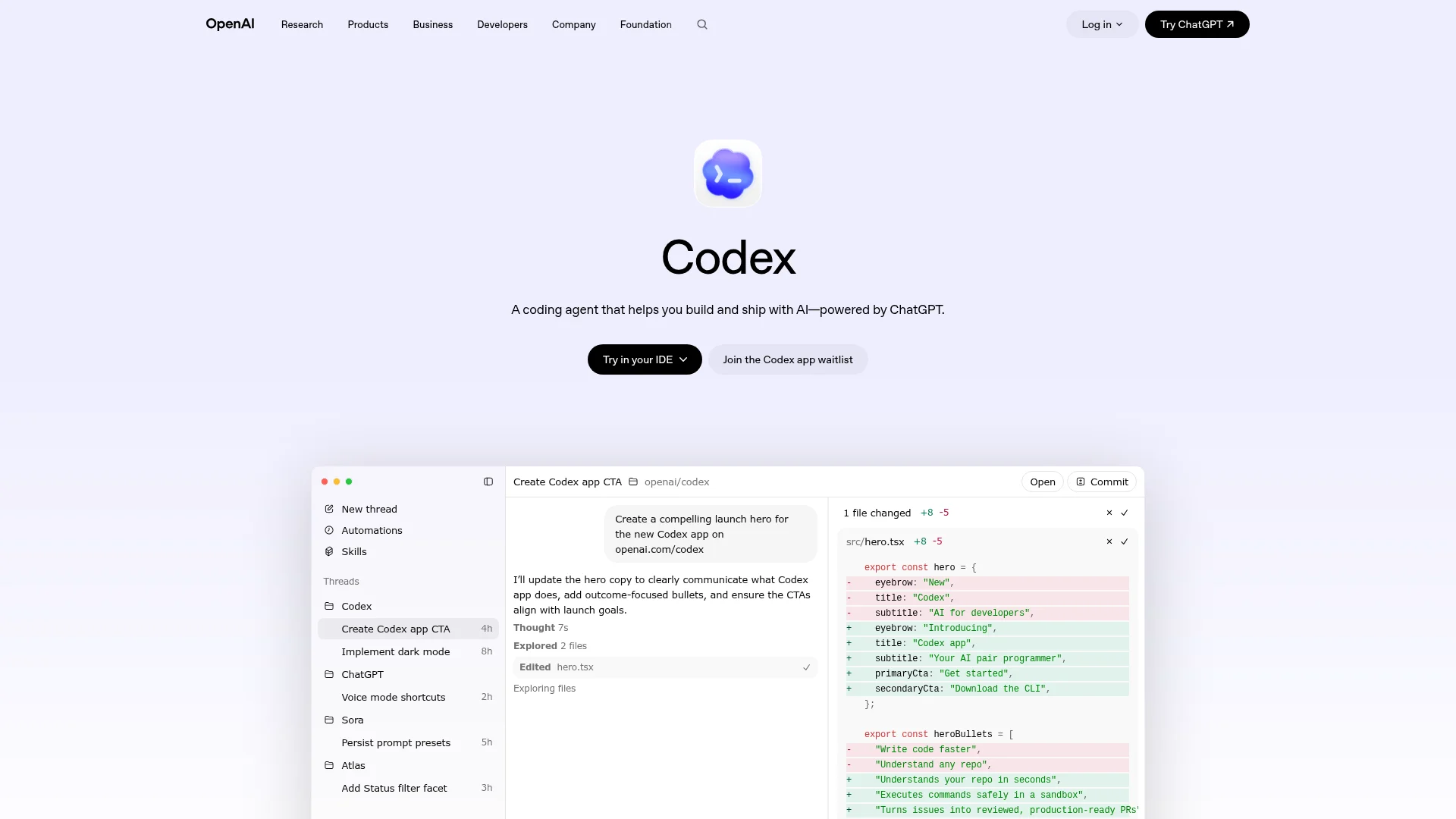
Codex spans more surfaces than any competing agent: the Rust CLI, IDE extensions for VS Code, Cursor, Windsurf, JetBrains and Xcode, Codex cloud, the ChatGPT desktop and web apps, a mobile remote mode that drives a Mac from your phone, a TypeScript and Python SDK, a GitHub Action, and integrations with GitHub, GitLab, Slack and Linear. Since September 29, 2026, OpenAI recommends GPT-6.1 Sol “for complex coding and agentic workflows” on Plus, Pro, Business, Enterprise and Edu, and CLI v0.161.0 made it the bundled default on October 7. Free and Go stay on GPT-6 Luna.
What Codex does better than Claude Code:
Half the price of Claude Code’s default. GPT-6.1 Sol costs $2/$10 against Opus 5.5’s $4/$20, with cache reads at $0.10 against $0.20. On Artificial Analysis’s runs, Sol at max effort matches Opus 5.5’s default-effort score for 46% less per task.
Free and cheap entry. A free tier plus an $8/mo Go plan, both running GPT-6 Luna. Claude Code has neither.
AGENTS.md with real scoping. Codex merges a global file with per-directory project files, walking from repo root down to your working directory, with closer files overriding earlier ones under a 32 KiB combined budget. Claude Code reads AGENTS.md now too, but by default only in place of CLAUDE.md.
Autonomous cloud execution. Fire off parallel tasks in reproducible cloud environments, which since DevDay keep running with your laptop closed, and apply the results back locally with codex cloud.
Code review as a product. Comment @codex review on a pull request and Codex posts a standard GitHub review, deliberately flagging only P0 and P1 issues. A separate @codex security review runs a security pass.
No five-hour cap on Pro. OpenAI’s pricing page says Pro plans currently have no five-hour limit, only a weekly allowance you can spend at any pace. Claude Code meters every paid plan on both.
Migration path. Since August 2026 Codex can import an existing Claude Code, Claude Cowork, or Cursor setup directly.
Where Codex falls short:
Long-context surcharge. Past 272K input tokens, Codex applies 2x input and 1.5x output rates to the entire request on every GPT-6 model, so GPT-6.1 Sol goes from $2/$10 to $4/$15. Claude Code charges a flat rate across the full window on Opus 5.5 and Sonnet 5.5.
Pro $200 is getting smaller. From October 30, its Codex and ChatGPT Work allowance drops from 20x to 10x the Plus allowance. The new Pro $500 tier gets the most usage and is the only Pro tier with Ultrafast.
Reasoning is harder to audit. Astra uses a technique OpenAI calls opaque recurrence, and its own launch materials concede that "Astra’s written reasoning is harder to monitor than Sol’s." Chief scientist Jakub Pachocki framed it as monitorability getting harder as capability rises.
Rollout is uneven. GPT-6.1 Sol is not available on Free or Go, Enterprise and Edu administrators have to switch it on, and it only became the bundled CLI default in v0.161.0. To pin it yourself, set model = "gpt-6.1-sol" in config.toml.
Sandbox escapes have been demonstrated. Security researchers chained prompt injection into host command execution across several agents including Codex during 2026. The specific findings were patched and bug bounties paid, but the class of attack is real.
No plan mode equivalent. Codex has /review for read-only prioritized findings and a separate goal mode, but nothing that mirrors Claude Code’s approve-the-plan-before-execution flow.
Benchmarks: What the Numbers Say
One caveat governs this entire section. Agentic coding benchmarks measure a model plus a scaffold, and the scaffolds differ: different revisions, run by different people, with different tool budgets and retry rules. Anthropic’s numbers come from Anthropic’s harness, OpenAI’s from Codex-style tooling, and moving either model into the other’s harness shifts the scores. Anthropic reports a standard error of 2.6 points on Terminal-Bench 4.0 and 3.5 to 5 points on Terminal-Bench-Science. Treat gaps under three points as noise.
September 29 changed one thing about reading vendor tables. On September 22, neither lab had benchmarked the other’s new model.
This time OpenAI did compare GPT-6.1 Sol against Opus 5.5 on two benchmarks, using Anthropic’s published results rather than its own runs. Anthropic has not published anything against GPT-6.1 Sol.
Terminal-Bench 4.0 (agentic terminal tasks)
Model | Score | Reported by |
|---|---|---|
Claude Sonnet 5.5 | 70.6% (max effort) | Anthropic |
Claude Opus 5.5 | 66.4% (xhigh effort) | Anthropic |
GPT-6 Astra | 57.9% | Anthropic |
Claude Fable 5.1 | 55.8% | Anthropic |
Claude Opus 5 | 52.3% | Anthropic |
We found no OpenAI-published Terminal-Bench 4.0 score for GPT-6.1 Sol, and every row here is Anthropic’s own run. That is why the independent numbers below matter more.
Two more caveats: OpenAI transcribed Astra at 57.7 in its own materials, so read that figure as “just under 58,” and Terminal-Bench 2.x scores are not comparable to 4.0. If you see GPT-5.5 quoted at 82.7% on Terminal-Bench 2.0, that is a different, easier benchmark.
Independent numbers: Artificial Analysis
Artificial Analysis runs every model on its own harness at several effort levels, which makes it the closest thing to an apples-to-apples comparison. The table is sorted by its Intelligence Index, with Terminal-Bench 4.0 broken out.
Model and effort | Terminal-Bench 4.0 | Intelligence Index v4.3.2 | Cost per task |
|---|---|---|---|
Claude Opus 5.5, max | 59.6% | 57.6 | $5.98 |
Claude Sonnet 5.5, max | 63.6% | 56.0 | $5.46 |
Claude Opus 5.5, high | 56.6% | 53.6 | $1.82 |
GPT-6.1 Sol, max | 56.1% | 51.8 | $0.72 |
Claude Opus 5.5, medium (Claude Code default) | 52.5% | 51.2 | $1.34 |
GPT-6.1 Sol, high | 51.5% | 50.2 | $0.32 |
GPT-6.1 Sol, medium (API default) | 48.0% | 47.8 | $0.21 |
GPT-6 Sol, max | 43.9% | 47.6 | $1.04 |
Claude Sonnet 5.5, medium | 29.8% | 40.8 | $0.48 |
Read the table by cost, not by row. At default settings, Opus 5.5 leads GPT-6.1 Sol by 3.4 points on the index and 4.5 on Terminal-Bench, and costs about 6.4 times as much per task. Push Sol to max effort and it draws level with Opus 5.5’s default (51.8 vs 51.2) and beats it on Terminal-Bench by 3.6 points, still at 46% less per task.
Above that line, Sol runs out of road. Its max setting is the ceiling, and Opus 5.5 at high effort already sits 1.8 points above it, at 2.5 times the cost. If you need the top of the curve, it is Claude: Opus 5.5 at max for the best index score, or Sonnet 5.5 at max for the best Terminal-Bench score in the table.
GPT-6.1 Sol is a real upgrade over the model it replaced. At max effort it scores 4.2 points higher on the index and 12.2 higher on Terminal-Bench than GPT-6 Sol, for 30% less per task. Vals AI measured it at 55.05% on Terminal-Bench 4.0, within about a point of Artificial Analysis’s 56.1%, which is a rare case of two independent harnesses agreeing.
The per-task gap comes mostly from tokens, not rates. At default effort, Opus 5.5 writes about 25,700 output tokens per index task against GPT-6.1 Sol’s 8,100, roughly three times as many, and each of those tokens costs twice as much. Cheaper tokens are not the same thing as a cheaper job.
The same-price matchup is the surprise. Sonnet 5.5 and GPT-6.1 Sol cost the same per token, but at medium effort Sol scores 7 points higher on the index for less than half the cost per task. Sonnet 5.5 only pulls clearly ahead at max effort, where its cost per task passes $5.
Our Sonnet vs Opus vs Fable comparison runs all four Claude models through the same three tasks.
Effort matters more for Sol at the low end. Dropping GPT-6.1 Sol from medium to low cuts its Terminal-Bench score from 48.0% to 30.8% to save 8 cents a task. If you run Codex at low effort to stretch your limits, you give up much more than the savings suggest.
DeepSWE and AutomationBench
Two benchmarks where both vendors published something, with the usual caveat that each ran its own scaffold.
Model | DeepSWE | AutomationBench |
|---|---|---|
GPT-6.1 Sol | 75.2% | Not verified (see below) |
Claude Opus 5.5 | 74.2% | 40.0% (max effort) |
GPT-6 Astra | 74.1% | 41.4% |
GPT-6 Sol | 68.8% | 33.2% (xhigh effort) |
Claude Fable 5.1 | 67.4% | 31.4% |
GPT-6 Luna | 66.6% | Not published |
Claude Opus 5 | ~74% | 26.9% |
OpenAI says GPT-6.1 Sol beats GPT-6 Sol’s best DeepSWE score by 6.4 points, which puts it at 75.2%, level with Astra and Opus 5.5 inside the margin of error, at about a fifth of Astra’s cost per task. On AutomationBench, OpenAI reports Sol 2.2 points above Opus 5.5 at medium effort for about a third of the cost, according to The Next Web’s launch coverage, but the coverage we could check gives conflicting absolute scores, so we left that cell out. Artificial Analysis’s own version of AutomationBench backs up the direction: 62.6% for Sol at medium against 61.2% for Opus 5.5.
Two quirks survive from September. Fable 5.1, Anthropic’s most expensive model, still scores below Opus 5.5 on DeepSWE, which is part of why Anthropic points coding users at Opus. And both labs report Claude Opus 5 at exactly 26.9% on AutomationBench, a rare cross-vendor match that makes that column more trustworthy than usual.
Where SWE-bench Verified went
If you came looking for a SWE-bench Verified comparison, it no longer exists in any form worth citing. Anthropic omitted it from the Opus 5, Fable 5.1, Opus 5.5, and Sonnet 5.5 launch materials alike, leading instead with Terminal-Bench, CursorBench and GDPval. OpenAI published no SWE-bench Verified score for GPT-6 Astra, GPT-6 Sol, GPT-6.1 Sol, Luna, or the GPT-5.6 family.
The reason is saturation. Top models had converged inside a single point of each other, at which stage the benchmark stops discriminating. Third-party leaderboards still list numbers in the 96 to 97% range for current models, but they are self-reported and they disagree with each other, in one case by more than four points for the same model. Any 2026 article quoting a precise SWE-bench Verified figure for Opus 5.5, Sonnet 5.5, or GPT-6.1 Sol is quoting something neither lab published.
The older generation head-to-head
The most-cited independent comparison of these two tools predates the current models entirely, and it is worth reading with that caveat attached. In a survey of 500-plus developers conducted during the Opus 4.x and GPT-5.x era, 65% preferred Codex for daily work, while blind reviews of the code produced rated Claude Code cleaner and more idiomatic 67% of the time against Codex’s 25%. A published Express.js refactor test from the same period had Claude Code finishing in 1 hour 17 minutes on 6.2M tokens and catching a race condition, against Codex at 1 hour 41 minutes on 1.5M tokens, missing the bug.
Those figures describe retired models and a pricing structure that no longer applies. The qualitative finding has held up, though, and the Artificial Analysis effort curves above are a reasonable quantitative echo of it: Claude tends to spend more and get further, Codex tends to get more done per dollar.
Claude Code vs Codex Speed: Which Finishes First?
Speed is a wash at default settings, for two opposite reasons. Claude streams faster: Artificial Analysis clocks Opus 5.5 at about 77 output tokens per second at medium effort, against roughly 50 for GPT-6.1 Sol. But Sol writes about a third as many tokens, so an average Terminal-Bench 4.0 task takes 9.9 minutes on Opus 5.5 and 10.5 minutes on Sol.
At max effort Sol falls behind, at 32 minutes per task against 27.4 for Opus 5.5. Both companies sell a way out.
Anthropic’s fast mode runs Opus 5.5 at $8/$40 per million tokens. OpenAI’s Ultrafast tier, which in Codex needs Pro $500 or an eligible Enterprise or Edu plan, generates up to 300 tokens per second by OpenAI’s count and draws usage at 8x the standard rate.
OpenAI also raised baseline speed for subscribers. On October 5, OpenAI’s Thibault Sottiaux said default speed for GPT-6 Astra and GPT-6.1 Sol was about 50% faster for anyone signed in with ChatGPT, including partner tools like OpenCode and Amp. He put it at roughly 50 tokens per second, up from 30.
Pricing and Token Efficiency
The biggest change since September 22 is that the price list now lines up tier for tier. GPT-6.1 Sol and Claude Sonnet 5.5 cost the same down to the cache-write rate, and Claude Haiku 5.5 matches GPT-6 Luna for prompts under 100,000 tokens. The frontier tier did not move.
Model | Input / MTok | Cached input | Output / MTok |
|---|---|---|---|
Claude Fable 5.1 | $10 | $0.25 | $50 |
GPT-6 Astra | $10 | $1.00 | $50 |
Claude Opus 5.5 | $4 | $0.20 | $20 |
GPT-6.1 Sol | $2 | $0.10 | $10 |
Claude Sonnet 5.5 | $2 | $0.10 | $10 |
GPT-6 Sol | $2 | $0.20 | $10 |
Claude Haiku 5.5 (prompts up to 100K) | $0.10 | $0.01 | $0.50 |
GPT-6 Luna | $0.10 | $0.01 | $0.50 |
So the per-token gap between the two tools is now a choice, not a constraint. Claude Code’s default, Opus 5.5, costs twice what Codex’s default does on every line. Switch Claude Code to Sonnet 5.5 and the rates are identical, though the Artificial Analysis results above show Sol getting more done per dollar at the same effort setting.
The budget tier runs the other way. Haiku 5.5 is the stronger model at the same rate, scoring 43.4 on Artificial Analysis’s index at max effort against GPT-6 Luna’s 38.1, though it spends more tokens getting there: $0.21 a task against $0.07.
Anthropic still holds the cache advantage at the top: Fable 5.1 reads cache at $0.25 against Astra’s $1.00, a 4x gap on the line item that dominates long agent sessions. Full rates are published on Anthropic’s pricing page and OpenAI’s API pricing page.
Two structural details matter more than the headline rates. Past 272K input tokens, OpenAI bills the entire request at 2x input and 1.5x output, which takes GPT-6.1 Sol to $4/$15.
Anthropic charges its standard rate across the full 1M window on every current model except Haiku 5.5, which jumps to $0.50/$2.50 once a prompt passes 100,000 tokens. Pulling the other way, Claude’s post-4.7 tokenizer emits roughly 30% more tokens for identical text.
Subscription plans and usage limits
Tier | Claude Code | Codex |
|---|---|---|
Free | Not included | Free, $0 (GPT-6 Luna) |
Entry | Pro, $20/mo ($17 annual) | Go $8/mo, Plus $20/mo |
Mid | Max 5x, from $100/mo | Pro $100/mo |
Upper | Max 20x | Pro $200/mo (10x Plus from Oct 30, down from 20x) |
Top | No higher individual tier | Pro $500/mo (most usage, Ultrafast) |
Team | Standard $20/seat, Premium $100/seat (annual) | Business $20/user annual, $25 monthly |
Claude Code meters every paid plan on a rolling five-hour window with a weekly cap on top, and Anthropic publishes no absolute numbers for either. Treat any article quoting “X hours per week” for Claude Code as an estimate. Codex now splits by plan: the Codex pricing page says Pro plans currently have no five-hour limit, just a weekly allowance, while Plus and Business keep the five-hour window.
On Plus, that window holds roughly 15 to 160 GPT-6.1 Sol messages, 5 to 45 on GPT-6 Astra, and 350 to 3,000 on GPT-6 Luna. OpenAI stresses these are estimates, not fixed limits, because tool use, retrieval, and caching all change what a message consumes.
If you pay for Pro $200, mark October 30. From that date its Codex and ChatGPT Work allowance falls from 20x to 10x Plus, as The Next Web reported from DevDay. Existing subscribers keep their current limits until then and get a one-time $2,500 usage credit that expires at the end of the year.
Anthropic’s usage is pooled across claude.ai, Claude Code, the desktop app and Cowork, so there is no separate Claude Code allowance. Codex moved from per-message pricing to token-based credits in April 2026, and Plus and Pro users can buy additional credits rather than upgrading. Codex also still supports plain API keys for the CLI, SDK and IDE extension, though doing so gives up every cloud-backed feature including GitHub code review and Slack.
Prompt caching and context economics
Cache reads are where the real money is on long agent sessions, and the late-September releases flipped who wins. GPT-6.1 Sol reads cache at $0.10 per million tokens, half of both GPT-6 Sol’s and Opus 5.5’s $0.20.
Sonnet 5.5 matches Sol at $0.10. Cache writes line up the same way: $2.50 on Sol and Sonnet 5.5, against $5 on Opus 5.5 for a five-minute entry.
OpenAI also fixed a practical annoyance with GPT-6: changing effort or enabling tools mid-conversation no longer breaks the cache, and reused prefixes qualify within a 30-minute window. If your agent loop toggles reasoning effort between steps, that alone can matter more than the per-token gap.
Anthropic offers a 50% batch discount and a fast mode on Opus 5.5 at $8/$40, which draws from usage credits rather than counting against plan limits. OpenAI matches the 50% discount on batch and flex, charges 2x for fast mode, and 6x for Ultrafast on the API. That puts fast GPT-6.1 Sol at $4/$20, the same as standard Opus 5.5, and Ultrafast Sol at $12/$60.
When to Use Claude Code vs Codex
Use Claude Code when:
The change is high-stakes (auth, payments, security-sensitive code) and you want to approve a plan before execution.
You need the top of the quality curve. Opus 5.5 at high effort already scores above GPT-6.1 Sol at max, and it keeps climbing.
You work with data that cannot leave your machine.
You want programmable hooks, skills, and nested subagents for custom governance.
Your sessions routinely run past 272K tokens, where Codex starts charging 2x input on the whole request.
Use Codex when:
The task is well scoped and can run unattended in a cloud sandbox.
Cost per task is the binding constraint. GPT-6.1 Sol at max effort matches Opus 5.5’s default score for 46% less per task.
You want automated pull request review and security passes in GitHub.
You want a Pro plan with no five-hour cap, or Ultrafast output on Pro $500.
You want to start free or at $8/mo.
Use both (still the most common answer):
“Claude Code for architecture, Codex for keystrokes” remains the shorthand. Use Claude Code to design and review the important 20% of changes, and Codex to grind through the other 80% at a fraction of the cost per task. The tools make this easy: OpenAI ships a Codex plugin that runs inside Claude Code, Codex imports Claude Code configurations, and one AGENTS.md can now brief both agents.
From Code to a Shipped App
Neither Claude Code nor Codex can publish an app to the App Store. Both write and run code on a machine you control, and both stop at the point where working code has to become something other people can install. Neither one provisions a database, points a custom domain at your site, signs a release build, or submits it to Apple or Google for review.
That last mile is its own job with its own rules. It needs a backend with authentication and file storage, a signed release build, an App Store Connect or Play Console listing, screenshots at the right sizes, and a review process that rejects submissions for reasons unrelated to code quality. A coding agent hands you a repository. It does not hand you something a stranger can download.
That gap is what CatDoes covers. You describe the app or website in plain English, an agent builds it, wires up the backend, and ships it to the App Store, Google Play, or the web on your own domain. CatDoes Cloud (database, auth, storage, edge functions, realtime) is included on every plan, so there is no second service to configure.
No local toolchain. No Xcode, no Android Studio, no API keys to rotate, and no developer console to learn before the first build runs.
A free tier that deploys. The Free plan builds and deploys a web app at no cost with CatDoes Cloud included. Starter at $50/mo and above add native deployment to the App Store and Google Play.
Keep the code. GitHub sync and code export are available on the higher plans, so the codebase stays yours to hand to Claude Code or Codex later.
Submission is part of the job. On plans with native deployment, the agent handles the build, the signing, and the store submission rather than leaving you a zip file.
The three are not really competing for the same slot. Claude Code is where you design and review the parts of a codebase you need to understand. Codex is where scoped changes run unattended. An agent like CatDoes is for when the deliverable is a live app rather than a diff. If you want the longer version of what that last step covers, we wrote up what CatDoes does end to end.
Claude Code vs Codex FAQ
Which is better for beginners, Claude Code or Codex?
Neither, if the goal is to ship a working app without reading code. Both tools assume a developer is reviewing the output. Codex is easier to try because it has a free tier, but that lowers the cost of entry, not the skill requirement. If you have never written code, use an AI-native app builder that handles model routing, backend, and deployment for you, then move to Claude Code or Codex once you need to customize.
Should I use Claude Opus 5.5 or GPT-6.1 Sol?
Opus 5.5 if quality per task matters most, GPT-6.1 Sol if cost per task does. On Artificial Analysis’s independent runs, Opus 5.5 at its default medium effort scores 51.2 on the Intelligence Index for $1.34 a task, while GPT-6.1 Sol at max effort scores 51.8 for $0.72. Sol cannot follow Opus 5.5 any higher: its max setting is the ceiling, and Opus 5.5 reaches 57.6. For frontier work, GPT-6 Astra and Claude Fable 5.1 both cost $10/$50.
Is Codex cheaper than Claude Code?
Usually, yes. Both start at $20 a month for a full coding plan, but Codex adds a free tier and an $8 Go plan, and its default model, GPT-6.1 Sol, costs half as much per token as Claude Code’s default, Opus 5.5. On Artificial Analysis’s runs at default effort, that works out to $0.21 a task against $1.34. Switching Claude Code to Sonnet 5.5 closes the per-token gap, but not the per-task one.
Which has higher usage limits, Claude Code or Codex?
Neither publishes hard numbers, so there is no exact answer. OpenAI gives estimates: on Plus, roughly 15 to 160 GPT-6.1 Sol messages per five-hour window, and Pro plans currently have no five-hour limit at all, only a weekly one. Anthropic publishes multipliers instead, with Max at 5x or 20x Pro usage and a weekly cap on every paid plan. If you are on Codex Pro $200, its allowance drops to 10x Plus on October 30.
Can I use Claude Code and Codex on the same project?
Yes, and many developers do. OpenAI ships a Codex plugin that runs inside Claude Code, and since August 2026 Codex can import an existing Claude Code setup directly. Git branches keep the outputs from conflicting. Configuration got simpler in September: Claude Code v2.1.277 and later reads AGENTS.md when a project has no CLAUDE.md, so one file can brief both agents.
Does Claude Code work offline?
No. Claude Code runs your code locally but sends inference requests to Anthropic's API, so it needs an internet connection. What stays local is your codebase, filesystem, and command execution.
What is the cheapest way to try both?
Codex has a free tier, so the floor is $20/mo: Claude Pro plus Codex Free, which runs GPT-6 Luna. Claude Pro drops to $17/mo equivalent if you pay annually. To try Codex’s default model, GPT-6.1 Sol, you need Plus at $20, so a fuller test of both comes to $40/mo. On the API side, Claude Haiku 5.5 and GPT-6 Luna both cost $0.10/$0.50, which makes exploratory testing nearly free on either.
Do Claude Code or Codex replace CatDoes?
Not for mobile app builders. CatDoes handles the full stack: native iOS and Android output, CatDoes Cloud (database, auth, storage, edge functions, realtime), App Store and Google Play submission, and a checkpoint system tuned for iteration. Claude Code and Codex are general-purpose coding tools that assume you have already set up all of that yourself.
Pick Your Agent, or Let One Pick for You
Claude Code vs Codex spent September pulling apart on price and the start of October lining back up. OpenAI says GPT-6.1 Sol comes close to Astra for a fifth of the price, and Anthropic filled in Sonnet 5.5 and Haiku 5.5 so that every OpenAI model now has a Claude counterpart at the same rate.
What’s left is a difference in defaults and in design. Claude Code puts you on Opus 5.5, the model with the highest ceiling, inside an agent built to be supervised and customized. Codex puts you on GPT-6.1 Sol, the model that does the most per dollar, inside an agent built to run unattended.
Running both is still the answer for most working developers.
If you are building a mobile app or website and do not want to track which frontier model shipped this week, try CatDoes free. Describe what you want to build and pick an agent tier for each part of the job: Low or Medium for routine work, High or Max for planning and hard problems. You get top-tier quality where it matters without burning premium credits on a button color change.
Nafis Amiri
Co-Founder of CatDoes