Blog
Insights
Sonnet vs Opus vs Fable: Which Claude to Use
Sonnet vs Opus vs Fable (and Haiku) compared: API prices, context windows, speed, and three real task results, so you know which Claude model to use for what.

Nafis Amiri
Co-Founder of CatDoes
Picking a Claude model used to take five seconds. Opus for hard problems, Sonnet for everything else, Haiku when the bill mattered. Then Anthropic shipped three new models in four weeks, and the Sonnet vs Opus question got harder: on some real tasks, the cheaper model now wins.
This guide compares Claude Sonnet 5.5, Opus 5.5, Fable 5.1 and Haiku 4.5 on price per million tokens, context window, speed, and what each one does best. You will see how all four did on the same three tasks, followed by a short "pick this if" list.
TL;DR
Sonnet 5.5 ($2 / $10 per million input / output tokens) is the best value. It tied Opus 5.5 on the Vals AI index and scored highest of the four at building web apps, at about half the cost.
Opus 5.5 ($4 / $20) is Anthropic's recommended starting point and the default model in Claude Code. Pick it for long, open-ended agent work.
Fable 5.1 ($10 / $50) is Anthropic's most capable model open to all customers. Use it when Opus at high effort still falls short.
Haiku 4.5 ($1 / $5) is for high-volume work you can check. It scored 11% at building a web app.
Table of Contents
Sonnet vs Opus vs Fable vs Haiku: Comparison Table
Claude Sonnet 5.5: Best Value for Everyday Work
Claude Opus 5.5: Anthropic's Default Pick
Claude Fable 5.1: Most Capable, Most Expensive
Claude Haiku 4.5: Cheap and Fast, With Limits
Which Claude Model Should You Use? Pick This If
Frequently Asked Questions
The Bottom Line
How we put this together: we did not run these models ourselves for this guide. Prices and limits come from Anthropic's documentation, and speed and cost-per-task figures come from Artificial Analysis.
The three task results come from Vals AI and Simon Willison, who ran the same prompts on all four models and published the outputs. Effort settings change these numbers a lot, so we name the setting every time.
Sonnet vs Opus vs Fable vs Haiku: Comparison Table
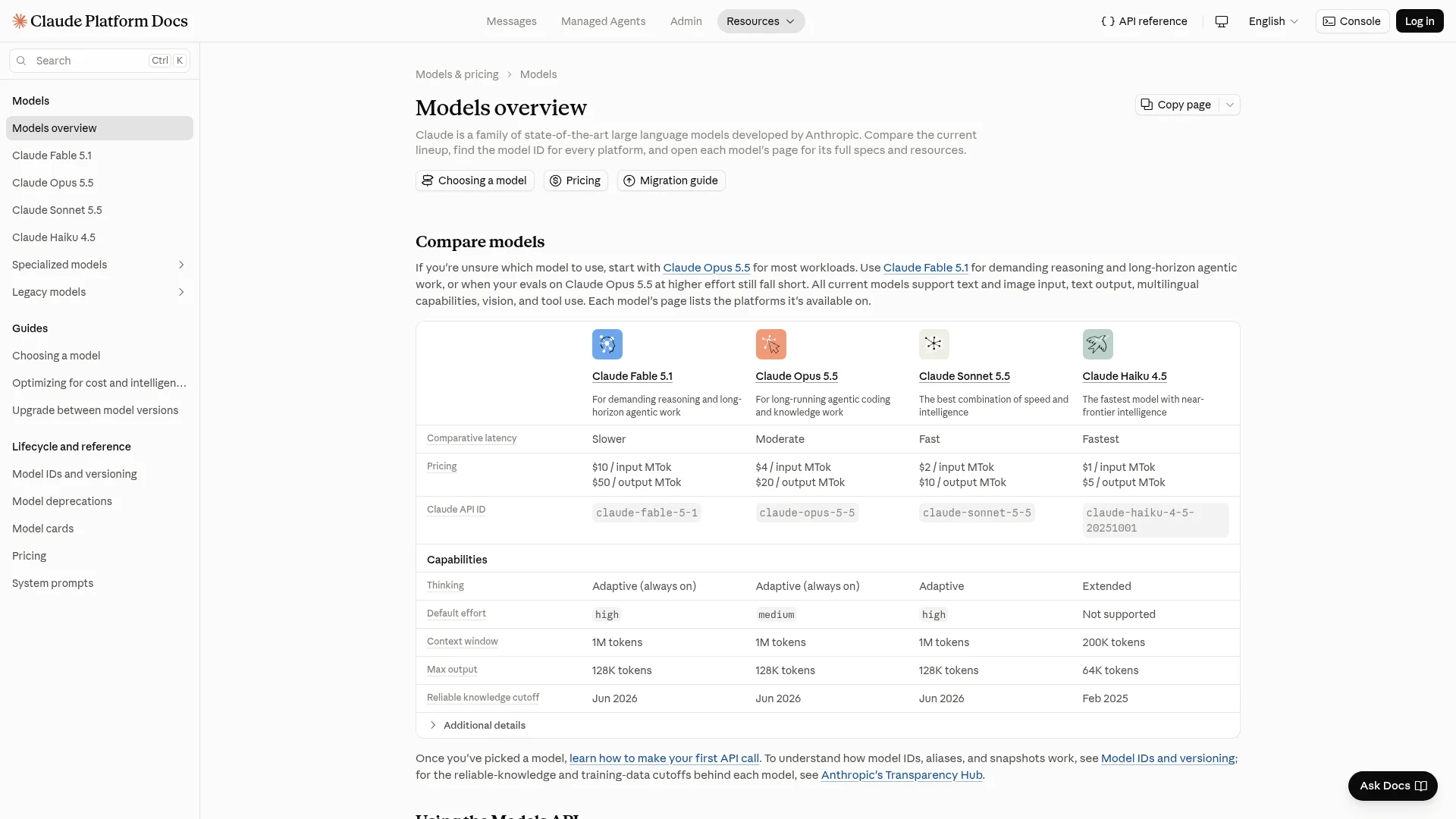
Opus 5.5 costs twice as much per token as Sonnet 5.5, and Fable 5.1 costs two and a half times as much as Opus. Three of the four share a 1M-token context window. Haiku 4.5 stops at 200K and has the oldest knowledge cutoff.
Price, Context Window and Speed
Sonnet 5.5 | Opus 5.5 | Fable 5.1 | Haiku 4.5 | |
|---|---|---|---|---|
Price per 1M tokens (input / output) | $2 / $10 | $4 / $20 | $10 / $50 | $1 / $5 |
Cached input per 1M tokens | $0.20 | $0.20 | $0.25 | $0.10 |
Context window | 1M tokens | 1M tokens | 1M tokens | 200K tokens |
Max output | 128K tokens | 128K tokens | 128K tokens | 64K tokens |
Anthropic's latency rating | Fast | Moderate | Slower | Fastest |
Default effort on the API | high | medium | high | Not supported |
Output speed at default effort | 102 tokens/s | 73 tokens/s | 54 tokens/s | 108 tokens/s |
Intelligence Index at default effort | 47 | 51 | 51 | 17 |
Reliable knowledge cutoff | Jun 2026 | Jun 2026 | Jun 2026 | Feb 2025 |
Released | Sep 28, 2026 | Sep 22, 2026 | Sep 1, 2026 | Oct 15, 2025 |
Prices, limits and latency ratings are from Anthropic's models overview. Output speed and the Intelligence Index come from Artificial Analysis (index v4.3.2), measured at each model's default effort. Haiku's figures are for its reasoning mode.
One row deserves a second look. At its default medium effort, Opus 5.5 scores 51 on the Intelligence Index, the same as Fable 5.1 at its default high effort. Opus gets there for $1.34 per task, against $3.91 for Fable.
Three Tasks, Four Models
Specs only go so far, so here are three tasks that independent testers ran on all four models. The first is app building: Vals AI's Vibe Code Bench asks each model to build a complete web app from a spec, then an agent clicks through it to check that the features work.
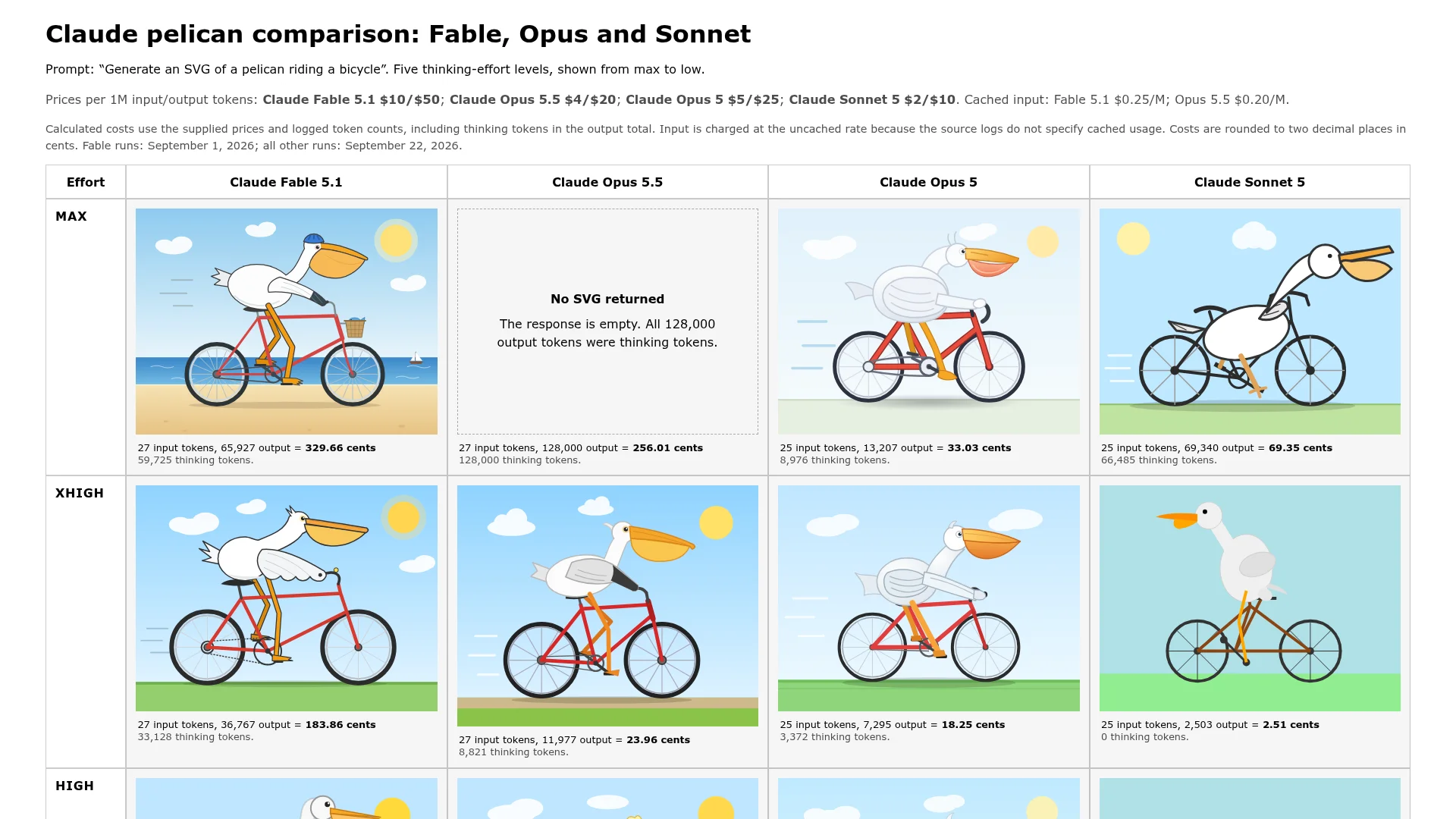
The second is Simon Willison's "Generate an SVG of a pelican riding a bicycle" prompt, a quick test of one-shot code output. The third is Vals' MedScribe, which grades clinical notes against 100 rubrics, a stand-in for high-volume writing.
Task | Sonnet 5.5 | Opus 5.5 | Fable 5.1 | Haiku 4.5 |
|---|---|---|---|---|
Build a web app (Vals, max effort) | 92.39%, $31.25, 61 min | 90.29%, $57.92, 96 min | 90.26%, $33.37, 58 min | 11.39%, $1.31, 13 min |
Pelican SVG (Willison, xhigh effort) | $0.057, 41 s | $0.24, 1 min 54 s | $1.83, 7 min 51 s | $0.0076 (no effort setting) |
Clinical notes (Vals MedScribe, max effort) | 91.10%, $0.51 per note | 91.43%, $1.15 per note | 91.29%, $0.96 per note | 85.23%, $0.04 per note |
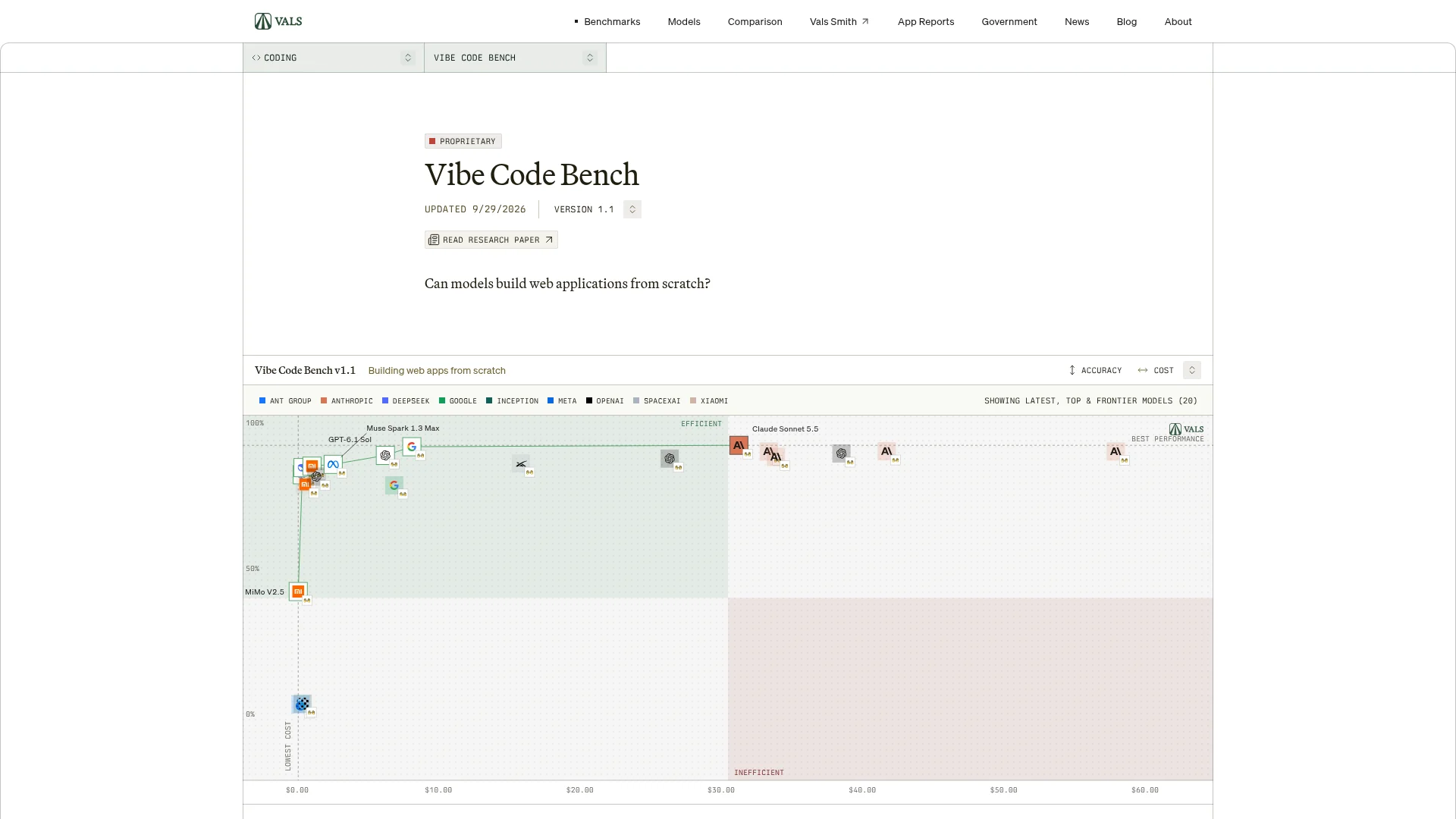
The most expensive model was not the best app builder. Sonnet 5.5 scored highest, at 54% of Opus's cost per app and in 64% of the time.
On the clinical notes, the three 5.x models finished within a third of a point of each other, so price decides it. Haiku ran the Vals tests in thinking mode, since it has no effort setting.
Claude Sonnet 5.5: Best Value for Everyday Work
Sonnet 5.5 is the model most people should try first. It costs half as much as Opus 5.5, and on the scored tests in this guide it matched or beat Opus.

Anthropic released Sonnet 5.5 on September 28, saying it "runs 30%+ faster, and costs up to 30% less for most work" than Sonnet 5. The per-token price stayed at $2 / $10, with a 1M-token context window and 128K tokens of output. It is also on the Claude Free plan, and Willison notes it is now the model behind the claude.ai free tier.
The headline result comes from the Vals Index, which puts Sonnet 5.5 at 67.04% and Opus 5.5 at 66.97%. Vals calls them "effectively tied," since the gap sits well inside the roughly ±0.9 point standard error. Sonnet ran the index for $21.34 per test against $32.14 for Opus.
Anthropic says Sonnet 5.5 is strongest at well-scoped everyday tasks, fixing bugs, and polished documents, slides and spreadsheets.
How Sonnet 5.5 Did on the Three Tasks
App building: 92.39%, the highest of the four, at $31.25 and 61 minutes per app.
Pelican SVG: 5.74 cents and 41 seconds at xhigh effort. Willison called it "good," with a "correct bicycle frame, legs either side of the frame, feet touching the pedals, chain in the right place," and "a misshapen blue bicycle helmet." At max effort it spent all 128,000 output tokens thinking ($1.28) and returned no SVG.
Clinical notes: 91.10% at $0.51 per note, a third of a point behind Opus for 44% of the cost. On Vals' MedCode billing-code test, it beat Opus outright, 52.92% to 49.80%.
There are two catches. Anthropic itself says "Opus 5.5 remains clearly stronger at complex, open-ended work requiring sustained judgment." And max effort is expensive on Sonnet: Artificial Analysis measured $7.67 per task at max, more than Opus 5.5's $5.98.
Choosing a coding tool rather than a model? Our Claude Code vs Cursor comparison covers that.
Claude Opus 5.5: Anthropic's Default Pick
Opus 5.5 is the model Anthropic tells developers to start with: "If you're unsure which model to use, start with Claude Opus 5.5 for most workloads." It is also the default model in Claude Code on Pro, Max, Team, Enterprise and the API.
It costs $4 / $20 per million tokens, cheaper than Opus 5 at $5 / $25. Anthropic's launch post says it "performs at the level of Claude Fable 5.1 on most work and costs 40% less to run than Opus 5." It also "generates output more than 30% faster than Opus 5." A fast mode, still a research preview, offers up to 2.5x the output speed at twice the price.
Opus 5.5 is the only current model that defaults to medium effort, and Anthropic's own testing explains why. In its cost guide, Opus 5.5 at medium "matched Fable 5.1 at its default (92.8% against 92.3%, inside run-to-run noise) for about a fifth of the cost per solved task ($0.22 against $1.19)" on a SWE-bench Pro subset.
Anthropic's real-work examples point the same way. Rewriting the HAProxy load balancer from C to Rust, "Opus 5.5 finished in 9.5 hours compared to 12 for Fable 5.1, and cost 51% less." For how Claude Code on Opus compares with OpenAI's agent, see our Claude Code vs Codex breakdown.
How Opus 5.5 Did on the Three Tasks
App building: 90.29% at $57.92 and 96 minutes per app. Vals calls it "the most expensive run on the board."
Pelican SVG: 15 seconds at low effort, 25 at medium, and 1 minute 54 seconds at xhigh for 24 cents. At max it thought through all 128,000 output tokens and returned nothing. Willison tried twice, at $2.56 a try and nearly 20 minutes each.
Clinical notes: 91.43%, the top score by a hair, at $1.15 per note.
The lesson from the pelican runs: max effort is not a free upgrade. On both Opus 5.5 and Sonnet 5.5 it burned the whole output budget on a simple prompt.
Claude Fable 5.1: Most Capable, Most Expensive
Fable 5.1 is Anthropic's most capable model open to all customers. It costs 2.5 times as much as Opus 5.5 per token and runs the slowest, so it earns its place only on the longest, hardest jobs.
Anthropic launched Fable 5.1 on September 1 alongside Mythos 5.1, noting that "Claude Fable 5.1 and Claude Mythos 5.1 are the same model, but with different levels of safeguards." Mythos is available only through trusted access programs, so for most teams Fable is the top of the range.
The price is $10 / $50 per million tokens. Cached input costs $0.25, just 2.5% of the input rate. Anthropic says Fable 5.1 "will cost an estimated 25% less than Fable 5 for typical workloads." On speed, Artificial Analysis measured 54 tokens per second at its default high effort, the slowest of the four.
Anthropic's model guide reserves Fable for "agent sessions that run for hours, multistep deep research, analysis carried through to a finished document, spreadsheet, or deck." Its advice is to move up only "if your evals at xhigh or max effort still fall short" on Opus 5.5. On claude.ai, Fable is not on the Free plan, Pro gets it through usage credits, and the Max plan lists it at "50% of weekly limits."
How Fable 5.1 Did on the Three Tasks
App building: 90.26% at $33.37 and 58 minutes per app. That ties Opus on accuracy at 58% of its cost and in less time, but trails Sonnet.
Pelican SVG: about 10 cents and 23 seconds at low or medium effort. At max effort it used 65,927 output tokens over 13 minutes 54 seconds for $3.30, and Willison called the result "the best pelican I've seen from any of Anthropic's models."
Clinical notes: 91.29% at $0.96 per note, and the fastest of the 5.x models at 188 seconds per note.
Fable produced the output Willison rated best, but not the best value. On every scored task here, Sonnet 5.5 came within about a point of it, or beat it, for less money.
Claude Haiku 4.5: Cheap and Fast, With Limits
Haiku 4.5 is the cheapest model in the lineup at $1 / $5, and Anthropic rates it the fastest. It is also the oldest, and it struggles with long, multi-step work.
Haiku 4.5 launched on October 15, 2025, almost a year before the other three. It has a 200K-token context window, 64K tokens of output, and a reliable knowledge cutoff of February 2025.
Anthropic's guide points it at "real-time applications, high-volume intelligent processing, cost-sensitive deployments needing strong reasoning, sub-agent tasks." Its cost guide adds that Haiku "answered GPQA Diamond questions at about a fifth of Claude Opus 5.5's cost per question, with 63% accuracy compared with 92% for Opus 5.5, and fell much further behind on long coding tasks."
How Haiku 4.5 Did on the Three Tasks
App building: 11.39% at $1.31 per app. Cheap, but it passed only about 11% of Vals' click-through checks.
Pelican SVG: 1,513 output tokens for 0.76 cents. Willison described "a bird with a round tan body, pink beak, and orange legs riding a bicycle."
Clinical notes: 85.23% at about 4 cents per note in 66 seconds. That is about 6 points behind Sonnet 5.5 for one-twelfth of the cost.
Before building on Haiku 4.5, know that a replacement is coming. Anthropic's Sonnet 5.5 announcement says "Claude Haiku 5.5, built for high-volume and cost-sensitive applications, will join the Claude 5.5 family in the coming weeks." Haiku 4.5's retirement date is listed as "not sooner than October 15, 2026," and Anthropic gives at least 60 days' notice, so keep the model name in a config file and plan to swap it.
Which Claude Model Should You Use? Pick This If
Anthropic's docs say most workloads should start with Opus 5.5. The test data above makes a case for trying Sonnet 5.5 first on well-scoped work, then moving up only where it misses.

Pick Sonnet 5.5 If
You write, review or fix code in well-defined chunks.
You are building an app or website from a clear spec.
You produce documents, slides or spreadsheets.
Cost matters and you need near-Opus results.
Pick Opus 5.5 If
An agent will run for hours on a task without a clear spec.
You are refactoring a large codebase or designing a complex system.
The work needs judgment calls along the way, not only correct output.
Pick Fable 5.1 If
Opus 5.5 at xhigh or max effort still falls short on your evals.
You need multistep research carried through to a finished report or deck.
The quality of a single output matters more than its cost.
Pick Haiku 4.5 If
You classify, extract or route thousands of items and can check the results.
You need a cheap sub-agent working under a bigger model.
Latency matters more than depth, and 200K tokens of context is enough.
Whichever model you pick, adjust effort before you switch models. Anthropic's model guide puts it plainly: "Tuning effort is often a better lever than switching models." CatDoes works the same way when it builds apps. You switch between Low, Medium, High and Max agent tiers as you work, and the docs suggest letting a higher tier plan a feature, then switching lower to build it.
Frequently Asked Questions
Is Claude Opus better than Sonnet?
On long, open-ended work, yes. Anthropic says Opus 5.5 "remains clearly stronger" there. On scored tests the gap is gone: Vals AI rates Sonnet 5.5 and Opus 5.5 effectively tied (67.04% vs 66.97%), and Sonnet scored higher at building web apps for about half the cost.
Which Claude model is best for coding?
Opus 5.5 for multi-hour agentic coding and large refactors, which is why it is the Claude Code default. Sonnet 5.5 for everyday code generation and bug fixes, where it matches Opus for less. Move to Fable 5.1 only when Opus at xhigh or max effort still falls short.
Is Claude Fable 5.1 worth the price?
For most work, no. Fable costs 2.5 times as much as Opus 5.5 per token, and Opus at medium effort matched it on Anthropic's own coding test for about a fifth of the cost per solved task. Fable makes sense for multi-hour agent runs and deep research where Opus falls short.
What is the difference between Claude Fable 5.1 and Mythos 5.1?
They are the same model with different safeguards. Fable 5.1 is open to all API customers at $10 / $50 per million tokens. Mythos 5.1 ships with different safeguards and is offered only to vetted organizations through Anthropic's cyber and life-sciences access programs.
Which Claude models can I use for free?
The Claude Free plan includes Sonnet and Haiku. Opus needs a paid plan such as Pro, which costs $20 a month billed monthly. Fable is not on Free, uses usage credits on Pro, and is listed at "50% of weekly limits" on Max.
Is Claude Haiku 4.5 being retired?
Not yet. Anthropic lists its retirement as "not sooner than October 15, 2026" and promises at least 60 days' notice. It has also said Claude Haiku 5.5 will join the lineup "in the coming weeks," so expect a replacement soon.
The Bottom Line
Price no longer tracks quality in a straight line across the Claude lineup. Sonnet 5.5 matched or beat Opus 5.5 on every scored task in this guide for about half the cost. Opus 5.5 is still the safer pick for long, unscripted agent work, and Fable 5.1 sits on top for the rare job that needs it.
Haiku 4.5 still fits high-volume pipelines, but its successor is close. Whatever you choose, test effort levels before paying for a bigger model.
If what you want is a finished app rather than a model to manage, that is what we built CatDoes for. Describe the app, and the agent builds it and ships it to the App Store, Google Play or the web, with the backend included.
Nafis Amiri
Co-Founder of CatDoes


