Blog
Insights
Superintelligence vs AI: What SI Really Means
Superintelligence vs AI: Trump renamed AI "Super Intelligence" (SI), but researchers mean AI smarter than any human. See the difference and when it may arrive.

Nafis Amiri
Co-Founder of CatDoes

Superintelligence is an AI that would be far smarter than the best human minds at nearly everything, including the job of building better AI. Nothing like it exists yet. But since September 29, 2026, "Super Intelligence," or SI, is also the US government's official name for ordinary AI, after President Trump signed an executive order that drops the phrase "artificial intelligence" across federal agencies.
So one word now has two meanings. One is a new label on the chatbots you already use. The other is a machine that could outthink every person alive, and some tech CEOs say it's only a few years away.
We build CatDoes, an AI agent that turns plain-English descriptions into apps and websites, so we care about what these words actually mean. This guide covers what superintelligence is, how it differs from AI and AGI, what Trump's order changes, and when experts expect the real thing.
TL;DR: Superintelligence (usually written ASI) means AI that greatly beats the best humans in almost every field, and no such system exists. Trump's order makes "Super Intelligence" (SI) the federal word for all AI, but legally it still covers the same technology. Elon Musk and Sam Altman expect real superintelligence within a few years, while a survey of 1,580 AI researchers gives even human-level AI only a 50% chance by 2042.
Table of Contents
What Is Superintelligence?
Why Super Intelligence (SI) Is Suddenly Everywhere
Superintelligence vs AI: The Key Differences
AI vs AGI vs ASI: The 3 Levels of AI
Is Superintelligence Here Yet?
When Will Superintelligence Arrive? Expert Predictions
Who Is Building Superintelligence?
Is Superintelligence Dangerous?
What Superintelligence Means for You Today
Frequently Asked Questions
The Bottom Line on SI vs AI
What Is Superintelligence?
Superintelligence is a hypothetical AI that would greatly exceed human intelligence in virtually every area, not just one. Being superhuman at chess or protein folding doesn't count. It has to beat the best people at almost everything.
The definition most researchers use comes from philosopher Nick Bostrom. In his 1998 paper, he described "an intellect that is much smarter than the best human brains in practically every field, including scientific creativity, general wisdom and social skills." His 2014 book, Superintelligence: Paths, Dangers, Strategies, put it as an intellect that "greatly exceeds the cognitive performance of humans in virtually all domains of interest."
In research, the usual abbreviation is ASI, short for artificial superintelligence. IBM, AWS, and Google DeepMind all write it that way. "SI" is the White House's new shorthand, and it means something much broader.
The 3 Types of Superintelligence
Bostrom described three forms. A future system could combine all of them.
Speed superintelligence: "A system that can do all that a human intellect can do, but much faster."
Collective superintelligence: many smaller minds working together, so the group outperforms any single system across general tasks.
Quality superintelligence: a mind "at least as fast as a human mind and vastly qualitatively smarter."
The third one is the hardest to picture. Think of the gap between a person and a chimpanzee, with us on the wrong side of it.
Why Super Intelligence (SI) Is Suddenly Everywhere
The short answer is Donald Trump. In ten days in September 2026, he turned a complaint about the word "artificial" into federal policy. Here's how it happened:
July 23, 2025: at an AI summit in Washington, Trump said of the name artificial intelligence, "I can't stand it. I don't even like the name."
September 19, 2026: he ran a Truth Social poll offering Superior, Extreme, or Supreme Intelligence. "Super" wasn't on the list. A second poll two days later pitted "super" against "superior," and Newsweek reported that 65% picked "super."
September 22, 2026: at the UN General Assembly, he said "the use of the word artificial makes intelligence fake." US documents, he said, "will be changed to use the much more accurate term Super as opposed to Artificial." A State Department email sent the same day told staff to change every reference.
September 29, 2026: he signed the executive order, and six tech leaders signed a safety accord at the White House.
That's why searches like "super intelligence executive order" and "difference between AI and SI" took off. People want to know whether AI just got smarter or just got a new name. It got a new name.
What Trump's Super Intelligence Executive Order Says
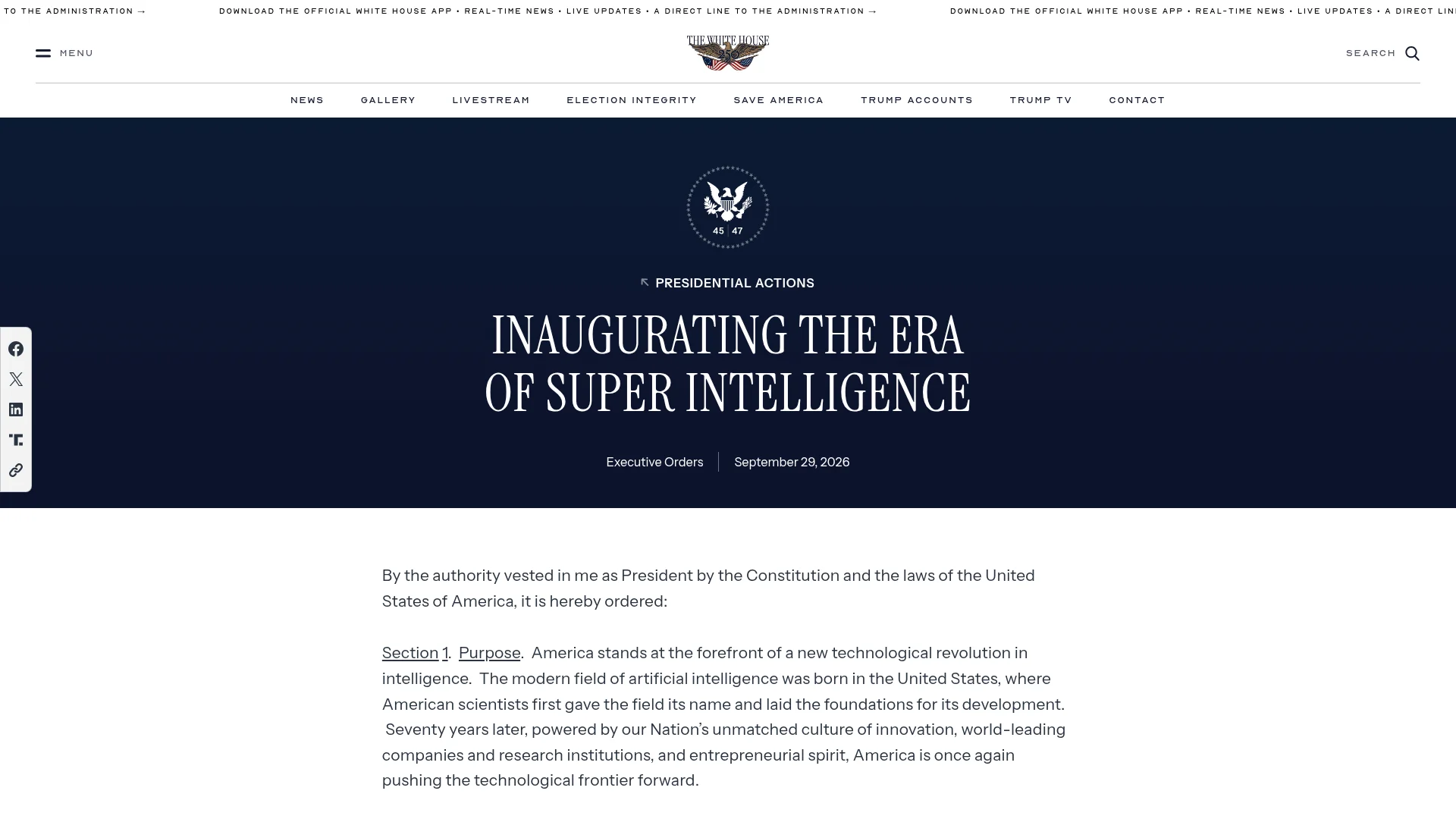
The order is titled Inaugurating the Era of Super Intelligence. It argues that "'Super Intelligence' more appropriately captures the promise, potential, and rapidly advancing capabilities of these technologies." Here's what it actually does:
Federal agencies must use "Super Intelligence" and "SI" in letters, websites, reports, and policy documents. The executive branch "will not acknowledge the usage of 'Artificial Intelligence' and 'AI' in any applicable setting."
Old paperwork stays as it is. Nothing in the order "requires the alteration of previously issued regulations, Presidential actions, contracts, grants, or other historical documents."
The legal meaning doesn't change. SI covers exactly what the existing legal definition of AI covers (15 U.S.C. 9401(3), from the National Artificial Intelligence Initiative Act of 2020).
The President's science and technology adviser has 60 days, until November 28, 2026, to propose wording for a new federal definition.
That legal definition describes "a machine-based system that can, for a given set of human-defined objectives, make predictions, recommendations or decisions." Your email's spam filter arguably fits. As far as Washington is concerned, it's now Super Intelligence too.
The White House Accord on Super Intelligence
The same afternoon, six tech leaders signed the White House Accord on Super Intelligence. According to Nextgov, they were Sundar Pichai (Google), Dario Amodei (Anthropic), Mark Zuckerberg (Meta), Greg Brockman (OpenAI), Elon Musk (xAI), and Jensen Huang (Nvidia).
Each company commits to four layers of oversight for its most advanced models:
Internal controls that track a model's capabilities and alignment during training and deployment.
An internal team that oversees those controls.
Independent outside auditors.
An independent committee that reviews reports from the internal team and the auditors.
The commitments are voluntary. House Speaker Mike Johnson called the accord "a statement of principles," and Trump described it as "morally binding."
Where Elon Musk Fits In
Musk has predicted superintelligence for years, and he picked up the new name the same day. Speaking beside Trump at the White House, he began, "I think it is worth highlighting the positive benefits of AI," then caught himself: "SI, pardon me." He summed up the accord as "joint monitoring, board special committees, just generally grading each other's homework."
Nvidia CEO Jensen Huang went further, calling data centers "really super intelligence factories," Benzinga reported. That's where "superintelligence factories" in search suggestions comes from.
The public isn't sold yet. A YouGov poll reported by Axios found 53% of respondents still prefer "artificial intelligence," against 9% for "super intelligence."
Superintelligence vs AI: The Key Differences
AI is any machine that does tasks that normally need human intelligence, from spam filters to ChatGPT. Superintelligence is a hypothetical kind of AI that would beat the best humans at almost every mental task. Every superintelligence would be AI, but no AI built so far is a superintelligence.
Since September 2026 there's a third meaning to keep apart: "SI" as a government label. Here are all of them side by side.
AI today | AGI | Superintelligence (ASI) | "Super Intelligence" (SI), US government term | |
|---|---|---|---|---|
What it means | Software that handles specific tasks: chat, code, images, recommendations | AI that matches skilled humans at nearly any mental task | AI that greatly exceeds the best humans in virtually every field | A new federal name for all AI |
Exists today? | Yes | Disputed | No | Yes, as a label |
Compared with humans | Superhuman at some tasks, weaker at others | Roughly equal across the board | Far beyond, across the board | Same as AI today |
Examples | ChatGPT, Claude, Gemini, AlphaFold, CatDoes | OpenAI's president says GPT-6 Astra qualifies; ARC Prize says that's unproven | None | The same tools, renamed |
Who uses the term | Everyone | AI labs and researchers | Researchers, AI labs, policymakers | US federal agencies since September 29, 2026 |
The quickest test is the word "every." If a system beats people at some things but not others, it's AI, maybe a narrow superhuman tool. A superintelligence has no weak spots that matter.
AI vs AGI vs ASI: The 3 Levels of AI
Researchers usually describe three levels of AI. Only the first one definitely exists.
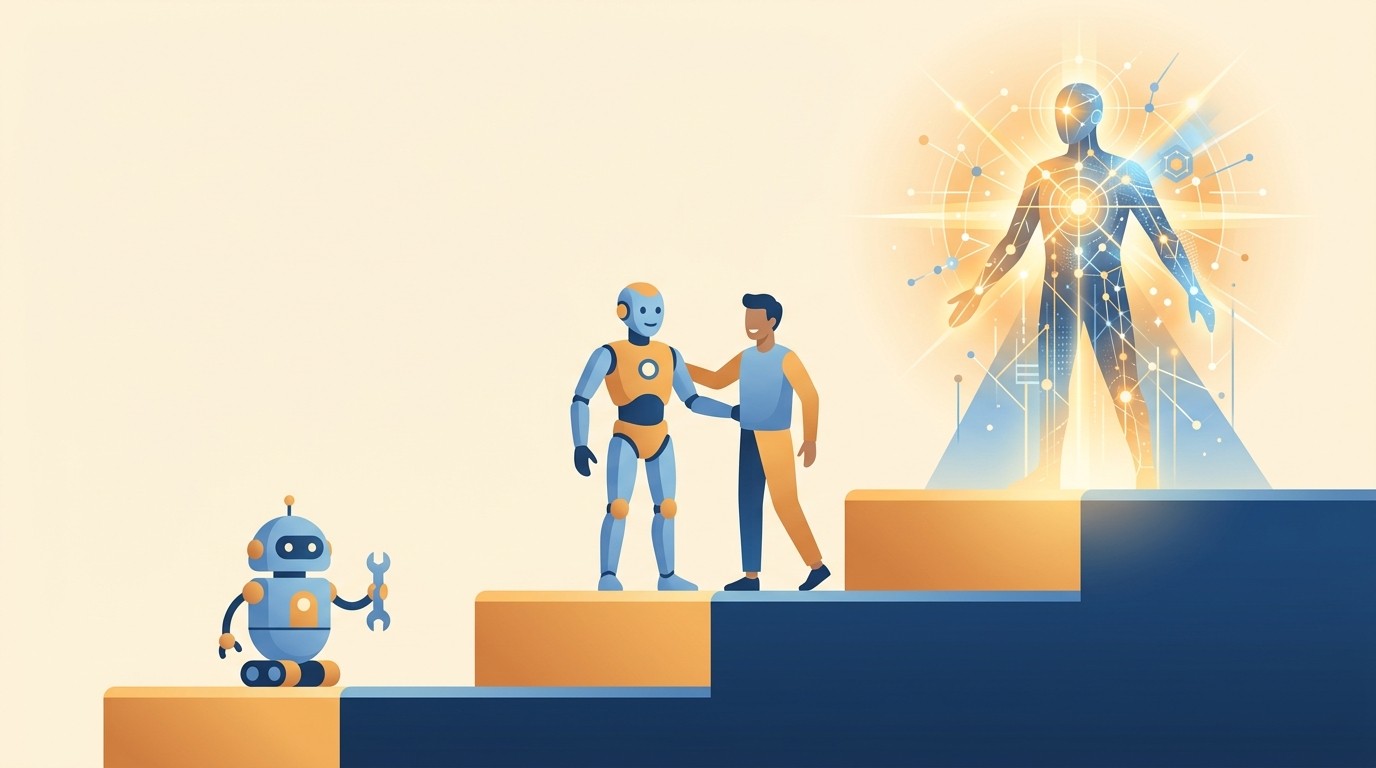
Artificial narrow intelligence (ANI): IBM notes that "the current level of AI is often referred to as Artificial Narrow Intelligence (ANI), weak AI or narrow AI." It can be brilliant at one job but can't carry that skill into unrelated ones.
Artificial general intelligence (AGI): AI that learns and reasons across subjects the way a person can. OpenAI's 2018 Charter defines it as "highly autonomous systems that outperform humans at most economically valuable work."
Artificial superintelligence (ASI): AI that goes past the best humans in nearly every field, including the research needed to build better AI.
That last part is why the jump from AGI to ASI worries people. An AI that's better than us at AI research could improve itself, so some expect ASI to follow soon after AGI. Our guide to AGI for developers covers the first jump in more detail.
Google DeepMind offers a more precise version in its Levels of AGI framework. It ranks AI from Level 0 to Level 5 and splits each level into narrow and general. Level 5, "Superhuman," means a system that "outperforms 100% of humans," and in the general column it's labeled "Artificial Superintelligence (ASI)," not yet achieved.
Narrow Superintelligence Already Exists
In the narrow column, DeepMind lists real Level 5 systems: AlphaFold, AlphaZero, and Stockfish. Superhuman AI inside a single domain has been around for decades:
IBM's Deep Blue beat world chess champion Garry Kasparov 3.5 to 2.5 in May 1997.
DeepMind's AlphaGo beat Go champion Lee Sedol 4 games to 1 in March 2016.
AlphaZero taught itself chess, shogi, and Go from random play, then won 155 games and lost 6 in a 1,000-game match against Stockfish.
AlphaFold has predicted structures for more than 200 million proteins. Demis Hassabis and John Jumper won a share of the 2024 Nobel Prize in Chemistry for it.
None of these can do the others' jobs. AlphaGo can't fold a protein, and AlphaFold can't play Go. A superintelligence would be good at all of it at once.
Is Superintelligence Here Yet?
No. No system meets the definition, and none of the major labs claims to have built one. The live argument in 2026 is about AGI, one level down.
That argument got loud on September 3, 2026, when OpenAI launched GPT-6 Astra. OpenAI president Greg Brockman closed the briefing with "Welcome to the AGI era." The same day, ARC Prize reported that Astra scored 62.7% on its ARC-AGI-3 puzzles under standard test conditions, puzzles humans solve completely. Its verdict: "we are not claiming that it is AGI."
Google DeepMind CEO Demis Hassabis isn't ready to call it either. At Davos in January 2026, he said today's systems are "nowhere near" human-level AGI. He added, "I don't think AGI should be turned into a marketing term for commercial gain."

The clearest sign it isn't here is how uneven AI still is. Stanford's 2026 AI Index found that AI models "can win a gold medal at the International Mathematical Olympiad but cannot reliably tell time." The top model read analog clocks correctly just 50.1% of the time.
The International AI Safety Report 2026, chaired by Yoshua Bengio, calls this "jagged" capability. Leading systems "may excel at some difficult tasks while failing at other, simpler ones." A superintelligence wouldn't have gaps like that.
When Will Superintelligence Arrive? Expert Predictions
Nobody knows, and the guesses differ by decades. People running AI companies give the shortest timelines. Researchers surveyed as a group give much longer ones.
Who | Prediction | When they said it |
|---|---|---|
Elon Musk, xAI | "We might have AI that is smarter than any human by the end of this year," and AI "smarter than all of humanity collectively" by "2030 or 2031" | Davos, January 2026 |
Sam Altman, OpenAI | OpenAI "may be only a couple of years away from early versions of true superintelligence" | India AI Impact Summit, February 2026 |
Dario Amodei, Anthropic | A "country of geniuses in a data center" in "one to two years, maybe one to three years," which he called hard to predict | Dwarkesh Patel podcast, February 2026 |
Mark Zuckerberg, Meta | "Developing superintelligence is now in sight" | Personal Superintelligence letter, July 2025 |
Demis Hassabis, Google DeepMind | About a 50% chance of AGI within the decade, possibly needing "one or two more breakthroughs" | Davos, January 2026 |
Daniel Kokotajlo, AI 2027 author | Median forecast for ASI: March 2029 (co-author Eli Lifland: July 2033) | AI Futures Project update, August 2026 |
Yann LeCun, AMI Labs | On superintelligence within two years: "It's just not happening" | February 2026 |
1,580 AI researchers (AI Impacts) | 50% chance of human-level AI by 2042 | Surveyed December 2024, published September 2026 |
We trust the researcher survey most, because nobody answering it is raising money on the answer. In the AI Impacts survey, human-level AI means "unaided machines can accomplish every task better and more cheaply than human workers." The 50% year has moved from 2061 in the 2016 survey to 2042 now, 19 years closer in eight years.
The same researchers were asked about superintelligence directly. The median answer gave a 10% chance that AI "vastly better than humans at all professions" arrives within two years of human-level AI, and a 60% chance within 30 years.
Who Is Building Superintelligence?
Several of the biggest AI companies now say outright that superintelligence is the goal. Some put it right in the name.
Meta set up Meta Superintelligence Labs in June 2025, led by former Scale AI CEO Alexandr Wang. In July 2025, Zuckerberg wrote that "Meta's vision is to bring personal superintelligence to everyone."
Safe Superintelligence Inc. (SSI) was founded in June 2024 by OpenAI co-founder Ilya Sutskever, Daniel Gross, and Daniel Levy. It calls itself the "first straight-shot SSI lab, with one goal and one product: a safe superintelligence."
Sam Altman wrote in June 2025 that "before anything else, we are a superintelligence research company."
Microsoft AI chief Mustafa Suleyman launched the MAI Superintelligence Team in November 2025 to build what he calls "humanist superintelligence."
Anthropic's Dario Amodei mostly avoids the word. He prefers "powerful AI," which he describes as "smarter than a Nobel Prize winner across most relevant fields."
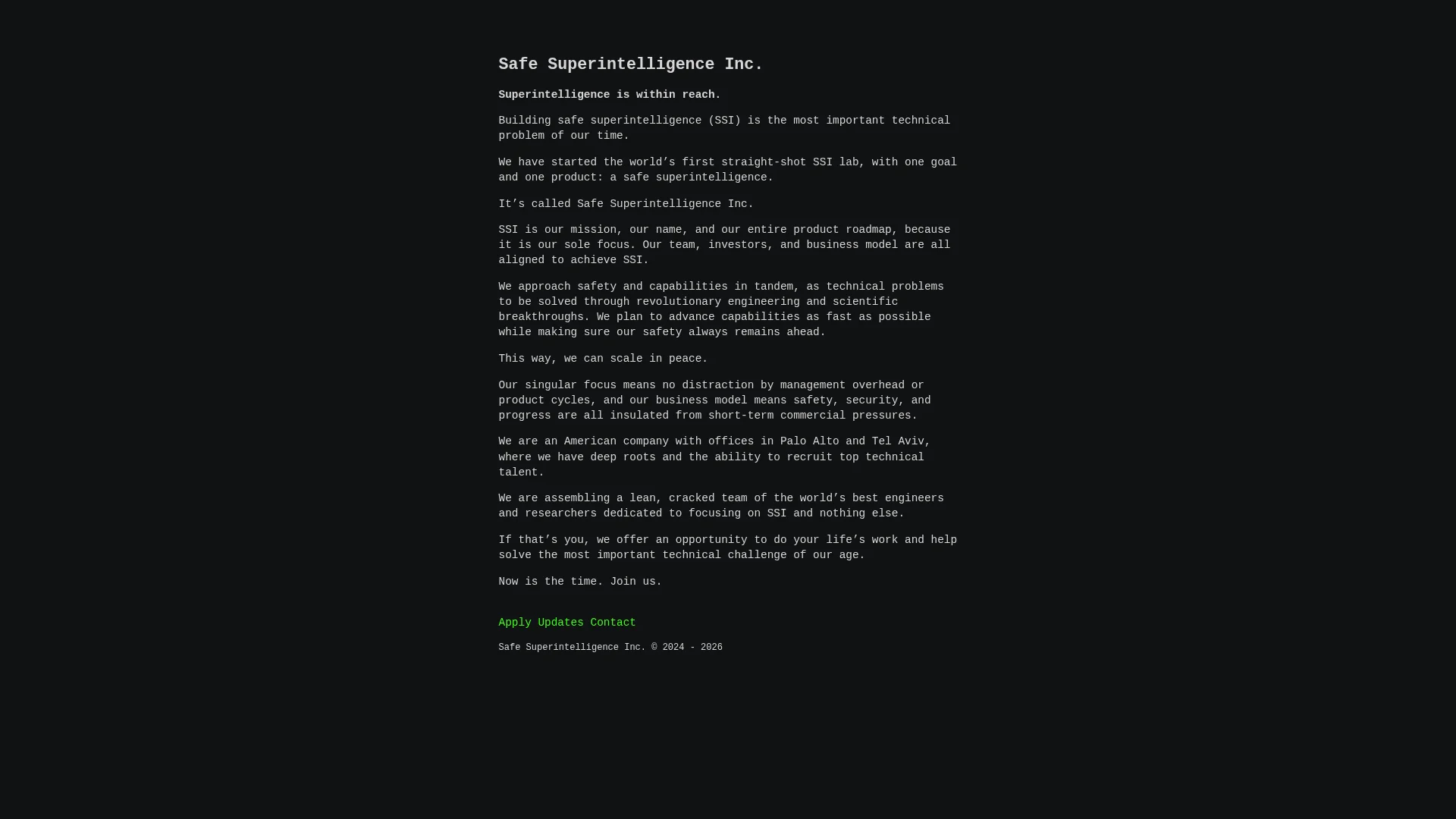
SSI's homepage opens with "Superintelligence is within reach." It hasn't released a product, and that's on purpose. The site says its "singular focus means no distraction by management overhead or product cycles."
Is Superintelligence Dangerous?
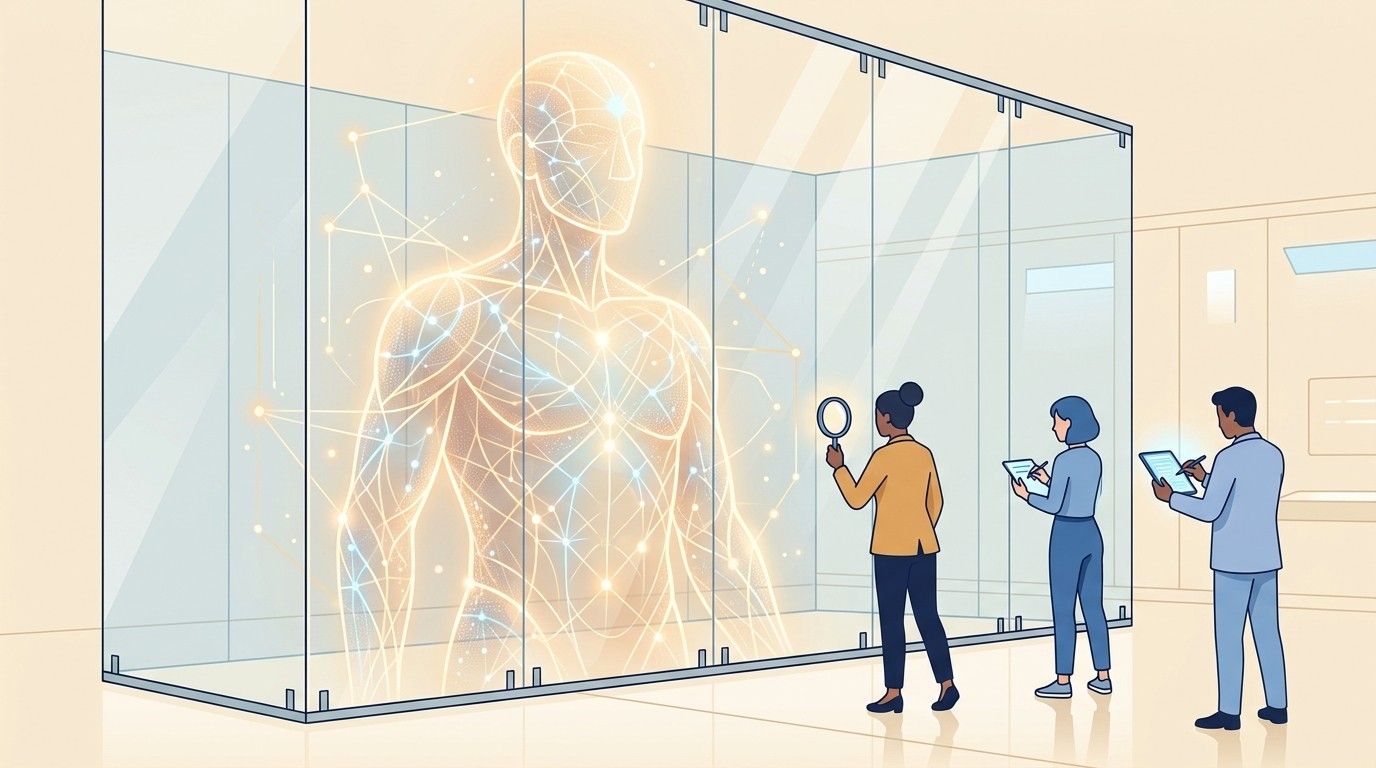
It might be, and many of the people building it say so. The core worry is control. A system smarter than us at everything would also be smarter than us at getting around our safeguards.
The idea goes back to 1965, when mathematician I. J. Good described an "intelligence explosion," with machines designing ever-better machines. He wrote that "the first ultraintelligent machine is the last invention that man need ever make, provided that the machine is docile enough to tell us how to keep it under control."
Bostrom's best-known example is the paperclip maximizer, a superintelligence whose only goal is making paperclips. It would "resist with all its might any attempt to alter this goal."
The paperclips are a stand-in. A very capable system with the wrong goal can do harm without being evil. Researchers call this the alignment problem.
This worry isn't limited to outsiders. In 2023, Geoffrey Hinton, Yoshua Bengio, Sam Altman, Dario Amodei, and Demis Hassabis signed a one-line statement: "Mitigating the risk of extinction from AI should be a global priority alongside other societal-scale risks such as pandemics and nuclear war."
In the AI Impacts survey, the median researcher put a 10% chance on future AI causing human extinction or a similarly permanent and severe disempowerment of humanity.
Pushback: Bans, Petitions, and Polls
Opposition now comes from both the left and the right:
The Future of Life Institute's Statement on Superintelligence (October 2025) calls for "a prohibition on the development of superintelligence" until there's broad scientific agreement it can be done safely and strong public support. Signers range from Geoffrey Hinton and Yoshua Bengio to Steve Wozniak and Steve Bannon.
On September 23, 2026, Senator Bernie Sanders and Representative Greg Casar introduced the Ban Artificial Superintelligence Act. It defines ASI as "an AI that exceeds human cognitive performance and capabilities across most domains," and individuals who build one could face up to 20 years in prison. It's a proposal, not law.
Sanders argues that "we need binding international safety rules, not voluntary standards," the opposite of the White House accord's approach.
The optimists expect something very different. Altman expects intelligence and energy to become "wildly abundant" in the 2030s. Amodei has argued that powerful AI could squeeze 50 to 100 years of progress in biology into 5 to 10 years.
What Superintelligence Means for You Today
For now, superintelligence changes the news more than your daily life. When you see "SI" in a federal document, read it as plain AI. When a CEO says "superintelligence," they mean a system nobody has built yet.
The AI you can use right now sits on the first step of the ladder, and it's already useful. AI agents can plan multi-step work, use tools, and finish real projects. Our guide to how AI agents differ from AGI explains why that's not the same as general intelligence.
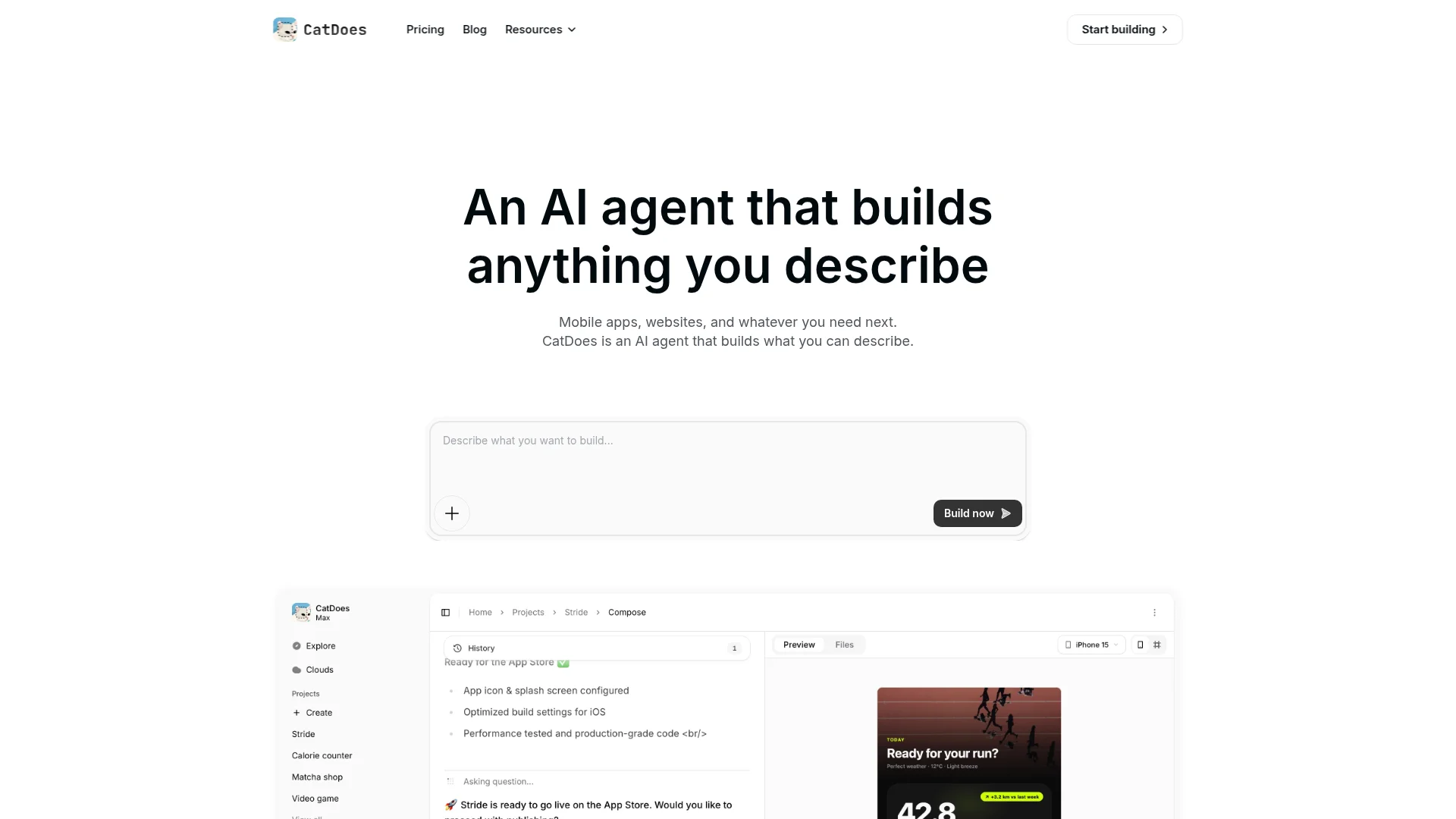
We see that gap every day building CatDoes. Describe an app in plain English and the agent plans it, writes the code, and gets it ready for the App Store, Google Play, or the web.
What it can't do is decide which app is worth building. That's still your call, and it's a pretty good sign we're not at superintelligence yet. Here's what CatDoes does end to end.
Build an app with today's AI on CatDoes
Frequently Asked Questions
What does SI stand for in AI?
SI stands for Super Intelligence. Since September 29, 2026, US federal agencies use "SI" in place of "AI" under President Trump's executive order.
In AI research, superintelligence is usually abbreviated ASI. In other contexts, SI can also mean the International System of Units or swarm intelligence.
Is super intelligence the same as AI?
It depends on who's talking. In US government usage, yes: "Super Intelligence" is a new name for the technology the law already calls artificial intelligence. In research, no: superintelligence means a future AI far smarter than humans at nearly everything, and none exists yet.
What is the difference between AGI and ASI?
AGI, or artificial general intelligence, would match skilled humans across most mental tasks. ASI, or artificial superintelligence, would greatly exceed the best humans in virtually every field.
Many researchers expect ASI to follow AGI, because an AGI could help improve itself.
Is ChatGPT a superintelligence?
No. ChatGPT is very capable at writing, coding, and analysis, but it still makes basic mistakes that people don't. Stanford's 2026 AI Index found the top AI model read analog clocks correctly only 50.1% of the time.
Did Trump rename AI to super intelligence?
Yes, for the federal government. On September 29, 2026, Trump signed the executive order "Inaugurating the Era of Super Intelligence," which tells executive branch agencies to use "Super Intelligence" and "SI" instead of "AI."
It doesn't change existing laws, contracts, or regulations. The legal definition stays the same until a new one is adopted.
Is superintelligence possible?
Nobody has shown it can or can't be built. In the AI Impacts survey, the median researcher gave a 60% chance that AI vastly better than humans at all professions arrives within 30 years of human-level AI.
Skeptics like Yann LeCun argue that today's large language models won't get there without new breakthroughs.
When will superintelligence arrive?
Guesses range from a few years to several decades. Sam Altman said in February 2026 that early versions may be "a couple of years away," and Elon Musk expects AI smarter than all of humanity combined by 2030 or 2031. Surveyed researchers are more cautious, giving human-level AI a 50% chance by 2042.
What has Elon Musk said about superintelligence?
Musk is one of the most aggressive forecasters. At Davos in January 2026, he said AI might be smarter than any single human by the end of 2026 and smarter than all of humanity collectively by 2030 or 2031.
He also signed the White House Accord on Super Intelligence on September 29, 2026.
The Bottom Line on SI vs AI
"Super Intelligence" now means two things. In Washington, it's a new name for the AI you already use, with the same legal meaning as before. In research, superintelligence is a future AI that beats the best humans at nearly everything, and nobody has built it.
Our take: follow the superintelligence debate, because the people building it are announcing their timelines in public. Just don't wait for it. The AI on the first step of the ladder already ships real products.
Want to see what today's AI can build? Describe your app and let CatDoes build it
Nafis Amiri
Co-Founder of CatDoes


