
Blog
Insights
AGI vs AI Agents: What's the Difference?
AGI is hypothetical AI matching human performance across any task. AI agents are production software today. Here's how they differ, and why it matters.

Nafis Amiri
Co-Founder of CatDoes
TL;DR
AI agents are production software shipping today. They use a language model, tools, and memory to finish multi-step tasks inside a defined domain.
AGI (Artificial General Intelligence) is a hypothetical system that would match or exceed human performance on any intellectual task. No shipping product qualifies in 2026.
Every agent you use (Claude Code, Devin, Manus, CatDoes) is narrow AI with scaffolding, not AGI. Expert AGI predictions cluster between 2027 and 2047 depending on who you ask.
Agents are the practical stepping stone. The engineering problems solved building agents (planning, tool use, memory, evaluation) are the same problems AGI will need to solve at scale.
For builders in 2026, ship narrow agents now. Bet on durable skills: agent architecture, tool integration, evaluation, and memory systems.
Table of Contents
AGI vs AI Agents: The Short Answer
What Is an AI Agent?
What Is AGI (Artificial General Intelligence)?
AGI vs AI Agents: Side-by-Side Comparison
How AI Agents Build Toward AGI
What This Means for Developers Today
Agentic AI, Narrow AI, and Superintelligence Explained
Frequently Asked Questions
From Agents Today to AGI Tomorrow
"AGI" and "AI agents" get used interchangeably in pitches, launch threads, and product copy. They describe very different things, and mixing them up leads to bad technical bets, wasted capital, and teams chasing sci-fi while practical opportunities pass by. This guide lays out what each term actually means in 2026, how they relate, and what builders should do with both concepts today.
AGI vs AI Agents: The Short Answer
AI agents are production software today. They take a goal, plan the steps, call tools, remember context across turns, and return a finished result. Claude Code, Devin, Manus, and CatDoes are all agents. You can pay for them, measure them on benchmarks, and ship real work with them.
AGI is a hypothetical future system that would match or exceed human performance on any intellectual task a person can do, without task-specific retraining. No product in 2026 qualifies. Nobody fully agrees on the definition either.
Everything else flows from that gap. Agents are narrow and useful. AGI is general and theoretical. Agents are the path toward AGI, not the destination.
What Is an AI Agent?
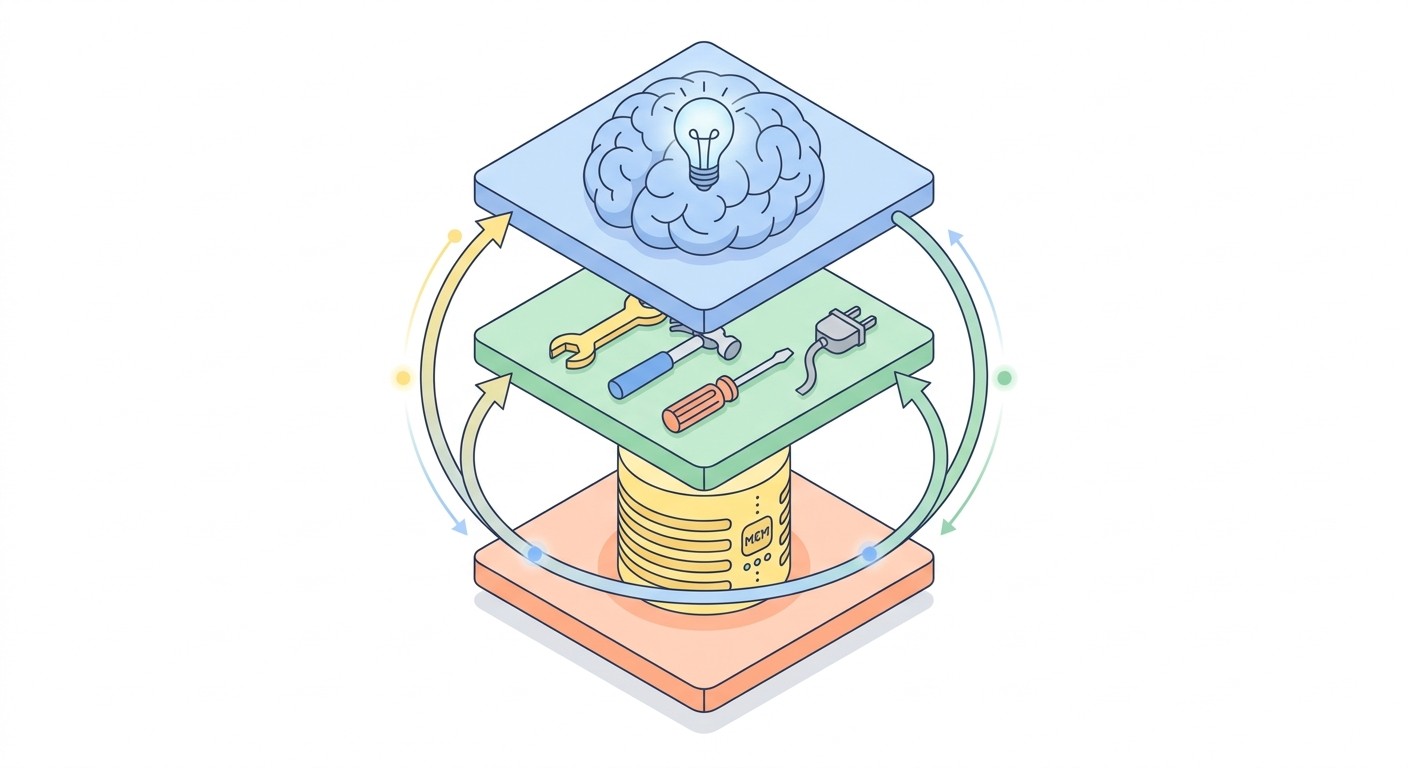
An AI agent is software that uses a language model to achieve a goal through multiple steps, not a single response. The model reasons about what to do next, calls tools to act on the world, and keeps context across turns until the work is done or it gets stuck.
The minimum ingredients of an agent
Every real agent has four parts:
A language model for planning and decision-making (Claude Sonnet 4.6, GPT-5, Gemini 3).
Tools the model can call (file systems, browsers, APIs, databases, code execution, shell).
Memory that persists within a session, and sometimes across sessions.
A loop that lets the model think, act, observe the result, and think again.
Remove any of those and you have a chatbot, not an agent. Chatbots respond to one message at a time. Agents keep going until the task is finished.
Types of AI agents today
Agents cluster into a few rough categories:
Coding agents (Claude Code, Devin, Cursor Agent) write, modify, and ship software with the developer in the loop.
Research agents (ChatGPT Deep Research, Perplexity) scout sources, compile findings, and produce reports.
General task agents (Manus, OpenAI's Operator) book flights, fill forms, and execute multi-step computer tasks.
Product-building agents like CatDoes turn natural language into shipped mobile apps and websites, including deployment and backend infrastructure.
Multi-agent systems coordinate several specialized agents on a shared goal, with roles like planner, coder, and reviewer.
All of these are narrow AI. They work inside a defined sandbox (a repo, a browser, an app) and tend to fail outside it.
Gartner predicts that 40% of enterprise applications will include task-specific AI agents by the end of 2026, up from less than 5% in 2025. McKinsey's latest State of AI survey reports 62% of organizations are already experimenting with agents, with 23% running full-scale deployments.
What Is AGI (Artificial General Intelligence)?
AGI, or artificial general intelligence, is an AI system that would match or exceed human performance on any intellectual task a person can perform, without task-specific retraining.
The hard word is "any." Today's models are remarkable inside their training distribution and brittle outside it. AGI would not be.
What makes AGI different from today's AI
A true AGI system would:
Learn genuinely new skills from small amounts of data, the way a human picks up a new tool.
Transfer knowledge across domains without prompting (a chemistry insight shows up in a protein-folding task without being asked).
Reason persistently over months or years of context, not a single conversation window.
Act in the physical world and handle messy real-world feedback loops, including long-tail failures.
Nobody agrees on the exact bar. OpenAI's charter defines AGI as "highly autonomous systems that outperform humans at most economically valuable work." DeepMind's Shane Legg frames it as "an artificial agent that can do the kinds of cognitive things that people can typically do." Nvidia's Jensen Huang has argued the bar should be economic: if an AI can run a billion-dollar company, it qualifies. Sam Altman has said OpenAI already knows how to build AGI. Dario Amodei of Anthropic has said it could arrive within a few years. Demis Hassabis of Google DeepMind puts it at five to ten years.
The Metaculus community forecast (roughly 1,800 contributors) currently puts 50% probability on general AGI by April 2033, down from a median of 2070 just six years ago. Academic researcher surveys cluster later, around 2047. That compression is one of the fastest revaluations of a major forecast in modern history.
The clearest window into that timeline disagreement is the joint Hassabis and Amodei debate at the World Economic Forum 2026, titled "The Day After AGI." Both leaders address timelines, job impact, and what it takes to close the gap from today's agents to AGI.
For the full landscape of definitions, benchmarks, and open research questions, read our Developer's Guide to AGI in 2026.
AGI vs AI Agents: Side-by-Side Comparison
The clearest way to see the gap is feature by feature:
Dimension | AI Agents (2026) | AGI (Hypothetical) |
|---|---|---|
Status | Shipping in production today | Not demonstrated by any system |
Scope | Specific task or domain | Any intellectual task a human can do |
Learning | Frozen after training; uses tools and in-context memory | Learns new skills from minimal data, like a human |
Cross-domain transfer | Limited; breaks outside training distribution | Transfers freely across domains |
Memory | Session or task-scoped; some long-term memory | Continuous, long-horizon, cross-domain memory |
Reasoning | Multi-step inside a tool sandbox | General, open-ended, novel problem solving |
Consumer price | $20 to $400 per month | Undefined |
Typical failure | Loops, hallucinations, wrong tool calls | Undefined (no system exists to fail) |
Example | Claude Code, CatDoes, Devin, Manus | None |
Key metric | Task success rate on benchmarks (SWE-bench, GAIA, OSWorld) | Human parity across all cognitive tasks |
The table captures the practical reality. Agents are a specific, measurable kind of software. AGI is a moving target that means different things to different labs.
How AI Agents Build Toward AGI
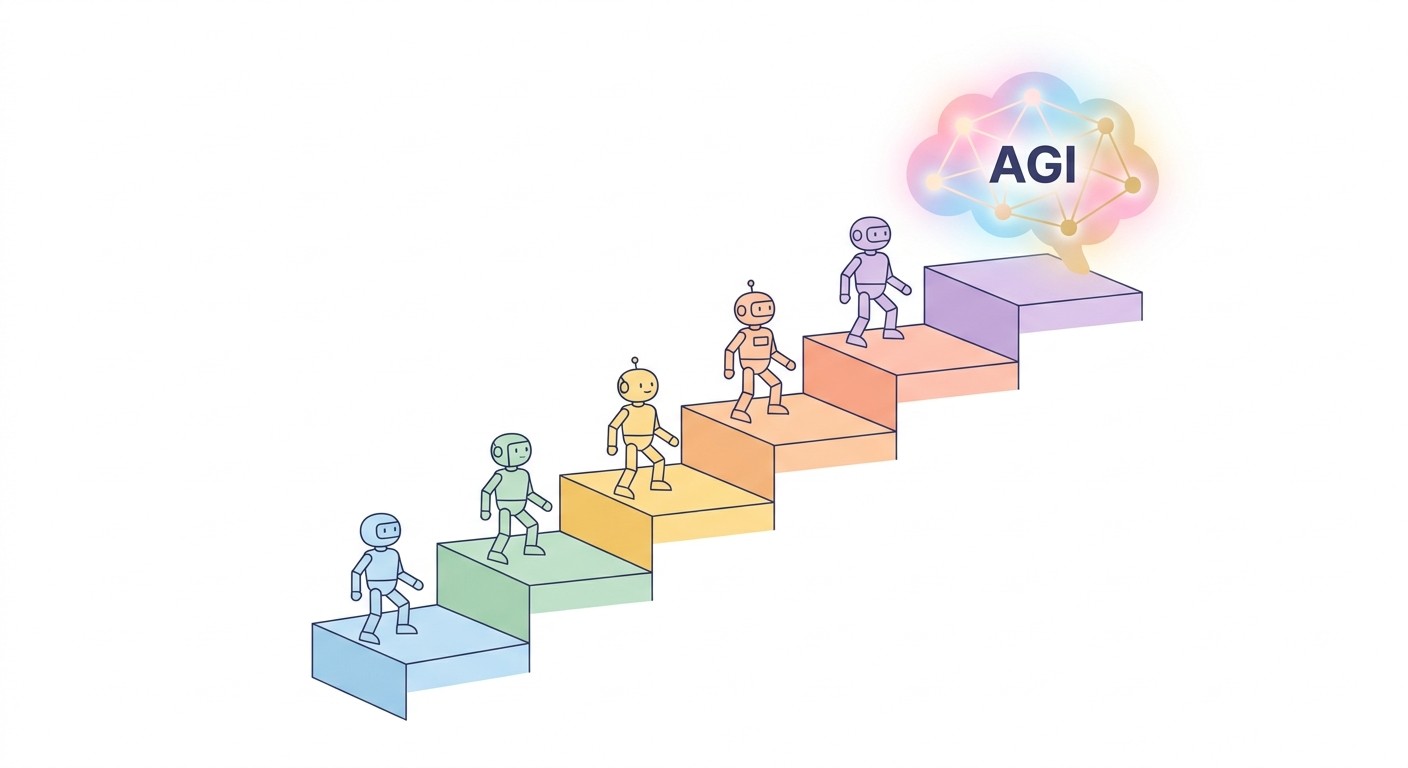
If AGI is years off, why do agents matter as a step toward it? Because the engineering problems you solve building good agents are the same problems AGI will need to solve at larger scale.
Long-horizon planning. Agents that ship real work have to plan over many steps, backtrack from dead ends, and recover from errors. Every agent framework is an incremental answer to "how does a model reason over time." AGI researchers ask the same question.
Tool use. AGI will need to interact with the world through software, APIs, robots, and physical sensors. Today's agents already call hundreds of tools through protocols like MCP. The plumbing ports forward.
Memory. Agents with persistent memory are starting to do things standalone LLMs cannot, like tracking user preferences across months. Memory architecture is one of the key AGI bottlenecks.
Evaluation. How do you measure whether a system is getting smarter? Agent benchmarks (SWE-bench, WebArena, GAIA, OSWorld) are the only realistic training grounds for measuring general capability today.
Multi-agent coordination. Groups of specialized agents already solve problems no single model can. Read our guide to multi-agent systems for how coordination patterns work in practice. This is a concrete instance of the "society of mind" concept AGI researchers have studied for decades.
None of this gets to AGI on its own. But each capability is a piece of the system AGI will need, and every agent product in production is running real-world experiments against those pieces.
What This Means for Developers Today
Three practical takeaways for anyone building in 2026.
1. Do not wait for AGI to build with agents. The gap between today's agents and full AGI is real, but it does not block useful work. A narrow agent that ships code, files taxes, books travel, or builds mobile apps delivers value now. Waiting for AGI to build an AI product is like waiting for fusion before installing solar panels.
2. Bet on durable skills. Prompt engineering is a 2023 skill. The durable bets in 2026 are:
Agent architecture. How do you structure planning, tool use, and memory into a reliable loop that recovers from errors?
Tool integration. How do you expose your software to agents cleanly (MCP servers, typed APIs, clear schemas)?
Evaluation. How do you know your agent is getting better and not regressing on a silent dimension?
Memory systems. How do you give agents rich context without blowing up latency and cost?
Those skills transfer whether the underlying model is Sonnet 4.6, Opus 5, or something nobody has named yet.
3. Ship agents that do one thing well. The agents that work in production today have tight scopes. CatDoes builds mobile apps. Claude Code writes software. Devin closes tickets. Each is a narrow specialist. That is a feature, not a bug. For most founders, the moat is not "general intelligence," it is "agent plus domain plus interface" for a specific job people actually pay to get done.
Agentic AI, Narrow AI, and Superintelligence Explained
Three adjacent terms muddy the conversation in nearly every vendor pitch.
Narrow AI is the academic term for systems trained and useful on one task (image classification, translation, today's LLMs). Every system shipping in 2026 is narrow AI, including every agent listed above.
Agentic AI is a marketing-flavored umbrella for "software with agent-like properties." It covers everything from a good LLM plus tools up to fully autonomous workflows. In practice it means the same thing as "AI agents" in most sentences.
ASI (Artificial Superintelligence) is AGI's bigger sibling: AI that surpasses the best human in every domain. If AGI is a peer, ASI is an overwhelming superior. Most forecasters put ASI after AGI on the same logarithmic timeline, which means the uncertainty compounds.
Use the terms precisely and you cut through vendor decks quickly. A startup claiming "agentic AI" is probably selling you a narrow AI agent. A startup claiming "AGI" is either reaching, redefining the term, or doing something extraordinary enough to need extraordinary proof.
Frequently Asked Questions
Is ChatGPT an AGI?
No. GPT-5 is a large language model trained on a fixed dataset. It cannot learn new skills from a single example, cannot act over long time horizons without agent scaffolding, and stays frozen in its training distribution. Sam Altman himself has stated that GPT-5 does not learn from experience after training. Every new conversation starts fresh.
Is Claude Code an AI agent?
Yes. Claude Code plans, calls tools (Read, Write, Bash, Edit, and others), keeps context across many turns, and completes software engineering tasks end-to-end. It is a narrow coding agent, not AGI.
Are agentic AI and AI agents the same?
Practically, yes. "Agentic AI" more often describes the property of software that uses agents. "AI agents" names the software itself. Any deeper distinction is mostly semantic and varies by vendor.
When will AGI arrive?
Nobody knows. Metaculus's community forecast puts 50% probability on general AGI by April 2033. Anthropic's Dario Amodei has said "a few years" (pointing to coding automation as the accelerant). Demis Hassabis estimates five to ten years. Academic researcher surveys cluster around 2047. The answer depends on definition and who you ask.
Can multi-agent systems achieve AGI?
Multi-agent systems solve more complex problems than single agents, but stacking narrow agents does not automatically yield general intelligence. Coordination helps. Fundamental breakthroughs in learning, reasoning, and memory are still expected before a system crosses the AGI bar.
What should I learn to stay relevant as AGI develops?
Agent architecture, tool integration, evaluation methods, and memory systems. Those skills compound whether the next model is slightly better than today's Sonnet or a full AGI that rewrites the stack.
From Agents Today to AGI Tomorrow
AGI is where the field is headed. AI agents are how the field gets there. The clearest mental model in 2026: agents are the scaffolding that builds AGI, one production workflow at a time.
For builders, that means ship agents now. For investors, it means agent architecture is the underlying bet, whether the label on the pitch deck says "copilot," "agentic AI," or "AGI." For everyone else, it means the AI you use today is narrow, capable, and very much not AGI. Treat it accordingly and you will make better product decisions, better career bets, and better purchasing calls.
CatDoes is an AI agent that builds mobile apps and websites, and the foundation for a broader agentic platform. If you want to see what a narrow production agent looks like today on the way to something bigger, start building with us.
Nafis Amiri
Co-Founder of CatDoes


