
Blog
Insights
AGI for Developers: A Practical 2026 Guide
AGI for developers explained: what AGI actually is, when experts predict it arrives, and why AI agents are the practical bridge to build on today.

Nafis Amiri
Co-Founder of CatDoes
TL;DR
Artificial General Intelligence (AGI) is AI that can match or exceed human performance on any intellectual task, not just narrow ones like writing or image generation.
Every AI you use today (Claude, GPT-5, Gemini) is narrow AI. Capable, but frozen, single-domain, and unable to learn new skills mid-conversation.
Expert predictions for AGI cluster between 2027 and 2040, with Metaculus' community median around 2031.
AI agents are the bridge. Stateful, tool-using agents are the first practical step from narrow AI toward general systems.
For developers, the durable skills are agent architecture, tool integration, evaluation, and memory systems, not prompt engineering.
Table of Contents
What Is Artificial General Intelligence (AGI)?
AGI vs Narrow AI vs Superintelligence
The Current State of AGI in 2026
When Will AGI Arrive? Expert Predictions and Timelines
How AI Agents Are Building Toward AGI
What AGI Means for Developers
Risks and Open Questions
Frequently Asked Questions
Build Toward AGI, Ship Today
"AGI" gets thrown around so often it has lost meaning. Every chatbot launch comes wrapped in AGI hype, and every open-source release claims it moves the field closer. But AGI for developers is a more practical question than the headlines suggest: what is artificial general intelligence actually, when might it arrive, and what should you build toward in the meantime?
This developer's guide to AGI lays out what artificial general intelligence means in 2026, where the field stands, and why AI agents are the first practical step on the road to AGI. No marketing gloss and no sci-fi detours. Just what developers need to make good technical bets.
What Is Artificial General Intelligence (AGI)?
Artificial General Intelligence (AGI) is an AI system that can understand, learn, and apply knowledge across any intellectual task a human can perform. The key word is general. A modern large language model is extraordinary at language tasks but can't drive a car, solve a novel mathematical problem without scaffolding, or hold a job for six months. AGI is the hypothetical AI that can do all of those, and swap between them, without task-specific retraining.
Different labs draw the line slightly differently. OpenAI's charter defines AGI as "highly autonomous systems that outperform humans at most economically valuable work." Google DeepMind has proposed a more graduated definition with five levels of AGI, where the top tier is a system that "can perform any cognitive task an expert adult can." Both capture the same core idea: breadth matters more than raw capability on any single benchmark.
What separates AGI from today's systems isn't intelligence in isolation. It's generality, learning efficiency, and persistence. A model that scores in the 99th percentile on legal, medical, and coding benchmarks but can't plan its own week isn't AGI. One that teaches itself a novel domain from scratch given a few weeks and a real-world deadline probably is.
AGI vs Narrow AI vs Superintelligence
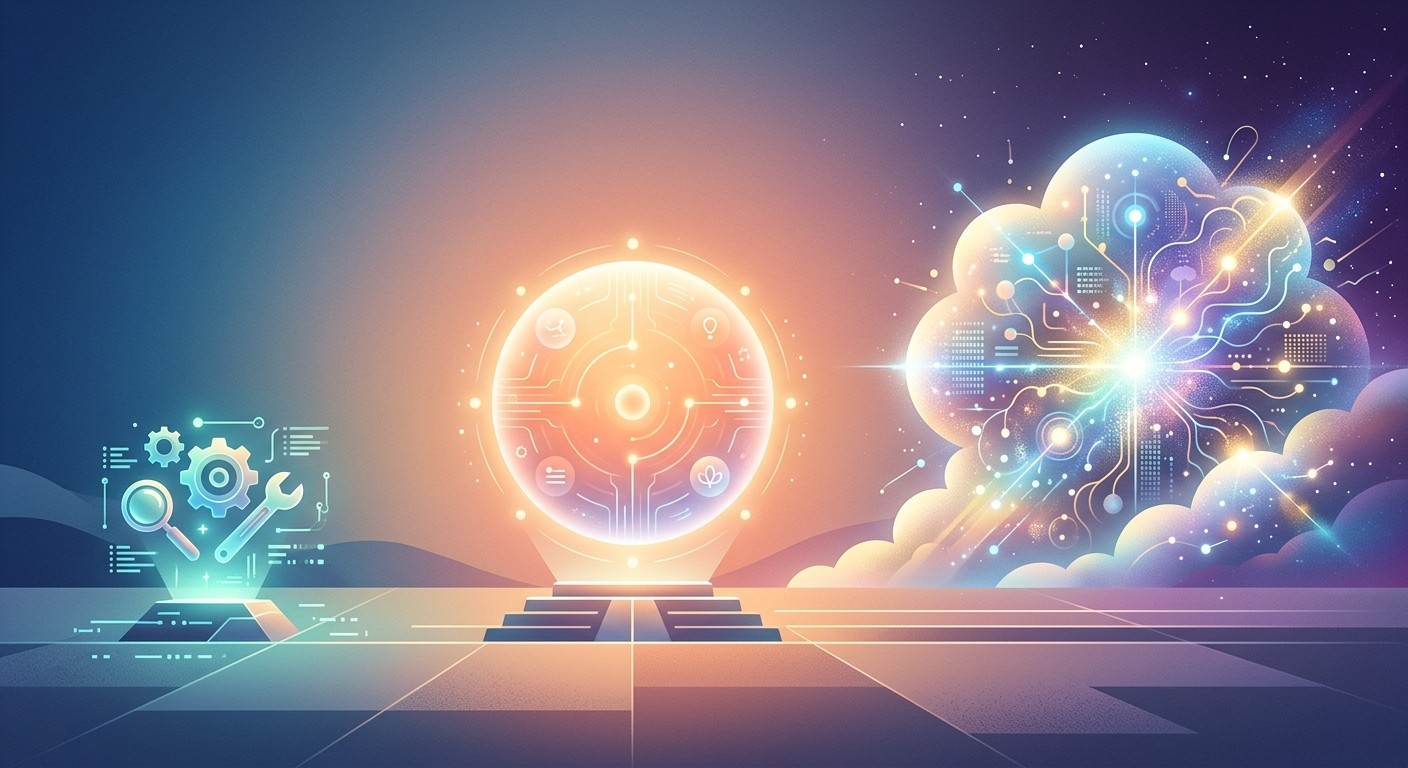
Three terms get used interchangeably in news coverage. They shouldn't be.
Term | What It Means | Examples in 2026 |
|---|---|---|
Narrow AI (ANI) | Systems trained for specific tasks or domains | Claude, GPT-5, Gemini, DALL·E, AlphaFold, Tesla Autopilot |
Artificial General Intelligence (AGI) | Human-level performance across any cognitive task | Does not exist yet, subject of active research |
Artificial Superintelligence (ASI) | Exceeds human intelligence in every domain, including AI research itself | Theoretical |
Every AI system you use today is narrow AI. They look general because they handle text, images, and code inside one interface. But they're trained once, frozen at a checkpoint, and deployed. They can't pick up new skills mid-conversation, remember what you told them last week without an external memory system, or notice they've been wrong for the last hour.
AGI would handle all of that natively. Superintelligence is the speculative stage that might follow: a system that outperforms humans at everything, including the research needed to build better AI.
The Current State of AGI in 2026
As of mid-2026, no system meets the AGI bar. But the gap is narrower than most developers realize, and it's closing along three axes.
What's Working in 2026
Multi-step reasoning. Frontier models (Claude Opus 4.6, GPT-5, Gemini 3) can plan, revise, and execute hundred-step tasks with tool use and self-critique.
Long context. Context windows of 1M–10M tokens mean models can hold entire codebases, document corpora, or multi-day conversations in working memory.
Tool orchestration. The same models can autonomously call APIs, run code, browse the web, and coordinate subagents across long-running tasks.
What's Still Missing for AGI
Continual learning. Models can't update their weights from experience. Every conversation starts from the same frozen snapshot.
Robust generalization. Systems still fail on tasks that look superficially similar to training data but require genuinely novel reasoning.
Open-ended agency. Most agents still need guardrails, retries, and human checkpoints. They can't be trusted to run for weeks unsupervised.
The practical state of the art is scoped agents that outperform humans on narrow workflows like coding, research, data analysis, and support triage, while still requiring human oversight on anything genuinely new.
When Will AGI Arrive? Expert Predictions and Timelines

Predicting AGI is a game where every participant has been wrong before. Still, the 2026 landscape has converged more than most people expect.
Metaculus. The community forecast for "weakly general AI" has compressed to 2027–2029. The stricter "strong AGI" question sits around 2031–2035.
Sam Altman (OpenAI). Has publicly said AGI-capable systems arrive within his chairmanship, with compute being built for a 2027–2030 window.
Dario Amodei (Anthropic). Targets "powerful AI" for 2026–2027, and in his essay Machines of Loving Grace lays out what transformative systems could do by 2030.
Demis Hassabis (Google DeepMind). Estimates 5–10 years to AGI from 2025, so roughly 2030–2035.
Yann LeCun (Meta). Skeptical that current LLMs can reach AGI. Argues new architectures (JEPA, world models) are required and puts AGI at 10–20 years.
The rough consensus: something that looks a lot like AGI arrives between 2028 and 2035, with optimists at 2027 and skeptics beyond 2040. For developers, that's close enough to matter and far enough away to plan around.
For a longer view from one of the experts cited above, Dario Amodei's conversation with Lex Fridman goes deep on AGI definition, timelines, and what capability thresholds actually look like.
How AI Agents Are Building Toward AGI
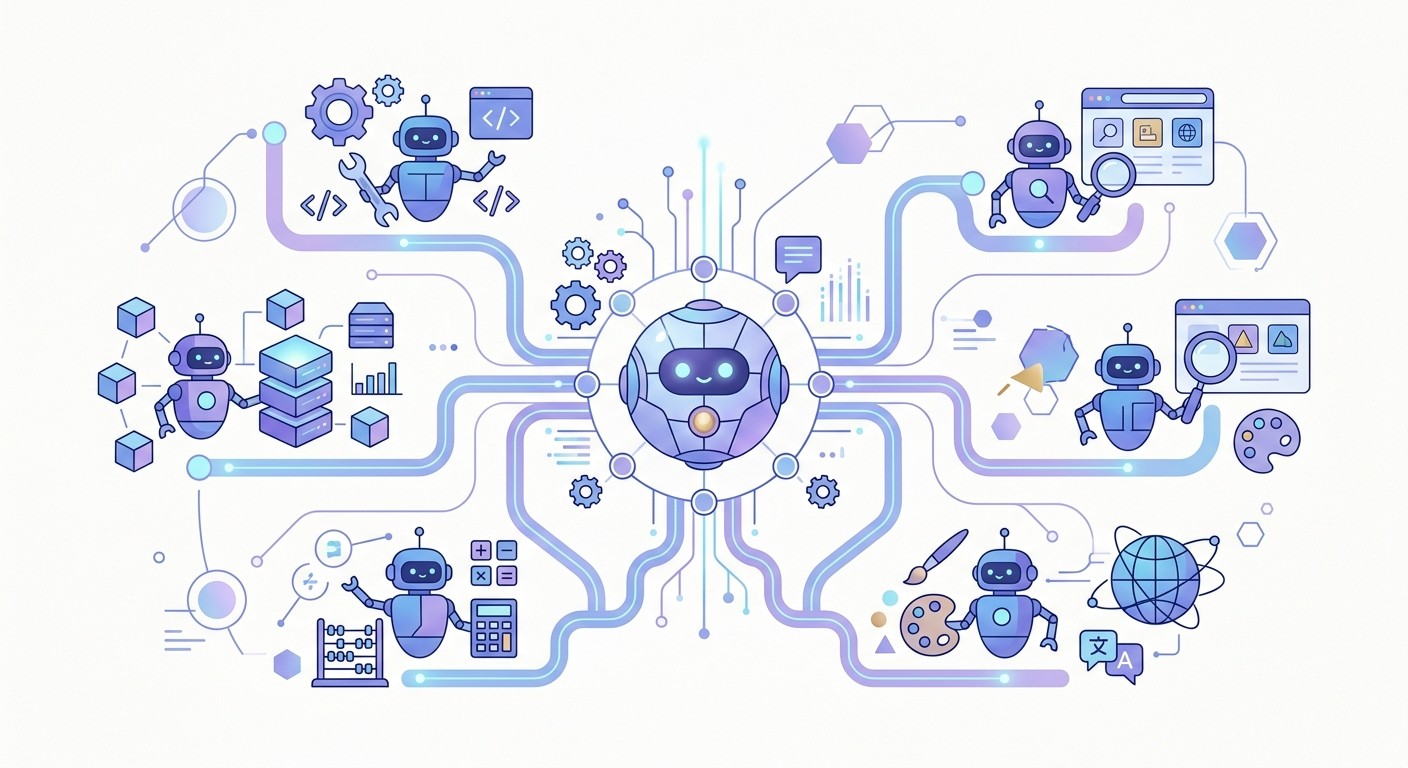
Today's LLMs are frozen intelligence. AI agents are the first systems that deliberately break out of that frame. If you want the sharper distinction, our guide to AGI vs AI agents breaks down exactly where one ends and the other begins.
An AI agent is an LLM plus three ingredients: memory, tools, and a loop. The loop lets it plan, act, observe, and revise. Tools let it reach out of the chat window to browsers, codebases, APIs, and file systems. Memory lets it persist across turns and tasks.
This matters for AGI because every serious definition requires generality and persistence. A one-shot LLM call can't "do any cognitive task." It can only do one prompt's worth. An agent system can sequence thousands of prompts toward a goal, call external tools when its own reasoning is insufficient, and accumulate context over hours or days.
You can already see the shape of AGI forming in today's agent architectures:
Planner + worker split. A top-level agent decomposes goals; specialized subagents execute steps in parallel.
External memory. Vector databases, filesystems, and document stores give agents long-lived context that survives model resets.
Tool discovery. Agents can read API documentation and use tools they've never seen before, turning any service into an affordance.
Self-critique. Multi-pass agents review their own output, catch errors, and retry with new strategies.
No single one of these is AGI. Together, they're a working sketch of general intelligence running on narrow components. The bet many labs are making, including ours, is that scale, better training, and smarter orchestration narrow the gap rather than require an entirely new paradigm. For a deeper look at how multiple agents coordinate, see our guide to what a multi-agent system is.
If you're building software today, agent architectures are the most AGI-adjacent things you can ship. Learn tool calling, multi-agent coordination, and evaluation loops. That's the closest thing to AGI practice that exists in 2026.
What AGI Means for Developers
AGI is a long-horizon shift, but the near-term implications for developers are concrete, and the bets you make this year will compound for the next decade.
1. The job is shifting from syntax to orchestration. Writing a function by hand is a solved problem. Designing an agent that can write, test, deploy, and monitor a thousand functions is not.
2. Evaluation is the new bottleneck. As agent systems grow, the hardest engineering problem is telling whether they worked. Evals, traces, and human-in-the-loop review are becoming core infrastructure, not optional tooling.
3. Every API is an agent surface. Any endpoint you expose will be called by an agent, not a human, within three years. Clean contracts, deterministic responses, and explicit error codes matter more than ever.
4. Memory and state management are product features. Users will expect agents to remember them, including preferences, prior work, and past context, across sessions. Building these substrates is a greenfield market.
5. The gap between prototype and production is still enormous. Demos are trivial in 2026. Reliability at scale, including latency, cost, hallucination, and observability, is where nine out of ten engineering hours go.
For teams deciding where to invest now, the durable bet is building agent-native products. Even if full AGI slips past 2035, the infrastructure being built around agents will dominate software architecture for the next decade. For a practical starting point, see how to prompt an AI app builder to get production-ready results.
Risks and Open Questions
No honest AGI post skips the downsides. Three live concerns every developer should understand:
Alignment. How do you specify what you want an AGI to do, knowing it will find creative loopholes in any spec? Research is active but the problem is unsolved.
Concentration of power. The companies training frontier models need billions of dollars in compute. AGI may not be open-source by default, and that has governance implications.
Capability overhang. Models often have capabilities that aren't discovered for months after release. Agents compound this. They find uses humans didn't anticipate.
These aren't reasons to stop building. They're reasons to build with intention, instrumentation, and kill switches.
Frequently Asked Questions
What is AGI in simple terms?
AGI (Artificial General Intelligence) is AI that can do any intellectual task a human can do. Today's AI is narrow. It's great at specific tasks like writing or image generation but can't generalize across arbitrary problems, learn new skills mid-conversation, or hold persistent memory without external systems.
Is ChatGPT AGI?
No. ChatGPT, Claude, GPT-5, and Gemini are all narrow AI. They're extraordinarily capable at language tasks, but they can't learn new skills after training, reliably act in the world without supervision, or match human cognition across open-ended problems.
When will AGI be achieved?
Expert predictions range from 2027 to 2040. Metaculus' community median is around 2031 for "strong AGI." OpenAI and Anthropic leadership expect transformative systems by 2030. Skeptics like Yann LeCun put it past 2040.
What's the difference between AGI and superintelligence?
AGI matches human cognitive ability across any task. Superintelligence (ASI) exceeds human intelligence across all domains, including AI research itself. AGI is the milestone; superintelligence is what some researchers expect to follow shortly after.
How is AGI different from AI agents?
AI agents are scoped systems that combine LLMs with tools, memory, and execution loops to complete tasks. They're narrow AI wearing generality's clothes. AGI would be a single system that matches humans on any task without task-specific scaffolding.
What should developers learn for the AGI era?
Agent architectures, tool calling, evaluation and tracing, memory systems, and distributed coordination. The durable skill is designing systems that orchestrate narrow AI toward general outcomes.
Build Toward AGI, Ship Today
AGI isn't here. It may not be here for another decade. But the building blocks of agents, tools, memory, and evaluation are the most important infrastructure being built in software right now.
The developers who win the next decade aren't the ones waiting for AGI. They're the ones shipping AI agents that handle real work today, adding memory and tools a feature at a time, and building products that get smarter as the models behind them do.
That's why we built CatDoes, an AI agent that builds mobile apps and websites end-to-end, and the foundation of an agentic AGI platform. Start with a natural-language prompt, let the agent design, build, and deploy, and keep shipping while the rest of the industry argues about definitions.
Nafis Amiri
Co-Founder of CatDoes


