Blog
Insights
Perplexity vs ChatGPT: Which to Pick in 2026
Perplexity vs ChatGPT in 2026: pricing, citations, agents, and the new GPT-6 Sol and Luna models. See which wins for research versus writing and code.

Nafis Amiri
Co-Founder of CatDoes

TL;DR: Perplexity vs ChatGPT comes down to verification against creation, and 2026 pushed the two further apart. Perplexity is a citation-first research engine that killed advertising entirely in February 2026 and now ships an agentic desktop product called Computer. ChatGPT is a general assistant that added ads to its free tiers in the same month and now runs a three-model GPT-6 lineup, after OpenAI shipped GPT-6 Sol and GPT-6 Luna on September 22, 2026 at half the API price of the models they replace. Choose Perplexity when you need sourced answers you can check in one click. Choose ChatGPT when you need to write, reason, code, or produce finished work.
If you have ever pasted a ChatGPT answer into Google to confirm whether it was actually true, you already understand this debate. One tool shows you where every sentence came from. The other writes you a finished draft and asks you to trust it.
This comparison covers what both products actually shipped through September 2026. That includes pricing and platform changes most published comparisons have not caught up with yet. You will get a plan-by-plan cost breakdown, the independent data on citation accuracy, how the two agent strategies split, and a straight recommendation for four kinds of user.
Table of Contents
Perplexity vs ChatGPT at a Glance
What Changed in 2026
Pricing and Plans
Accuracy and Citations
Research Depth
Models Under the Hood
Agents and Browsers
Writing, Coding, and Everyday Work
Which Should You Choose?
From Answers to Working Apps
Frequently Asked Questions
Perplexity vs ChatGPT at a Glance
Perplexity searches the live web by default and attaches a source to nearly every claim. ChatGPT answers from the model first and searches only when the question demands it. That single design choice explains most of the differences below.
Factor | Perplexity | ChatGPT |
|---|---|---|
Core job | Search, cite, verify | Generate, reason, produce |
Flagship model | Routes across ~20 third-party models | GPT-6 Astra, plus Sol and Luna since Sept 22, 2026 |
Free tier | Unlimited basic search, a few Pro searches daily | GPT-5.6 Luna in Chat, GPT-6 Luna in the desktop app |
Ads | None, removed February 2026 | Free and Go tiers since February 2026 |
Entry paid plan | Pro, $20/mo | Go, $8/mo |
Mainstream plan | Pro, $20/mo | Plus, $20/mo |
Top consumer plan | Max, $200/mo | Pro, from $100/mo |
Browser | Comet, free on all platforms | Atlas discontinued August 2026 |
Agent product | Perplexity Computer | ChatGPT agent and Codex |
Best for | Research, fact-checking, market scans | Writing, coding, analysis, images |
What Changed in 2026
Both companies made decisions this year that changed the comparison more than any benchmark did. The biggest one was about money.
On February 9, 2026, OpenAI started showing ads to logged-in adult users on the ChatGPT Free and Go tiers in the United States. By May it had opened a self-serve ads manager and expanded to markets including the UK, Japan, Brazil, Mexico and South Korea. Paid tiers stayed ad-free.
Nine days later, Perplexity went the opposite direction. On February 18, 2026 it abandoned advertising entirely and committed to subscription and enterprise revenue only. CEO Aravind Srinivas argued that sponsored content inside AI answers would corrode the one thing a citation engine sells, which is trust. The move cost Perplexity almost nothing, since ad revenue had been under 0.1% of its total.
Two other shifts matter. OpenAI shut down its standalone Atlas browser on August 9, 2026 and folded browser-based agent work into ChatGPT and Codex. Perplexity did the reverse and kept investing in a separate browser, Comet, which has been free since October 2025.
The last shift landed in September, and it was about money again. OpenAI followed GPT-6 Astra with two cheaper siblings, GPT-6 Sol and GPT-6 Luna, on September 22, 2026, cutting API prices by half or more in the process. Anthropic had released Claude Opus 5.5 about ninety minutes earlier. Perplexity licenses models from both labs, so a price war between its suppliers lands on its cost base rather than its roadmap.
Pricing and Plans
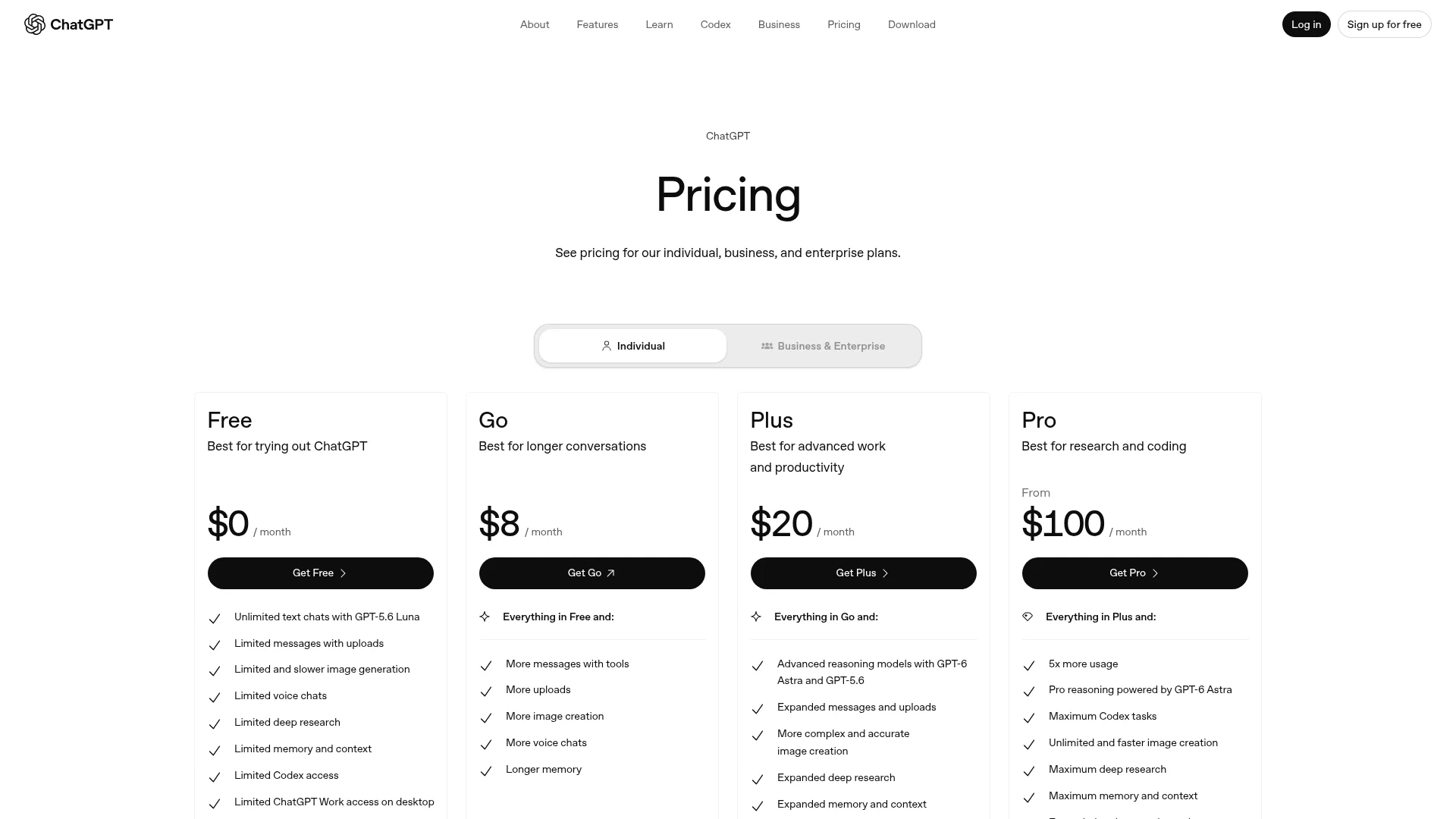
The headline price is identical at $20 a month. Everything above and below that number is where the two lineups stop resembling each other.
Plan | Perplexity | ChatGPT |
|---|---|---|
Free | $0, no ads | $0, with ads |
Budget | Education Pro, $10/mo (students) | Go, $8/mo, with ads |
Standard | Pro, $20/mo or ~$200/yr | Plus, $20/mo |
Power | Max, $200/mo or ~$2,000/yr | Pro, $100/mo or $200/mo |
Team | Enterprise Pro, $40/user/mo | Business, ~$20-25/seat/mo |
The Free Tiers Diverge on Ads
Perplexity's free plan gives you unlimited basic search with citations and a small daily allowance of Pro searches. Reports put that allowance at roughly three to five per day, and Perplexity adjusts it over time. There is no model picker and no image generation.
ChatGPT's free plan runs GPT-5.6 Luna in the main chat box, with caps on messages, uploads and image generation, and it shows sponsored chat cards below answers. Free and Go users can now also try GPT-6 Luna, but only in the desktop app. If ads inside your research bother you, Perplexity free is the cleaner starting point.
Perplexity Pro vs ChatGPT Plus
At the same $20, these plans buy genuinely different things. Perplexity Pro removes the Pro search cap and opens up a model picker spanning several labs. It also adds file uploads, image generation and Computer credits.
ChatGPT Plus is the cheapest ad-free tier and the cheapest tier with agent mode. One catch is worth knowing, and September made it sharper. OpenAI now ships new models to ChatGPT Work and Codex first, not to the chat box most people actually open. GPT-6 Astra arrived that way on September 3, a staggered rollout Sam Altman called messy the following day. Sol and Luna repeated it on September 22 with no Chat availability at all. If you pay $20 and go looking for GPT-6 Sol in an ordinary conversation, it is not there. You have to switch to the Work tab.
Perplexity Max vs ChatGPT Pro
Perplexity Max at $200 a month is the only way to get unlimited Perplexity Computer, Model Council, and the highest usage ceilings. The jump from $20 to $200 is steep with nothing in between.
ChatGPT Pro is more forgiving here. OpenAI added a $100 tier on April 9, 2026 that offers roughly 5x the usage of Plus, with the $200 tier at 20x. Pro buys headroom rather than exclusive features, so most people never need it.
Accuracy and Citations
This is where the marketing gets loud and the evidence gets thin. Plenty of 2026 comparison posts quote precise accuracy percentages with no traceable methodology behind them. Treat those with suspicion.
The most rigorous public test remains Columbia Journalism Review's Tow Center study from March 2025, which ran 1,600 queries across eight AI search tools. Perplexity answered incorrectly 37% of the time, the best result in the study. ChatGPT Search misidentified 134 of 200 articles, a 67% error rate. Grok 3 came in worst at 94%.
Two caveats keep that from being a clean win. Collectively the tools were wrong on more than 60% of queries, so "best" is a low bar. And the study found Perplexity Pro produced more confidently incorrect answers than the free version, which is the opposite of what you would expect from a paid upgrade.
The practical takeaway is structural rather than statistical. Perplexity's dominant failure mode is misattribution, where the link is real but the sentence it supports overstates what the page says. That is a failure you can catch in ten seconds. ChatGPT frequently answers without searching at all, which leaves nothing to check.
Research Depth
Speed and depth pull in opposite directions here, and the two tools sit at different points on that line.
Perplexity is built for the fast end. A standard Pro search returns a cited answer in a few seconds, and its deeper research mode works across dozens of sources in under a minute. For checking a claim, scanning a market, or pulling current numbers, that loop is hard to beat.
ChatGPT's deep research runs longer and goes further. It follows citation chains across many sources over several minutes and returns a structured report. When the job involves reasoning through conflicting evidence or pulling code and data analysis into the same answer, the extra wait pays for itself.
A reasonable workflow uses both. Perplexity to find and verify the raw material, ChatGPT to reason over it and turn it into something finished.
Models Under the Hood
OpenAI builds its own models. Perplexity licenses everyone else's. That is the deepest structural difference between the two products, and September brought it into focus.
The GPT-6 Lineup After September 22
GPT-6 Astra shipped on September 3, 2026 as the successor to the GPT-5.6 family of Sol, Terra and Luna. Nineteen days later OpenAI added GPT-6 Sol and GPT-6 Luna. Sol is the workhorse for coding and multi-step agent work. Luna is the cheap, fast model for summarizing documents, extracting fields and answering short questions. No GPT-6 Terra shipped, so the middle rung of the old lineup quietly disappeared.
All three share the same 1,050,000-token context window and the same 128,000-token output ceiling. What separates them is price.
Model | Input per 1M tokens | Output per 1M tokens | Change vs GPT-5.6 |
|---|---|---|---|
GPT-6 Astra | $10 | $50 | New flagship tier |
GPT-6 Sol | $2 | $10 | Down from $4 and $20 |
GPT-6 Luna | $0.10 | $0.50 | Down from $0.20 and $1.20 |
Cached input reads cost a further 90% less, and OpenAI told VentureBeat that these are permanent prices rather than promotional ones. For comparison, Anthropic's Claude Opus 5.5 landed the same day at $4 and $20.
Cheaper did not mean weaker, at least by OpenAI's own measurements. It reports GPT-6 Sol scoring 60.5% at xhigh effort on the OSWorld 2.0 computer-use benchmark against Claude Opus 5's 60.3% at medium, for roughly 80% less cost, and 68.8% on DeepSWE 1.1 against Claude Fable 5's 69.9%. It also claims Sol makes about half as many factual mistakes as GPT-5.6 Sol. Those are vendor numbers on vendor-chosen tests, so treat the margins as directional rather than settled.
Perplexity Buys From Everyone
Perplexity takes the opposite bet, and it moves quickly when a new model lands. GPT-6 Astra reached Perplexity Computer for Pro and Max subscribers within days of release. By the week of September 22, Perplexity's own Agent API changelog listed gpt-6-sol, gpt-6-luna, claude-opus-5-5 and grok-4.7 as supported models.
Perplexity also stopped asking you to choose. Effort Mode arrived in Computer on September 21, 2026 and replaced the single default orchestrator with four presets, Light through Ultra, that pick both the model and the reasoning depth for you. Lower settings route to cheaper models on purpose. A custom option still lets you override both.
Each approach has a real cost. OpenAI controls the full stack and ships frontier capability first, but you are locked to one lab's judgment. Perplexity always has access to whichever model currently leads a category, and September's price cuts flow straight into its cost base, but it is permanently downstream of other companies' roadmaps and pricing. If you want the model-level detail on how these families compare, our Grok vs ChatGPT breakdown goes deeper on the benchmarks.
Agents and Browsers
This is the sharpest strategic split between the two companies in 2026, and it is where the comparison is likely to be decided over the next year.
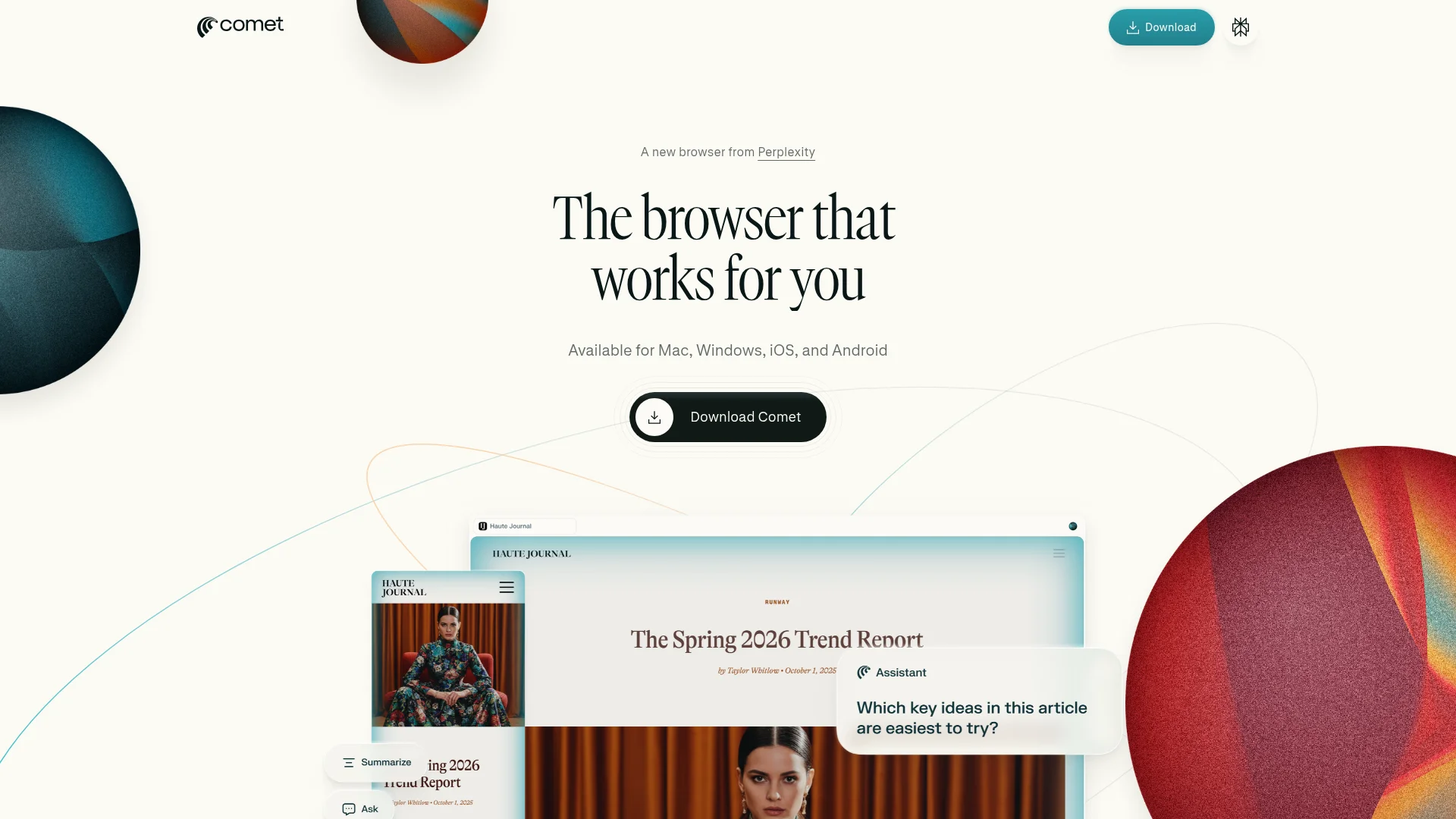
Perplexity bet on the browser. Comet is a Chromium-based browser that has been free worldwide since October 2025 and is now on Windows, Mac, iOS and Android. The assistant holds context across every open tab and can carry out multi-step tasks rather than just summarizing the page in front of you.
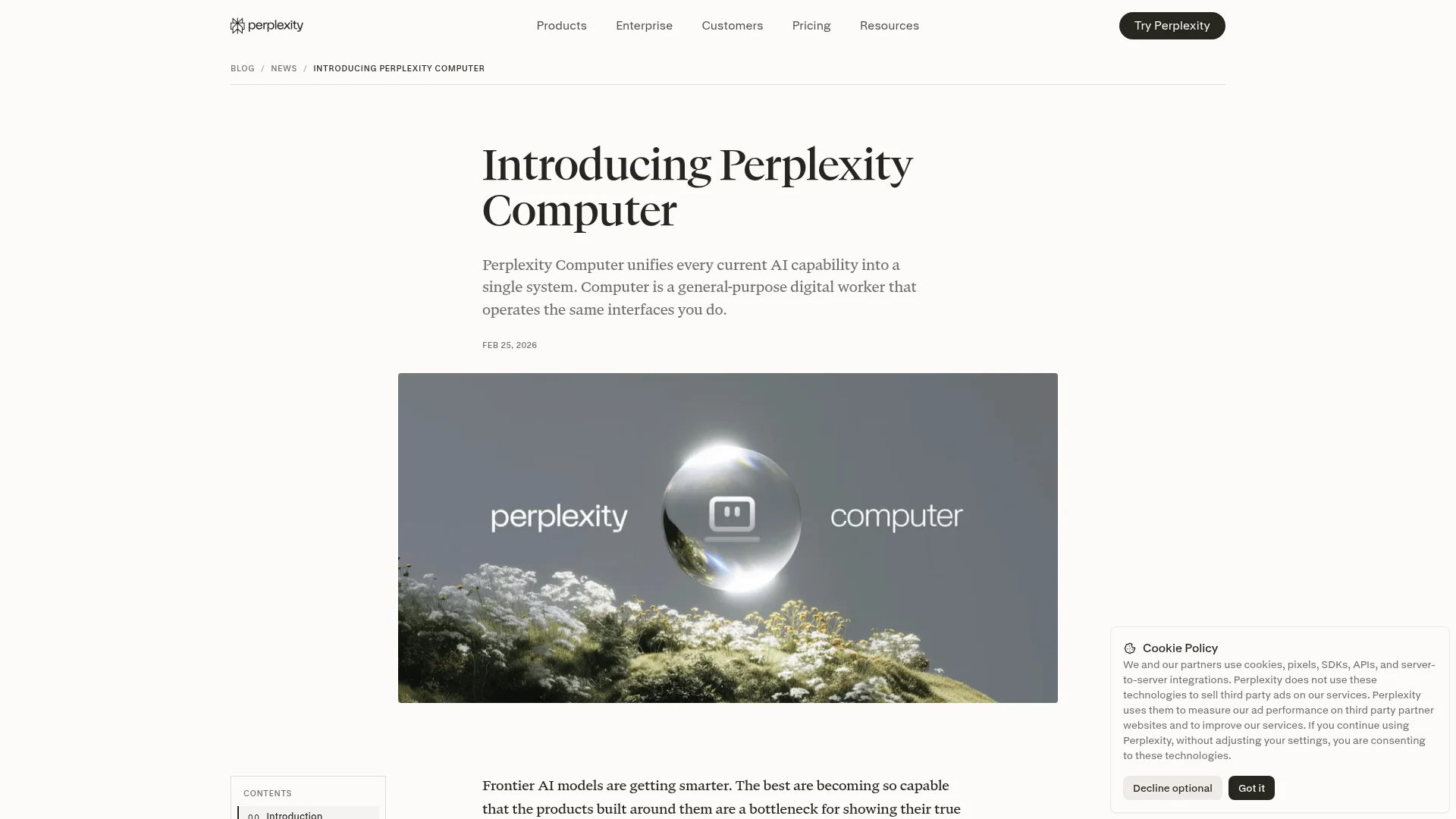
On top of that sits Perplexity Computer, launched February 25, 2026 on the Max plan. It routes work across roughly 20 models and spawns subagents for long tasks. It has also moved fast: Windows in July, a local NVIDIA-powered Portable Computer in August, and hybrid local plus cloud compute on Mac on September 1, 2026.
OpenAI went the other way. It retired Atlas on August 9, 2026 and moved agentic browsing into the ChatGPT app and Codex instead of maintaining a separate browser. If you want the wider context on where this category is heading, we covered it in AGI vs AI agents.
Writing, Coding, and Everyday Work
For anything that produces rather than retrieves, ChatGPT is the stronger tool and it is not particularly close.
Long-form writing, code generation, data analysis, image generation and extended back-and-forth conversation all favor ChatGPT. GPT-6 Astra was positioned specifically around producing finished professional artifacts such as documents, slides and spreadsheets, and GPT-6 Sol now brings most of that capability into a model that costs a fifth as much to run. That matters less for a $20 subscription than it does for anyone building on the API.
Perplexity can write and can generate code, but its reasoning on tasks that are not search-shaped lags behind. Ask it to refactor a codebase or hold a nuanced creative thread across twenty messages and the gap shows. For serious development work, neither chatbot is really the right category anyway, as our Claude Code vs Codex comparison explains.
Which Should You Choose?

Researchers, analysts and journalists: Perplexity Pro. Sourced answers with one-click verification beat a polished paragraph you cannot audit.
Writers, marketers and developers: ChatGPT Plus. You need output quality and tool breadth more than you need footnotes.
Budget-conscious users: Perplexity free if ads bother you, ChatGPT Go at $8 if they do not and you want higher limits.
Teams running long agentic workflows: Perplexity Max, mainly for Computer. It is $200 a month, so pilot it before committing.
If you can afford $40 a month, running both is the honest answer. They are not really competitors so much as two halves of a workflow.
From Answers to Working Apps
Both tools stop at the same wall. Perplexity will find you the market research for an app idea. ChatGPT will write you the code for it. Neither one will wire up a database, point a custom domain at your site, or submit a build to the App Store.
That last mile is its own job. It needs a backend, authentication, file storage, a signed build, a store listing, and a review process with rules of its own. A chat window hands you a plan and a folder of code. It does not hand you something a stranger can download.
That gap is what CatDoes was built for. You describe the app or website you want in plain English, and an agent builds it, connects the backend, and ships it to the App Store, Google Play, or the web on your own domain. CatDoes Cloud, which covers database, auth, storage, edge functions and realtime, is included on every plan, so there is no second service to wire up.
Describe it in plain English. No Xcode, no developer console, no boilerplate to copy across.
Try it before you pay. The free plan builds and deploys a web app at no cost, CatDoes Cloud included.
Keep what you build. GitHub sync and code export are available on higher tiers, so you are not locked in.
Ship to the stores. On paid plans the agent handles the build, the signing and the store submission.
In practice that is a three-step handoff. Perplexity to check the idea against real sources, ChatGPT to reason through the spec, then an agent that can actually publish the result. If you want the longer version of how that last step works, we wrote up what CatDoes does end to end. Otherwise, describe your first app and let the agent take the first pass.
Frequently Asked Questions
Is Perplexity better than ChatGPT?
For search and fact-checking, yes. Perplexity had the lowest error rate of eight tools in Columbia Journalism Review's 1,600-query study, at 37% against ChatGPT Search's 67%. For writing, coding, reasoning and image generation, ChatGPT is clearly stronger. They are optimized for different jobs.
Is Perplexity free?
Yes, permanently. The free plan includes unlimited basic search with citations plus a small daily allowance of Pro searches, commonly reported at three to five. It carries no ads. The Comet browser is also free on Windows, Mac, iOS and Android.
Does ChatGPT show ads?
On the Free and Go tiers, yes. OpenAI began showing sponsored chat cards to logged-in adult US users on February 9, 2026 and expanded internationally in May. Plus, Pro, Business, Enterprise and Education remain ad-free.
Which is better value at $20 a month?
It depends on what you do most. Perplexity Pro buys unlimited cited search and a model picker spanning several labs. ChatGPT Plus buys ad-free access to OpenAI's frontier models plus agent mode, image generation and the wider tool ecosystem, though the newest GPT-6 models sit in the Work tab rather than the main chat box. Research work favors Pro, production work favors Plus.
What are GPT-6 Sol and GPT-6 Luna?
They are the two cheaper models in OpenAI's GPT-6 family, released on September 22, 2026 alongside the flagship GPT-6 Astra. Sol handles coding and agentic work at $2 per million input tokens and $10 per million output. Luna handles high-volume tasks such as summarizing and extraction at $0.10 and $0.50. Both undercut their GPT-5.6 versions by half or more. Inside ChatGPT they appear in Work and Codex rather than ordinary chat, and Free and Go users can try Luna in the desktop app.
What is Perplexity Computer?
It is Perplexity's agentic platform, launched February 25, 2026 on the $200 Max plan. It orchestrates around 20 models and splits long tasks across subagents. It runs on Mac and Windows, and an NVIDIA-backed Portable Computer version released in August 2026 runs entirely on local hardware.
Can I use both Perplexity and ChatGPT?
Yes, and most heavy users do. The common pattern is Perplexity for gathering and verifying sources, then ChatGPT for reasoning over that material and producing the finished document, analysis or code.
Nafis Amiri
Co-Founder of CatDoes


