Blog
Insights
CatDoes vs Lovable: Which Ships Mobile Apps?
CatDoes vs Lovable compared for 2026: pricing, features, and native App Store and Google Play publishing. See which one ships real iOS and Android apps.

Nafis Amiri
Co-Founder of CatDoes

TL;DR: CatDoes and Lovable both turn plain-English prompts into working software without code, but they finish in different places. Lovable is excellent at generating web apps, internal tools, and polished UI that live in the browser. CatDoes is an AI agent that builds and ships real mobile apps and websites, publishing straight to the App Store, Google Play, and the web with custom domains, backend included. If you need a web app fast, Lovable is a strong pick. If you need a native app your users can download, CatDoes takes it all the way there.
You want to build an app without hiring engineers, and two names keep coming up: Lovable and CatDoes. Both promise AI that writes the code for you. Both start free. Both show slick demos of an idea becoming a real product in minutes.
The catch is that "app" means two very different things here. One tool stops at a web app that opens in a browser. The other keeps going until your app is live on the App Store and Google Play. Pick the wrong one and you either ship exactly what you needed, or you hit a wall the moment someone asks "where do I download it?"
This guide compares CatDoes and Lovable on what actually matters: what each one builds, real 2026 pricing, the native-mobile question, and who should choose which.
Table of Contents
What Is Lovable?
What Is CatDoes?
CatDoes vs Lovable: The Core Difference
Feature Comparison
Pricing: CatDoes vs Lovable in 2026
Can You Ship a Real Mobile App?
The Lovable Mobile Trap
Which One Should You Choose?
Frequently Asked Questions
The Bottom Line
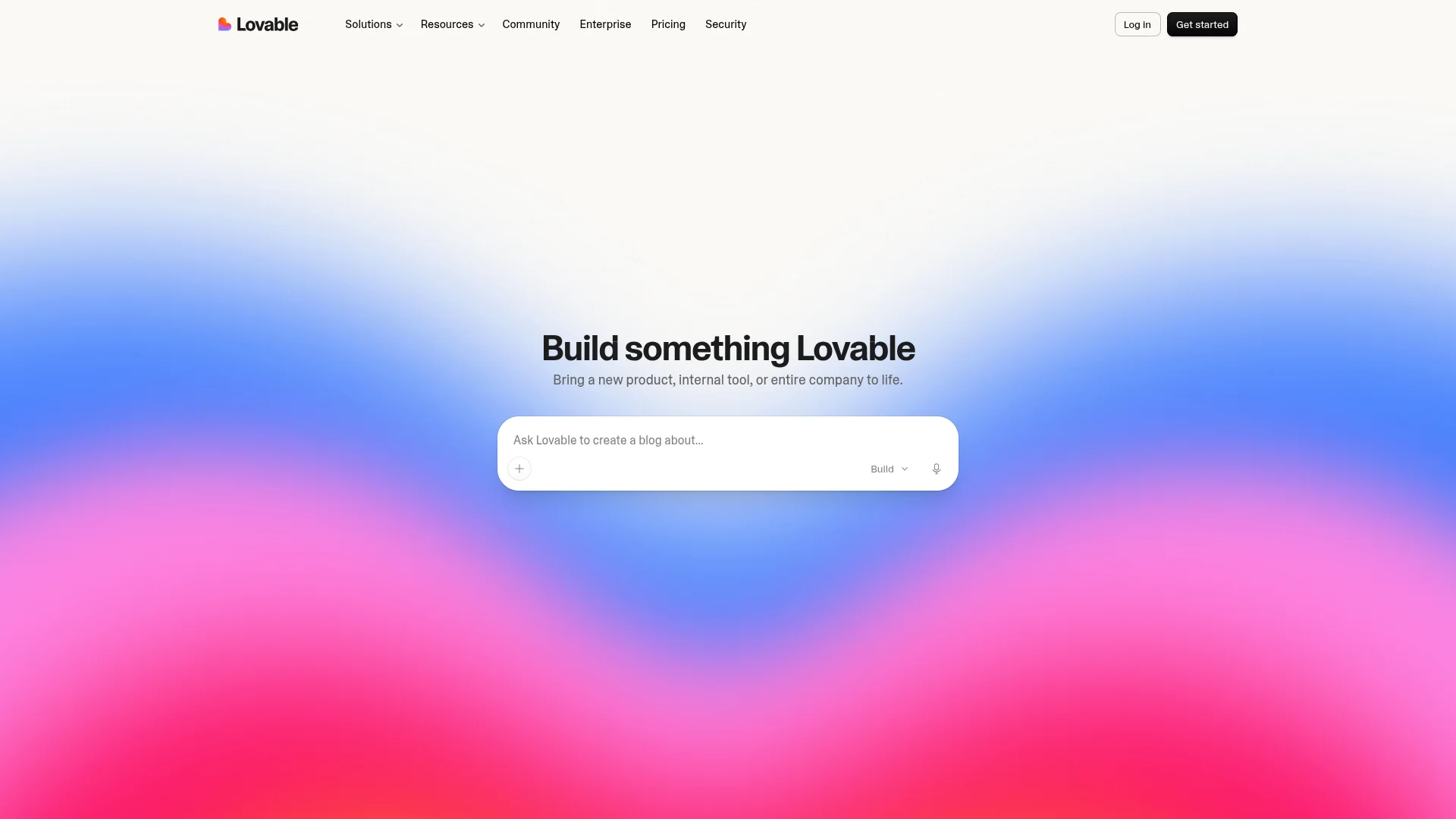
What Is Lovable?
Lovable is an AI web app builder. You describe what you want in plain English, and it generates a working web application you can preview, edit, and deploy. Under the hood, a Lovable project is a standard React app built with Vite and Tailwind CSS, backed by Lovable Cloud, a Supabase-powered database, auth, and storage layer. It is genuinely good at what it does: spinning up landing pages, dashboards, internal tools, and MVPs quickly, with clean UI and a real backend attached.
Where Lovable lives is the browser. Your finished project deploys to a web URL, on a free lovable.app subdomain or your own custom domain on paid plans. That makes it a fast way to get a web product in front of people. It also defines the edge of what it does: Lovable builds for the web, not for the App Store.
What Is CatDoes?
CatDoes is an AI agent that builds mobile apps and websites from natural language. You describe the app, and the agent runs in the cloud, spins up its own subagents, writes the code, and ships the result to the App Store, Google Play, or the web with a custom domain. There is no IDE to install and no code you are required to touch.
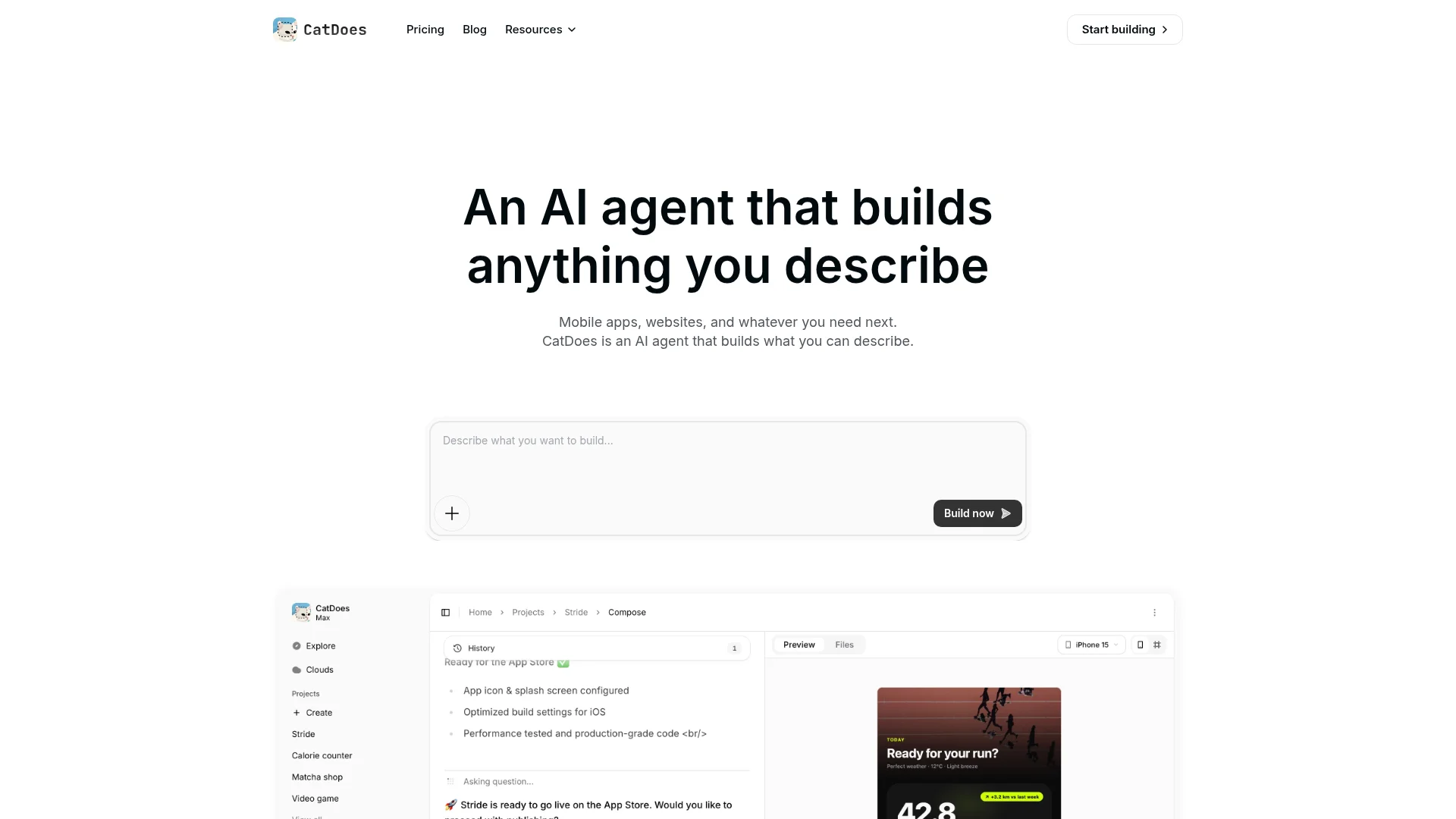
Every plan includes CatDoes Cloud, a built-in backend with database, authentication, storage, edge functions, and realtime, so a finished app has data and logins from day one. Developers can bring a GitHub repo, export the code, and work with the stack directly, while non-technical founders can go from idea to a downloadable app without opening an editor. For the wider field, our guide to the best Lovable alternatives compares CatDoes with Bolt, Replit, v0, and other tools.
CatDoes vs Lovable: The Core Difference
The cleanest way to frame it: Lovable builds you a web app, and CatDoes builds and ships you an app, including the native mobile version. Both take plain English in, run in the cloud, and come with a backend. The split is what happens at the finish line. The same split shows up against the rest of the field, which we cover in CatDoes vs Rork and CatDoes vs Emergent.
With Lovable, the finish line is a live web URL. From there, getting onto a phone as a real, installable app is a separate project you take on yourself. With CatDoes, publishing is part of the job: the agent produces a native app and submits it to the App Store and Google Play, then handles web deployment with custom domains on top. One hands you a web app, the other hands you a shipped product across web and mobile.
Feature Comparison
Here is how the two line up on the things that decide whether you end up with the app you actually wanted.
Feature | CatDoes | Lovable |
|---|---|---|
What it is | AI agent that builds & ships apps | AI web app builder |
Coding required | No | No |
Runs in | The cloud (browser) | The cloud (browser) |
Builds web apps | Yes, with custom domains(up to 20) | Yes, with custom domains |
Builds native mobile apps | Yes, iOS & Android | No (web only) |
Publishes to App Store / Google Play | Yes | No |
Backend included | Yes (CatDoes Cloud) | Yes (Lovable Cloud) |
GitHub import / code export | Yes | Yes |
Best for | Web apps, internal tools, MVPs, Shipping real apps to the stores | Web apps, internal tools, MVPs |
Both give you no-code building, a cloud backend, and code access when you want it. The biggest practical difference is native mobile: CatDoes outputs iOS and Android apps you can publish to the stores, while Lovable outputs web apps.
Pricing: CatDoes vs Lovable in 2026
Both tools start free and scale with usage-based credits, where each action you ask the AI to perform draws down a balance. Here is Lovable's current lineup, per its official pricing page:
Lovable Plan | Price | What you get |
|---|---|---|
Free | $0 | 5 daily credits, Cloud, community support |
Pro | $25/mo | 100 monthly credits, custom domains, badge removed |
Business | $50/mo | Team workspace, SSO, roles & permissions |
Enterprise | Custom | Volume pricing, SCIM, audit logs |
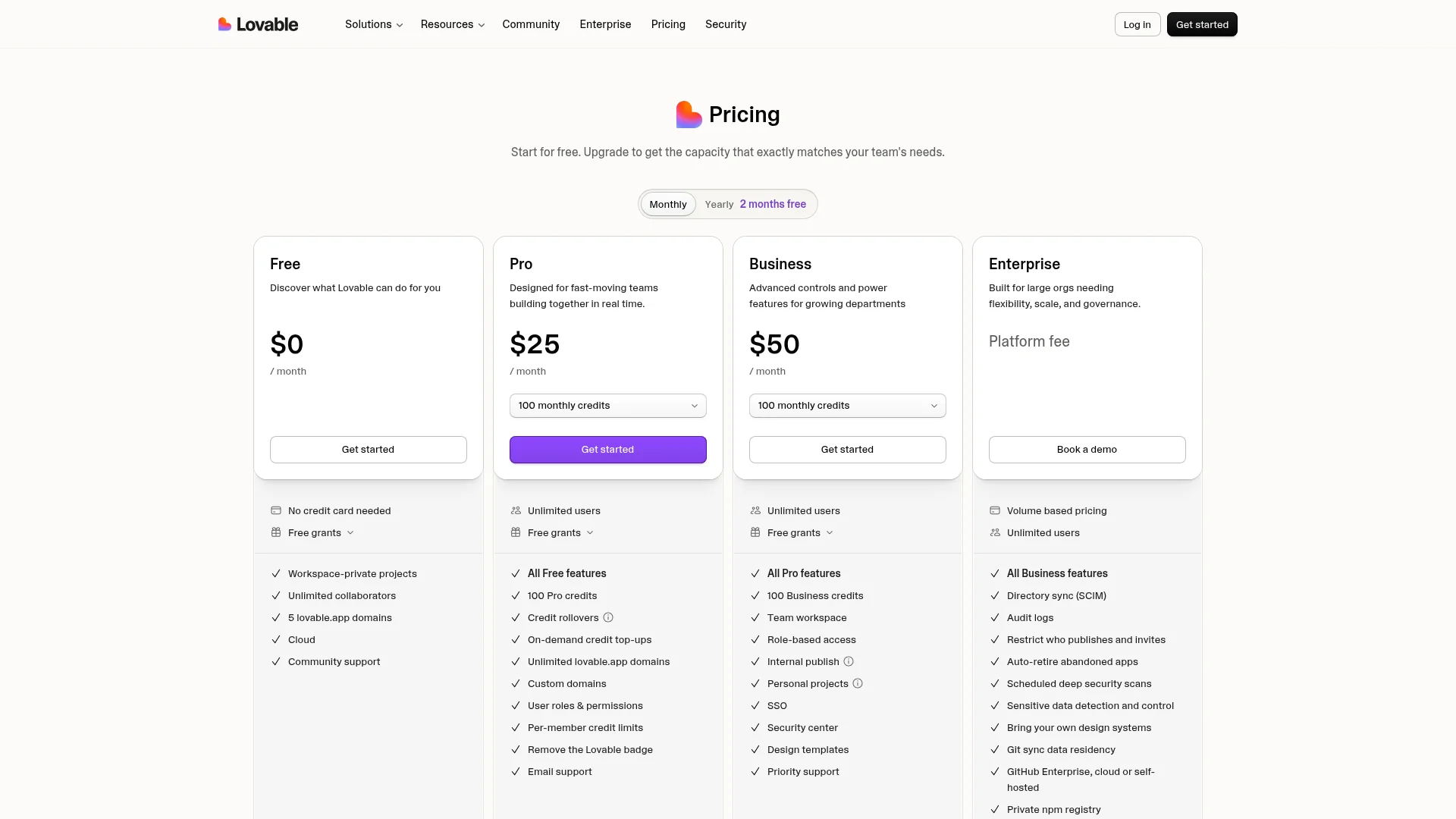
Annual billing takes off two months. Credits are consumed per action, so a heavier build month can push you into top-ups or a higher credit tier.
CatDoes also uses a monthly credit model, and every plan includes CatDoes Cloud:
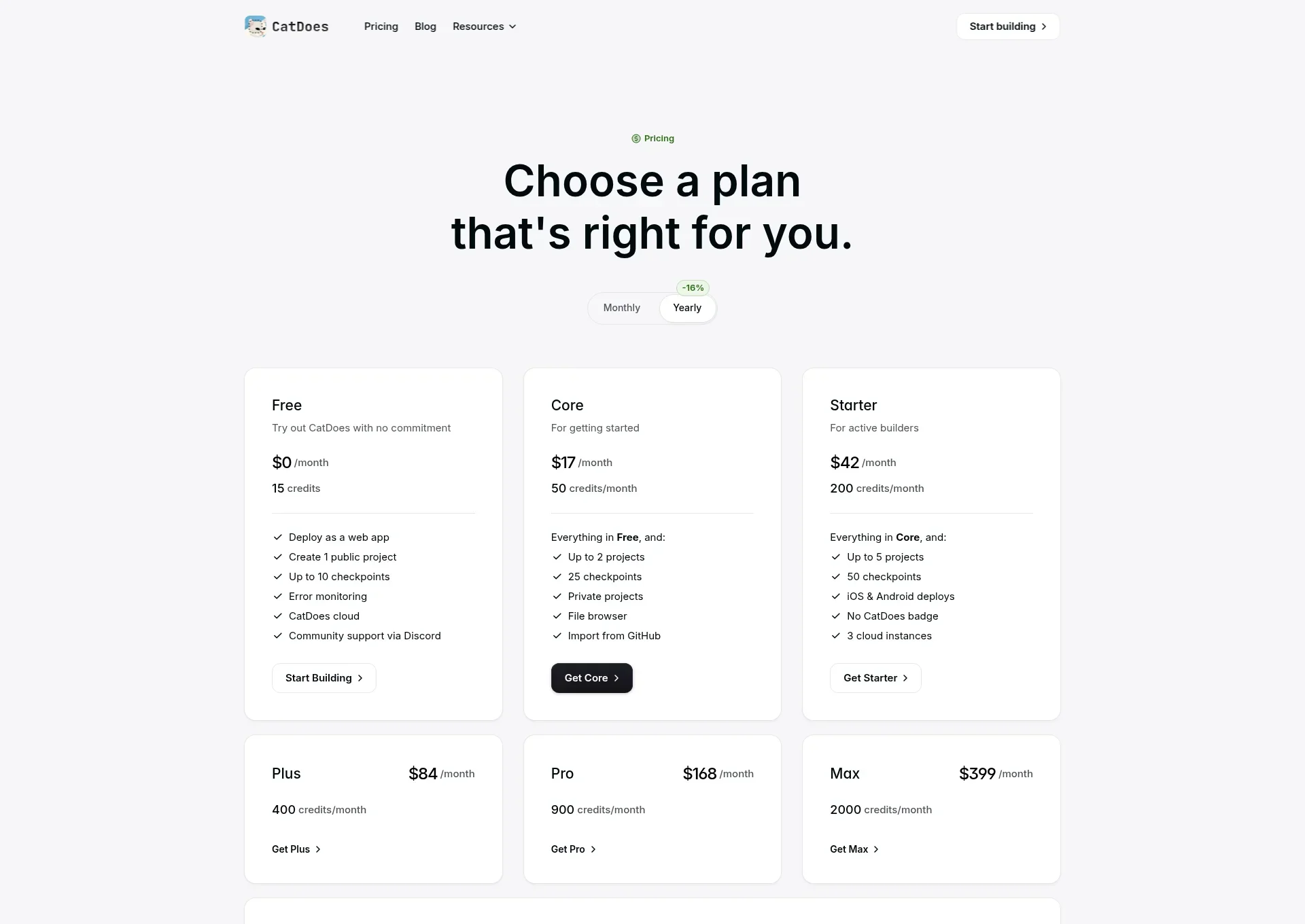
CatDoes Plan | Price | Credits/mo |
|---|---|---|
Free | $0 | 15 (one-time) |
Core | $20/mo | 50 |
Starter | $50/mo | 200 |
Plus | $100/mo | 400 |
Pro | $200/mo | 900 |
Max | $399/mo | 2,000 |
The entry prices land close together: Lovable's first paid tier is $25, CatDoes' Core is $20. But you are buying different jobs. Lovable's plans pay for generating and hosting web apps. CatDoes' plans pay for building an app, running its backend, and publishing it to the App Store and Google Play. Once you factor in the extra tooling a Lovable project needs to become a mobile app, the sticker prices aren't really comparing the same outcome.
Can You Ship a Real Mobile App?
This is where the two tools separate most clearly. With Lovable, the honest answer is no, not a native one. Lovable builds React web apps that run in the browser. There is no React Native or Expo output, and no button that publishes to the App Store or Google Play. A Lovable project can look great in a phone's browser, but a browser tab is not an installable app with a store listing, push notifications, and full device access.
CatDoes treats native publishing as the point. The agent builds a real native app and submits it to the App Store and Google Play for you, and it deploys to the web with custom domains as well. If you have ever fought through a first store submission, removing that pipeline is the whole reason this category exists.
The Lovable Mobile Trap
Because Lovable stops at the web, users who need a mobile app usually reach for a workaround, and it is worth knowing the trap before you fall into it. The common move is to wrap the Lovable web app in a WebView shell with a tool like Capacitor or Median, which loads your website inside a native container. It feels like a shortcut. It often ends in a rejection.
Apple's App Store Review Guideline 4.2 explicitly targets apps that are just a website in a native wrapper. If your app looks and behaves identically to your site in Safari, reviewers can and do reject it. Even when a wrapper slips through, you inherit sluggish performance, limited device access, and no reliable push notifications. The dependable path from Lovable to a store-ready app is a native rebuild in React Native. CatDoes does that conversion, and native builds from scratch, as part of the normal flow. That makes it the most direct Lovable alternative when your endpoint is the App Store, not a web URL.
Which One Should You Choose?
Choose Lovable if: you want a web app, an internal tool, a dashboard, or a fast MVP that lives in the browser, and a public URL is your finish line. It is a polished web builder with a backend included, and for web-first products it does the job well.
Choose CatDoes if: you want a real app your users can download, not only a web page. If your goal is a finished product on the App Store, Google Play, or the web, with the backend, deployment, and store submission handled for you, CatDoes is built for exactly that. Founders and non-developers get there without code, and developers get there without babysitting the release pipeline.
The two aren't really rivals so much as answers to different questions. "I need a web app" points to Lovable. "I need my app on the App Store" points to CatDoes.
Weighing other AI builders too? See our CatDoes vs Replit comparison for another alternative.
Frequently Asked Questions
Can Lovable publish an app to the App Store? No. Lovable builds web apps that deploy to a URL. It has no native iOS or Android output and no store submission. To get a Lovable project onto the App Store or Google Play, you convert it to native code or rebuild it in React Native, which is the gap CatDoes fills.
Do I need to know how to code to use CatDoes? No. You describe the app in plain English and the agent builds and ships it. Developers can go deeper with GitHub import and code export, but coding is optional.
Is Lovable or CatDoes cheaper? Both start free. Lovable's first paid tier is $25/month and CatDoes' Core is $20/month. They price different jobs, though: Lovable charges for building and hosting web apps, while CatDoes charges for building, hosting, and publishing native apps to the stores.
Can I move my existing Lovable project to CatDoes? Yes. You can import a Lovable app into CatDoes by URL or by connecting its GitHub repo, and the agent rebuilds it as a native iOS and Android app. Your Lovable web app keeps running untouched.
Is CatDoes better than Lovable for mobile apps? Yes. Lovable is a web builder and cannot produce a native mobile app on its own, so if a downloadable App Store or Google Play app is the goal, CatDoes is built for it, with store publishing and a backend included.
The Bottom Line
CatDoes vs Lovable comes down to one question: do you need a web app, or a shipped app? Lovable is a polished AI web builder that turns prompts into browser-based apps and internal tools, backend included. CatDoes is an AI agent that turns the same plain-English ideas into real mobile apps and websites, with backend, deployment, and App Store and Google Play publishing handled for you, no code required.
If your goal is a finished product your users can download, try CatDoes free and describe your first app. The agent takes it from there.
Nafis Amiri
Co-Founder of CatDoes


