Blog
Insights
CatDoes vs Replit: Best Replit Alternative (2026)
CatDoes vs Replit for 2026: pricing, native iOS and Android apps, and App Store publishing. The best Replit alternative when you need to ship a real app.

Nafis Amiri
Co-Founder of CatDoes

TL;DR: CatDoes and Replit both use AI to turn plain English into working software, but they aim at different people. Replit is a browser-based cloud development platform (an IDE, hosting, and an AI Agent) that leans toward developers and web apps. CatDoes is an AI agent that builds native mobile apps and websites and ships them for you to the App Store, Google Play, and the web, with the backend included and no coding required. Replit can now build a native iOS app, but you still bring your own Apple Developer account and run the submission yourself. If you want a coding platform, pick Replit. If you want the Replit alternative that ships a finished app to the stores without touching code, pick CatDoes.
You searched for a way to build an app with AI and landed on two tools that both promise exactly that. Replit and CatDoes each turn a sentence into a running product. Both start near $20 a month. Both talk about mobile. So which one actually gets your app onto a phone and into the App Store?
Here is the trap: pick the wrong one and you either end up inside a coding environment you did not want, or you get a web app when you needed a real app in the stores. The distance between "AI helps me build and host a web app" and "AI builds and ships my native app for me" is where these two tools split. This guide breaks down what each one is, real 2026 pricing, the mobile-and-publishing question, and who should choose which.
Table of Contents
What Is Replit?
What Is CatDoes?
CatDoes vs Replit: The Core Difference
Feature Comparison
Pricing: CatDoes vs Replit in 2026
Can Replit Build Native iOS and Android Apps?
Watch the Usage: How Replit Credits Work
Which One Should You Choose?
Frequently Asked Questions
The Bottom Line
What Is Replit?
Replit is a browser-based cloud development platform. You write, run, and host projects entirely from a browser, with no local setup, and its AI system, Replit Agent, turns natural-language prompts into full-stack apps. It started as an online code editor for developers and students, and that heritage still shows: at its core, Replit is a coding environment with hosting and AI wrapped around it.
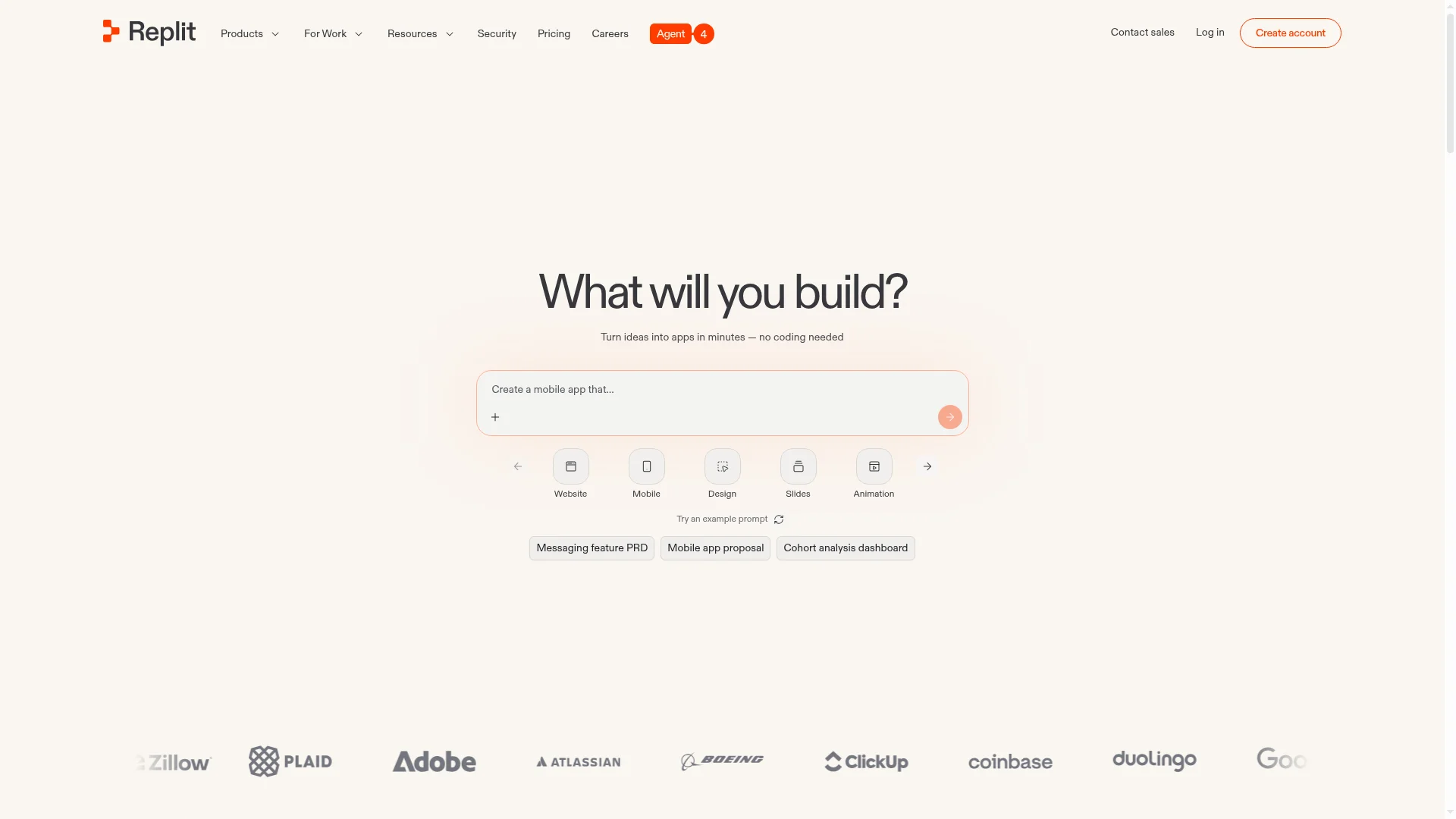
Replit Agent can scaffold a database, wire up an auth flow, and deploy a web app to a live URL. In 2026 Replit also added a native mobile path: Agent can generate a native iOS app using Expo and React Native, and you preview it on a real device through a QR code. It is a genuinely capable platform, but it is still a development platform first. It assumes you are comfortable living near the code, managing deployments, and owning the release process yourself.
What Is CatDoes?
CatDoes is an AI agent that builds mobile apps and websites from natural language. You describe what you want, the agent runs in the cloud, spins up its own subagents, writes the code, and ships the result to the App Store, Google Play, or the web with a custom domain. There is no IDE to open and no code you are required to touch.
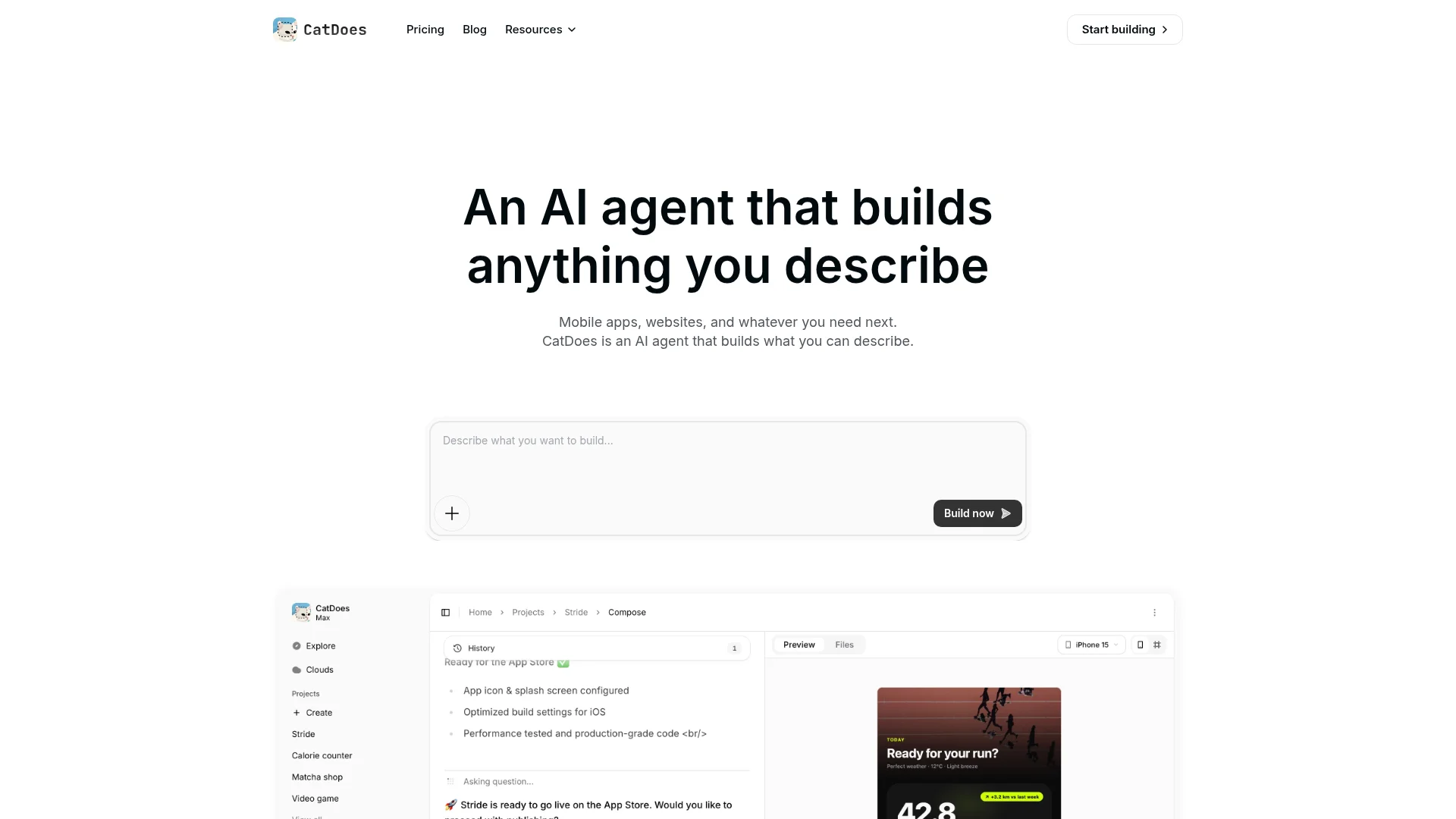
Every plan includes CatDoes Cloud, a built-in backend with database, authentication, storage, edge functions, and realtime, so a real app has its data and logins from day one. Developers can still bring a GitHub repo, export the code, and work with the underlying stack, but a non-technical founder can go from idea to a live, downloadable app without ever opening an editor. For the wider landscape, our guide to the best AI app builder options puts CatDoes in context.
CatDoes vs Replit: The Core Difference
The cleanest way to see it: Replit gives you a place to build and host software; CatDoes builds the app and ships it to the stores for you.
With Replit, you are in the driver's seat inside a cloud dev environment. The Agent accelerates the work, but you still choose deployment types, connect an Apple Developer account for mobile, and carry the app through store review. With CatDoes, the entire lifecycle (code, backend, deployment, and app-store submission) is the agent's job, and you steer it in plain English. One is a powerful platform for people who build; the other is an agent that hands you the finished result.
Feature Comparison
Here is how the two line up on the things that decide whether you actually end up with a shipped app.
Feature | CatDoes | Replit |
|---|---|---|
What it is | AI agent that builds & ships apps | Cloud IDE + AI dev platform |
Coding required | No | Optional, but developer-leaning |
Interface | Chat-driven agent | Full coding IDE plus Agent |
Builds native mobile apps | Yes, iOS & Android | iOS via Expo (Android unclear) |
Publishes to App Store / Google Play | Yes, done for you (both stores) | Guided submission, you run it |
Web deployment | Included, custom domains | Yes (Autoscale, Static, Reserved VM) |
Backend included | Yes (database, auth, storage, realtime) | Built-in database; you assemble the rest |
Pricing model | Fixed monthly credits | Monthly credits + pay-as-you-go overages |
Best for | Founders & non-devs shipping apps | Developers building web apps in the cloud |
Both tools give you access to strong models. Replit routes work through its Agent and Assistant and unlocks its most powerful models on higher tiers; CatDoes lets you switch between Low, Medium, High, and Max agent tiers so simple tasks stay cheap and hard ones get the deepest reasoning. The difference is not the model. It is everything wrapped around it.
Pricing: CatDoes vs Replit in 2026
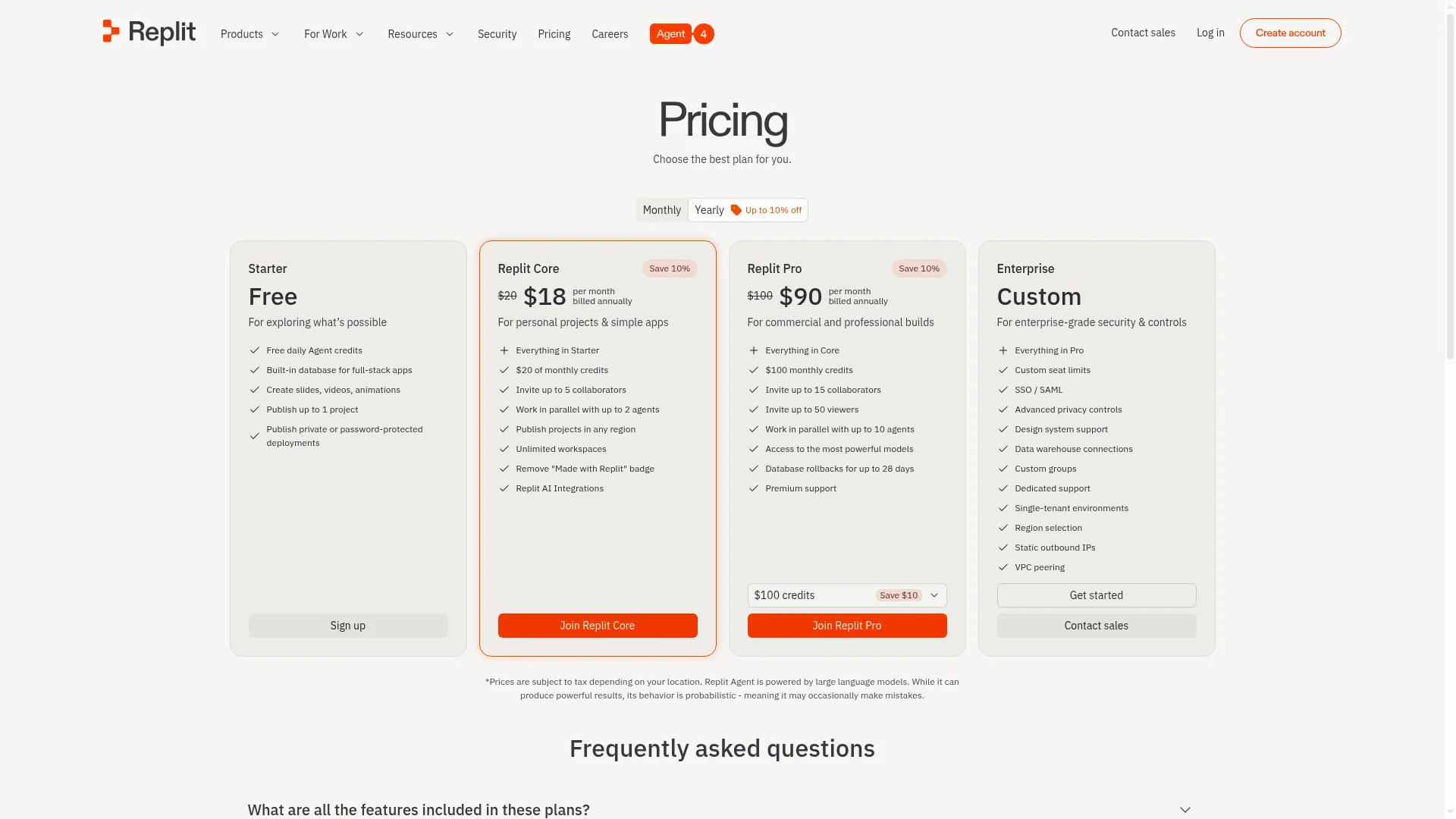
Replit uses a subscription plus a usage-based credit system. Each plan includes a pool of monthly credits, and once they run out, building switches to pay-as-you-go. Current plans, per the official pricing page:
Replit Plan | Price | What you get |
|---|---|---|
Starter (Free) | $0 | Free daily Agent credits, publish 1 project |
Core | $20/mo ($18 billed annually) | $20 monthly credits, 5 collaborators, 2 parallel agents |
Pro | $100/mo ($90 billed annually) | $100 monthly credits, 15 collaborators, 10 parallel agents |
Enterprise | Custom | SSO/SAML, single-tenant, advanced privacy |
CatDoes also uses credits, but each plan includes a fixed monthly allocation and every plan comes with CatDoes Cloud, the built-in backend.
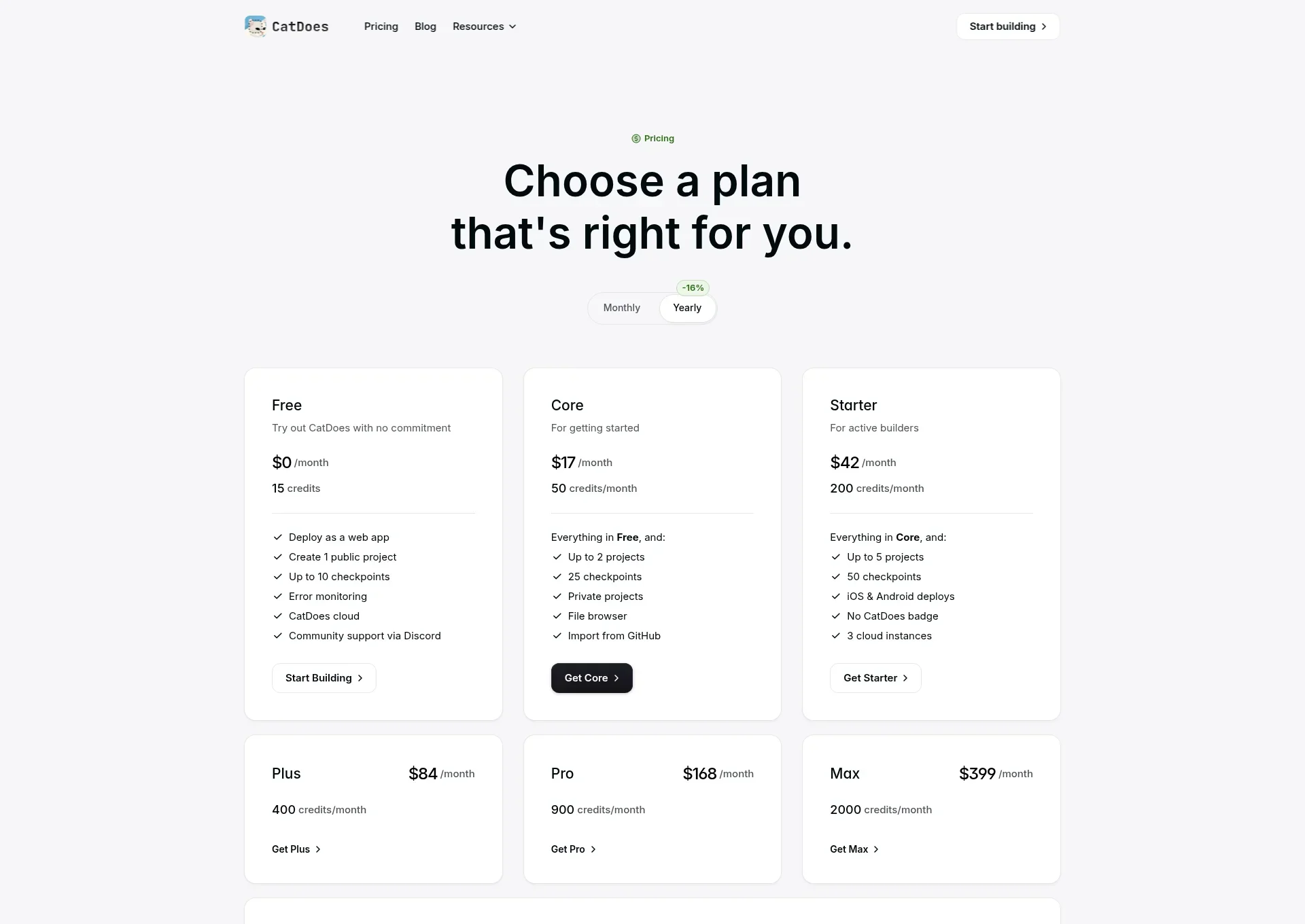
CatDoes Plan | Price | Credits/mo |
|---|---|---|
Free | $0 | 15 (one-time) |
Core | $20/mo | 50 |
Starter | $50/mo | 200 |
Plus | $100/mo | 400 |
Pro | $200/mo | 900 |
Max | $399/mo | 2,000 |
The entry price is nearly identical: both are free to start, and both charge $20 a month for their first paid tier. But you are buying different jobs. On Replit, that $20 buys AI inside a development platform you still operate, plus separate usage costs as you build. On CatDoes, it buys an agent that writes the code, hosts the backend, and pushes the app to the stores for you. The sticker prices look similar; the outcomes are not.
Can Replit Build Native iOS and Android Apps?
This is where the two separate most clearly, and it is more nuanced than a simple yes or no. Replit can now build a native mobile app. Its mobile page says Replit Agent turns plain language into a native iOS app using Expo and React Native, generating real code and previewing on a physical device through a QR code. That is real, and it is more than many AI coding tools offer.
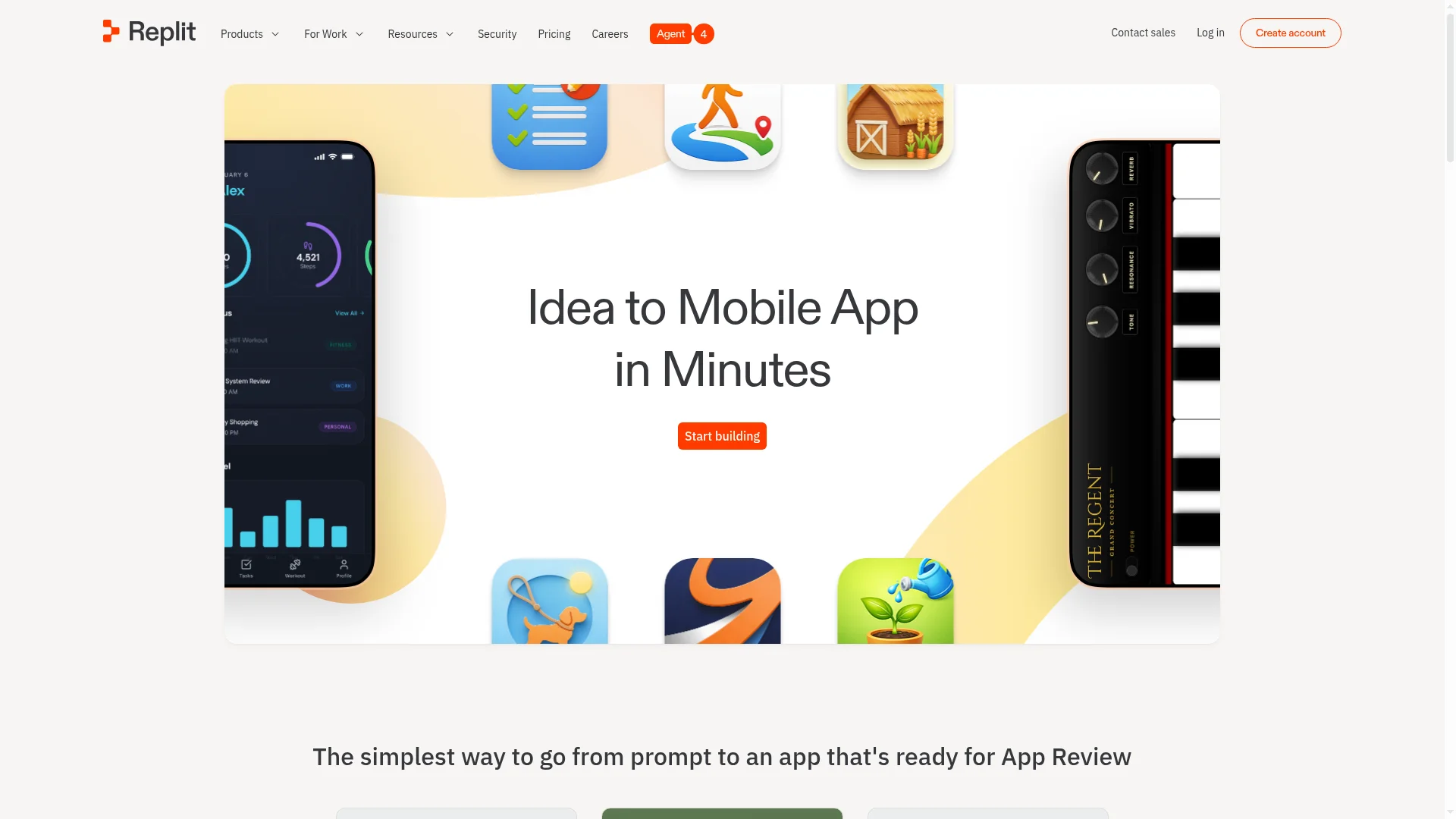
The gap is what happens next. Replit does not ship the app for you. In its own words, it "prepares your app and walks you through submission to the App Store," you need your own Apple Developer account, and the app goes through Apple's standard App Review before it is listed. Replit also states plainly that it "is not an app store and does not distribute apps directly to mobile devices." The native focus is iOS; Android is raised as an open question in Replit's own FAQ. So you get a native build, but you still own the Apple Developer account, the submission, and the store review.
CatDoes treats publishing as part of the job. The agent builds a cross-platform native app for both iOS and Android and ships it to the App Store and Google Play for you, then handles web deployment with custom domains on top, backend included. If you have ever fought through a first submission, our walkthrough on how to publish an app on Google Play shows how much that pipeline normally involves, and why removing it is the whole point. And if you already built something on Replit, our guide on converting a Replit web app into a native mobile app covers the exact path from URL or repo to a shipped app.
Watch the Usage: How Replit Credits Work
One thing worth understanding before you commit to Replit is how the credits behave. Each plan comes with a monthly credit pool ($20 on Core, $100 on Pro), and every Agent action, from writing a file to running a tool call, spends against it. A quick tweak might cost a few credits; scaffolding a full feature can cost many more.
When the pool runs dry, Replit switches to pay-as-you-go, and by default there is no spending cap. On Core, unused credits expire at the end of the cycle; on Pro, they roll over for one month. For a heavy building session, the real monthly cost can land well above the base plan price. It is not hidden, but it is worth budgeting for. CatDoes keeps this simpler: your plan's monthly credits are a fixed, predictable allocation, and Cloud is bundled in rather than metered separately.
Which One Should You Choose?
Choose Replit if: you are a developer, student, or technical builder who wants a full cloud development environment with AI, you are mainly shipping web apps, and you are comfortable owning deployments and, for mobile, your own Apple Developer account and submission. It is a genuinely strong platform for people who like being close to the code.
Choose CatDoes if: you are a founder, solo builder, or non-developer who wants a real app in the stores, not a coding environment. If your goal is a finished product on the App Store, Google Play, or the web, with the backend, deployment, and store submission handled for you, CatDoes is built for exactly that. Developers who just want the app shipped without babysitting the pipeline benefit too.
The two are less rivals than answers to different questions. "Where do I build and host my web app?" points to Replit. "How do I get my app built and launched in the stores?" points to CatDoes.
Frequently Asked Questions
Can Replit publish my app to the App Store? Not for you. Replit prepares the app and walks you through submission, but you need your own Apple Developer account and the app goes through Apple's standard App Review. CatDoes handles publishing to both the App Store and Google Play for you.
Does Replit build Android apps? Its native mobile path currently centers on iOS via Expo and React Native, and Android is listed as an open question in Replit's own FAQ. CatDoes builds a cross-platform native app for both iOS and Android from a single project.
Do I need to know how to code to use CatDoes? No. CatDoes is designed so a non-developer can describe an app in plain English and get a built, deployed result. Developers can go deeper with GitHub import and code export, but coding is optional.
Which is cheaper? Both start free, and both charge $20 a month for their first paid tier. The difference is the usage: Replit adds pay-as-you-go credit overages once your monthly pool runs out, while CatDoes plans include a fixed monthly credit allocation with the backend bundled in.
Can I use both? Yes. Some builders prototype and ship with CatDoes, then use a cloud IDE like Replit for deep, hands-on code changes on the exported repo.
Does Replit support React Native and Expo? Yes. Replit Agent generates native iOS apps with React Native and lets you preview them through Expo. CatDoes also builds cross-platform React Native apps, and on top of that ships them to the App Store and Google Play for you.
Is there a free Replit alternative? Yes. CatDoes has a free plan you can start on, and it builds and previews your app before you pay to publish. It is a genuine Replit alternative for people who want a finished app rather than a coding environment.
The Bottom Line
CatDoes vs Replit comes down to one question: do you want a place to build software, or a shipped app? Replit is a powerful browser-based development platform with an excellent AI Agent, strongest when you are building and hosting web apps and comfortable owning the release. CatDoes is the Replit alternative for people who want the app, not the codebase: an AI agent that turns plain-English ideas into real native mobile apps and websites, with backend, deployment, and app-store publishing included, without requiring you to code.
If your goal is a finished product on the App Store, Google Play, or the web, try CatDoes free and describe your first app. The agent takes it from there.
Nafis Amiri
Co-Founder of CatDoes