Blog
Insights
CatDoes vs Rork: Which One Ships Apps? (2026)
CatDoes vs Rork compared for 2026: real pricing, built-in backend, and app store publishing. See which AI app builder actually ships a real mobile app.

Nafis Amiri
Co-Founder of CatDoes
TL;DR: CatDoes and Rork both turn a plain-English prompt into a mobile app, but they stop at different finish lines. CatDoes is an AI agent that builds and ships the whole thing. It creates native mobile apps for the App Store and Google Play, plus real websites you can publish to up to 20 custom domains (a dashboard, an admin panel, and more), with a backend (CatDoes Cloud) included and store publishing handled for you. Rork is fast at spinning up a React Native prototype, but its native engine is iOS-only and you still wire up your own backend and run the store submission yourself. Want a quick prototype? Rork works. Want a finished, launched app and website without touching a build pipeline? CatDoes.
Comparing CatDoes vs Rork usually starts the same way: you typed "AI app builder" into a search bar, watched a demo, and landed on two tools that both promise to turn an idea into a mobile app just by chatting with AI. Both start at $20 a month. Both talk about the App Store. On the surface they look like the same product.
The problem shows up after the first prompt. One tool hands you a slick prototype and then leaves you to set up a database, connect authentication, generate a build, and fight through your first store submission on your own. The other treats all of that as its job. Pick wrong and you either burn a weekend learning Expo and Xcode, or you pay for features you didn't need. The gap between "AI wrote my app's code" and "AI launched my app" is exactly where these two split.
This guide breaks down what CatDoes and Rork each do, their real 2026 pricing, whether you can get a live app into the stores, and who should pick which. Every price comes from each company's current pricing page.
Table of Contents
What Is CatDoes?
What Is Rork?
The Core Difference: Build vs Ship
Feature Comparison
Pricing: CatDoes vs Rork in 2026
Can You Ship a Real Mobile App?
Rork Pro vs Rork Max: The iOS Split
Rork vs Replit, FlutterFlow, and Lovable
Which One Should You Choose?
Frequently Asked Questions
The Bottom Line
What Is CatDoes?
CatDoes is an AI agent that builds mobile apps and websites from natural language, then deploys them for you. You describe what you want; the agent runs in the cloud, spins up its own subagents, writes the code, and ships the result to the App Store, Google Play, or the web. It doesn't stop at native mobile apps. CatDoes also builds full websites and can publish them across up to 20 custom domains per project, so a marketing site, a dashboard, and an admin panel can all live under your own domains. There is no IDE to install and no code you are required to touch.
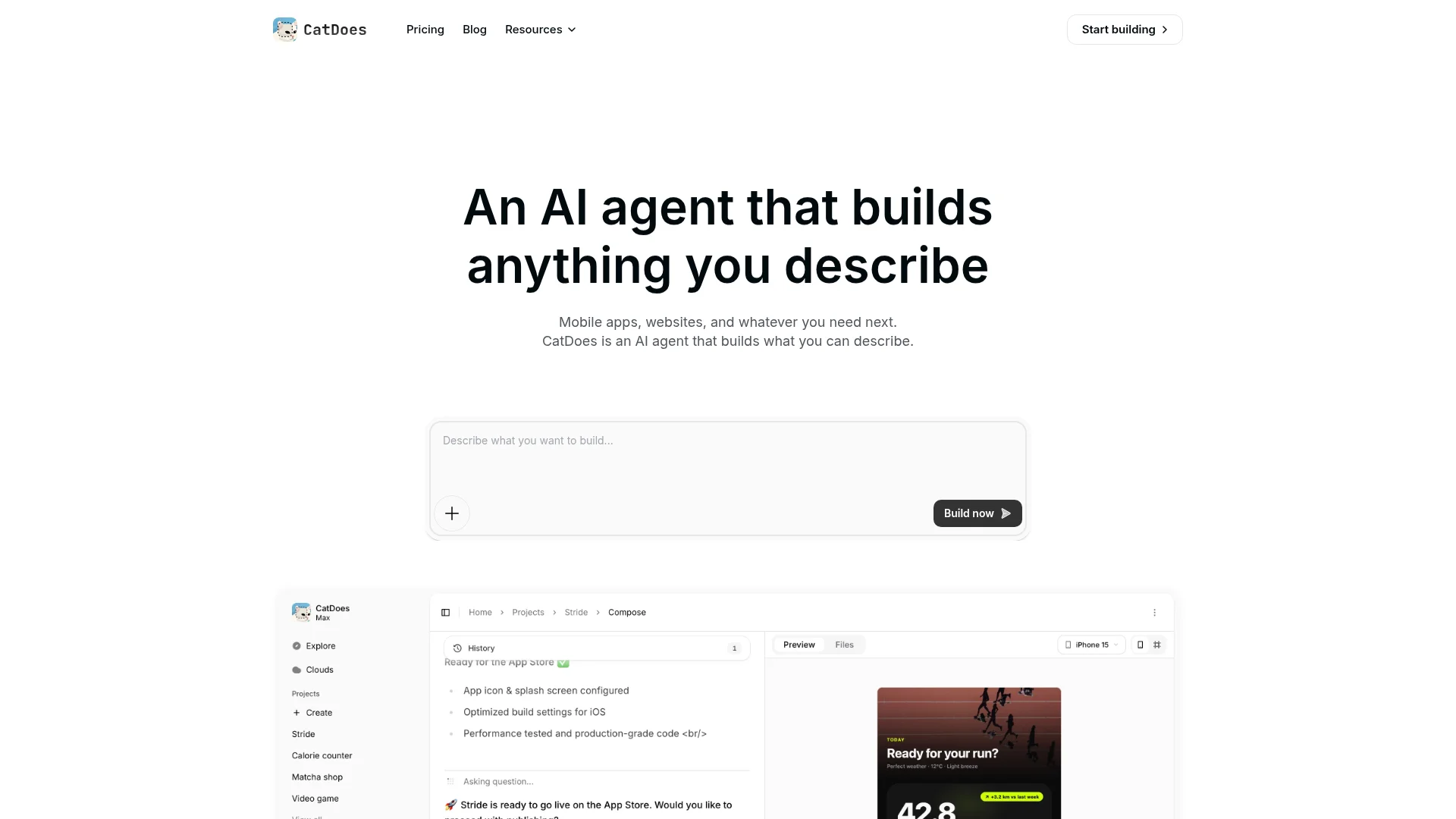
Every plan includes CatDoes Cloud, a built-in backend with database, authentication, storage, edge functions, and realtime. That matters because a real app is more than a screen: it needs data, logins, and a server. Developers can still bring a GitHub repo, export the code, and go deeper, but a non-technical founder can go from idea to a downloadable app, and a live website, without opening an editor. If you want the wider field, our guide to the best AI app builder tools puts CatDoes in context.
What Is Rork?
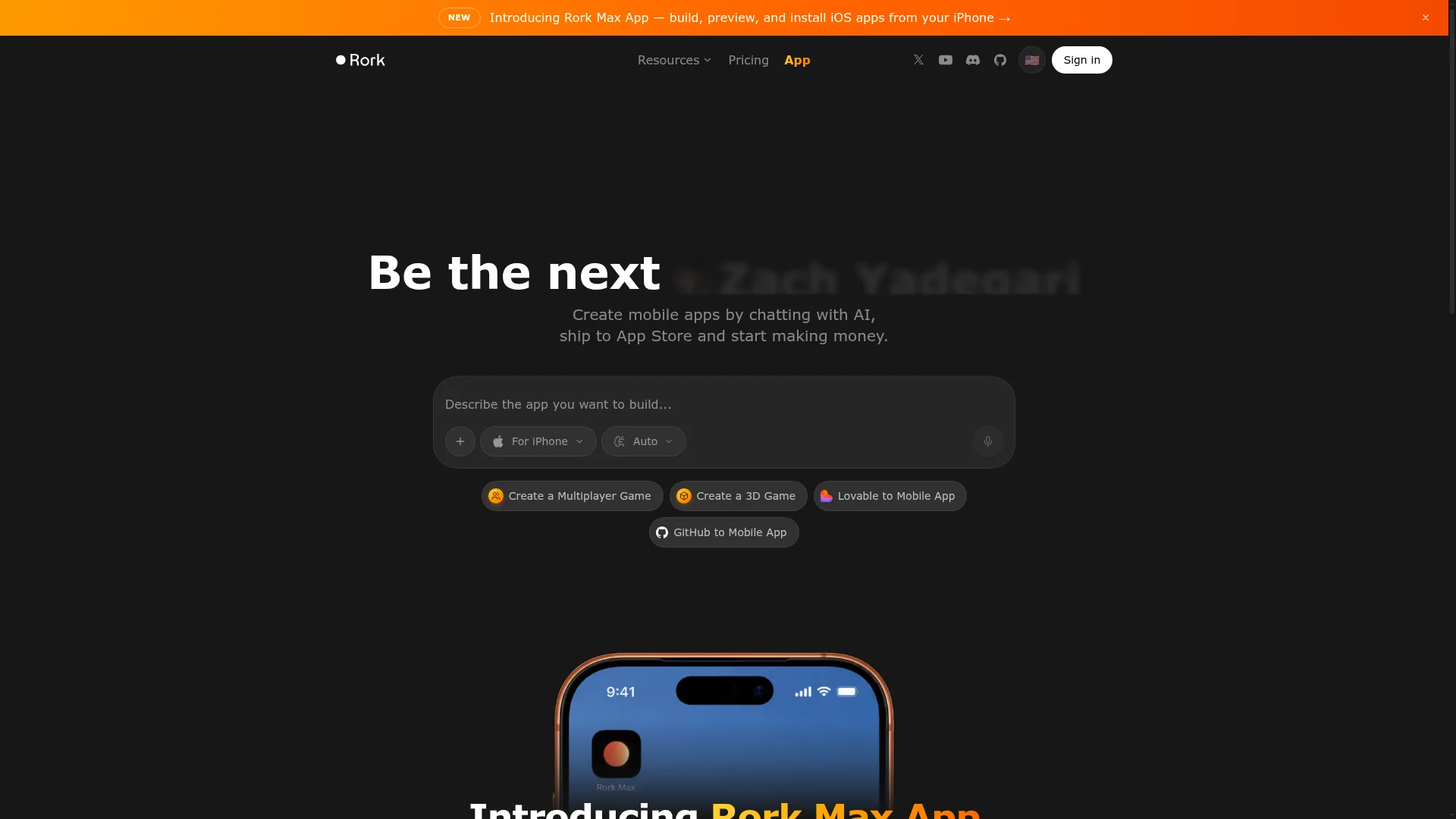
Rork is an AI mobile app builder. You describe an app in a chat box, and Rork generates a Native app, which you preview on your phone by scanning a QR code with Expo Go. Its tagline sums up the pitch: "Create mobile apps by chatting with AI, ship to App Store and start making money."
The Core Difference: Build vs Ship
The cleanest way to frame it: Rork builds you an app; CatDoes builds and ships one. Rork is excellent at the generation step, then hands the project back to you for the backend, the build, and the store submission. CatDoes treats the entire lifecycle (code, backend, deployment, and app-store publishing) as the agent's job. That generate-versus-ship line repeats elsewhere, and you can see it in CatDoes vs Emergent and CatDoes vs Windsurf.
That difference decides who each tool is for. Comfortable connecting Supabase, running Expo builds, and managing an Apple Developer account? Rork's speed is a real advantage. Just want a finished app in the stores and would rather never see a provisioning profile? The shipping half is the point of CatDoes.
Feature Comparison
Here is how the two line up on the things that decide whether you actually end up with a launched app.
Feature | CatDoes | Rork |
|---|---|---|
What it is | AI agent that builds & ships apps and websites | AI agent that builds apps |
Coding required | No | No |
Builds | iOS, Android, and web | iOS, Android |
Backend included | Yes, CatDoes Cloud on every plan | No |
App store publishing | Handled for you | You submit it yourself |
Websites + custom domains | Yes, up to 20 custom domains/project | Mobile-first; no custom domains |
Version history | Checkpoints (roll back anytime) | Not built in |
Free tier | 15 credits, backend included | 35 credits/mo, design mode only |
Starting paid price | $20/mo (Core) | $20/mo (Rork Pro) |
Both give you strong models: Rork lets you pick one or leave it on Auto, and CatDoes lets you switch between Low, Medium, High, and Max agent tiers so simple tasks stay cheap. The model isn't the real difference; everything wrapped around it is.
Pricing: CatDoes vs Rork in 2026
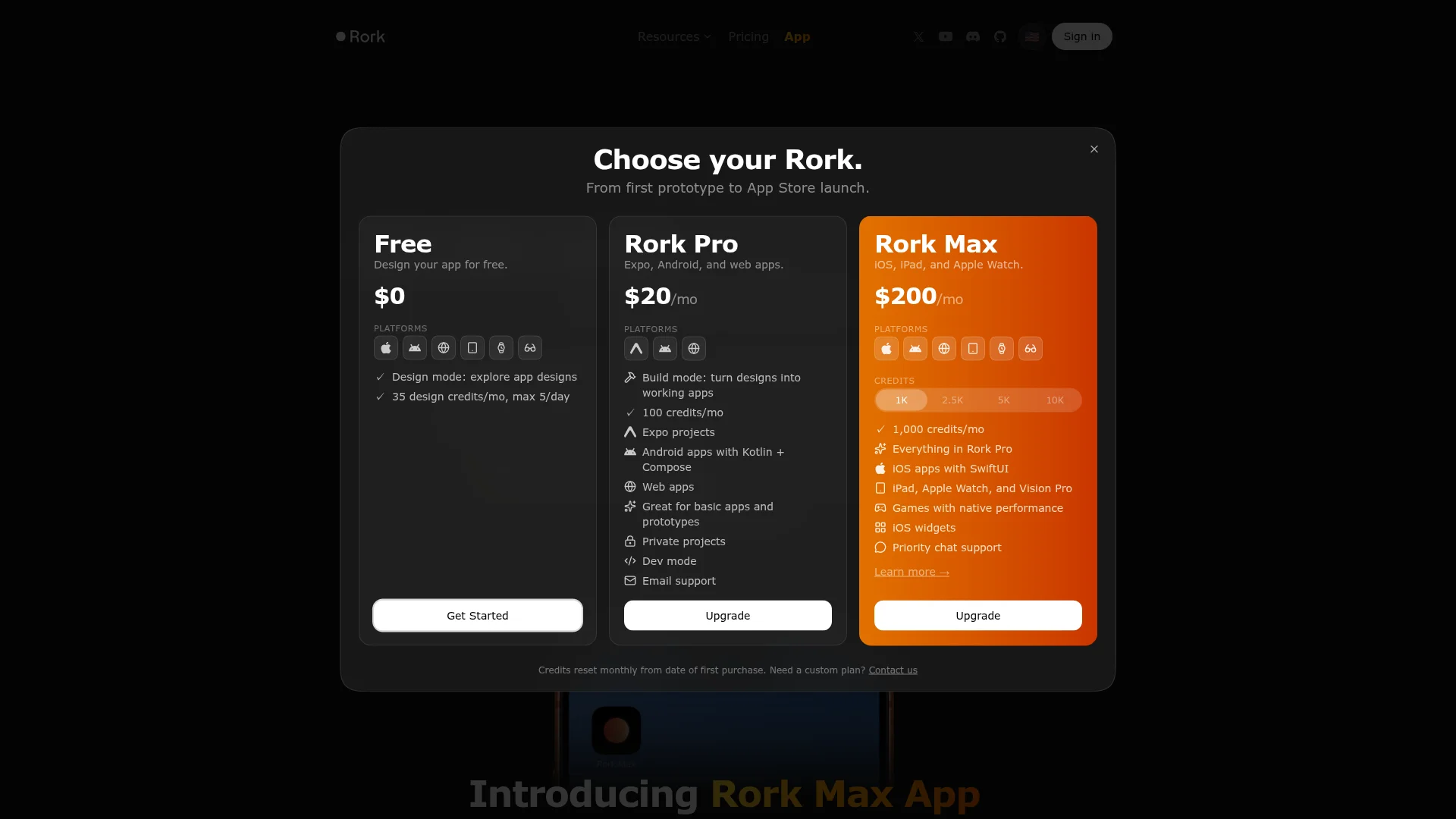
Both tools start free and both have a $20/mo entry plan, so the sticker prices look identical. What you get for the money is not. Here is Rork's current pricing, from its official pricing page:
Rork Plan | Price | What you get |
|---|---|---|
Free | $0 | 35 credits/mo (5/day), design mode only |
Rork Pro | $20/mo | 100 credits; Expo, Android & web; private projects |
Rork Max | From $200/mo | 1,000–10,000 credits; native iOS (SwiftUI), iPad, Apple Watch |
CatDoes uses a credit-based model where every plan, including Free, comes with CatDoes Cloud. The prices below are monthly; annual billing takes about 16% off, which is the lower number the screenshot shows.
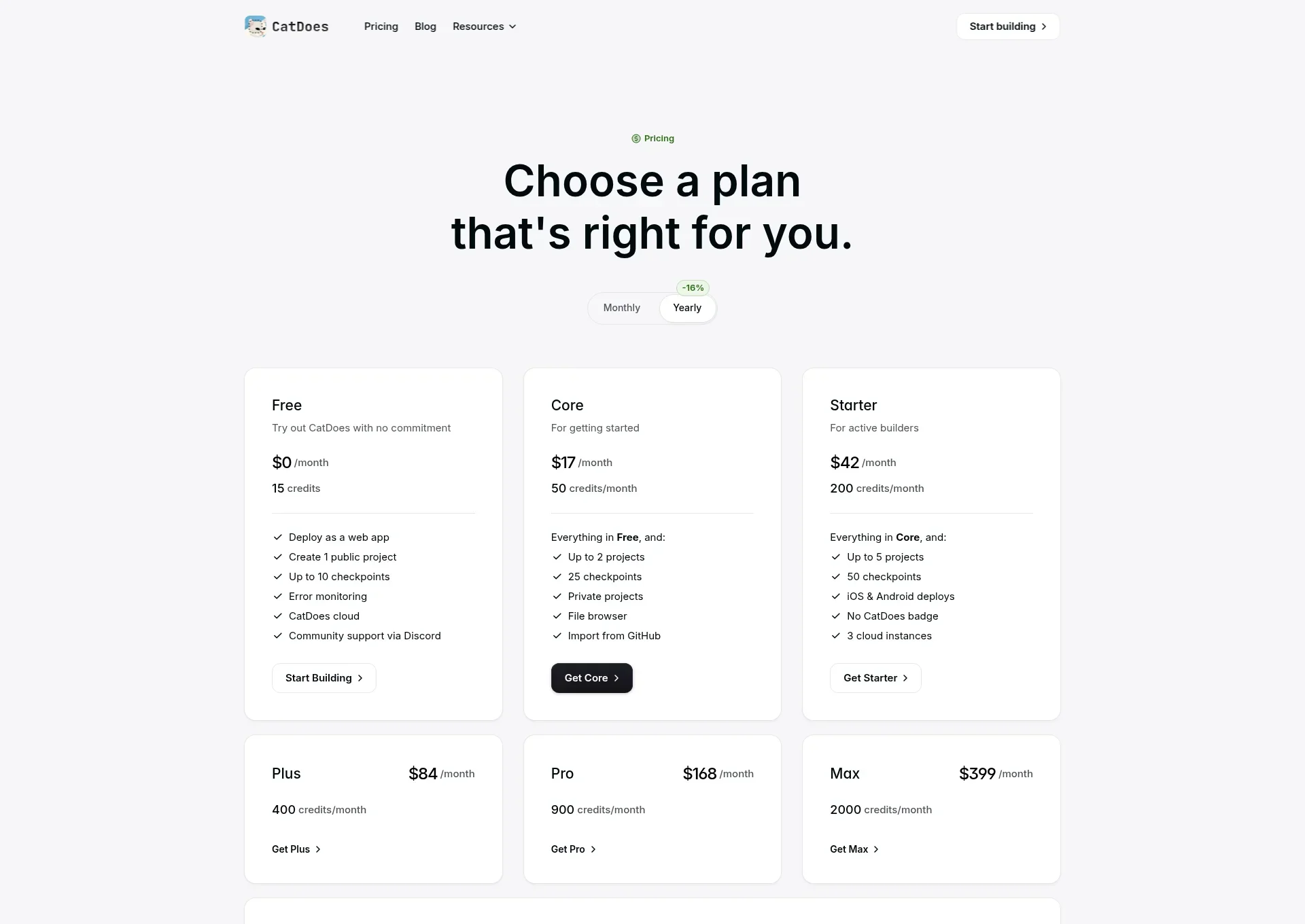
CatDoes Plan | Price | Credits/mo |
|---|---|---|
Free | $0 | 15 (one-time) |
Core | $20/mo | 50 |
Starter | $50/mo | 200 |
Plus | $100/mo | 400 |
Pro | $200/mo | 900 |
Max | $399/mo | 2,000 |
The $20 headline hides the real comparison. To publish native apps to the App Store and Google Play, CatDoes' store deploys begin on the Starter plan at $50/mo, backend included. Rork's $20 Pro plan builds React Native (Expo), Android, and web apps, while its native iOS engine, Rork Max, starts at $200/mo. Match the plan to the job you actually need done.
Can You Ship a Real Mobile App?
This is where the two separate most clearly. With Rork, you can absolutely generate a mobile app, and for a prototype you can preview it in minutes over Expo Go. Getting it into the stores is the manual part. Rork prepares the build and gives you guides, but you create your own Apple Developer account ($99/year) and Google Play account ($25 one-time), then run the submission: certificates, provisioning, a build upload, and store review. Rork generates the app; you own the release pipeline.
CatDoes treats publishing as part of the job. The agent builds the native app and handles submission to the App Store and Google Play for you, plus web deployment across up to 20 custom domains. You still need the developer accounts (Apple requires that of everyone), but you're not the one wrangling Xcode. If you've ever fought a first submission, our roundup of Rork alternatives covers how much that pipeline normally involves, and why removing it is the whole pitch.
Rork Pro vs Rork Max: The iOS Split
One quirk worth understanding before you commit to Rork: it's really two products under one name. The standard engine (Rork Pro, $20/mo) writes React Native via Expo and covers Android and web. Native iOS is a separate engine, Rork Max, that generates SwiftUI for iPhone, iPad, Apple Watch, and Vision Pro, and it starts at $200/mo. Rork even ships a companion "Rork Max" iPhone app to build and install iOS apps from your phone.
For an Apple-first builder who wants hand-written native Swift, Rork Max is a genuinely interesting option. But it ties your plan choice to your platform: cross-platform React Native on the cheap tier, native iOS only if you jump to the top one. CatDoes takes the other approach, shipping iOS and Android from a single React Native project, so the platform you target isn't a pricing decision. Its checkpoint system also lets you roll back a bad AI edit instead of prompting your way out of a mess.
Rork vs Replit, FlutterFlow, and Lovable
Rork rarely gets shortlisted on its own. If you're weighing it against the other tools people compare it to, here's the quick read, and where each leaves the same gap CatDoes fills:
Rork vs Replit: Replit is general-purpose (web, backend, and mobile from one browser IDE), so it's broader but less tuned for mobile. Rork is mobile-first; Replit is the Swiss Army knife.
Rork vs FlutterFlow: FlutterFlow is a visual, drag-and-drop builder on Flutter and Dart with Firebase for the backend, great for pixel control but slower and more manual. Rork is prompt-first and quicker to a prototype.
Rork vs Lovable: Lovable builds polished web apps (React) with Supabase, but not native mobile, so it won't put you in the App Store on its own. Our CatDoes vs Lovable breakdown covers that matchup.
The common thread: Replit spreads across everything, FlutterFlow asks for manual work, and Lovable stays on the web. CatDoes keeps Rork's prompt-to-mobile speed while adding a built-in backend, websites on custom domains, and hands-off App Store and Google Play submission.
Which One Should You Choose?
Choose Rork if: you want the fastest path from prompt to a previewable prototype, you're comfortable connecting your own backend and handling store submission, or you specifically want native SwiftUI iOS apps and don't mind the Rork Max tier. It's a fast, capable prototyping tool.
Choose CatDoes if: you want a finished, launched product rather than a codebase to complete yourself. If your goal is a real app on the App Store, Google Play, or a website on your own custom domains, with the backend and store submission handled and version history built in, CatDoes is built for exactly that. Developers who just want the app shipped without babysitting the pipeline benefit too, and can still export the code. You can try CatDoes free and describe your first app in a sentence.
Frequently Asked Questions
Is CatDoes a good Rork alternative? Yes. Both build React Native apps from plain-English prompts, so switching is straightforward. CatDoes adds a built-in backend, handles store submission for you, ships websites on custom domains, and includes checkpoints to undo a broken AI edit. Those are the exact gaps Rork users most often hit after the prototype stage.
Is Rork free? Rork has a free tier, but it's design mode only: 35 credits a month (capped at 5 a day) to explore app designs, with building working apps starting on Rork Pro at $20/mo. CatDoes's free tier includes 15 credits, a live web deploy, and CatDoes Cloud, so you can ship something functional without paying.
Does Rork publish my app to the App Store for me? Not on its own. Rork prepares the build and provides guides, but you supply your Apple Developer and Google Play accounts and run the submission yourself. CatDoes handles the store submission pipeline for you.
Do I need to know how to code to use either one? No. Both are built for non-developers to describe an app in plain English and get working software. CatDoes lets developers go further with GitHub import and code export, but coding is optional on both.
Does Rork include a backend? Rork is rolling out Rork Cloud, a built-in backend, but it's still in beta; historically Rork apps connect a third-party service like Supabase or Firebase. CatDoes Cloud (database, auth, storage, functions, realtime) is included and production-ready on every CatDoes plan.
Which is cheaper? Both start free and both have a $20/mo plan, but they price different jobs. Rork's $20 Pro builds React Native, Android, and web apps and expects you to add a backend and handle publishing. CatDoes bundles the backend on every plan and adds store deploys from the $50 Starter tier. Compare the plan that matches what you need to ship, not just the entry price.
The Bottom Line
CatDoes vs Rork comes down to one question: do you want a fast prototype, or a launched product? Rork is a quick, capable way to turn a prompt into a React Native app, but it leans iOS-first for native and leaves you to add the backend and run the store submission yourself. CatDoes is an AI agent that turns a plain-English idea into a real, launched mobile app on the App Store and Google Play, plus full websites on up to 20 custom domains, with the backend, deployment, and app-store publishing included and no coding required.
If your goal is a finished product on the App Store, Google Play, or the web, try CatDoes free and describe your first app. The agent takes it from there.
Nafis Amiri
Co-Founder of CatDoes


