Blog
Insights
CatDoes vs Emergent: Which One Ships Apps? (2026)
CatDoes vs Emergent compared for 2026: pricing, credits, features, and native app-store publishing. See which AI app builder actually ships real apps.

Nafis Amiri
Co-Founder of CatDoes

TL;DR: The short version of CatDoes vs Emergent: both are AI agents that build full-stack apps from a plain-English prompt, no coding required. The difference shows up at the finish line. Emergent builds web and mobile apps and hands you export-ready builds, which means you still open an Apple or Google developer account and submit to the stores yourself. CatDoes builds the app and ships it to the App Store, Google Play, and the web for you, backend included. If you want a builder that stops at the build, pick Emergent. If you want the app actually live in the stores, pick CatDoes.
You want an app, and you would rather describe it than code it. Search for a tool and you land on two AI app builders that sound almost identical: both promise full-stack apps from a prompt, both start free, and both add a $20 tier. On the surface, Emergent and CatDoes look like the same product.
The gap hides in the last mile. Building a working app is one thing; getting it live on the App Store and Google Play is another, with code signing, developer accounts, provisioning profiles, store listings, and review. That last mile is where CatDoes vs Emergent really gets decided. This guide breaks down what each one builds, their real 2026 pricing, how credits work, and the one question that settles most of it: who actually ships your app to the store?
Table of Contents
What Is Emergent?
What Is CatDoes?
CatDoes vs Emergent: The Core Difference
Feature Comparison
Pricing: CatDoes vs Emergent in 2026
Can You Publish to the App Store and Google Play?
The Credit Question: Budgeting Either Tool
Which One Should You Choose?
Frequently Asked Questions
The Bottom Line
What Is Emergent?
Emergent is an agentic AI app builder from a Y Combinator-backed team. You describe an idea in plain English and its AI agents plan, build, test, and deploy a full-stack app, with no IDE and no local setup. It builds websites, mobile apps for iOS and Android, and progressive web apps, and it leans into "vibe coding": you prompt, and the agent writes and wires up the code. If that approach is new to you, here is our primer on how to vibe code a mobile app.
Under the hood it is genuinely full-stack: the agent generates a frontend, a backend, and a database, adds authentication, and offers one-click hosting to a live URL. The Standard plan and up add GitHub integration, private project hosting, the ability to fork tasks, and the option to buy extra credits when you run low. It is a capable builder aimed at first-time builders and creators who want a working product fast.
What Is CatDoes?
CatDoes is an AI agent that builds mobile apps and websites from natural language. You describe what you want; the agent runs in the cloud, spins up its own subagents, writes the code, and ships the result to the App Store, Google Play, or the web with a custom domain. There is no IDE to install and no code you are required to touch.
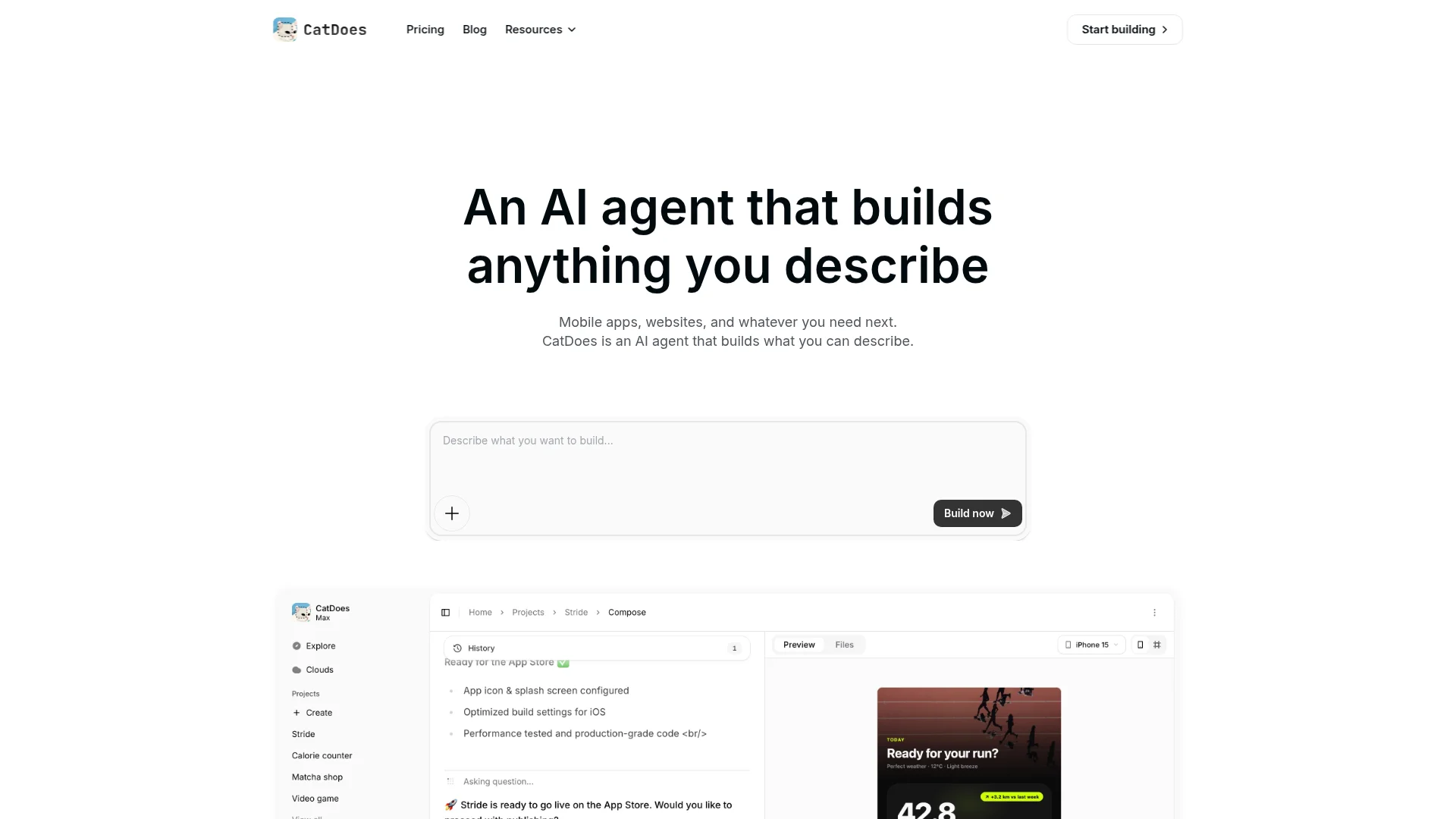
Every plan includes CatDoes Cloud, a built-in backend with database, authentication, storage, edge functions, and realtime, because a real app needs data, logins, and a server, not just screens. Developers can bring a GitHub repo, export the code, and work with the stack directly, while non-technical founders can go from idea to a live, downloadable app without opening an editor, the real promise of no-code mobile app development. For the wider landscape, our guide to the best AI app builder options puts CatDoes in context.
CatDoes vs Emergent: The Core Difference
Here is the cleanest way to frame it: Emergent builds you an app, and CatDoes builds and ships one. Both are no-code, cloud-based, full-stack agents, and that part is genuinely similar. The split is what happens after the build is done.
Emergent finishes with export-ready builds: working web and mobile apps you can download and take to the stores yourself. CatDoes treats store submission as part of the agent's job. It builds the native app and publishes it to the App Store and Google Play for you, then handles web deployment with a custom domain on top. One hands you the package; the other mails it. Bolt.new draws the line in yet another place, as we cover in CatDoes vs Bolt.new.
Feature Comparison
Here is how the two line up on the things that decide whether you end up with a shipped app.
Feature | CatDoes | Emergent |
|---|---|---|
What it is | AI agent that builds & ships apps | Agentic AI app builder ("vibe coding") |
Coding required | No | No |
Runs in | The cloud (browser) | The cloud (browser) |
Builds web apps | Yes | Yes |
Builds mobile apps | Yes, natively | Yes (iOS & Android) |
Publishes to App Store / Google Play | Yes, handled for you | Export-ready builds (you submit) |
Web deployment | Included, custom domains | Included, custom domains |
Backend included | Yes (CatDoes Cloud: DB, auth, storage) | Yes (full-stack) |
GitHub / code export | Yes (import & export) | Yes (GitHub integration) |
Best for | Founders shipping apps to the stores | Builders who want a full-stack app fast |
The similarities are real: both are prompt-driven, both are full-stack, and both let you export the code. The row that matters most is store publishing, and it is the one where they part ways.
Pricing: CatDoes vs Emergent in 2026
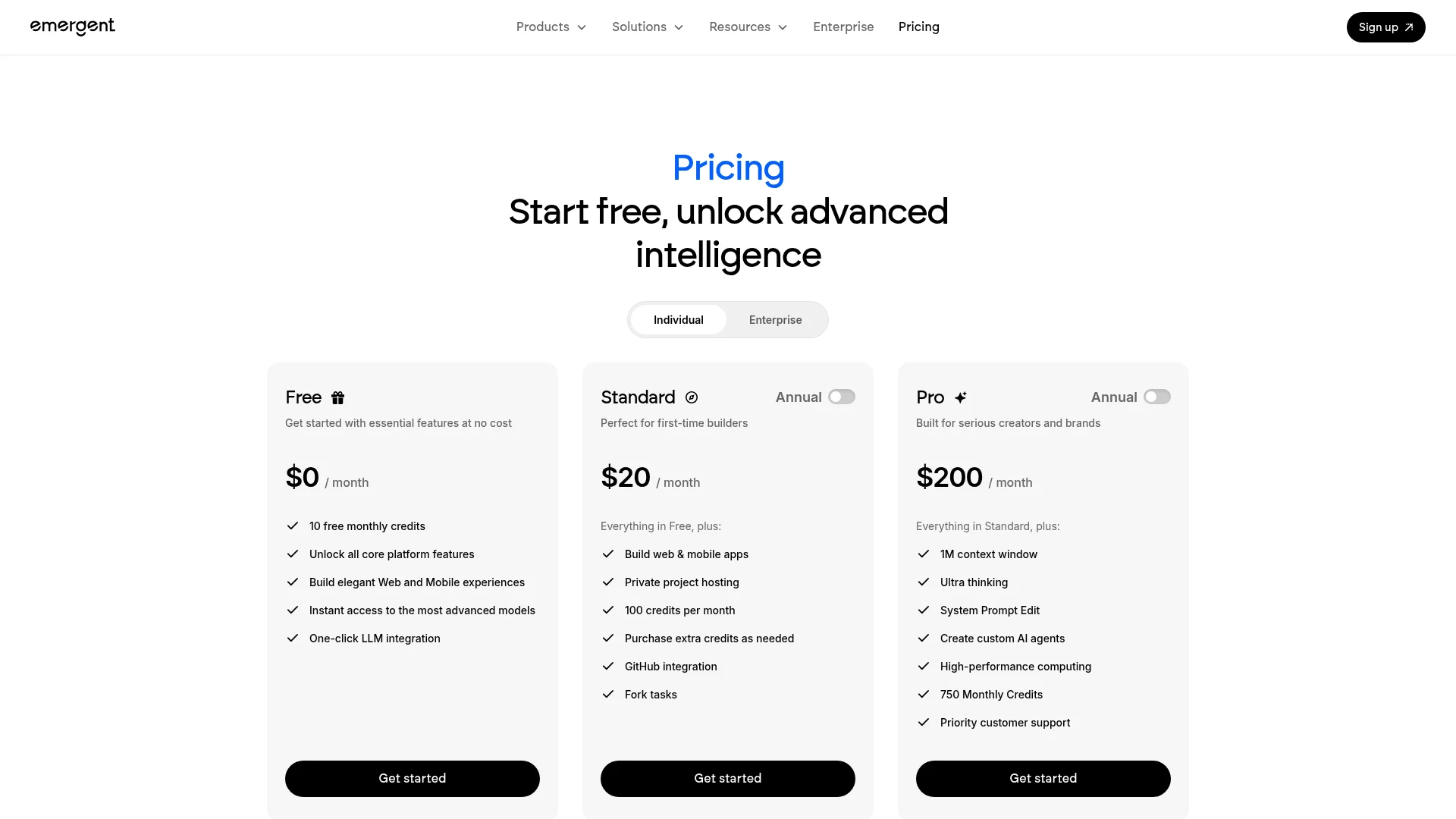
Emergent runs on a credit-based model where every AI action draws down a monthly credit balance. Current plans, from its pricing page:
Emergent Plan | Price | Credits/mo |
|---|---|---|
Free | $0 | 10 |
Standard | $20/mo | 100 |
Pro | $200/mo | 750 |
Business | Custom | Contact sales |
Enterprise | Custom | Contact sales |
CatDoes also uses monthly credits, and every plan comes with CatDoes Cloud:
CatDoes Plan | Price | Credits/mo |
|---|---|---|
Free | $0 | 15 (one-time) |
Core | $20/mo | 50 |
Starter | $50/mo | 200 |
Plus | $100/mo | 400 |
Pro | $200/mo | 900 |
Max | $399/mo | 2,000 |
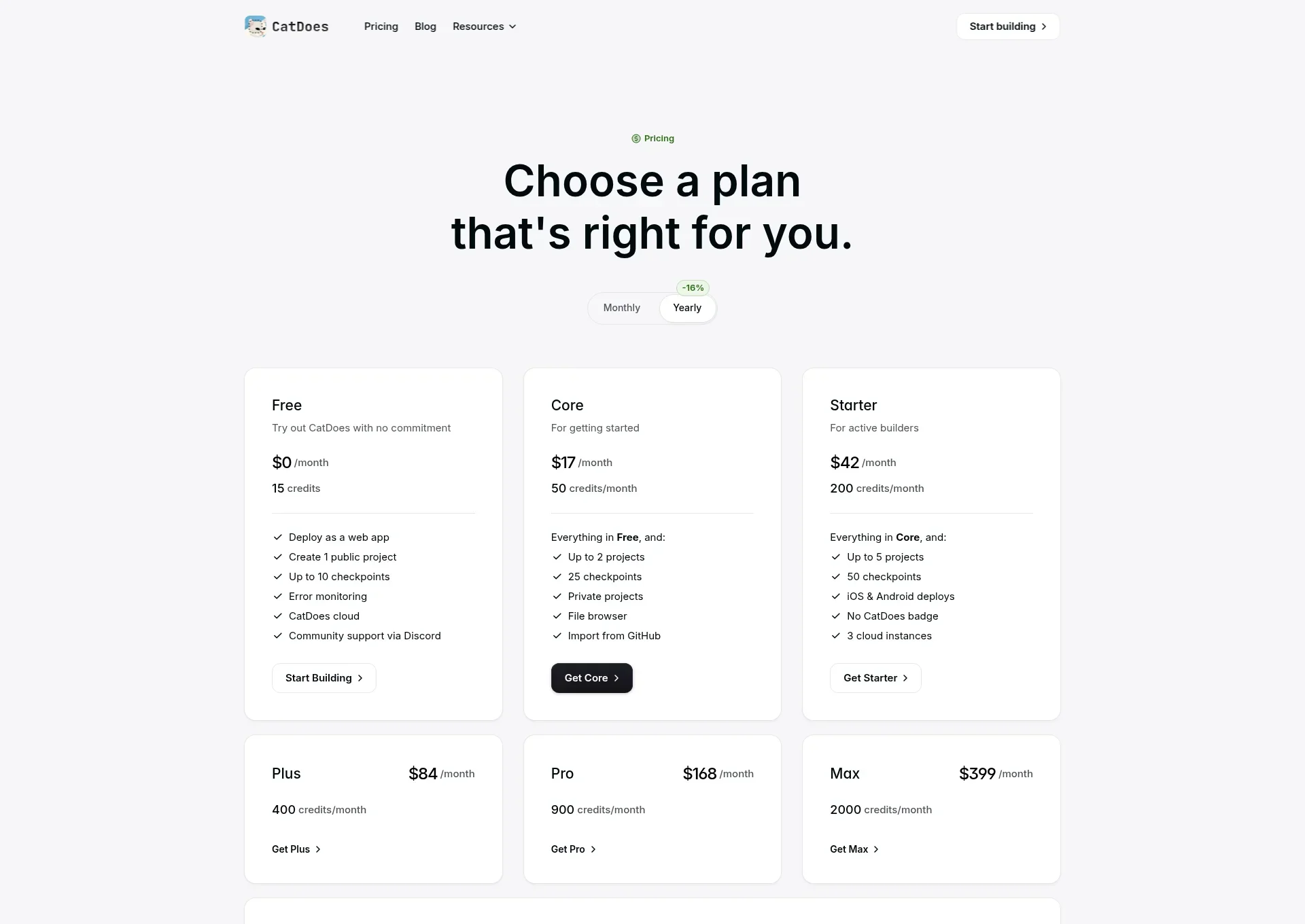
Both start free and both have a $20 tier, so the entry point looks the same. The credit counts are not directly comparable, though: a credit buys a different amount of work in each tool, and neither company publishes a fixed dollar value you can map one-to-one. What you can compare is structure and what is included. Emergent jumps from $20 straight to $200, with custom Business and Enterprise plans above that. CatDoes runs a six-step ladder ($20, $50, $100, $200, $399), so you can scale spend in smaller increments as a project grows. Both discount annual billing (Emergent by roughly 15%, CatDoes by about 16%, as the screenshots show), and CatDoes bundles its cloud backend and store publishing into every tier.
Can You Publish to the App Store and Google Play?
This is the question that separates the two most clearly. Both build mobile apps. Only one publishes them.
Emergent produces what it calls export-ready builds, ready in its own words for "seamless App Store publishing" and "Google Play Store submission." Read that carefully: export-ready means the app is packaged and ready for you to submit. You still need an Apple Developer Program account and a Google Play Console account, code signing and provisioning, and a store listing with screenshots and privacy details, and you still sit through Apple's App Store review and Google Play's. If you have shipped a native app before, you know that pipeline, often run through Expo EAS Submit, is where the days go.
CatDoes closes that last mile. The agent builds the native app and submits it to the App Store and Google Play for you, then deploys the web version with a custom domain. Our walkthrough on how to publish an app to the App Store and Google Play shows how much that process normally involves, and why handing it to an agent is the whole point.
The Credit Question: Budgeting Either Tool
Both tools run on credits, and credits get consumed as the agent works: planning, building, testing, and fixing. On Emergent, every AI action draws down your monthly balance, and Standard users and up can buy more as they go. Emergent does not publish a fixed dollar value per credit, so the practical advice is to watch your balance while you build and top up before you run dry.
CatDoes allocates credits monthly across its plan ladder and lets you pick from four agent tiers (Low, Medium, High, and Max), so routine tasks run on a cheaper tier and you save the top tiers for the hard problems. Either way, the honest expectation with any agentic builder is the same: iteration costs credits, so scope your first build, review each step, and expect a complex app to cost more than a simple one.
Which One Should You Choose?
Choose Emergent if: you want a fast full-stack build from a prompt and you are comfortable taking export-ready builds to the App Store and Google Play yourself. If you like buying credits as you go and do not mind owning the submission process, it is a strong, flexible builder.
Choose CatDoes if: you want the app actually live in the stores without touching Xcode or a developer dashboard, with the backend (CatDoes Cloud) and web deployment handled for you. If you are a founder, solo builder, or non-developer whose goal is a finished, downloadable product rather than a codebase, CatDoes is built for exactly that.
The deciding question is simple: do you want to stop at a build, or end up in the store? "Give me a working app" points to Emergent. "Get my app published" points to CatDoes.
Frequently Asked Questions
Does Emergent build native mobile apps? Yes. Emergent builds mobile apps for iOS and Android alongside websites and progressive web apps. The catch is what comes next: it produces export-ready builds you submit to the stores yourself, while CatDoes builds the native app and handles App Store and Google Play submission for you.
Can Emergent publish my app to the App Store? Not for you. Emergent hands you export-ready builds, and you submit them yourself with an Apple or Google developer account, code signing, and store review. CatDoes handles store submission for you.
How do I publish an app to the App Store without coding? Use a no-code agent that owns the whole pipeline. CatDoes builds your native app from a prompt and submits it to the App Store and Google Play for you, including the build, signing, and store listing, so you never touch Xcode or a developer dashboard.
Do I need to know how to code to use either one? No. Both are no-code, prompt-driven agents. CatDoes adds GitHub import and code export for developers who want to go deeper, but coding is optional in both.
Does Emergent include a backend? Yes. Emergent builds full-stack apps with a frontend, backend, and database. CatDoes bundles CatDoes Cloud (database, authentication, storage, edge functions, and realtime) on every plan.
Which is cheaper? Both start free and both have a $20 tier. The credit amounts differ (Emergent's Standard includes 100 credits, CatDoes' Core includes 50), but credits do different amounts of work in each tool, so the raw numbers are not directly comparable. Compare what each tier includes instead.
Is there a free Emergent alternative? Yes. CatDoes has a free tier that lets you build and deploy a web app at no cost, with CatDoes Cloud included, so you can try the full build-and-ship flow before paying. Emergent also offers a free plan with 10 monthly credits.
Can I use both? Sure. You could prototype in one and export the code to keep building elsewhere, since both offer code export and GitHub integration.
The Bottom Line
CatDoes vs Emergent comes down to the last mile. Both are no-code, full-stack AI agents that turn a prompt into a working web or mobile app. Emergent stops at export-ready builds you take to the stores yourself. CatDoes builds the app and ships it, to the App Store, Google Play, and the web, backend included, without asking you to code or open a developer console.
If your goal is a finished product actually live in the stores, try CatDoes free and describe your first app. The agent takes it from there.
Nafis Amiri
Co-Founder of CatDoes