Blog
Insights
Website to App Cost Breakdown 2026
Website to app cost in 2026, ranked by real 3-year totals. An AI builder reaches both app stores for $2,122, a wrapper $3,886, an agency $4,222 and up. Compare.

Nafis Amiri
Co-Founder of CatDoes

Key takeaways
The cheapest route from website to app that actually reaches both stores is an AI app builder at about $2,122 over three years. The nearest WebView wrapper costs $3,886 and the cheapest agency rebuild starts around $4,222.
Every path pays Apple the same $99 per year and Google the same $25 once. That is $124 in year one and $322 across three years. Nothing else about your website to app cost is fixed.
Cheap wrapper tiers are Android-only. AppMySite's iOS support starts on its $129 per month Pro plan, which is where most published wrapper comparisons quietly go wrong.
Apple rejected 2,093,244 of 9,100,620 app submissions in 2025. Design issues, the category that covers minimum functionality, accounted for 415,532 of them, and that is the guideline WebView shells run into.
Maintenance adds 15% to 20% of your build cost every year and is the line item people forget. A $3,000 agency conversion is a $4,222 decision, not a $3,000 one.
A progressive web app is the only near-free option, but it never reaches the App Store. If store presence is the point, it is not on your shortlist.
Table of Contents
What you actually pay for
The fees you cannot avoid
How we ranked these four methods
Method 1: An AI app builder
Method 2: A WebView wrapper subscription
Method 3: An agency or freelance rebuild
Method 4: A progressive web app
Website to app cost compared over three years
The costs most people forget to budget
How to pick the cheapest path that still ships
Frequently asked questions
The number that actually matters
Ask five vendors what your website to app cost will be and you will get five numbers between $0 and $50,000. None of them are lying. They are quoting different products, and the quote almost never includes the parts that bill you later.
This breakdown separates the fees everyone pays from the ones that depend on which path you pick, then ranks the four methods by what they cost over three years rather than one. Three years is the honest window, because that is where subscription pricing and maintenance quietly overtake a one-time build.
What you actually pay for
Turning a website into an app is not one purchase. It is four separate cost buckets, and most quotes only cover the second one.
Store fees go to Apple and Google. They are fixed, unavoidable, and identical no matter how you build. Build cost is the conversion itself, whether that is a subscription, an agency invoice, or your own time. Running cost covers hosting, push notification delivery, and analytics. Maintenance is the annual work to keep the app alive through OS updates and store policy changes.
The trap is that vendors compete on bucket two and stay quiet about bucket four. A $3,000 agency conversion with 20% annual maintenance is a $4,200 build-and-upkeep bill by year three, before store fees, not a $3,000 one.
The fees you cannot avoid
Two line items are the same for everyone. The Apple Developer Program costs $99 per membership year, covers unlimited apps under one account, and renews annually. Let it lapse and your apps come off the store.
Google Play Console charges a US$25 one-time registration fee, with no annual renewal. Prepaid cards are not accepted, and the fee is non-refundable.
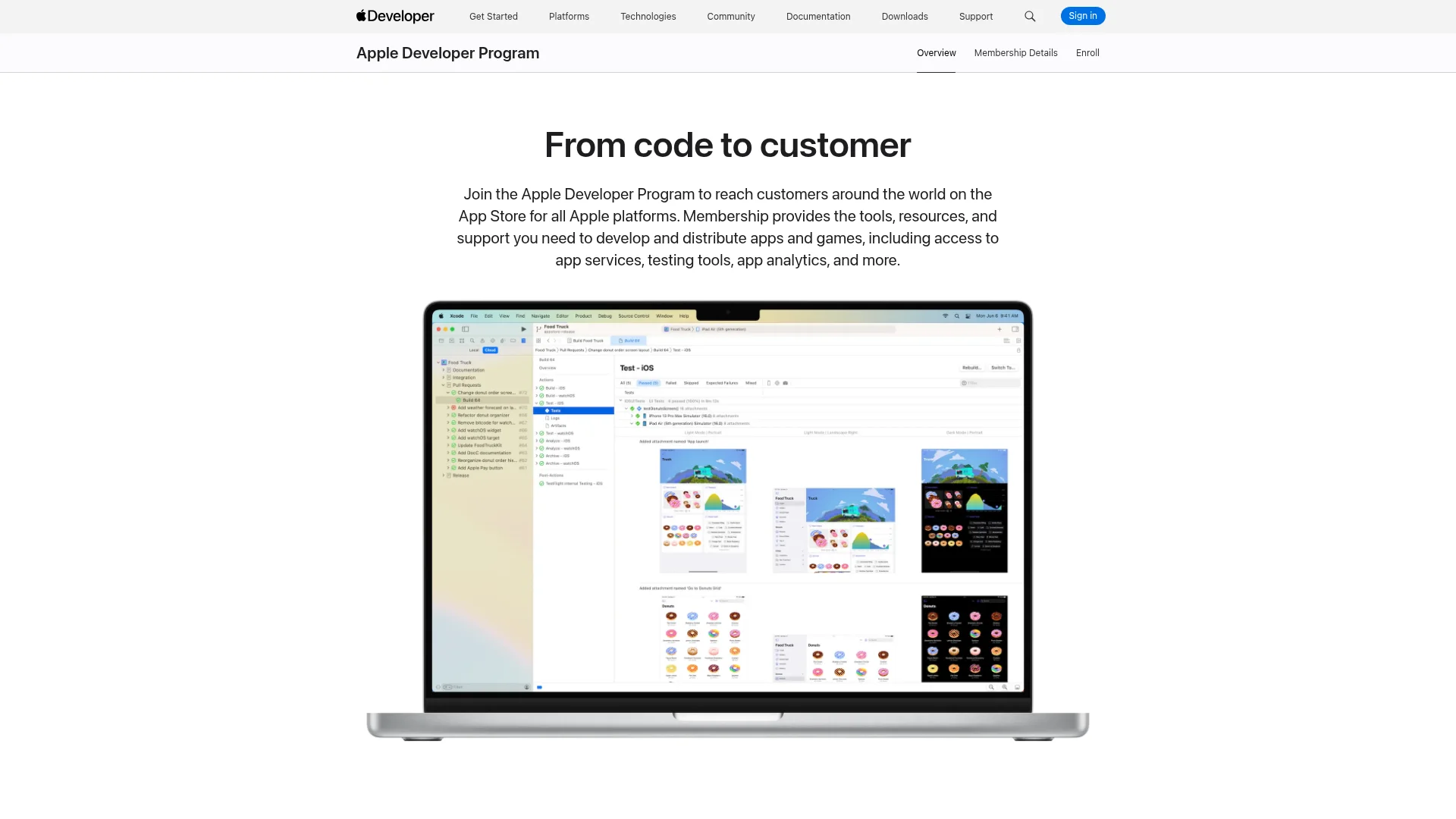
That means shipping to both stores costs $124 in year one and $322 across three years. Every quote you receive sits on top of that number.
One gotcha for solo founders: a personal Google Play account created after November 13, 2023 has to run a closed test with at least 12 testers before it can apply for production access. That costs nothing in dollars and roughly two weeks in calendar time.
How we ranked these four methods
The methods below are ordered by three-year total cost to publish to both the App Store and Google Play, cheapest first. Ranking by month-one price produces a different and misleading answer. Two rules keep the comparison honest:
Same destination. A method only competes if it reaches both stores. Android-only tiers are not cheaper options, they are different products, so they are scored separately.
Same window. Every figure covers three years and includes the $322 in store fees. Agency rows add maintenance at 15% to 20% of build cost in years two and three, not year one, since year one is the build itself.
That is why the progressive web app finishes fourth despite being the cheapest thing on the page. It costs almost nothing and it never reaches the App Store.
Method 1: An AI app builder
An AI app builder is the cheapest way to get a website into both app stores, at roughly $2,122 over three years. You describe the app or point the tool at your existing site, and it generates a native codebase rather than a shell around a URL.
On CatDoes, the Free plan covers web deployment, and App Store and Google Play deployment starts on the Starter plan at $50 per month. Over three years that is $1,800 in subscription plus $322 in store fees, so about $2,122 total. Year one comes to $724.
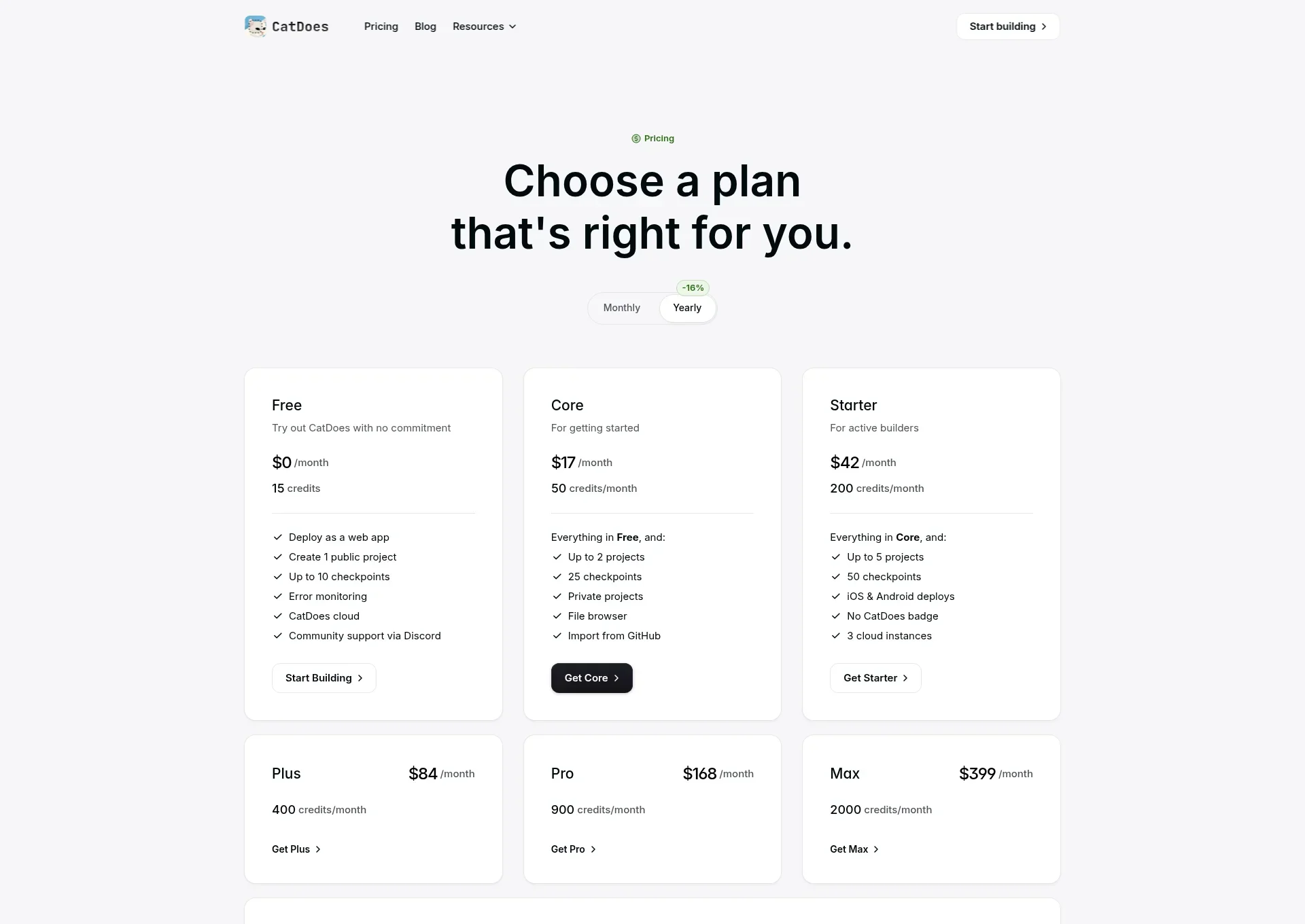
Line that up against the other paths that also reach both stores and the gap is concrete. It is $1,764 cheaper than the cheapest wrapper tier with iOS support, and $2,100 cheaper than the bottom of the agency range.
Price is only half of it. The other half is what gets submitted to review. A generated native app uses real navigation, offline behavior, and device APIs, which is exactly what Guideline 4.2 asks for. A WebView shell has to argue its way past that guideline on every submission, and design issues produced 415,532 rejections in 2025.
Two tier details before you budget. Code export and GitHub sync start on the Plus plan at $100 per month, not Starter, so if taking the source code with you matters, price the comparison at $3,922 over three years. And credits are metered per plan, so a month of heavy iteration draws down faster than a month of small edits.
The honest limitation is that this is still a subscription, not the same as owning an agency-built codebase outright. The difference from a wrapper is that ownership is purchasable on the Plus plan, and what you export is native rather than a browser window.
Three-year cost: about $2,122 on the cheapest plan that reaches both stores, or $3,922 with code export.
Method 2: A WebView wrapper subscription
A wrapper loads your website inside a native shell. You get a store listing, an icon, and usually push notifications, without changing your site. The cheapest tier that reaches iOS costs $3,886 over three years.
Pricing is public and easy to verify. AppMySite charges $69 per month for Starter, $129 for Pro, and $249 for Premium, dropping to $49, $99, and $199 per month on annual billing. Lifetime licenses run $1,999, $2,999, and $5,999.
Read the tier list carefully, because this is where most wrapper comparisons mislead. Starter covers one Android app. iOS support does not appear until Pro. If you want to be on the App Store, your real entry price is $129 per month, or $99 on annual billing, not the $69 headline. Other wrappers meter differently. webtoapp.design bills by monthly active users across tiers of 250, 2,500, 25,000, and unlimited, with push notifications capped at 0, 5, and 100 per month on the lower plans. MobiLoud quotes per customer rather than publishing a flat rate, so budget a call rather than a number.
Two things matter more than the sticker price. MAU-metered pricing punishes success, so a launch that goes well moves you up a tier. And the app stops existing when you stop paying, because you are renting a shell, not owning an app.
Three-year cost: $3,886 on AppMySite Pro with annual billing plus store fees, which is the cheapest wrapper tier that reaches iOS. Android only, on Starter, comes to $1,789.
Method 3: An agency or freelance rebuild
Hiring someone to rebuild your site as a real native app gives you code you own and device features a wrapper cannot reach. It starts around $4,222 over three years and is the widest price range on this list.
Industry quotes cluster into three bands: roughly $3,000 to $8,000 for a basic conversion, $8,000 to $20,000 for something with accounts and payments, and $20,000 to $50,000 or more for custom native work. Rates drive most of that spread. Senior React Native developers bill around $100 to $150 per hour in the US and Western Europe, and $25 to $60 per hour in Eastern Europe and South Asia.
Add maintenance at 15% to 20% of build cost in years two and three and the picture changes shape. A $3,000 conversion becomes $4,222 to $4,522 including store fees. An $8,000 build reaches $10,722 to $11,522. A $20,000 custom app lands between $26,322 and $28,322.
What you are buying here is ownership and headroom. If your app needs a hardware integration, a custom SDK, or a compliance review no generated codebase covers, this is the path. If it needs to look like your site and send push notifications, you are overpaying by a factor of two or more.
Three-year cost: $4,222 to $28,322 and up.
Method 4: A progressive web app
A progressive web app is your existing site with a service worker and a manifest, installable from the browser. It is the cheapest option at $0 to $25, and the only one that never reaches the App Store.
The cost is close to zero because you are already paying for hosting, and the build work is a few hours of front-end configuration. You can push a PWA into Google Play as a Trusted Web Activity for the $25 fee.
What you give up is iOS. Apple does not accept PWAs into the App Store, so if App Store presence is the reason you want an app, this path does not get you there. Push notification support on iOS is also more limited than on Android. Our PWA vs native app guide covers where that tradeoff lands.
Three-year cost: $0 to $25, assuming your hosting does not change.
Website to app cost compared over three years
Every figure below includes the $322 in unavoidable store fees, except the two Android-only rows, which pay Google's $25 and never touch Apple's $99. Rows that reach both stores are listed first, cheapest to most expensive, followed by the Android-only options.
Path | Platforms | Year 1 | 3-year total | What you ship |
|---|---|---|---|---|
AI builder (CatDoes Starter) | iOS + Android | $724 | $2,122 | Native app |
Wrapper (AppMySite Pro, annual) | iOS + Android | $1,312 | $3,886 | WebView shell, rented |
AI builder (CatDoes Plus) | iOS + Android | $1,324 | $3,922 | Native app, code export |
Agency, basic conversion | iOS + Android | $3,124 | $4,222 to $4,522 | Native app, you own it |
Agency, mid complexity | iOS + Android | $8,124 | $10,722 to $11,522 | Native app, you own it |
Agency, custom native | iOS + Android | $20,124 | $26,322 to $28,322 | Native app, you own it |
Wrapper (AppMySite Starter, annual) | Android only | $613 | $1,789 | WebView shell, rented |
Progressive web app | Android only | $0 to $25 | $0 to $25 | Browser app, no App Store |
Filter to the rows that actually reach the App Store and the cheapest option is an AI builder at $2,122. The nearest wrapper costs $1,764 more and ships a WebView shell rather than a native app.
The $613 row near the bottom looks like the bargain of the page until you notice it is Android-only, so it never competes with the rows above it. That is the whole reason this table sorts by destination before price.
The costs most people forget to budget
App Store rejection
Rejection is a real cost, paid in weeks rather than dollars. Apple's 2025 App Store Transparency Report shows 2,093,244 rejections out of 9,100,620 submissions reviewed, or about 23%. Design issues, the bucket Apple says covers "copycat apps, apps with minimum functionality, and spam," accounted for 415,532 of those.
Minimum functionality is the guideline wrappers run into. Guideline 4.2 states that your app "should include features, content, and UI that elevate it beyond a repackaged website," and that an app which is not "particularly useful, unique, or 'app-like'" does not belong on the App Store.
If you are paying a wrapper subscription for three months while resubmitting, that is real money on top of the delay.
Maintenance
iOS and Android ship major versions every year, and store policies change more often than that. Budgeting 15% to 20% of build cost annually is the standard planning assumption, and it is the single biggest reason year-one quotes mislead. We break the numbers down further in our guide to app maintenance costs.
Usage-based pricing
Read what your plan meters. Wrapper tools commonly bill on monthly active users and cap push notification sends, so the tier that fits at launch may not fit after a good month. Check the overage rate before you commit, not after.
How to pick the cheapest path that still ships
Four questions, in this order:
Do you need to be in the App Store? If the honest answer is no, build a progressive web app, pay Google $25, and you are done for under $25.
Does the tier you are pricing include iOS? If store presence matters, discard every Android-only tier immediately. That single filter removes the cheapest row from most wrapper pricing pages and changes which option is actually lowest cost.
What are you submitting to review? A wrapper sends Apple a WebView and hopes it clears Guideline 4.2. A generated native app sends something that already meets the bar. Given that design issues produced 415,532 rejections in 2025, that difference has a cost even when it does not have a price.
Do you need to own the code? If yes, price an AI builder with code export at $3,922 or an agency rebuild from $4,222. If no, the $2,122 route is the cheapest way into both stores.
Then compare over three years, not one. Subscriptions look cheap in month one and stop looking cheap around month thirty. Our walkthrough of four ways to turn your website into an app covers the mechanics of each route.
Frequently asked questions
How much does it cost to turn a website into an app?
Between $25 and $50,000 depending on method. Counting only the paths that reach both app stores, three-year totals are about $2,122 for an AI app builder, $3,886 for a WebView wrapper, and $4,222 to $28,322 for an agency rebuild, including store fees and maintenance.
What is the cheapest way to get a website into the App Store?
An AI app builder. CatDoes deploys to the App Store and Google Play from the $50 per month Starter plan, which works out to $2,122 over three years including store fees. The cheapest wrapper tier that also reaches iOS costs $3,886, and the cheapest agency band starts at $4,222.
What are the unavoidable fees?
The Apple Developer Program at $99 per year and Google Play registration at $25 one time. Publishing to both stores costs $124 in year one and $322 over three years, regardless of how you build.
Is a wrapper the cheapest way to reach the App Store?
No. Wrapper headline prices are for Android-only tiers, and iOS support starts higher up the ladder. AppMySite's cheapest plan with iOS is $129 per month, or $99 on annual billing, which is $3,886 across three years. That is $1,764 more than an AI builder that ships to both stores for $50 per month.
Will a wrapper app get rejected from the App Store?
It can. Apple's Guideline 4.2 requires apps to go beyond a repackaged website, and design issues accounted for 415,532 rejections in 2025. Adding push notifications, offline behavior, and native navigation improves the odds.
Why is maintenance quoted as a percentage?
Because the work scales with the size of what you built. Annual OS releases, dependency updates, and store policy changes all take proportionally longer on a bigger codebase, which is why 15% to 20% of build cost per year is the common planning figure.
Do I need both an iOS and Android account?
Only for the stores you publish to. Android alone costs $25 once, iOS alone costs $99 per year, and both together cost $124 in the first year.
The number that actually matters
Your website to app cost is not the quote. It is the quote plus $322 in store fees, plus maintenance, plus whatever your plan meters, measured across three years rather than one.
Run that math and the ranking holds. Filter out the Android-only tiers, count three years instead of one, and the cheapest route to both app stores is an AI builder at $2,122, ahead of the nearest wrapper at $3,886 and every agency quote above it.
If you want to see what your site looks like as a native app before spending anything, you can start building on CatDoes for free and only pay when you are ready to publish to the stores.
Nafis Amiri
Co-Founder of CatDoes


