Blog
Insights
Best Rork Alternatives for Mobile Apps in 2026 (6 Tested)
Rork crashing or failing to publish? Compare 6 Rork alternatives with built-in backends, reliable app store deployment, and free options. Updated 2026.

Nafis Amiri
Co-Founder of CatDoes

TL;DR: Rork is fast for prototyping, but crashes, publishing failures, and no built-in backend make it hard to ship a real app. CatDoes is the strongest Rork alternative for mobile apps: same React Native stack, but with a built-in backend, reliable publishing, and a checkpoint system that prevents broken iterations. FlutterFlow, Lovable, Replit, OnSpace, and Bolt.new are solid options too, depending on whether you need visual editing, web apps, or a managed backend.
You described your app idea, Rork generated something that looked promising, and then it fell apart. The preview crashed. The publish button did nothing. Your credits burned through debugging instead of building.
You are not alone. Rork holds a 2.9 out of 5 on Trustpilot, with recurring complaints about instability, broken publishing, and slow customer support. For quick prototypes it works, but when you need a real app in the App Store, the gaps show fast.
This guide covers 6 Rork alternatives that solve these problems in 2026, starting with the one built specifically for the use case Rork promises but struggles to deliver: shipping real mobile apps.
Table of Contents
Why Builders Are Switching Away from Rork
Rork Alternatives: Quick Comparison
1. CatDoes
2. FlutterFlow
3. Lovable
4. Replit
5. OnSpace
6. Bolt.new
Rork Pricing and Free Plan in 2026
How to Choose the Right Rork Alternative
Rork Alternatives FAQ
Why Builders Are Switching Away from Rork
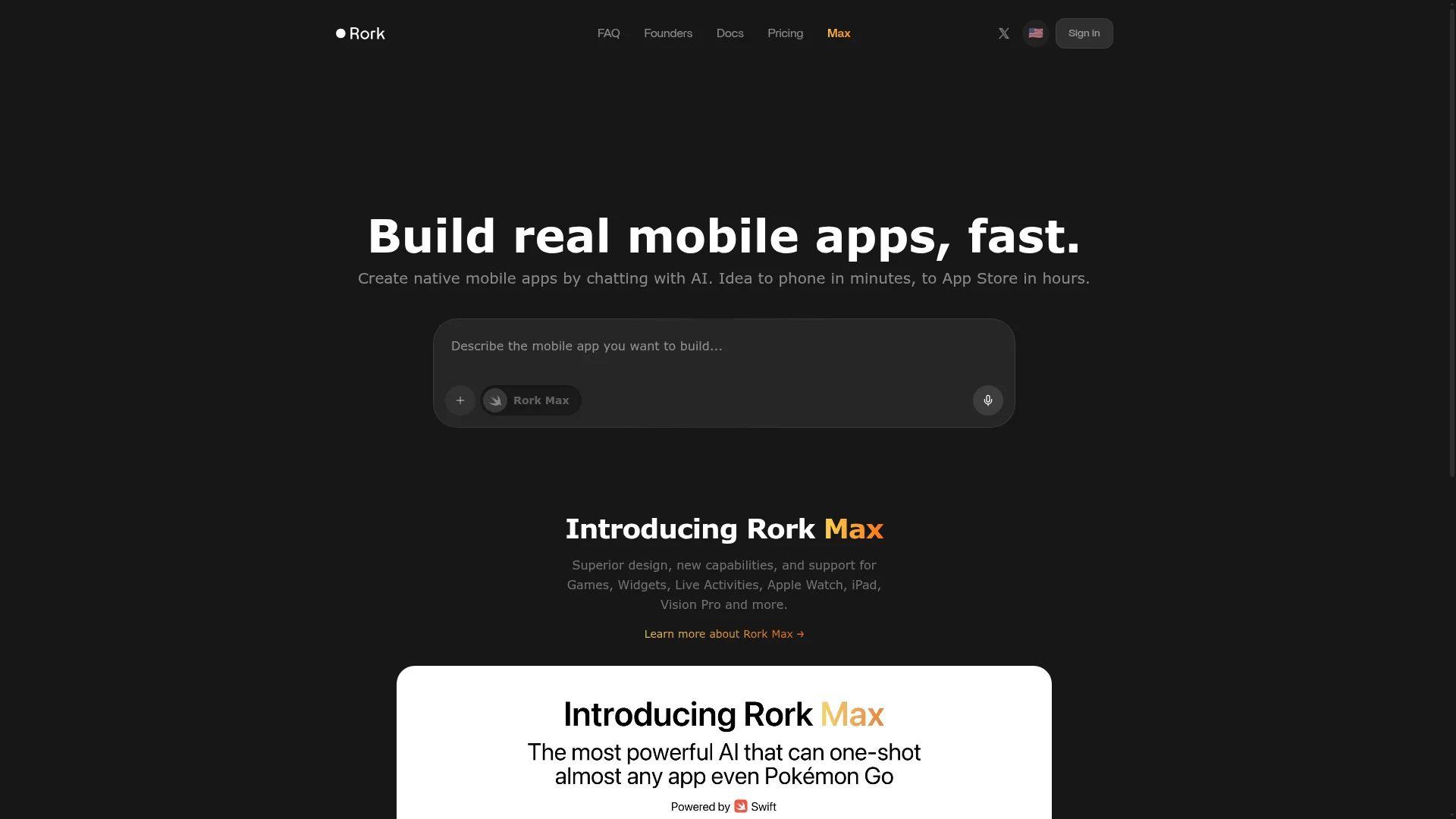
Rork does one thing well: turning a text prompt into a working mobile app prototype in minutes. The AI generates React Native code via Expo, and you can preview it on your phone with a QR code. For a first demo, that speed is hard to beat.
The problems start when you try to go beyond the prototype. Here are the most common reasons builders switch away from Rork:
Crashes and instability. Users report black screens, broken previews, and errors that consume credits without producing results. The app holds a 17.7 out of 100 safety score on JustUseApp based on 2,925 reviews.
Publishing failures. Getting an app from Rork to the App Store or Google Play is unreliable. Multiple users report hitting "Publish" and nothing happening.
No built-in backend. Rork generates frontend code but has no database, authentication, or storage layer. You set up Firebase, Supabase, or another third-party integration on your own for anything beyond a static UI.
Context loss after iteration. After 3 to 4 rounds of changes, the AI loses track of your app's state. Each edit risks breaking something that was working before.
No visual editor. Every change goes through text prompts. You cannot drag elements, adjust layouts, or fine-tune designs manually.
Weak support. Customer support is described as slow or unresponsive by multiple users in independent reviews, and official tutorials are scarce.
These are not edge cases. They show up consistently in Trustpilot reviews, Product Hunt comments, and Medium write-ups. If you have hit any of these walls, the alternatives below address them directly.
Rork Alternatives: Quick Comparison
Here is how the six Rork alternatives in this guide compare at a glance. Pay attention to the backend column, because a built-in backend is the single biggest gap most builders hit with Rork.
Tool | Focus | Built-in Backend | Visual Editor | Free Tier | Starting Price |
|---|---|---|---|---|---|
CatDoes | Mobile (iOS, Android) + Web | Yes (full BaaS) | No | Yes, 15 credits | $20/mo |
FlutterFlow | Mobile + Web | Firebase integration | Yes | Yes (limited) | $39/mo |
Lovable | Web apps only | Yes (Supabase) | Yes | Yes | $20/mo |
Replit | General (web + mobile) | Partial | Yes | Yes | $20/mo |
OnSpace | Mobile + Web | Yes (managed) | No | Yes | $25/mo |
Bolt.new | Web apps only | No | No | Yes | $25/mo |
Rork | Mobile only | No | No | Only Design | $25/mo |
Notice the pattern: most Rork alternatives are web-focused. CatDoes and OnSpace are the two that match Rork's mobile-first approach while including a built-in backend, and CatDoes ships native iOS, Android, and web from the same project.
1. CatDoes
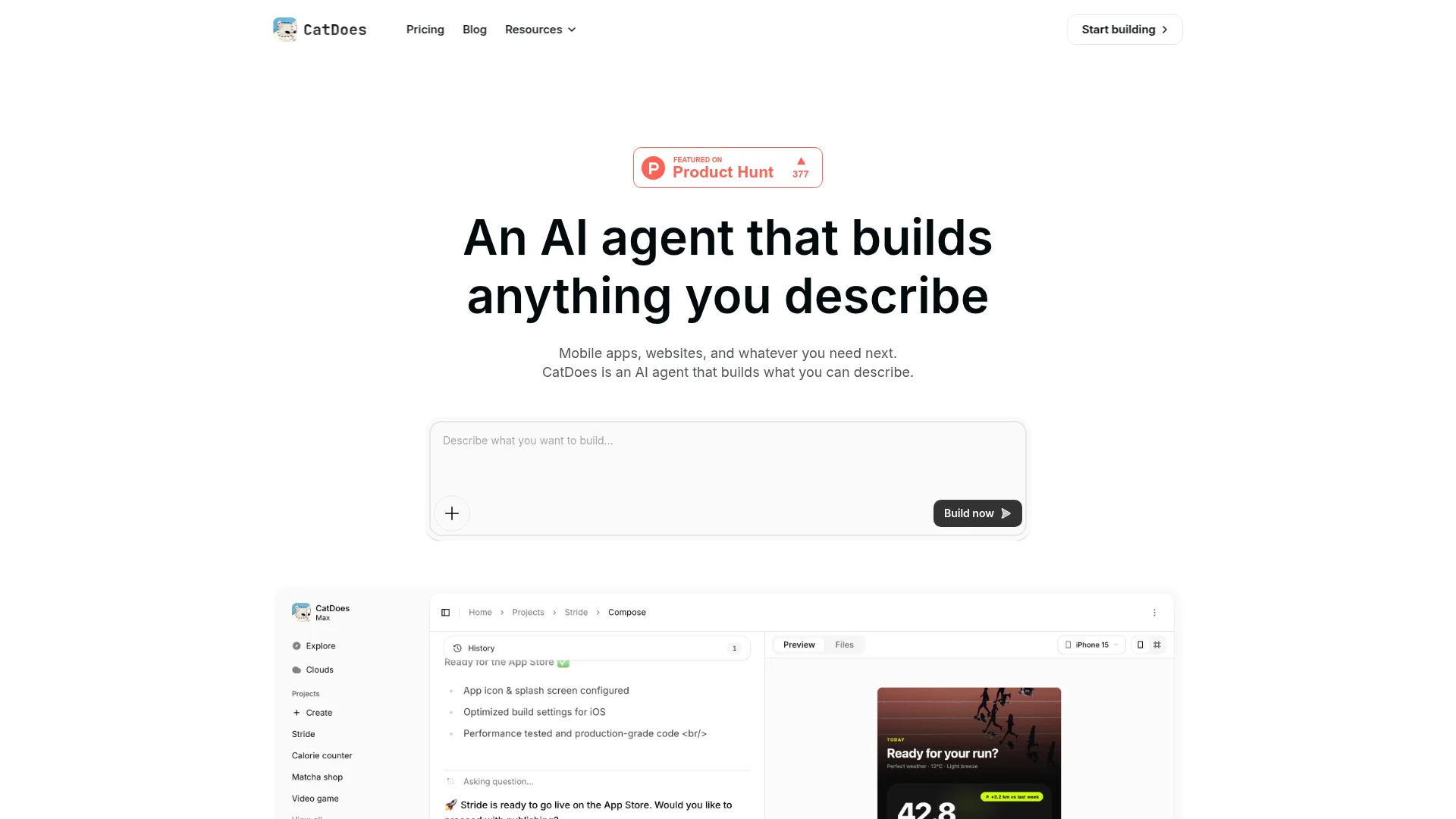
Best for: Builders who want to go from idea to App Store (or from idea to web) with one tool, no external services required.
CatDoes is the most direct Rork alternative on this list. Both platforms let you describe a mobile app in natural language and get a working React Native app for iOS and Android. CatDoes now also ships websites (Vite or Next.js) from the same project, so you are not locked into mobile-only output. The difference is what happens after that first prompt.
What CatDoes Fixes That Rork Gets Wrong
Built-in backend from day one. CatDoes Cloud, the platform's integrated Backend-as-a-Service, gives every app a database, authentication, file storage, edge functions, and realtime features out of the box. With Rork, you set up and connect an external backend yourself. With CatDoes, your app has a working backend from the first prompt. No Firebase setup, no Supabase configuration, no third-party juggling. That backend gap is the core of the head-to-head in CatDoes vs Rork.
Reliable publishing. Where Rork users report "nothing happens" when they hit Publish, CatDoes deploys to iOS, Android, and web consistently. The platform handles build configurations, code signing, and store submissions so you can focus on your app, not your deployment pipeline.
A cloud agent and checkpoints prevent broken iterations. Rork's most frustrating problem is that after 3 to 4 rounds of changes, the AI loses track of your app. CatDoes solves this two ways. Compose, the autonomous cloud agent, runs on its own computer, installs packages, executes tests, and fixes its own errors before handing work back, so it holds far more context than a browser-based chat. And a checkpoint system (up to 1,000 on higher plans) saves every version of your app, so if an edit breaks something you roll back to a working checkpoint instead of prompting your way out of a mess.
Four agent tiers for cost control. Instead of one setting for everything, CatDoes offers four agent tiers: Low for simple UI tweaks, Medium for bigger features, High for planning complex features, and Max for the hardest problems. You use a lower tier for quick changes and a higher one only when you need it. That keeps your credit spend lower than burning premium-tier messages on simple color changes.
Import from anywhere. If you already built something on Lovable, WordPress, or Shopify, you do not start from scratch. Paste the URL and the agent studies the site, then ships a matching native iOS and Android app. Rork gives you a blank prompt box.
CatDoes vs Rork: Head-to-Head
Feature | CatDoes | Rork |
|---|---|---|
Tech stack | React Native (Expo) | React Native (Expo) |
Built-in backend | Yes (database, auth, storage, edge functions, realtime) | No |
Publishing | iOS, Android, Web | iOS, Android |
Version control | Checkpoint system (up to 1,000) | None |
AI models | 4 tiers | 1 model |
Cloud agent | Yes (Compose runs in the cloud) | No |
Websites | Yes (Vite or Next.js) | No |
Import from URL | Yes (Lovable, WordPress, Shopify, etc.) | No |
GitHub sync | Yes (Plus+) | Yes (paid plans) |
Code export | Yes (Plus+) | Yes (paid plans) |
Free tier | 15 one-time credits | Limited design mode |
Starting price | $20/mo (50 credits) | $25/mo (100 messages) |
Credit bundles | Yes ($0.30/credit) | No |
Pricing: Free tier with 15 one-time credits. Paid plans from $20/mo (Core, 50 credits) to $399/mo (Max, 2,000 credits). One-time credit bundles at $0.30/credit are available on any plan, so you are never locked into upgrading just because you had a busy week.
2. FlutterFlow
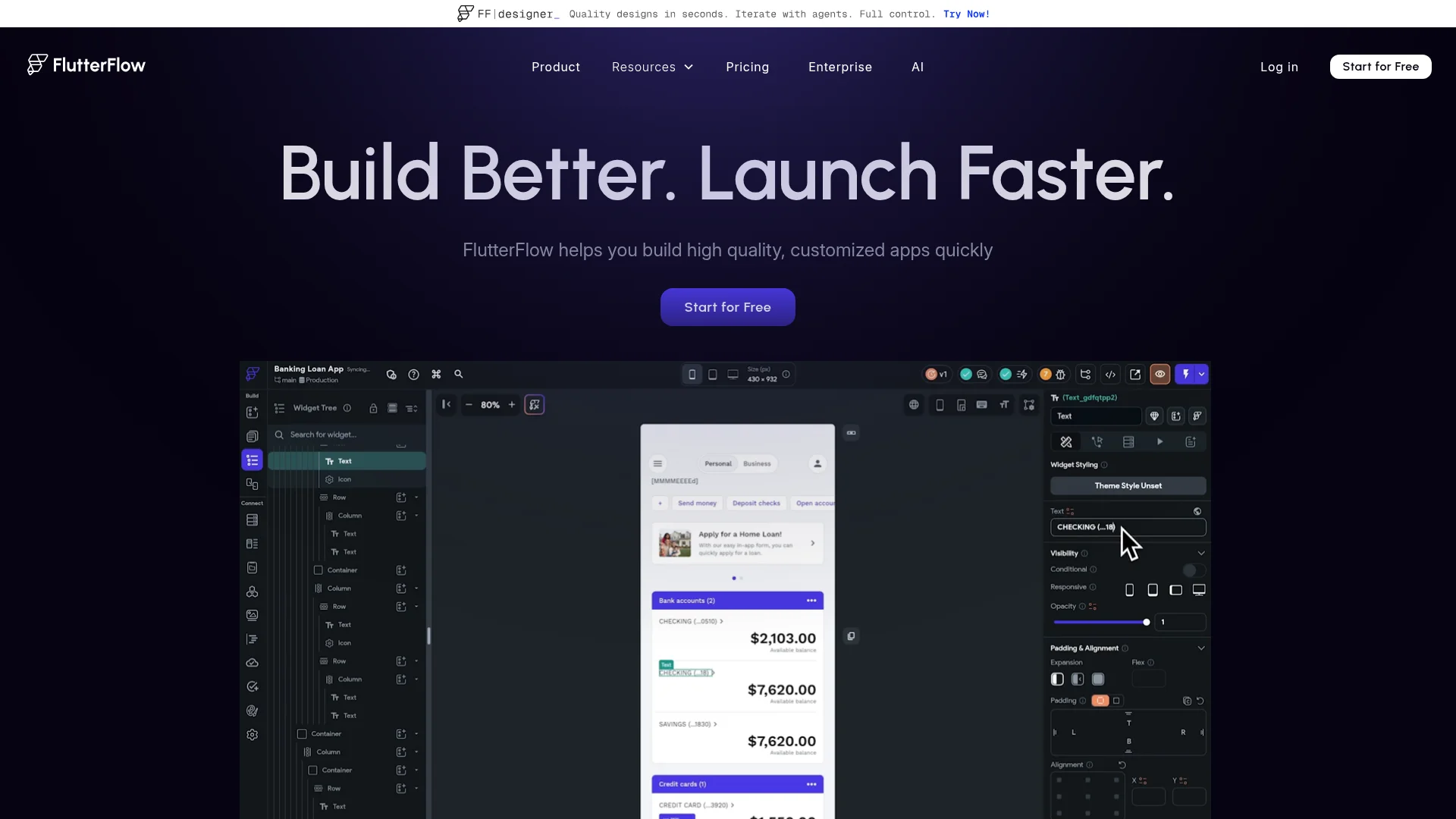
Best for: Builders who want visual, drag-and-drop control over their app's design.
FlutterFlow takes a fundamentally different approach. Instead of generating everything from text prompts, FlutterFlow gives you a visual canvas where you place UI components, connect Firebase for backend, and see changes in real time.
It does have AI features for generating components, but the core experience is manual and visual. This is great if you want pixel-perfect control over layouts. The trade-off is a steeper learning curve and slower iteration speed. You will need to understand concepts like state management and API calls, and building an app takes hours or days instead of minutes.
FlutterFlow vs Rork: Rork wins on speed (prompt to prototype in minutes), FlutterFlow wins on control and stability. FlutterFlow uses Flutter and Dart, while Rork uses React Native, so the two are not interchangeable codebases. FlutterFlow also requires you to set up Firebase separately for backend services, while CatDoes includes everything in one platform.
Pricing: Free tier available. Paid plans from $39/mo (Basic).
3. Lovable
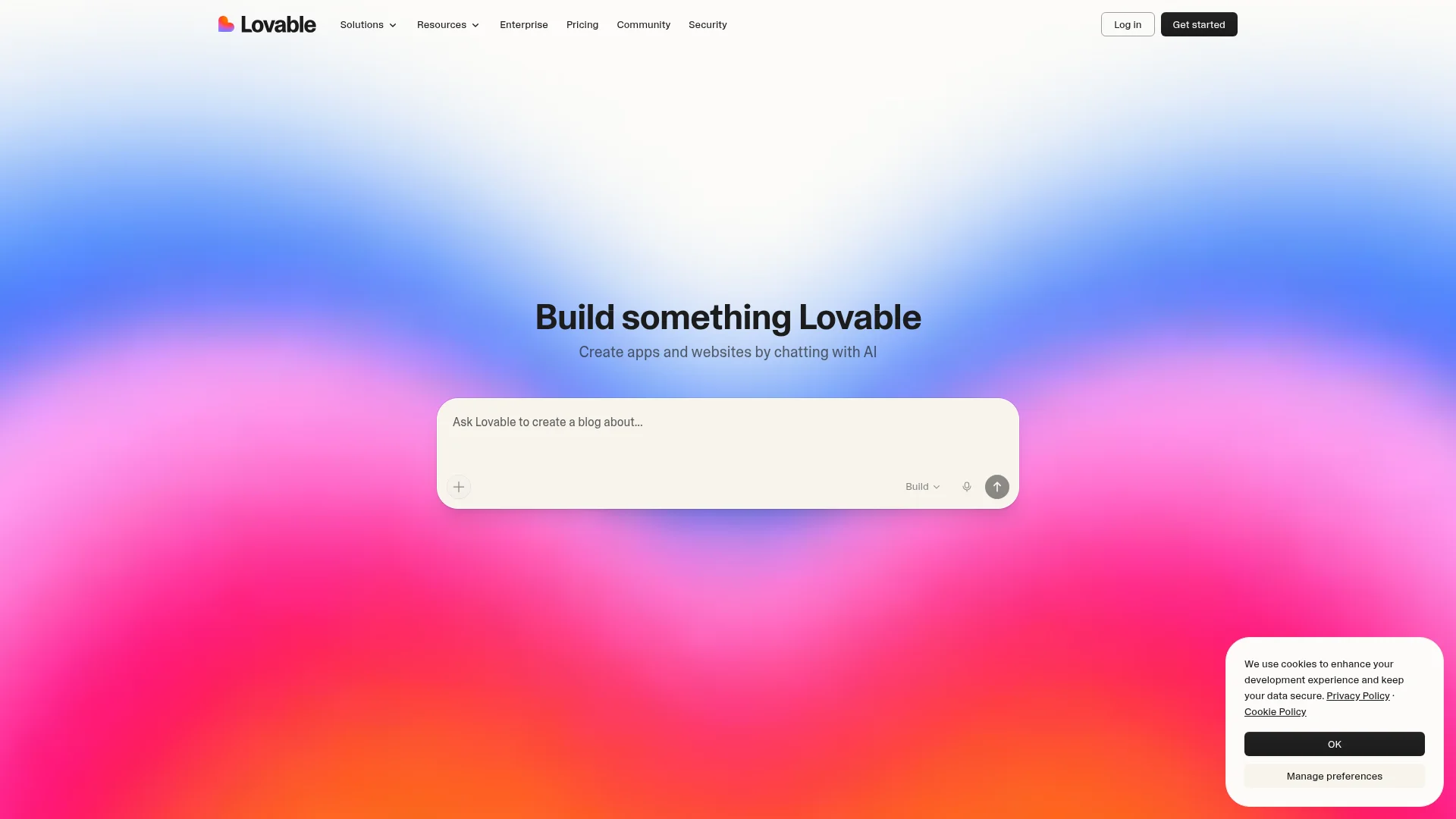
Best for: Builders whose primary need is a web app, not a native mobile app.
Lovable is one of the biggest names in AI app building, having raised $330M at a $6.6B valuation and reaching $200M ARR. It generates polished web applications from text prompts using React and TypeScript, with Supabase integration for backend services.
Lovable vs Rork: the key difference is the target platform. Lovable builds web apps, not native mobile apps. If your project needs to be in the App Store or Google Play, Lovable alone will not get you there. But if you have been using Rork and realized a web app would actually serve your users better, Lovable is the strongest option in that category. You can also convert a Lovable web app into a native mobile app using CatDoes.
Pricing: Free tier available. Paid plans from $20/mo.
4. Replit
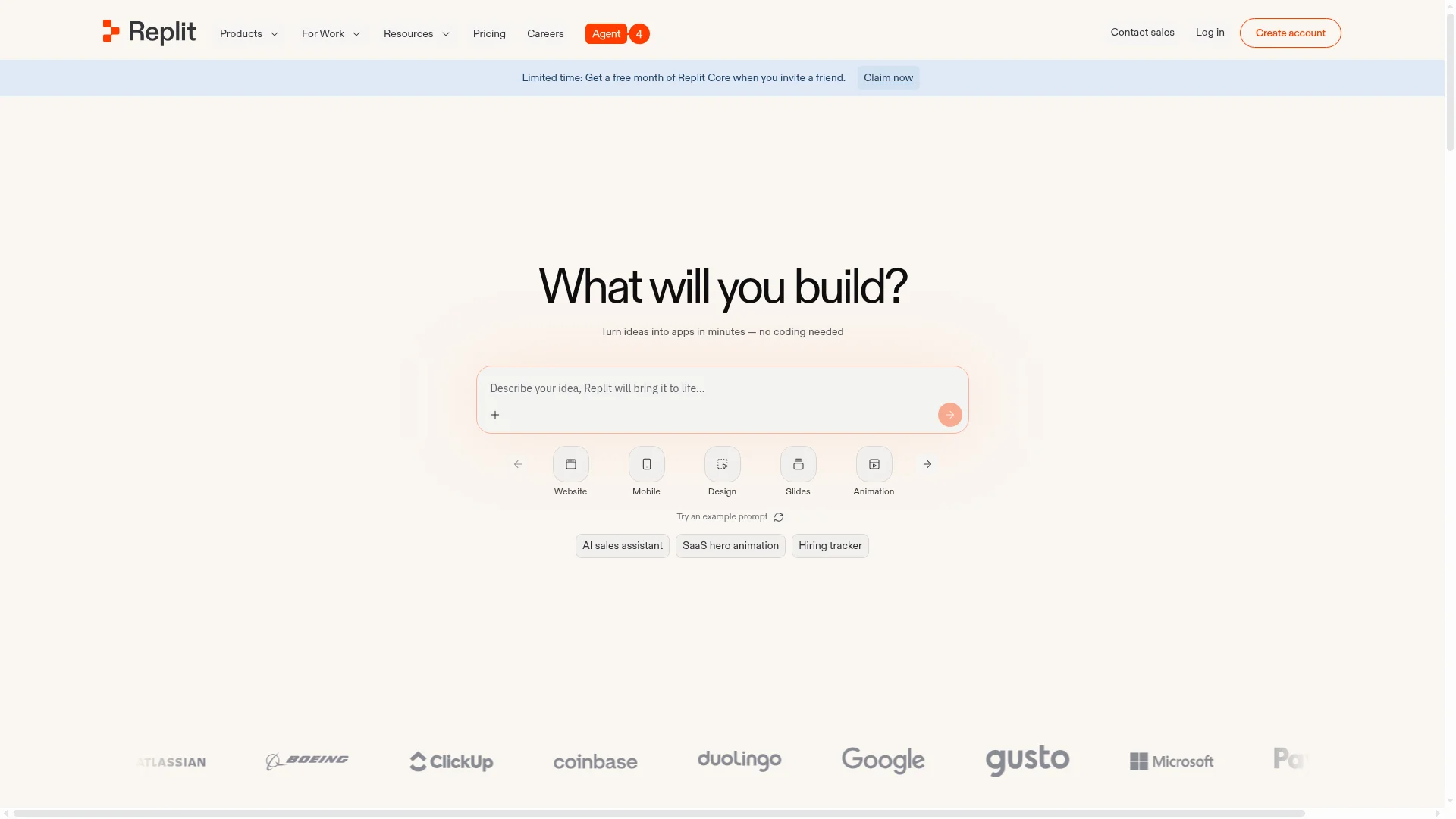
Best for: Builders who want one platform for web, mobile, and backend development.
Replit started as a browser-based code editor and evolved into a full AI app builder. It can generate mobile apps for iOS and Android, handle backend logic, and deploy everything from one interface. Replit's AI agent manages entire builds from a single prompt, and the platform includes hosting, databases, and deployment tools.
Rork vs Replit: Head-to-Head
This is the most common comparison people run when they leave Rork, so here is the short version. Rork is mobile-only and specialized for React Native apps. Replit is general-purpose: it builds web apps, backends, scripts, and mobile apps, but it is less tuned for mobile specifically. If your only goal is a native mobile app, Rork is more focused; if you want one environment for everything, Replit is broader.
Feature | Rork | Replit |
|---|---|---|
Focus | Mobile only | Web, mobile, backend (general) |
Mobile stack | React Native (Expo) | React Native |
Built-in backend | No | Partial (hosting + database) |
App store publishing | iOS, Android (unreliable) | iOS, Android (assisted) |
Best for | Quick mobile prototypes | General-purpose builds |
Free tier | ~35 msgs/mo | Yes |
Starting price | $25/mo | $20/mo (Core, billed annually) |
Replit is more flexible but less specialized for mobile, which means it lacks dedicated mobile features like CatDoes Cloud's built-in auth, storage, and realtime. You end up stitching together your own backend pieces. If mobile is the priority, CatDoes is the closer match to what Rork promised.
Pricing: Free tier available. Replit Core at $20/mo (billed annually) for serious builds.
5. OnSpace
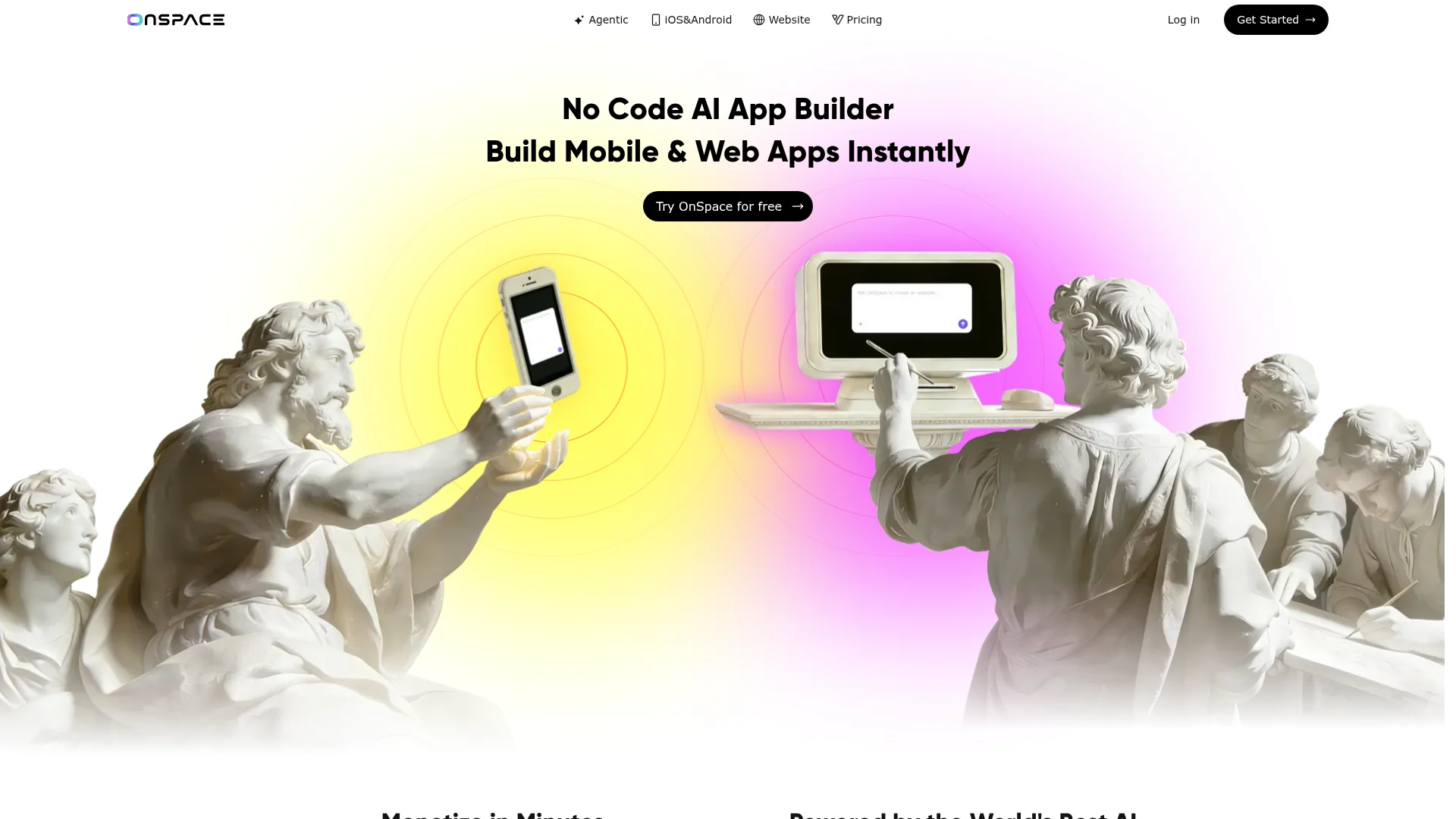
Best for: Builders who want a mobile-first AI builder with a managed backend and built-in payments.
OnSpace is the closest competitor to Rork on this list after CatDoes, because it shares the same mobile-first, prompt-to-app approach. It generates mobile and web apps from text, includes a fully managed backend (database, auth, edge functions, secrets, and logs), and ships built-in Stripe payments so you can monetize without wiring up your own payment infrastructure. It even has a mobile creator app so you can build from your phone.
OnSpace vs Rork: OnSpace fixes Rork's biggest gap by including a backend out of the box, which is why people comparing the two often ask which handles complex app logic better. OnSpace's managed backend gives it an edge there. Where CatDoes pulls ahead of both is the checkpoint system that protects you from broken iterations, the autonomous Compose cloud agent, and four agent tiers for cost control. OnSpace is a strong, newer option; CatDoes is the more complete package for shipping production apps.
Pricing: Free plan with 500 daily credits (2,000 monthly maximum). Paid plans from $25/mo (up to 7,500 credits/month).
6. Bolt.new
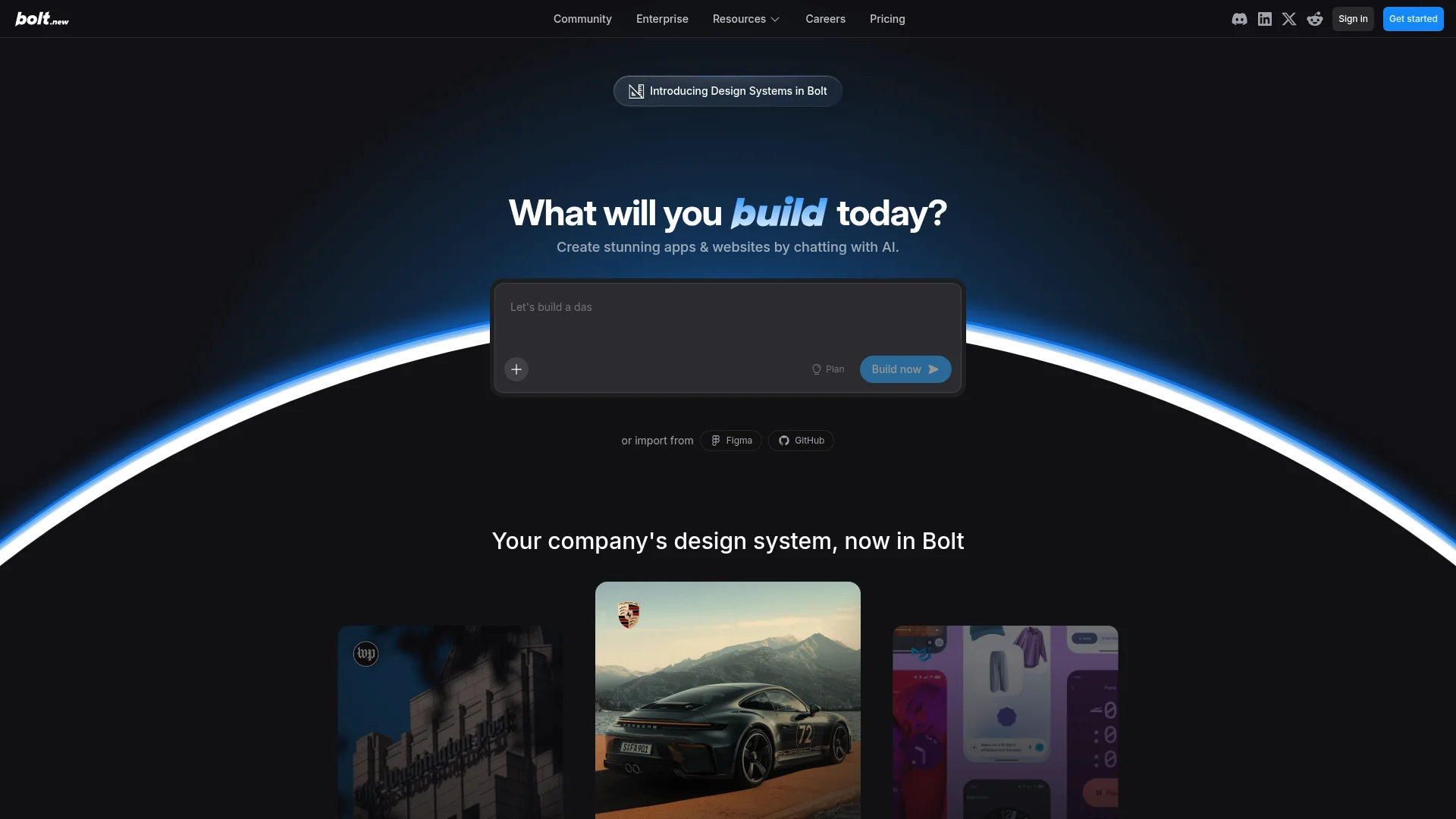
Best for: Web developers who want framework flexibility (React, Next.js, Vue, Svelte).
Bolt.new generates full-stack web applications with support for multiple frontend frameworks. It excels at rapid prototyping and gives you a browser-based IDE to modify the generated code directly.
Bolt.new vs Rork: like Lovable, Bolt focuses on web apps, not native mobile, and it has no built-in backend, so you connect your own database and authentication. If you tried Rork specifically because you needed a mobile app, Bolt is not the right fit. It is included here because it is a popular name in AI app building, but for mobile app development, CatDoes is the better match.
Pricing: Free tier available. Bolt.new Pro at $25/mo.
Rork Pricing and Free Plan in 2026
A lot of people looking for a Rork alternative are really reacting to its pricing and free-plan limits, so here is how Rork's plans break down in 2026.
Rork's free tier gives you roughly 35 messages per month with a 5-per-day cap. Free projects are public and cannot export code, which makes the free plan fine for testing but not for real work. Paid plans start at $25/mo for 100 messages on the Junior plan. There are no one-time credit purchases, so if you run out mid-project you either wait for the reset or upgrade.
If pricing is your main reason for switching, two alternatives stand out. CatDoes starts at $20/mo (50 credits), $5 cheaper than Rork's entry plan, and adds one-time credit bundles so a busy week does not force an upgrade. OnSpace has the most generous free plan here, with 500 daily credits up to a 2,000 monthly cap. For a genuinely free Rork alternative to test with, CatDoes (15 one-time credits) and OnSpace (free plan) are the easiest places to start.
How to Choose the Right Rork Alternative
The decision comes down to three questions:
Do you need a native mobile app? If yes, CatDoes is the clearest choice. It matches Rork's mobile-first approach while adding a built-in backend and reliable publishing. OnSpace is the other mobile-first option with a managed backend. FlutterFlow also builds mobile apps but requires more manual work. Lovable and Bolt are web-only. For a broader comparison of AI app builders, see our full 2026 guide.
Do you need a built-in backend? Rork's biggest gap is having no database, auth, or storage. CatDoes and OnSpace are the mobile-focused tools here with a backend included. Lovable connects to Supabase. FlutterFlow connects to Firebase. Replit and Bolt require you to bring your own.
How important is visual editing? If you want to drag and drop UI elements instead of writing prompts, FlutterFlow is the only option with a full visual editor. CatDoes, Lovable, Replit, OnSpace, and Bolt all use AI prompts as the primary interface.
Rork Alternatives FAQ
What is the best Rork alternative for mobile apps?
CatDoes is the closest alternative for AI-powered mobile app development. Both use React Native, and both let you build iOS and Android apps from text prompts. CatDoes starts at $20/mo, $5 cheaper than Rork's $25/mo entry plan. CatDoes pulls ahead with a built-in backend (CatDoes Cloud), reliable app store publishing, a checkpoint system, an autonomous cloud agent (Compose) that runs on its own computer, and support for websites from the same project. For a step-by-step walkthrough, read our guide on how to build an app with AI.
What is the best free Rork alternative?
For a free Rork alternative, CatDoes gives you 15 one-time credits to build with, and OnSpace offers a recurring free plan with 500 daily credits (up to 2,000 per month). Both let you test real app building without paying. CatDoes' free tier also includes a working backend, which Rork's free plan does not.
Rork vs Replit: which is better?
Rork is mobile-only and specialized for React Native apps, so it is more focused if a native mobile app is your single goal. Replit is general-purpose and better if you want one environment for web, backend, and mobile work. Neither includes a full mobile backend the way CatDoes does, so if mobile with a built-in database, auth, and storage is the priority, CatDoes is the stronger pick than either.
Is Rork free to use?
Rork offers a limited free tier with approximately 35 messages per month and a 5-per-day cap. Free projects are public and cannot export code. Paid plans start at $25/mo for 100 messages (Junior plan). There are no one-time credit purchases, so if you run out mid-project, you wait or upgrade.
Does Rork have third-party integrations and a backend?
Rork generates frontend React Native code but does not include a built-in backend, so database, authentication, storage, and payments rely on third-party integrations like Firebase, Supabase, or Stripe that you set up and connect yourself. Alternatives like CatDoes and OnSpace include a managed backend out of the box, which removes most of that integration work. If you would rather work in a terminal than a builder, our roundup of Claude Code alternatives covers that side of the market.
What technology does Rork use, and does Rork Max support Android?
Rork generates React Native code using the Expo framework, which produces real native apps, not web wrappers. In February 2026, Rork launched Rork Max, which generates native Swift code for Apple platforms including iPhone, iPad, Apple Watch, Apple TV, Vision Pro, and iMessage. Rork Max is Apple-only, so for Android you stay on Rork's standard React Native output. CatDoes uses React Native for both iOS and Android, making migration straightforward.
Can I export my code from Rork?
Yes, on paid plans. Rork supports GitHub sync and code export. However, the generated React Native codebase can become difficult to maintain after several rounds of AI-driven iteration, as state management complexity accumulates. CatDoes also offers GitHub sync and code export (on Plus plans and above), with the checkpoint system helping keep the codebase cleaner over time.
Is Rork good for production apps?
Rork works well for quick prototypes and MVPs. For production apps, multiple reviews flag stability issues, publishing failures, and context loss during iteration as barriers, which is also why some users report apps feeling unreliable or "down" mid-build. If you need a production-ready mobile app with a backend, reliable deployment, and version control, CatDoes is designed for exactly that use case.
Bottom line: Rork made AI mobile app building accessible, and that matters. But accessibility without reliability creates frustration. If you want to go from idea to App Store without juggling external backends, fighting publishing bugs, or losing progress to broken iterations, try CatDoes for free and see the difference.
Nafis Amiri
Co-Founder of CatDoes