Blog
Tutorials
CatDoes vs Windsurf: Which One Ships Apps? (2026)
CatDoes vs Windsurf compared for 2026: pricing, features, mobile app publishing, and who each tool is really for. See which one actually ships real apps.

Nafis Amiri
Co-Founder of CatDoes

TL;DR: CatDoes and Windsurf both use AI to help you build software, but they solve different problems. Windsurf (now rebranded as Devin Desktop under Cognition) is an AI coding IDE for developers who already write code. CatDoes is an AI agent that builds, deploys, and maintains mobile apps and websites from plain English, no coding required, and ships them straight to the App Store, Google Play, and the web. If you want a faster code editor, pick Windsurf. If you want a finished app without writing code, pick CatDoes.
You typed "AI app builder" into a search bar and ended up comparing two tools that look similar on the surface. Both promise AI. Both mention building apps. Both start around $20 a month. So which one actually gets you a shipped product?
Here is the problem: choose the wrong one and you either end up with a powerful code editor you don't know how to drive, or a simple builder that can't handle what you need. The gap between "AI helps me write code" and "AI builds and ships the whole app for me" is enormous, and it is exactly where these two tools split. This guide breaks down what each one does, real 2026 pricing, the mobile-app question, and who should pick which.
Table of Contents
What Is Windsurf (Now Devin Desktop)?
What Is CatDoes?
CatDoes vs Windsurf: The Core Difference
Feature Comparison
Pricing: CatDoes vs Windsurf in 2026
Can You Build a Mobile App?
The Windsurf Ownership Shake-Up
Which One Should You Choose?
Frequently Asked Questions
The Bottom Line
What Is Windsurf (Now Devin Desktop)?
Windsurf is an AI-native code editor. It's a desktop app built on top of VS Code with deep AI wired into every part of the coding workflow. It started life as Codeium, and its signature feature is Cascade, an agentic system that reads across your whole codebase and carries out multi-step coding tasks on request.
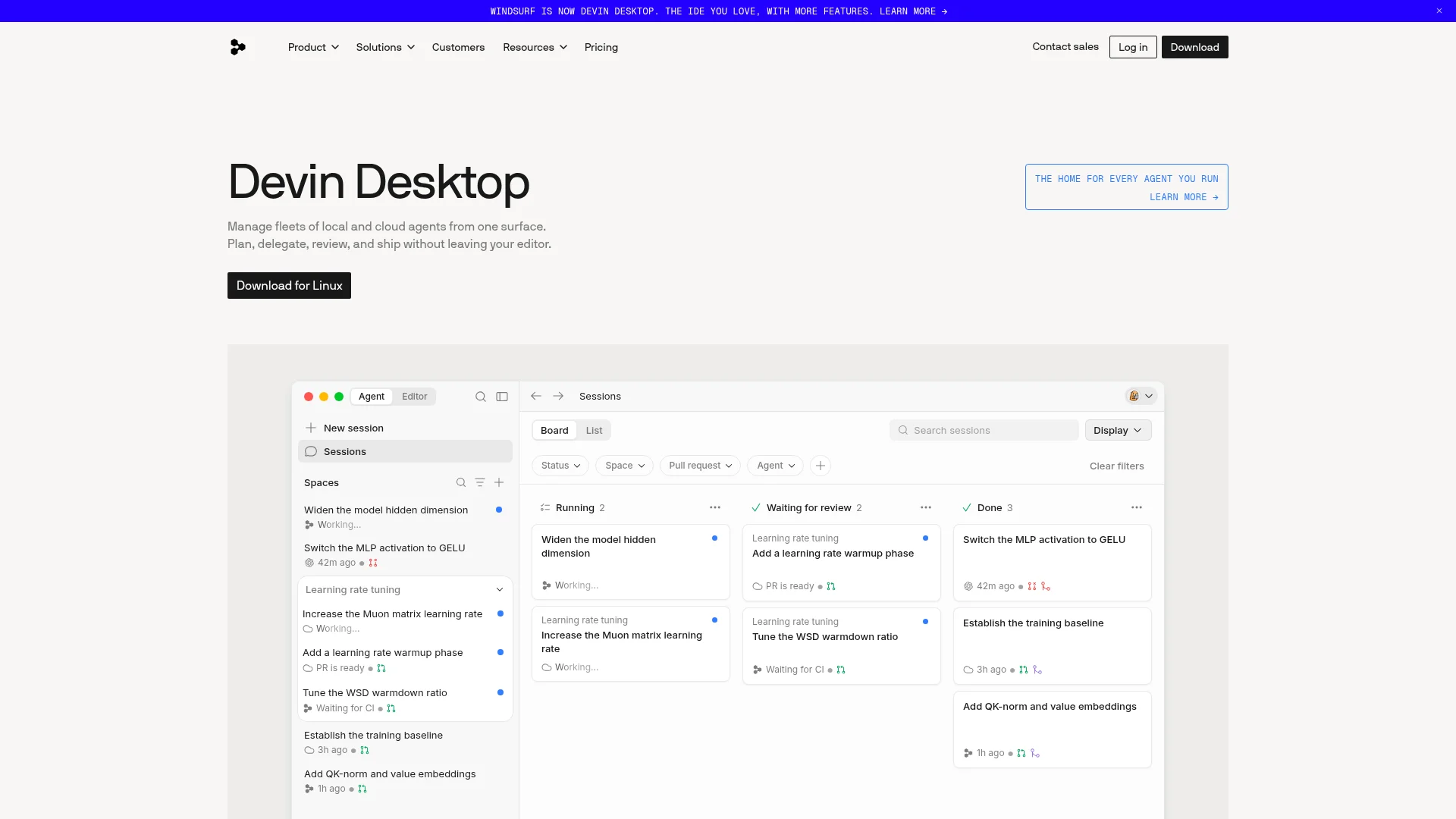
In June 2026, owner Cognition rebranded Windsurf to Devin Desktop. The default screen is now an "Agent Command Center" for managing multiple coding agents, and a new on-machine agent called Devin Local is replacing Cascade. The name is in transition, but the product is the same at its core: a desktop IDE for professional developers. It assumes you have a code repository, a working dev environment, and the ability to read and edit code yourself. Windsurf makes developers faster, but it does not remove the need to be one.
What Is CatDoes?
CatDoes is an AI agent that builds mobile apps and websites from natural language. You describe what you want, and the agent runs in the cloud, spins up its own subagents, writes the code, and ships the result to the App Store, Google Play, or the web with a custom domain. There is no IDE to install and no code you are required to touch.
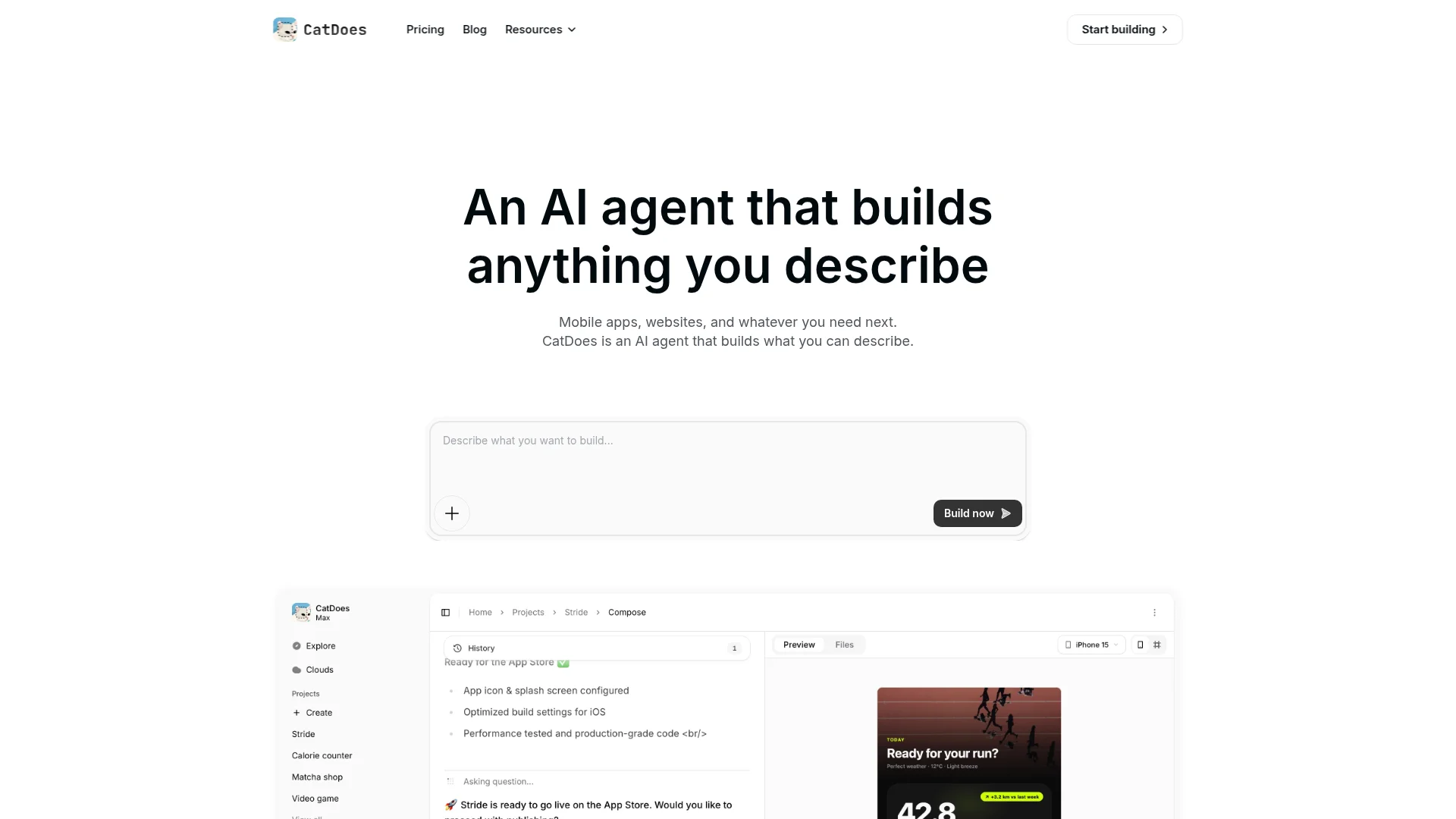
Every plan includes CatDoes Cloud, a built-in backend with database, authentication, storage, edge functions, and realtime. That matters, because a real app is more than a screen: it needs data, logins, and a server. Developers can still bring a GitHub repo, export code, and work with the underlying stack, but non-technical founders can go from idea to a live, downloadable app without ever opening an editor. If you want the wider landscape, our guide to the best AI app builder options puts CatDoes in context.
CatDoes vs Windsurf: The Core Difference
The cleanest way to think about it: Windsurf helps people who write code do it faster. CatDoes builds and ships the app for people who don't want to write code at all.
Windsurf lives on your desktop and works inside a codebase. You still manage the environment, run the build, handle deployment, and submit to app stores. The AI is a brilliant pair-programmer, but you are the one flying the plane. CatDoes runs in your browser and treats the entire lifecycle (code, backend, deployment, and store submission) as the agent's job. This is the same split we cover in our ChatGPT vs Cursor comparison: assistant-in-an-editor versus agent-that-ships. One accelerates a developer; the other replaces the need to be one.
Feature Comparison
Here is how the two tools line up on the things that decide whether you actually end up with a shipped app.
Feature | CatDoes | Windsurf (Devin Desktop) |
|---|---|---|
What it is | AI agent that builds & ships apps | AI coding IDE (desktop) |
Coding required | No | Yes |
Runs in | The cloud (browser) | A desktop app you install |
Builds mobile apps | Yes, natively | Helps you write the code |
Publishes to App Store / Google Play | Yes | No (manual Xcode / Expo) |
Web deployment | Included, custom domains | Web only, via Netlify (beta) |
Backend included | Yes (database, auth, storage) | No, bring your own |
Best for | Founders & non-devs shipping apps | Developers coding faster |
Both tools give you access to top models. Windsurf offers GPT-5, Claude, Gemini, and its in-house SWE coding model; CatDoes lets you switch between Low, Medium, High, and Max agent tiers so simple tasks stay cheap and hard ones get the deepest reasoning. The difference isn't the model. It's everything wrapped around it.
Pricing: CatDoes vs Windsurf in 2026
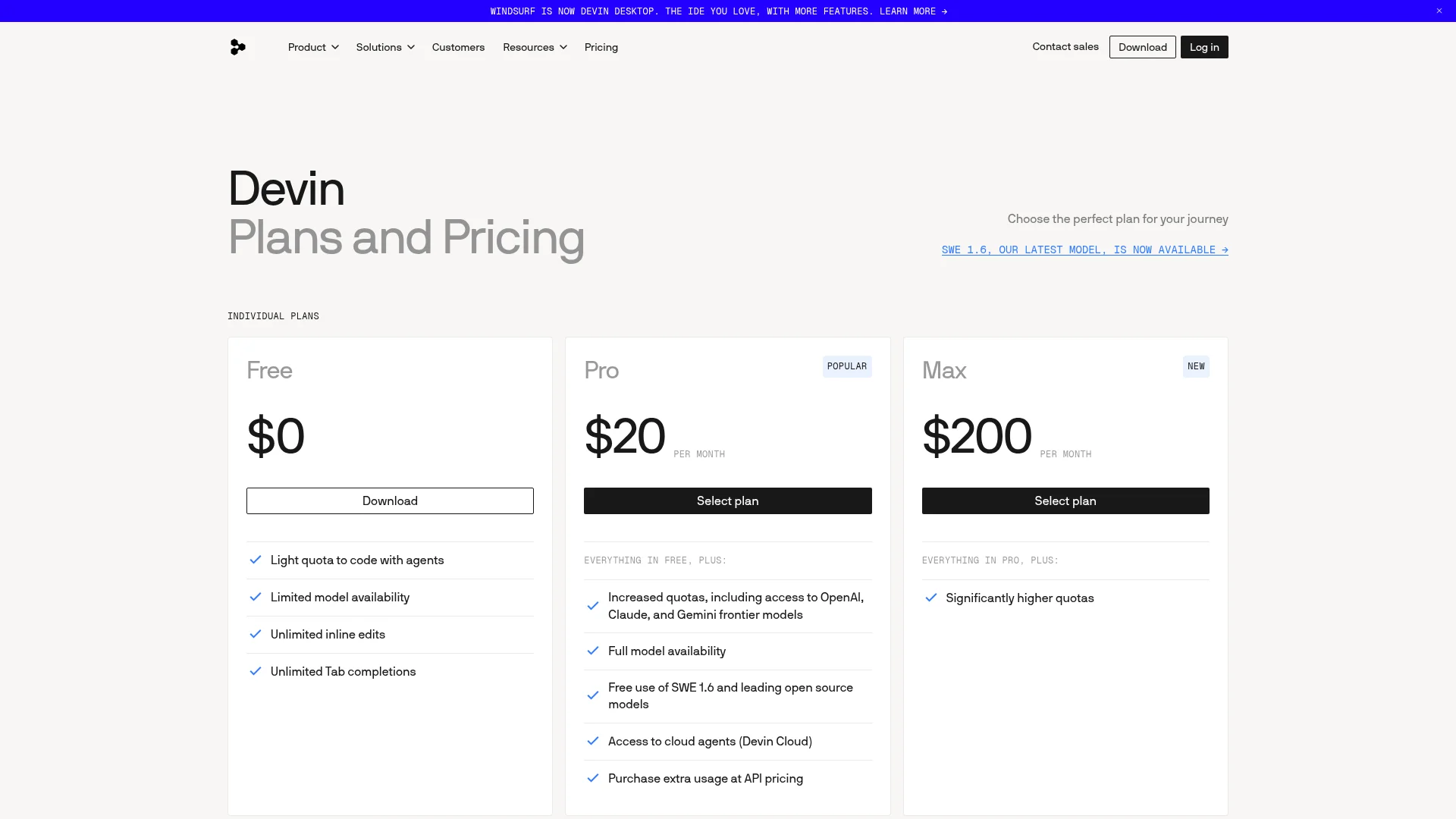
Windsurf overhauled its pricing in March 2026, dropping the old monthly credit pool for daily and weekly usage quotas that refresh automatically. Current plans, per the official pricing page:
Windsurf Plan | Price | What you get |
|---|---|---|
Free | $0 | Light quota, unlimited autocomplete |
Pro | $20/mo | Higher quotas, full model access |
Max | $200/mo | Significantly higher quotas |
Teams | $80/mo + $40/seat | Admin dashboard, sharing, support |
Enterprise | Custom | SSO, RBAC, dedicated deployment |
CatDoes uses a credit-based model where each plan includes a monthly credit allocation, and every plan comes with CatDoes Cloud.
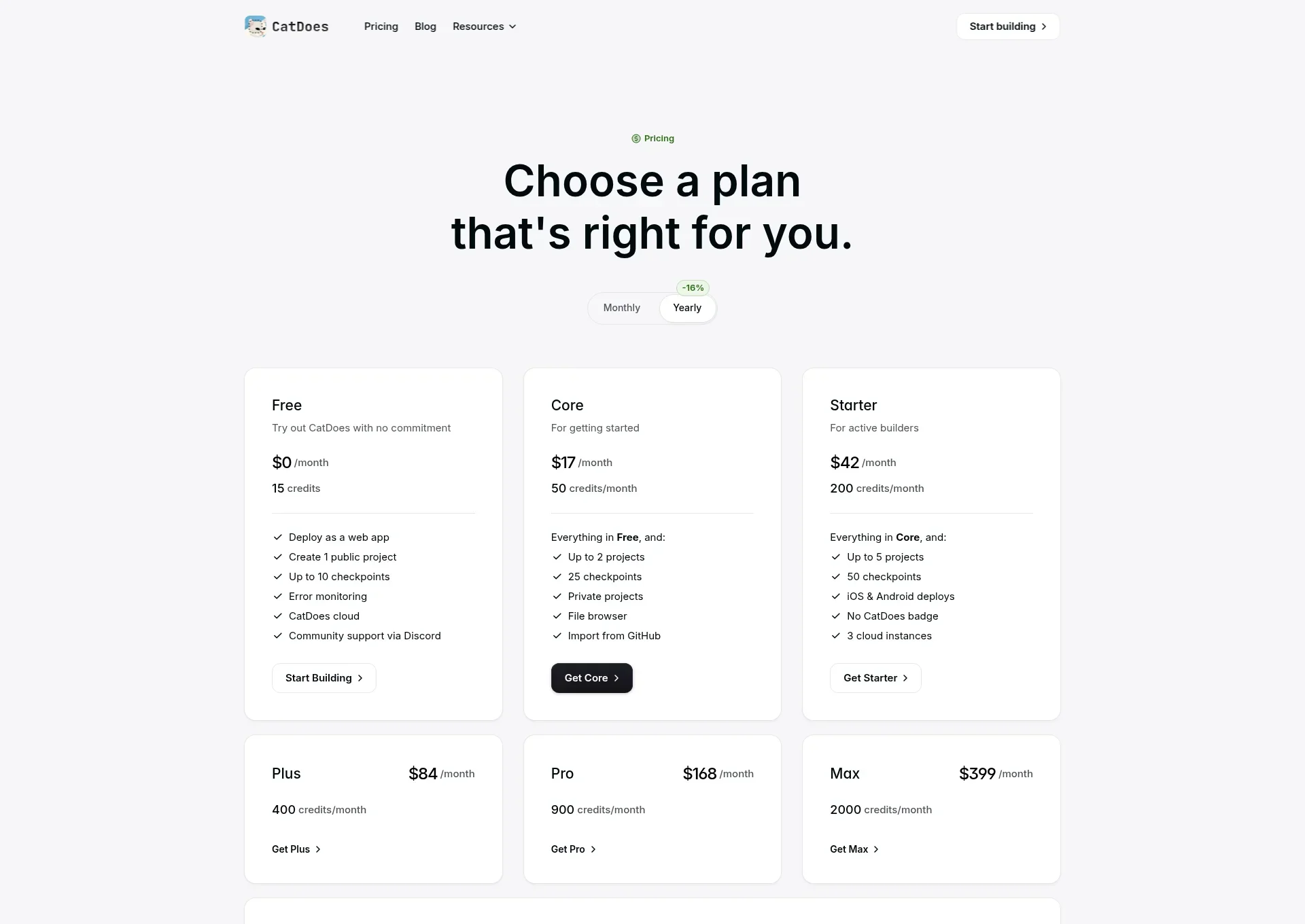
CatDoes Plan | Price | Credits/mo |
|---|---|---|
Free | $0 | 15 (one-time) |
Core | $20/mo | 50 |
Starter | $50/mo | 200 |
Plus | $100/mo | 400 |
Pro | $200/mo | 900 |
Max | $399/mo | 2,000 |
The entry price is nearly identical: both start free and both have a $20 paid tier. But you're buying different things. With Windsurf, $20 buys AI assistance inside an editor you still have to run. With CatDoes, that same tier buys an agent that writes the code, hosts the backend, and pushes the app to a store. When you factor in the separate hosting, database, and deployment tooling a Windsurf project needs, the sticker prices aren't really comparing the same job.
Can You Build a Mobile App?
This is where the two tools separate most clearly. With Windsurf, you can write a mobile app. The AI will happily help you build React Native or Flutter code, suggest components, and wire up navigation. But it does not natively build or publish mobile apps. There is no one-click path to the App Store or Google Play. Submitting still means running the standard native workflow yourself: Xcode, Apple certificates, Expo EAS builds, provisioning profiles, and the store review process. Windsurf can help you write the code; you own the release pipeline.
CatDoes treats publishing as part of the job. The agent builds the native app and ships it to the App Store and Google Play for you, and handles web deployment with custom domains on top. If you've ever fought through a first app submission, our walkthrough on how to publish an app on Google Play shows exactly how much that pipeline normally involves, and why removing it is the whole point.
Windsurf's deployment, meanwhile, is web-only. A native Netlify integration lets Cascade push web apps to a live URL from inside the editor, but it's aimed at previews, not native mobile releases.
The Windsurf Ownership Shake-Up
One thing worth knowing before you commit: Windsurf went through one of the strangest corporate sagas in AI. In 2025, OpenAI reportedly agreed to acquire it for around $3 billion, then the deal collapsed. Days later, Google DeepMind hired away CEO Varun Mohan, co-founder Douglas Chen, and key researchers in a roughly $2.4 billion talent-and-licensing deal, leaving most of the team behind.
Then, over a single weekend in July 2025, Cognition (the company behind the Devin AI coding agent) acquired what remained of Windsurf: the team, the IP, and the product. That's why the product is now being folded into Devin Desktop. None of this makes Windsurf a bad editor. It's still excellent. But the founders are gone, the brand is being retired, and the roadmap now answers to Cognition. If long-term stability matters to you, it's a factor worth weighing.
Which One Should You Choose?
Choose Windsurf if: you're a professional developer or an engineering team, you're comfortable managing a codebase and dev environment, and you want AI to make you dramatically faster at writing and refactoring code. It's a top-tier IDE for people who already ship software.
Choose CatDoes if: you're a founder, solo builder, or non-developer who wants a real app, not a codebase. If your goal is a finished product on the App Store, Google Play, or the web, with the backend and deployment handled for you, CatDoes is built for exactly that. Developers who just want the app shipped without babysitting the pipeline benefit too.
The two tools aren't really rivals so much as answers to different questions. "How do I code faster?" points to Windsurf. "How do I get my app built and launched?" points to CatDoes.
Frequently Asked Questions
Is Windsurf the same as Devin Desktop now? Yes. Cognition acquired Windsurf in 2025 and rebranded it to Devin Desktop in June 2026. It's still the same VS Code-based AI coding IDE at its core, now positioned as a hub for managing coding agents.
Do I need to know how to code to use CatDoes? No. CatDoes is designed so non-developers can describe an app in plain English and get a built, deployed result. Developers can go deeper with GitHub import and code export, but coding is optional.
Can Windsurf publish an app to the App Store? Not directly. Windsurf helps you write mobile app code, but submitting to the App Store or Google Play uses the standard native workflow (Xcode, Expo EAS, provisioning) that you run yourself. CatDoes handles store publishing for you.
Which is cheaper? Both start free and both have a $20 paid tier. But they price different jobs: Windsurf charges for AI coding assistance; CatDoes charges for building, hosting, and shipping the whole app, backend included.
Can I use both? Absolutely. Some developers prototype and ship with CatDoes, then use an IDE like Windsurf for deep, hands-on code changes on the exported repo.
The Bottom Line
CatDoes vs Windsurf comes down to one question: do you want to write code faster, or do you want a shipped app? Windsurf (now Devin Desktop) is a superb AI IDE for developers who live in a codebase. CatDoes is an AI agent that turns plain-English ideas into real mobile apps and websites, with backend, deployment, and app-store publishing included, without requiring you to code at all.
If your goal is a finished product on the App Store, Google Play, or the web, try CatDoes free and describe your first app. The agent takes it from there.
Nafis Amiri
Co-Founder of CatDoes