Blog
Insights
AI vs Traditional Software Development (2026)
AI vs traditional software development in 2026: real data on speed, cost, code quality, and security, plus how to choose the right approach for your project.

Nafis Amiri
Co-Founder of CatDoes

Key Takeaways
In any comparison of AI vs traditional software development, AI is no longer the alternative option. Google's 2025 DORA report found 90% of software professionals use AI at work, with a median of two hours per day.
AI clearly wins on writing speed. Faros AI telemetry from 22,000 developers found 66% more epics completed per developer under high AI adoption.
The cost shows up downstream. The same dataset found bugs per developer up 54%, median pull request review time up 441.5%, and code churn up 861%.
Traditional development still wins on anything where a mistake is expensive: regulated systems, complex legacy code, and architecture that has to survive five years.
The 2026 answer is not either/or. It is spec-driven: humans define the contract, AI writes the implementation, humans verify the result.
Every engineering leader is being asked the same question this year, usually by someone holding a budget: can we just use AI for this? The honest answer to AI vs traditional software development is that the comparison has changed shape. It is no longer a choice between two teams. It is a choice about which parts of the work you hand over, and what you put in place to catch what comes back.
The marketing around this topic is loud and mostly unsourced. So this guide leans on primary research published between mid-2025 and mid-2026: Google's DORA reports, GitClear's analysis of 623 million code changes, Faros AI's telemetry across 4,000 engineering teams, Veracode's security benchmarks, and METR's randomized controlled trial. Where the data disagrees, that is noted rather than smoothed over.
Table of Contents
AI vs Traditional Software Development at a Glance
What Traditional Software Development Means in 2026
What AI-Powered Development Actually Looks Like
Speed: AI Wins the Writing, Then Loses the Waiting
Cost: What Each Approach Really Costs
Code Quality and Security: The Maintainability Gap
Which Approach Fits Your Project
The Hybrid Model Teams Settled On in 2026
Will AI Replace Software Developers?
Frequently Asked Questions
The Bottom Line
AI vs Traditional Software Development at a Glance
AI-powered development uses coding agents and large language models to generate, refactor, and test code from natural language instructions. Traditional development relies on engineers writing that code by hand, guided by planning rituals, code review, and accumulated domain knowledge. Both ship software. They fail in different places.
Dimension | AI-Powered | Traditional |
|---|---|---|
Time to first working version | Hours to days | Weeks to months |
Typical project cost | Tool subscriptions plus review time | ~$132,480 average, per Clutch 2026 data |
Throughput per developer | +66% epics completed (Faros AI) | Baseline |
Defect rate | +54% bugs per developer (Faros AI) | Baseline |
Security pass rate | ~55%, flat since 2023 (Veracode) | Depends on team maturity |
Best at | Greenfield, boilerplate, prototypes, tests | Legacy systems, architecture, compliance |
Main bottleneck | Human review capacity | Engineer availability |
Knowledge retention | Weak unless specs are written down | Strong but concentrated in individuals |
The pattern across every credible 2026 dataset is the same. AI moves work forward faster and pushes more defects downstream. Whether that trade is worth it depends almost entirely on what you are building.
What Traditional Software Development Means in 2026
Traditional development in 2026 does not mean waterfall and a printed requirements binder. It means a human-paced pipeline: an engineer reads a ticket, understands the surrounding system, writes the code, opens a pull request, and another engineer reviews it before it merges.
The defining property is that every artifact passes through a person who understands it. That is slow, and it is also the reason the system works. Review capacity matches output capacity, because the same humans produce both.
The cost is real. Clutch's 2026 pricing data puts the average custom software project at roughly $132,480 across about 13 months. Senior engineering rates in North America run $160 to $280 per hour, and the US Bureau of Labor Statistics puts the median software developer wage at $133,080 before benefits and overhead. Offshore rates drop to $25 to $60 per hour, though the practical saving after coordination and rework lands closer to 25% to 35% than the rate card suggests.
What you buy for that money is judgment. Someone who knows why the payments module has that strange retry loop, and what will break if you remove it.
What AI-Powered Development Actually Looks Like
AI-powered development has moved through three distinct phases in under three years: autocomplete, then chat-based assistance, and now agents that plan multi-step changes and open pull requests on their own.
Adoption is effectively total. JetBrains' Developer Ecosystem Survey 2026, covering more than 15,000 professional developers, found 90% using AI coding agents at least weekly and 68% using them daily. Google's 2025 DORA report, based on responses from nearly 5,000 technology professionals, found the same 90% adoption figure, up 14 points year over year, with a median of two hours per workday spent working with AI.
The share of code involved is climbing fast at the top end. Sundar Pichai said in April 2026 that 75% of new code at Google is AI-generated and approved by engineers, up from roughly 50% the previous autumn. Satya Nadella put Microsoft's figure at 20% to 30% of repository code back in April 2025. Treat these as directional rather than comparable, since no one has published what they actually count: suggestions, commits, lines, or merged changes.
Tooling has consolidated around a handful of agents. If you are choosing between them, the practical differences in pricing and speed matter more than benchmark scores, as our Claude Code vs OpenAI Codex comparison breaks down.
Speed: AI Wins the Writing, Then Loses the Waiting
AI genuinely accelerates the act of producing code. It does not automatically accelerate the act of shipping it, and the gap between those two things is the single most misunderstood part of this comparison.
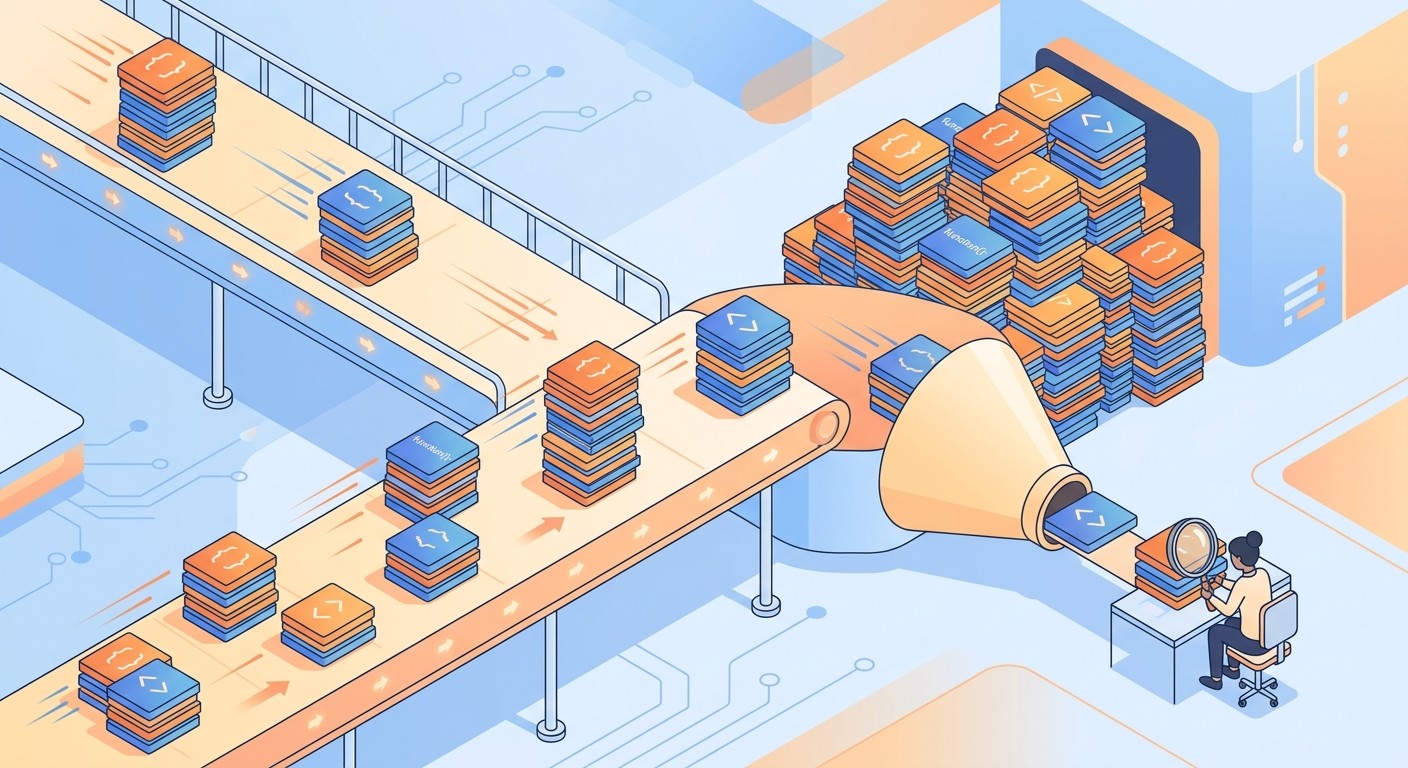
Faros AI's 2026 report, built on two years of telemetry from 22,000 developers across more than 4,000 teams, compared each organization's lowest and highest AI adoption periods. Under high adoption, epics completed per developer rose 66% and task throughput per developer rose 33.7%. That is a substantial, measured gain.
Then the same dataset shows where it went:
Median pull request review time rose 441.5%
Code churn rose 861%
Incidents per pull request rose 242.7%
Monthly incidents rose 57.9%
Pull requests merged with no review at all rose 31.3%
Faros attributes that last figure not to policy changes but to reviewers being unable to keep pace with the volume arriving for their attention.
The reason is structural. Every input to the system got an agent except one. A team with four people qualified to approve an architectural change last year still has four this year, working the same hours.
Task complexity also decides how much speedup you actually see. The 2026 DORA report on AI return on investment cites Stanford research finding 35% to 40% productivity gains on simple greenfield tasks, but 10% or less on complex legacy code. And METR's July 2025 randomized controlled trial produced the most uncomfortable result in the literature: 16 experienced open-source developers working in repositories they knew well were 19% slower with AI tools, while believing they had been 20% faster. METR has since flagged selection-effect concerns and revised its study design, so treat the number as a caution about self-reported productivity rather than a universal law.
Cost: What Each Approach Really Costs
The sticker price comparison is lopsided and slightly dishonest. An AI coding subscription costs tens to hundreds of dollars a month. A six-month engineering engagement at US rates costs six figures. If that were the whole picture, nobody would be debating this.

The honest accounting adds three line items that do not appear on the invoice:
Review time. A 441.5% increase in median review time is payroll. Senior engineers reviewing agent output are not building features.
Incident response. The 57.9% rise in monthly incidents noted above costs engineering hours, customer trust, and sometimes revenue.
The J-curve. DORA's 2026 ROI report found return on AI investment follows a J-curve: negative first, positive later, and only if the team adapts. It recommends explicitly budgeting for that as a tuition cost rather than being surprised by it.
Where AI economics are genuinely transformative is the low end. A founder validating an idea, a small business that needs an internal tool, or an agency building a client prototype was previously priced out entirely at $50,000 for a simple application. That work now costs a subscription and a weekend. The comparison is not AI versus a development team. It is AI versus the software never getting built.
Code Quality and Security: The Maintainability Gap
This is where the evidence is most consistent and least flattering. GitClear analyzed 623 million code changes from 2023 to 2026 and found eight maintainability signals moving the wrong way simultaneously.

The risk signals all climbed, and the reuse signals all fell:
Code block duplication: up 81%, from 40.3 to 73.0 instances per million changed lines, the highest level GitClear has recorded
Within-commit copy and paste: up from 9.4% of changes in 2022 to 15.7% in the first half of 2026
Refactored code: down from 21% of changes in 2022 to 3.8% in 2026
Long-term legacy maintenance: down from 1.7% to 0.46%
Cross-file function calls: down 35%, a proxy for code reuse
Developers are now roughly five times more likely to copy and paste than to refactor.
GitClear's Bill Harding frames the deeper issue as behavioral: "It's not just duplication, it's about not tending to legacy code." These findings are correlational, not causal, but the direction is unambiguous.
Security tells a similar story. Veracode's 2025 GenAI Code Security Report tested more than 100 models across 80 curated tasks and found that when given a choice between a secure and an insecure implementation, models chose the insecure one 45% of the time. Java failed 72% of tasks, and cross-site scripting failed 86%. The Spring 2026 update is the part worth internalizing: syntax correctness has climbed past 95%, while security pass rates have stayed flat around 55% since 2023. Models got dramatically better at writing code that runs and barely better at writing code that is safe.
None of this is an argument against using AI. It is an argument for treating agent output as untrusted input. If you are shipping AI-written code to production, work through a vibe coding security checklist before launch rather than after an incident.
Which Approach Fits Your Project
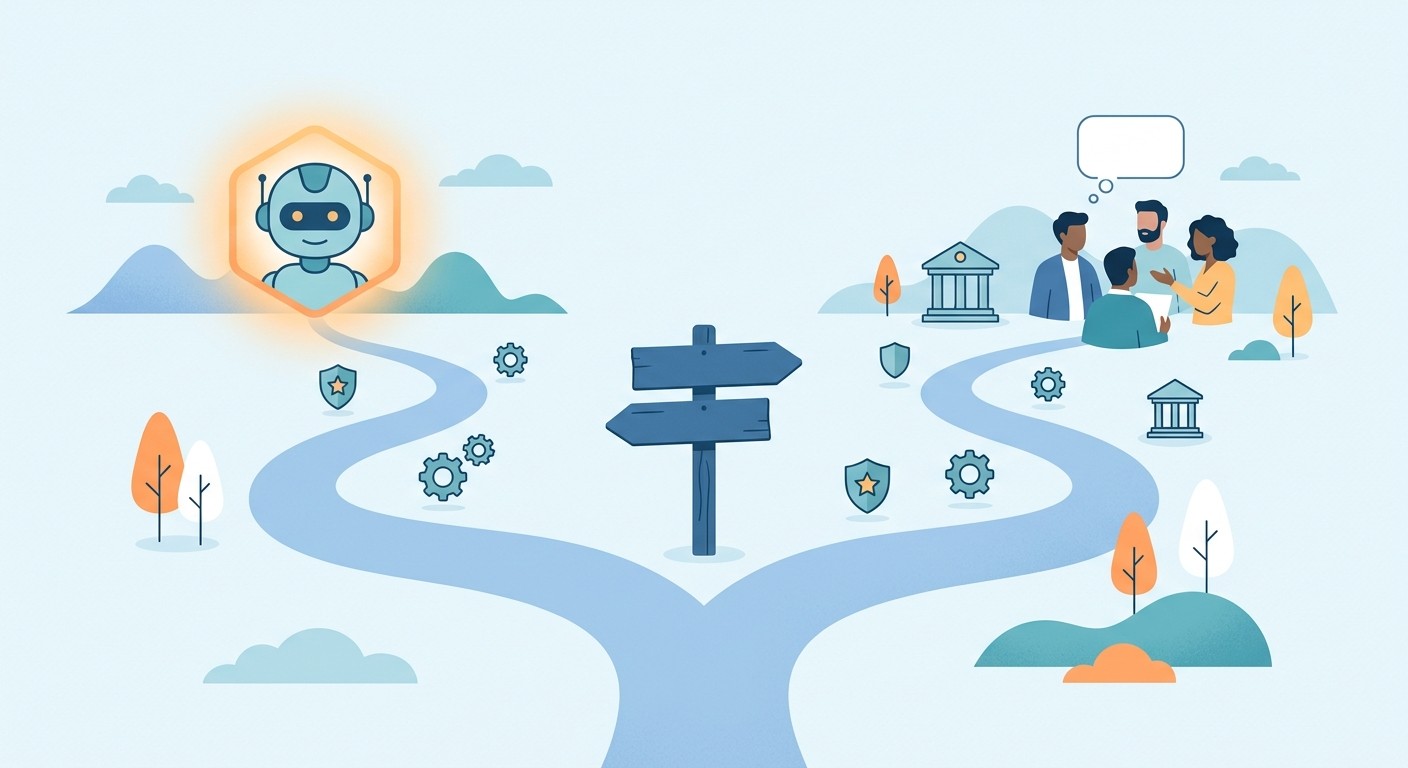
Match the approach to the cost of being wrong. That single question resolves most of the debate.
Your situation | Lean AI-powered | Lean traditional |
|---|---|---|
Validating an unproven idea | Yes | No |
Greenfield project, no legacy code | Yes | No |
Internal tool, small user base | Yes | No |
Boilerplate, CRUD, tests, docs | Yes | No |
Handling payments or health data | Assisted only | Yes |
Modifying a large legacy codebase | Assisted only | Yes |
Architecture meant to last five years | No | Yes |
Regulated industry with audit requirements | No | Yes |
No senior engineer available to review | No | Yes |
The last row deserves emphasis. AI-powered development without review capacity is not a faster version of traditional development. It is a system with the quality control removed, and the Faros data on unreviewed merges shows exactly what that produces.
The Hybrid Model Teams Settled On in 2026
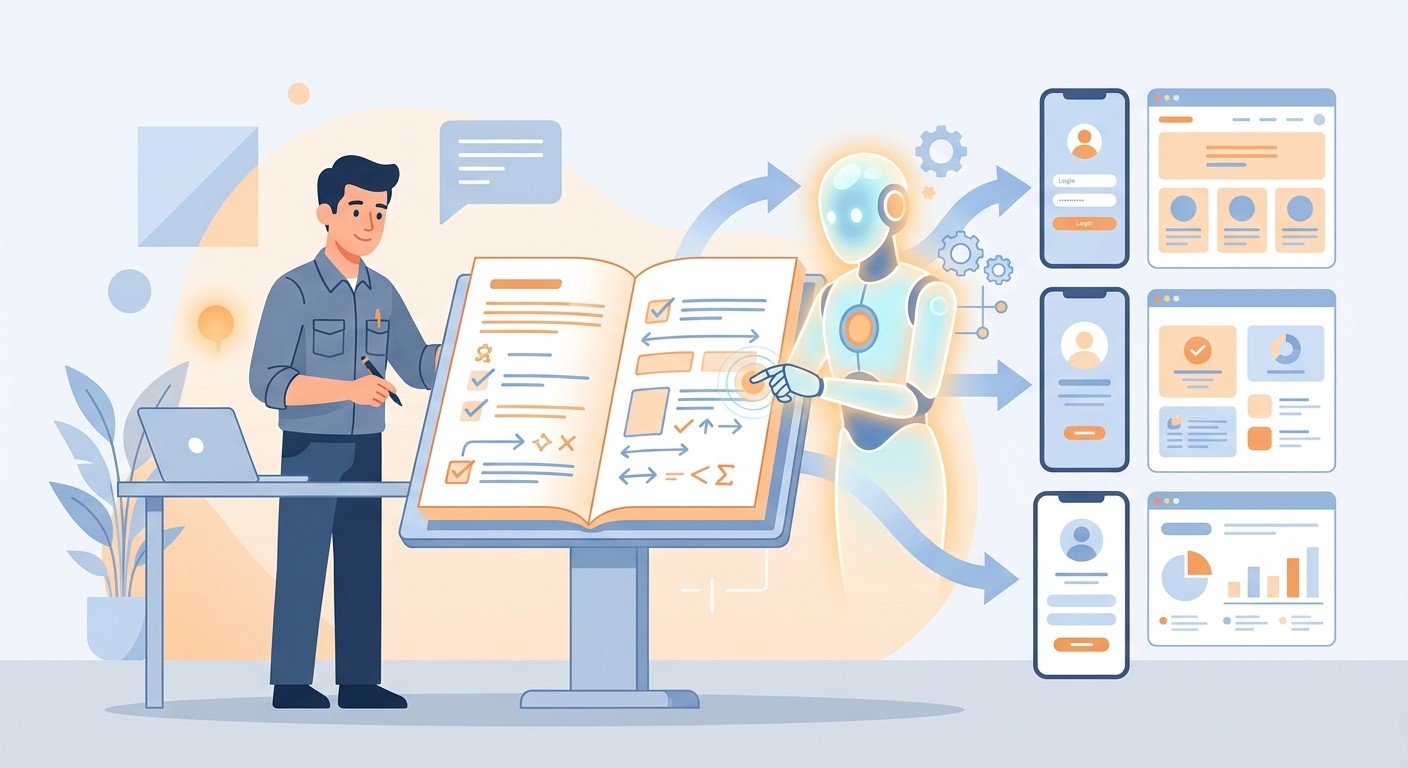
The methodology that emerged from the vibe coding hangover is spec-driven development. Instead of prompting an agent conversationally and hoping the result matches your intent, you write a version-controlled specification first, derive a plan from it, then let the agent implement against that contract.
The adoption signals are not subtle. GitHub's Spec Kit passed 90,000 stars, AWS took its spec-native Kiro IDE to general availability, and Thoughtworks added the practice to its Technology Radar. Andrej Karpathy, who coined the term vibe coding, has since described the vibe coding era as ending in favor of orchestrating agents against detailed specifications.
The reason it works is that it puts the judgment back upstream. The spec is where architecture, security requirements, and business rules get decided by a human. The agent handles volume. The specification survives the conversation, which matters because design decisions made in a chat window vanish when the window closes.
In practice, the split most teams land on looks like this:
Humans own the contract. Requirements, data model, security boundaries, and architecture.
AI owns the volume. Implementation, scaffolding, tests, migrations, and documentation.
Humans own the gate. Review, security scanning, and production approval, with review capacity budgeted as a real constraint.
Getting good output from step two is a learnable skill, and it is mostly about specificity. Our guide to writing better vibe coding prompts covers the patterns that hold up.
Will AI Replace Software Developers?
Not on current evidence, but the shape of the job market has changed sharply, and the change is concentrated at the entry level.
Indeed Hiring Lab data shows US software development postings grew almost 15% between the launch of Claude Code in late February 2025 and mid-2026, while overall job postings fell 7%. The catch is the composition: 71% of that increase came from senior roles. In the first quarter of 2026, entry-level positions made up just 4.5% of software development postings, the lowest share of any tracked occupation, while senior roles accounted for 69.3%. Stanford HAI's 2026 AI Index found entry-level software developer employment down nearly 20% from its 2024 peak.
So demand for engineers went up while demand for junior engineers went down. AI absorbed the work juniors used to learn on, which creates an obvious pipeline problem that the industry has not solved.
Gartner's read is that through 2027, generative AI will require 80% of the engineering workforce to upskill rather than shrink it. The skills that gained value are the ones AI does not have: system design, security reasoning, and knowing which of four plausible implementations will still make sense in three years. For a longer look at where this leads, see our guide on AGI for developers.
Frequently Asked Questions
What is the difference between AI and traditional software development?
Traditional software development relies on engineers writing code by hand, with every change reviewed by someone who understands the system. AI-powered development uses coding agents to generate code from natural language specifications, with humans reviewing the output. The practical difference is where the bottleneck sits: engineer availability in traditional development, review capacity in AI-powered development.
Is AI-generated code safe to use in production?
Only with review and security scanning. Veracode's Spring 2026 benchmark found AI coding tools achieve over 95% syntax correctness but roughly 55% security pass rates, a figure that has barely moved since 2023. AI-generated code should be treated as untrusted input regardless of which model produced it.
How much faster is AI-powered development?
It depends heavily on task type. DORA's 2026 ROI report cites Stanford research showing 35% to 40% gains on simple greenfield tasks but 10% or less on complex legacy code. Faros AI measured 66% more epics completed per developer under high AI adoption, though median review time rose 441.5% in the same period.
Is AI development cheaper than hiring a development team?
For prototypes, internal tools, and small applications, substantially. Clutch's 2026 data puts the average custom software project at about $132,480 over 13 months, against a monthly subscription for AI tooling. For large or regulated systems, the review, incident, and rework costs close much of that gap.
Will AI replace software developers?
Current data points to redistribution rather than replacement. Software development job postings rose almost 15% from early 2025 to mid-2026 per Indeed Hiring Lab, but 71% of the growth was senior roles, and entry-level postings fell to 4.5% of the total. Gartner expects 80% of engineers to need upskilling through 2027.
What is spec-driven development?
Spec-driven development makes a version-controlled specification the single source of truth instead of the code or the chat history. Humans define requirements, architecture, and constraints in the spec, then AI agents implement against it. When requirements change, you edit the spec and regenerate the affected code.
The Bottom Line
The question was never really AI vs traditional software development. Every credible 2026 dataset shows the same split: AI accelerates volume work and leaves judgment work exactly where it was. Scaffolding, tests, CRUD endpoints, and documentation are now close to free. Architecture, security reasoning, and understanding why a ten-year-old system behaves the way it does are not.
If you take one thing from the research, make it this: measure the cost downstream, not at the keyboard. A 66% throughput gain that arrives with 54% more bugs and a fivefold increase in review time is a real gain, but only if you funded the review capacity to absorb it.
For teams and founders who need working software rather than a development process, the practical path is to let an agent handle the build and keep a human on the specification and the gate.
Try CatDoes free and go from a description to a deployed app or website, with the code, the backend, and the deployment handled for you.
Nafis Amiri
Co-Founder of CatDoes


