Blog
Business
AI for Small Business: What It Can Do (2026)
AI for small business in 2026: where it saves you time across marketing, admin, and ops, plus the new AI agents that build your app or website without code.

Nafis Amiri
Co-Founder of CatDoes

TL;DR
AI for small business in 2026 is no longer just chatbots and copywriting. It now covers marketing, customer service, bookkeeping, scheduling, and the newest frontier: AI agents that build your app or website for you, no code required. This guide walks through every area where AI helps a small business today, where it still falls short, and how AI builders like CatDoes turn "I need an app" into a shipped product in an afternoon.
More than half of small businesses now use AI in some form, and the ones pulling ahead treat it as a teammate, not a toy. Below is a practical, no-hype look at what AI actually does for a small business owner, and how to start this week.
Table of Contents
What AI for Small Business Really Means in 2026
Where AI Helps a Small Business Right Now
The New Frontier: AI That Builds Your Product
How CatDoes Fits a Small Business
What AI Still Cannot Do for You
How to Start Using AI in Your Small Business
Frequently Asked Questions
The Bottom Line
What AI for Small Business Really Means in 2026
AI for small business means using artificial intelligence tools to do the work you never have time for: writing, designing, answering customers, tracking money, and now building software. The 2026 shift is that AI moved from "assistant that drafts text" to "agent that completes whole tasks," including shipping a working app or website.
The adoption numbers back this up. According to the U.S. Chamber of Commerce, 58% of small businesses used generative AI in 2025, up from 40% in 2024 and just 23% in 2023. A June 2026 U.S. Chamber Foundation study found that half of small business workers now use AI at work, mostly to get more done rather than to cut jobs. The trend is clear: AI has gone from novelty to normal.
The important nuance is what kind of AI you use for what job. A single chatbot can draft an email, but it cannot design your logo, reconcile your invoices, and build your booking app. That takes a stack of specialized tools, and the smartest owners mix a few rather than betting on one.
Where AI Helps a Small Business Right Now

AI earns its keep across almost every function of a small business. Here is where it delivers real time savings today, function by function.
Marketing and content
This is where most owners start. AI writes blog posts, social captions, product descriptions, and email campaigns in minutes instead of hours. Tools like ChatGPT and Jasper handle copy, while Canva Magic Studio produces on-brand graphics without a designer. For a solo founder, this is the difference between posting weekly and posting never. For a deeper breakdown of the specific tools, see our roundup of AI tools built for small business owners.
Customer service
AI chat widgets and email responders now handle the repetitive questions that eat your afternoon: hours, pricing, order status, refunds. A well-trained bot deflects a large share of routine tickets and hands the tricky ones to a human. The result is faster replies for customers and fewer interruptions for you.
Bookkeeping and admin
AI features inside accounting tools categorize expenses, flag anomalies, chase late invoices, and draft your monthly summary. Scheduling assistants read your calendar and book meetings without the back-and-forth. None of this is glamorous, but it is exactly the low-value, high-frequency work that drains an owner's week.
Operations and decisions
AI turns your messy spreadsheets into plain-English answers. Ask which product line is most profitable, which customers are about to churn, or what to reorder, and modern tools give you a usable answer without a data analyst. It will not replace your judgment, but it removes the grunt work that used to stand between you and the decision.
The New Frontier: AI That Builds Your Product

Here is the shift most guides miss. For years, "AI for small business" meant AI that helps you market or manage a business. In 2026 it also means AI that builds the actual product, your app or website, from a plain-English description. This is the category CatDoes is in, and it changes what a non-technical owner can ship.
The old options were bad for small budgets. Hiring an agency cost five figures and took months. Learning to code took years. No-code drag-and-drop builders were faster but hit a wall the moment you wanted something custom. AI app builders remove that trade-off: you describe what you want, and an agent writes, deploys, and maintains real software for you.
Concretely, that means a bakery can get an online-ordering app, a gym can get a class-booking system, and a consultant can get a client portal, without any of them writing a line of code. If you are hunting for ideas, our list of web app ideas for small businesses is a good starting point.
How CatDoes Fits a Small Business
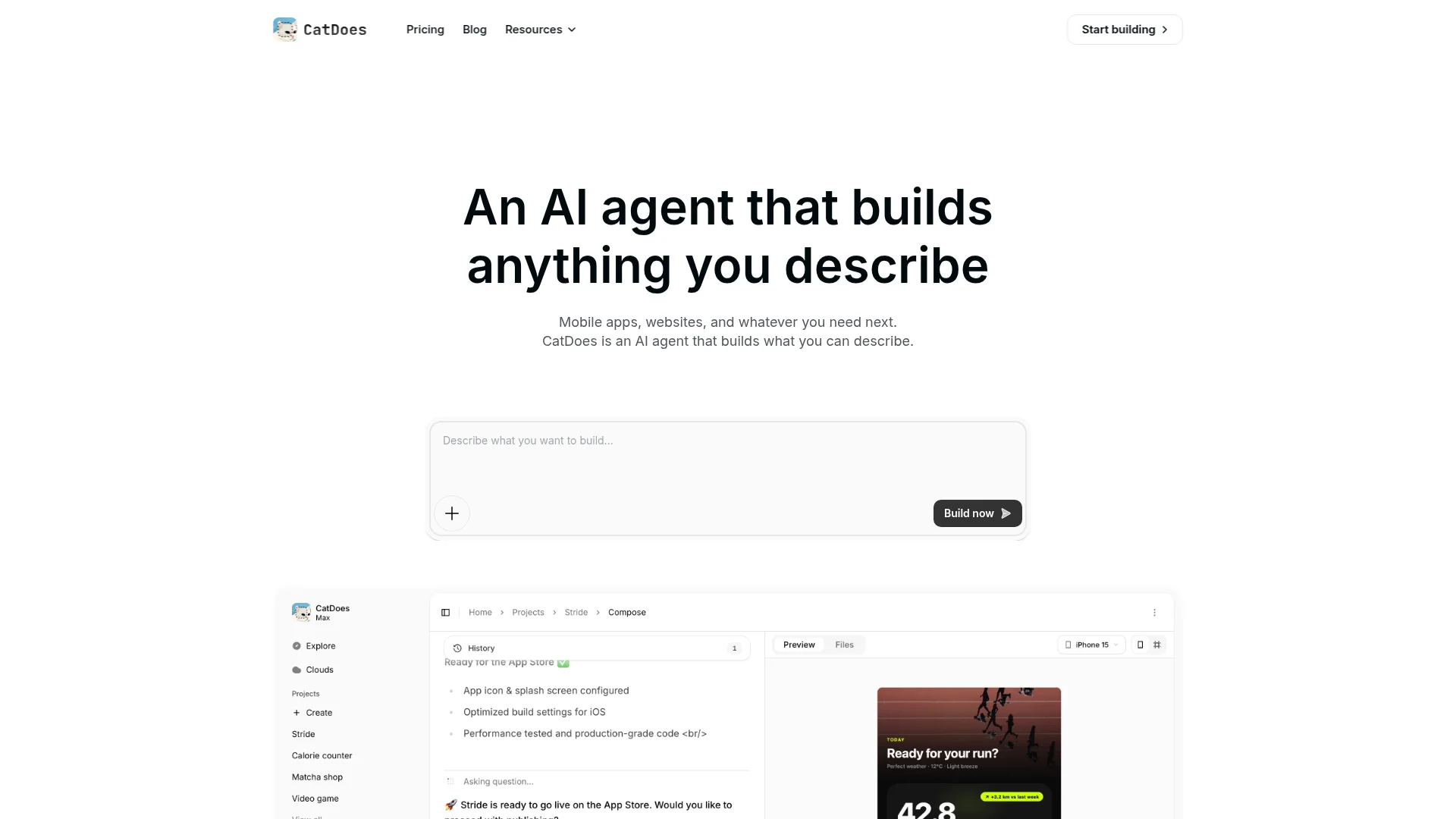
CatDoes is an AI agent that builds, deploys, and maintains mobile apps and websites from natural language. You describe your idea in plain English, the agent builds it in the cloud, and it ships to the App Store, Google Play, or the web with a custom domain. That is the whole loop, from idea to live product, handled by one AI.
For a small business, three things make this practical rather than a demo:
No technical background needed. You do not manage servers, databases, or app store submissions by hand. The agent handles the plumbing so you can focus on your business.
A real backend is included. CatDoes Cloud gives every project a database, user accounts, file storage, and more, so your app can actually store orders, log in customers, and hold data, not just look pretty.
It maintains what it builds. When you need a change, you ask for it in plain English. The agent updates the app and redeploys, so your product keeps up with your business instead of freezing the day the freelancer left.
The point is not that CatDoes replaces every tool on this page. You will still use a chatbot to draft copy and a design tool for graphics. The point is that the one job that used to be off-limits to non-technical owners, building your own software, is now on the table. Before you build, it is worth reading up on what your small business website needs so the thing you ship actually converts.
What AI Still Cannot Do for You
A balanced view matters, because overtrusting AI is how small businesses get burned. AI is a force multiplier, not an autopilot, and a few jobs still belong to you.
Judgment and strategy. AI can list options and draft plans, but deciding what business to run and who to serve is yours. It optimizes; it does not choose.
Real relationships. A bot can answer FAQs, but the loyal-customer conversation, the supplier you trust, the referral partner, those are human.
Fact-checking and taste. AI still makes confident mistakes. Every invoice number, legal claim, and published sentence needs a human glance before it goes out.
Treat AI output as a strong first draft, not a final answer. The owners who win with AI are the ones who review, edit, and add the judgment a model cannot.
How to Start Using AI in Your Small Business
You do not need a strategy deck. Pick one painful, repetitive task and hand it to AI this week. Here is a simple order of operations.
1. Name your biggest time sink. Writing posts? Answering the same emails? Chasing invoices? Start where the pain is loudest.
2. Pick one tool for it. Match the tool to the job: a chat assistant for writing, a design tool for graphics, an AI builder for software. Do not adopt ten tools at once.
3. Try it on a real task. Use it on this week's actual work, not a test. You will learn its limits fast.
4. Keep a human in the loop. Review every output before it reaches a customer. Trust, then verify.
5. Add the next tool once the first sticks. Layer in capabilities as each one earns its place. When you are ready to build your own app or website, that is where an agent like CatDoes comes in.
Frequently Asked Questions
What is the best AI for a small business?
There is no single best AI, because different jobs need different tools. Most small businesses combine a general chat assistant for writing, a design tool for graphics, and, increasingly, an AI builder like CatDoes to create their app or website. Start with the tool that solves your loudest problem, then add more.
Is AI for small business expensive?
Most tools are affordable, with free tiers and paid plans typically ranging from around $20 to $200 a month. Compared with hiring, the math is usually favorable: a single AI subscription can replace hours of freelance work each month. The bigger cost is time spent learning, not money.
Can AI build an app for my business without coding?
Yes. AI app builders like CatDoes let you describe your app in plain English and handle the coding, backend, and deployment for you. You get a real, working app on the App Store, Google Play, or the web without writing code or hiring a developer.
Will AI replace my employees?
For most small businesses, no. Survey data shows the majority of small business workers use AI to get more done, not to cut jobs. AI handles repetitive tasks so your team can focus on the work that needs human judgment and relationships.
The Bottom Line
AI for small business in 2026 is broad and genuinely useful: it writes, designs, answers, tracks, and now builds. The owners who benefit most are not chasing every shiny tool. They pick a few, keep a human in the loop, and let AI absorb the repetitive work that used to eat their week.
If you are still weighing what to build rather than how to run it, compare 12 businesses you can start solo in 2026 by startup cost and time to first revenue.
The biggest change is that building your own software is finally within reach. If "I wish I had an app for that" has been on your list for years, an AI agent can now make it real. Try CatDoes and describe the app or website you have been putting off, then watch it get built.
Nafis Amiri
Co-Founder of CatDoes


