
Blog
Tutorials
What Is Agile Software Development Methodology Explained
Understand what is agile software development methodology. This guide explores core values, principles, and frameworks like Scrum that drive results.

Nafis Amiri
Co-Founder of CatDoes
Agile software development isn't about having a perfect, rigid plan. It’s a philosophy centered on flexibility and collaboration, designed to build better products by adapting to reality. Instead of locking in every detail from day one, Agile teams work in short, fast cycles to build, test, and get feedback on small pieces of the product, over and over again.
From Rigid Blueprints to Adaptive Building
Think about the old way of building software, often called the Waterfall model. It worked just like constructing a skyscraper. You’d need a complete architectural blueprint before anyone could even think about pouring the foundation. Once you started building, changing that plan was a nightmare, incredibly expensive and slow.
For decades, that was the standard. But it was a terrible fit for the fast-moving world of technology. This rigidity often led to projects that were late, over budget, and delivered features nobody wanted anymore. Before diving deep into Agile.
This growing frustration finally came to a head in February 2001. A group of 17 pioneering software developers met at a ski resort in Utah, determined to find a better way. They came away with the Agile Manifesto, a simple but powerful document built on four core values that flipped the old model on its head.
The Agile Philosophy in Action
So, what does this actually look like day-to-day? Imagine you’re building a custom home. Instead of the architect handing you a finished blueprint and disappearing for a year, you work with the builder one room at a time. They build the kitchen, you walk through it, give your feedback, and they apply those lessons as they move on to the living room.
That’s Agile in a nutshell.
Projects are broken down into small, manageable chunks of work. Teams tackle these chunks in short cycles called sprints, which usually last from one to four weeks. At the end of each sprint, they deliver a small but genuinely working piece of the product. This iterative rhythm has some huge advantages:
Continuous Feedback: Stakeholders see and use the product early and often, which means the final result is far more likely to be what they actually need.
Greater Adaptability: Did a competitor launch a new feature? Did you get a brilliant new idea? No problem. The team can easily pivot and adjust priorities for the next sprint.
Reduced Risk: Instead of discovering a massive, project-killing problem months down the line, issues are found and fixed within a single sprint.
Faster Delivery: You get a usable product into the hands of real customers much sooner, allowing you to start learning and earning value almost immediately.
The core idea of Agile is to embrace uncertainty. It accepts that you can’t possibly know everything at the start of a project and gives you a framework for learning and adapting as you go.
This simple shift changes everything. Product development moves from being a high-stakes, all-or-nothing gamble to a flexible, collaborative journey focused on delivering real value, step by step.
To quickly grasp these foundational concepts, the table below breaks down the key characteristics of the Agile methodology.
Core Characteristics of Agile Methodology at a Glance
Characteristic | Description |
|---|---|
Iterative Approach | Work is done in short, repeated cycles (sprints), delivering small, functional pieces of the product each time. |
Customer Collaboration | Clients and stakeholders are involved throughout the entire process, not just at the beginning and end. |
Adaptive Planning | Plans are flexible and expected to change as new information and feedback become available. |
Incremental Delivery | The product is built piece by piece, allowing for early delivery of value and continuous improvement. |
Team Empowerment | Self-organizing teams are trusted to make decisions and manage their own work to achieve goals. |
Focus on Value | Prioritizes delivering the most valuable features to the customer first. |
Each of these traits reinforces the central goal: to respond to change effectively and build products that truly meet user needs.
The Values and Principles of the Agile Manifesto
To really get what Agile is about, you have to go back to its source: The Manifesto for Agile Software Development. Back in 2001, a group of developers got together and wrote this down, not as a rigid set of rules, but as a clear statement of priorities. It’s a simple document that outlines four core values, pushing for a more human-centered and adaptive way of building software. Turning those principles into daily practice is its own skill, which we cover in managing software development projects.
These values aren't about throwing the old ways out completely. Instead, they’re about shifting focus to what actually works.
The Four Core Values of Agile
The real power of the Manifesto is how it cuts through the noise and zeroes in on what makes software projects succeed.
Individuals and interactions over processes and tools. This is all about championing direct communication. It’s a simple reminder that a quick chat between two developers will solve a problem far more effectively than a clunky ticketing system ever could. Great people working together will always beat a complicated process.
Working software over comprehensive documentation. Agile teams focus on shipping functional code that users can actually click on and test. While documentation has its place, the true measure of progress is a product that works, not a mountain of paperwork describing how it’s supposed to work.
Customer collaboration over contract negotiation. Instead of trying to lock every single detail into a contract before a single line of code is written, Agile thrives on a continuous partnership with the customer. This constant feedback loop ensures the team is always building what the customer actually needs, not just what was agreed upon months ago.
Responding to change over following a plan. Let’s be honest: change is inevitable in software. Agile doesn't just accept this reality; it embraces it. A project’s success is measured by the final value it delivers, not by how perfectly it stuck to its original, outdated plan.
This diagram helps visualize how the high-level philosophy of Agile breaks down into the actual work teams do day-to-day.
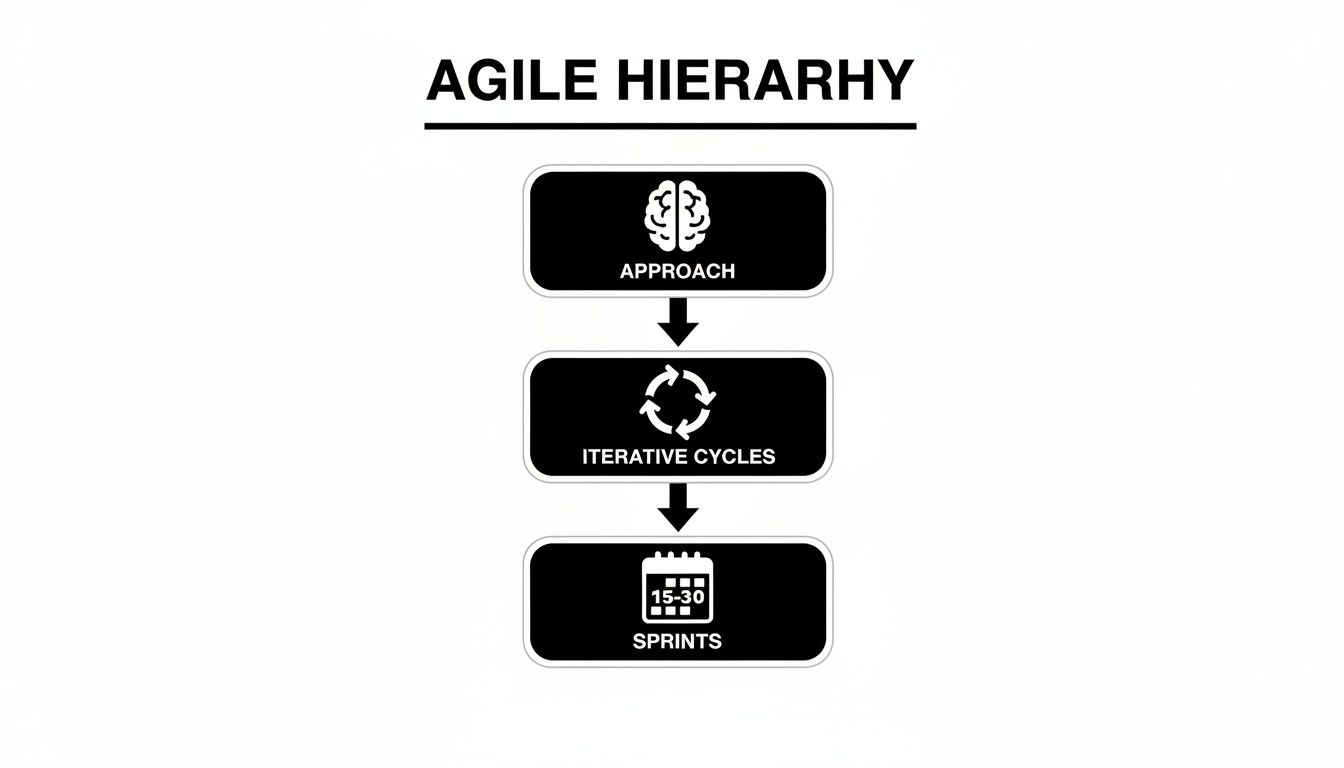
You can see how the broad Agile approach is put into practice through iterative cycles, which are further broken down into focused work periods called sprints.
The Twelve Supporting Principles in Action
Backing up these four values are twelve supporting principles that offer more practical guidance. Think of them as the "how-to" for living the values. They touch on everything from customer satisfaction to team dynamics and technical quality.
"Our highest priority is to satisfy the customer through early and continuous delivery of valuable software."
This first principle really sets the stage. It’s not just about building stuff; it’s about consistently delivering value into the hands of real users so you can get feedback and make the product better.
One of the most powerful principles is, "Welcome changing requirements, even late in development." This is where Agile really proves its worth. Imagine your team is building a new social media app. Halfway through, early user testing reveals a planned "event calendar" feature is just confusing people. What they really want is a dead-simple way to share photos.
In a traditional Waterfall project, that discovery would be a catastrophe, sparking contract renegotiations and massive rework. For an Agile team, it’s a gift. They can pivot in the very next sprint to build the photo-sharing feature the users are asking for. That ability to adapt is what separates a successful product from a failed one, and it's the heart of what makes the agile software development methodology so effective.
Putting Agile into Practice with Popular Frameworks
If the Agile Manifesto is the philosophy, then Agile frameworks are the playbooks. They are the practical systems that turn those big ideas into daily routines for your team. Think of them as different recipes that all follow the same core principles of good cooking.
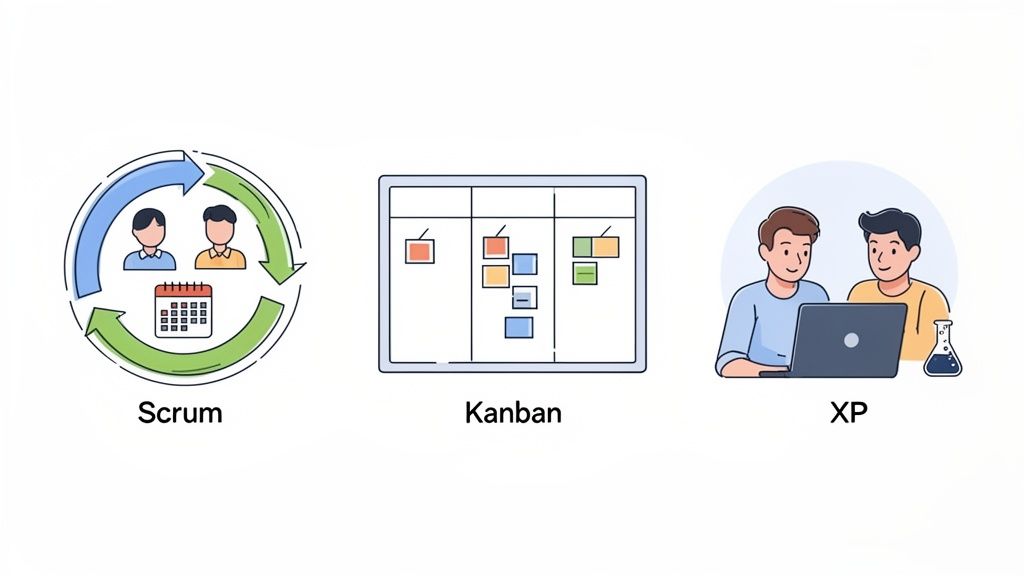
Each framework gives you a specific structure, a unique vocabulary, and a clear set of practices. This lets you pick the approach that feels right for your team’s workflow and your company’s culture. While dozens of frameworks exist, three have become the go-to choices for good reason: Scrum, Kanban, and Extreme Programming (XP).
Scrum: The Structured Sprint
Scrum is easily the most popular kid on the block, used by around 63% of Agile teams. Its entire rhythm is built around short, focused bursts of work called sprints. A sprint is a protected, time-boxed period, usually one to four weeks, where the team commits to finishing a specific chunk of work from their master to-do list, the product backlog.
To keep things running smoothly, Scrum defines a few key roles. The Product Owner decides what gets built and in what order. The Scrum Master is a coach and facilitator, making sure the team sticks to the process and clearing any roadblocks. And the Development Team is the group of experts who actually design, build, and test the product.
Scrum also relies on a cadence of regular meetings (often called "ceremonies") to keep everyone aligned. There’s Sprint Planning to kick things off, Daily Standups for quick syncs, Sprint Reviews to demo completed work, and Sprint Retrospectives to reflect and improve the process for next time.
Kanban: The Visual Workflow
If Scrum is a structured race, Kanban is a continuous, steady flow. Picture a busy coffee shop: orders are taken, drinks are made, and then they're served. Kanban brings that same visual logic to software development with a Kanban board. Tasks are represented by cards that move across columns like "To Do," "In Progress," and "Done."
The main goal here is to optimize the workflow and spot bottlenecks before they cause a pile-up. Kanban’s secret weapon is the Work in Progress (WIP) limit. This is a simple rule that restricts how many tasks can be in any one column at the same time.
By limiting how much work can be "in progress" simultaneously, Kanban forces teams to focus on completing tasks before starting new ones. This simple rule dramatically improves efficiency and exposes hidden process problems.
Unlike Scrum's fixed sprints, Kanban is all about continuous delivery. As soon as the team finishes a task and has capacity, they simply pull the next most important item from the backlog. This makes it perfect for teams dealing with a constant stream of unpredictable requests, like IT support or content creation.
Extreme Programming (XP): The Engineering Focus
Extreme Programming, or XP, is an Agile framework that’s laser-focused on technical excellence and high-quality code. It was designed to help smaller teams build better software while gracefully handling ever-changing customer needs. XP takes the core ideas of Agile and dials them up to eleven with a set of disciplined engineering practices.
A few of XP's signature practices include:
Pair Programming: Two developers share one computer. One writes the code while the other reviews it in real-time, catching errors and suggesting improvements. This leads to higher-quality code and spreads knowledge across the team.
Test-Driven Development (TDD): This flips the usual process on its head. Developers write an automated test before writing the code to make the test pass. It ensures every piece of functionality is covered by a test from the start.
Continuous Integration: Developers constantly merge their code changes back into a central repository, often multiple times a day. This practice catches integration bugs early, when they’re still small and easy to fix.
XP is a fantastic fit for projects where code quality and reliability are non-negotiable and requirements are expected to change. That disciplined approach is especially valuable for something like agile mobile app development, where a buggy release can sink your ratings.
To help you see the differences at a glance, here’s a quick comparison of the three frameworks.
Comparing Agile Frameworks Scrum vs Kanban vs XP
Aspect | Scrum | Kanban | Extreme Programming (XP) |
|---|---|---|---|
Cadence | Fixed-length Sprints (e.g., 2 weeks) | Continuous flow | Short iterations (e.g., 1-2 weeks) |
Key Metric | Velocity (work per sprint) | Cycle Time (time per task) | Velocity and code quality metrics |
Roles | Product Owner, Scrum Master, Dev Team | No prescribed roles | Customer, Coach, Programmer, Tester |
Change | Discouraged during a sprint | Allowed anytime capacity exists | Welcomed throughout the cycle |
Best For | Projects with stable priorities that can be planned in chunks. | Teams with unpredictable workloads like support or maintenance. | Projects where technical quality and adaptability are critical. |
Ultimately, the best framework is the one that fits your team's unique rhythm and project goals. Many teams even blend practices from different frameworks to create a hybrid approach that works just for them.
The Real-World Benefits of Adopting Agile
Let's move past the theory. The real magic of Agile isn't in the frameworks themselves, but in the actual results it delivers for a business. Companies that truly embrace Agile don't just shuffle their processes; they fundamentally change how they compete and create value. The impact is felt everywhere, from happier, more engaged development teams to seriously impressed customers.
One of the biggest wins is unmatched adaptability. Business is never static. A new competitor pops up, customer tastes change seemingly overnight, or a new technology lands and shakes up the entire market. Agile’s short, iterative cycles mean your team can pivot on a dime instead of being stuck following a rigid plan they made a year ago.
Faster Time to Market
Agile teams work in quick bursts called sprints, and the goal of each one is to ship a small but working piece of the product. This step-by-step delivery means you can get a Minimum Viable Product (MVP) into the hands of real users way sooner than you’d think.
Launching an MVP fast is a massive advantage. You start gathering invaluable user feedback, maybe even generate some early revenue, and carve out a space in the market while your slower competitors are still stuck in planning meetings. This speed is a game-changer when you're hunting for that perfect product-market fit. As many successful founders will tell you, finding that alignment early is everything, and they often credit iterative development for helping them uncover winning strategies for achieving product-market fit.
An Agile startup can easily outmaneuver a larger, more established competitor by focusing on shipping the most critical features first. While the big company spends months in meetings, the startup has already launched, learned from its first 1,000 users, and is already building a better version.
Enhanced Stakeholder Engagement and Alignment
Traditional development can feel like a black box for stakeholders. They wait months for the "big reveal," only to find out it's not what they wanted. Agile completely flips this script by making feedback a constant, built-in part of the process.
Regular Demos: At the end of every sprint, the team shows off the actual working software to stakeholders. No smoke and mirrors, just real progress.
Continuous Feedback: This creates a steady rhythm where stakeholders can see what's happening, ask questions, and steer the project in the right direction.
Shared Ownership: This collaborative vibe makes sure everyone is on the same page. The final product ends up perfectly aligned with business goals, killing the risk of building the wrong thing.
Improved Team Morale and Productivity
Finally, Agile is great for the people actually doing the work. It empowers development teams by giving them ownership and trusting them to figure out the best way to get things done. This autonomy is a huge motivator.
When teams are trusted to self-organize, it builds a culture of accountability and a desire to constantly get better. Seeing the direct impact of their work every couple of weeks gives morale and job satisfaction a serious boost. This focus on a sustainable pace and high quality connects directly to how software gets deployed. You can dive deeper into the technical side of this by checking out these continuous deployment best practices.
How Agile Compares to the Traditional Waterfall Model
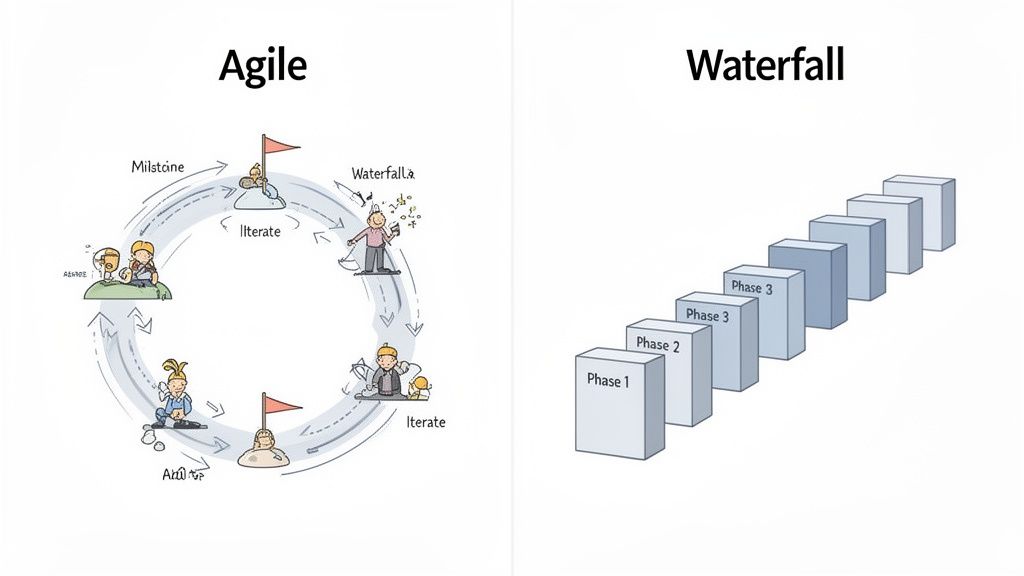
To really appreciate what makes Agile so powerful, it helps to look at what came before it. For decades, the software world ran on the Waterfall model. It’s a rigid, linear approach where a project cascades neatly from one phase to the next, just like a waterfall.
Think of building a car on a classic assembly line. First, you have to completely finish the design. Then you build the frame. After that, you install the engine. You can’t move to the next step until the previous one is 100% done, and trying to go backward is a nightmare. This is great for manufacturing physical products, but it crumbles in the ever-changing world of software.
Flexibility and Responding to Change
The biggest difference between the two is how they deal with change. Waterfall sees change as an enemy to be defeated. All requirements get defined and locked in stone right at the start. So, if the market suddenly shifts or a client gets a brilliant new idea six months in, the plan simply can't cope.
Agile, on the other hand, is built to embrace change. By working in short cycles, Agile teams fully expect and welcome new information. It’s this fundamental difference that has made Agile the go-to approach for building software in today's fast-moving markets.
Customer Feedback and Involvement
Another key battleground is customer involvement. In a typical Waterfall project, the customer is deeply involved at the very beginning to set requirements, and then they disappear until the very end for the "big reveal." That huge gap in the middle is a black box, creating a massive risk that the final product won't be what they actually wanted.
Agile completely flips this. It turns customer collaboration into an ongoing conversation. Stakeholders see and touch working software at the end of every single sprint, giving constant feedback that steers the project. This makes sure the team is always building what the customer truly needs, not just what was written down in a document months ago.
The Waterfall model's rigidity dominated software development from the 1970s through the early 2000s, but this approach came with a staggering 21% project failure rate. The rise of Agile, with its much lower 8% failure rate, marked a critical shift toward building more reliable and relevant software. Discover more insights about how Agile changed software development on Ideamatics.com.
When Waterfall Might Still Fit
Despite its flaws for modern software, the Waterfall model isn't completely useless. It can still be the right call in a few, highly predictable situations.
Fixed Requirements: When a project's needs are perfectly understood, documented, and guaranteed not to change. Think simple and straightforward.
Strict Regulatory Constraints: In industries with heavy compliance rules, the structured documentation and formal sign-offs of Waterfall can actually be a huge help for audits.
Simple, Small-Scale Projects: If the project is small, the outcome is crystal clear from day one, and there are no unknowns, a linear path can be efficient.
For pretty much everything else in the software world, where uncertainty and change are guaranteed, Agile’s adaptive approach provides a much smarter path to success.
Supercharging Your Agile Journey with CatDoes
Understanding Agile is one thing. Actually putting it into practice, especially when you’re moving fast, is a whole other challenge. This is where modern tools really make a difference, with platforms built from the ground up to make an agile workflow feel almost automatic.
CatDoes acts as a complete agile delivery system, designed to turn your ideas into a working app with incredible speed. It doesn't just support Agile; its core features are built around Agile values, making the whole process accessible whether you have a technical background or not. Think of it as your automated, always-on agile team.
From Conversation to Working Software
Agile is all about collaboration and getting a working product into people's hands quickly. CatDoes mirrors this perfectly with its conversational workflow. Forget about writing massive, detailed specification documents. You just describe what your app needs to do in plain English.
An AI Requirements agent listens and captures these needs, acting just like a product owner gathering user stories from stakeholders. This simple step cuts out all the usual friction between an idea and the first line of code. It’s a direct translation of collaborative input into a tangible starting point, which is the heart and soul of kicking off an agile project.
CatDoes takes the messy, chaotic beginning of a project and turns it into a structured, actionable backlog in minutes. This is the very definition of the agile principle "working software over comprehensive documentation," because it prioritizes a functional starting point above everything else.
This immediate translation from concept to a build-ready plan lets you validate ideas almost instantly, ensuring your project is on the right track from day one.
Continuous Feedback and Instant Previews
The feedback loop is the engine of any agile process. Teams build, stakeholders review, and the product gets better with each cycle. CatDoes bakes this loop right into the platform. As soon as you define your app's features, you get an instant, interactive preview right in your browser.
Even better, you can scan a QR code to test a live version on your iPhone or Android. This feature acts as a personal continuous delivery pipeline, giving you a real product to review at any moment.
Immediate Stakeholder Review: Share the QR code with teammates or potential customers to get feedback, just like you would in a sprint review.
Rapid Iteration: Take that feedback, refine your requirements in plain English, and watch the AI agents rebuild the app with your changes in minutes, not weeks.
Reduced Risk: By testing constantly, you spot design flaws and usability problems early, avoiding expensive rework later on.
This constant cycle of building and testing shrinks the feedback loop from weeks to minutes, massively accelerating your path to a market-ready app.
Responding to Change with AI Agents
The true test of agility is how well you respond to change. When a new idea pops up or user feedback demands a pivot, you need to be able to react without derailing the project. The platform's multi-agent system works like an automated development team that's always ready.
When you update your requirements, the AI Designer and Software agents immediately start implementing the changes. This creates a level of responsiveness that’s nearly impossible to achieve with a traditional team structure. CatDoes is more than a tool; it's an engine designed to bring your MVP or internal app to life faster than ever.
Got Questions About Agile? We’ve Got Answers.
As you start thinking about bringing Agile into your workflow, a few practical questions always pop up. It's one thing to understand the theory, but another to see how it works day-to-day. Let’s tackle some of the most common ones.
What Are the Main Stages of an Agile Project?
Even though Agile is flexible, projects still follow a general rhythm. The key difference from traditional methods is that this cycle repeats over and over in short bursts, not just once. Think of it as a loop, not a straight line.
Each iteration, or sprint, moves through five core stages:
Ideation: This is the starting line. It’s where the team, stakeholders, and product owner hash out the vision, define the business need, and decide which features are important enough to build in the next cycle.
Development: With a plan in hand for the sprint, the team starts building. This covers all the design, coding, and architectural work needed to create the first usable piece of the product.
Testing: In Agile, quality isn't an afterthought; it's woven into the entire process. As soon as a feature is built, it gets tested. This continuous feedback loop helps catch and squash bugs early, when they're cheap and easy to fix.
Deployment: Once a sprint's worth of work is built, tested, and gets the green light, it’s pushed live. This means a new, working version of the software is out in the world, delivering value to actual users.
Operations: The work doesn't stop at launch. This final stage is all about keeping the lights on, handling maintenance, listening to user feedback, and gathering the real-world data that fuels the ideation stage of the very next cycle.
Is Agile Just for Software?
Not anymore. While Agile got its start in the world of software development, its core ideas of flexibility, customer feedback, and making progress in small, steady steps are just too useful to stay in one industry.
Today, you’ll find Agile being used by all sorts of teams. Marketing departments run campaigns in short sprints, testing different ads and messages to see what resonates before committing a big budget. Product design teams use it to rapidly build and test prototypes, learning from user reactions with each new version. It's even found a home in fields like construction and education.
How Do You Actually Measure Success in Agile?
Success in an Agile project looks a little different. It’s less about rigidly sticking to an original plan and more about delivering real, tangible value to the people who use the product. While budgets and deadlines still matter, Agile teams focus on metrics that tell them if they're building the right thing.
The ultimate measure of success in an agile project is a satisfied customer. Key metrics often include cycle time (how long it takes to get a task from 'started' to 'done'), velocity (how much work a team can realistically handle in a sprint), and customer satisfaction scores.
These numbers aren't just for reports; they help the team see where they're getting stuck, understand their true capacity, and make sure they're consistently shipping a high-quality product that solves a real problem. The goal is always to get better, both at building the product and at working together as a team.
Ready to put these Agile principles into practice without the friction? CatDoes is an AI-native platform that turns your ideas into production-ready apps using a simple, conversational workflow. Experience the speed of true agile development and get your app to market faster than ever before. Start building for free today at https://catdoes.com.
Nafis Amiri
Co-Founder of CatDoes


