Blog
Insights
Aider vs Cursor (2026): Pricing & Features
Aider vs Cursor compared for 2026: current pricing, features, privacy, codebase context, and new agent workflows. See which AI coding tool fits your work.

Nafis Amiri
Co-Founder of CatDoes
Aider vs Cursor TL;DR: Pick Aider if you want a free, open-source terminal tool, your own model provider, local-model support, and automatic Git commits. Pick Cursor if you want strong autocomplete, visual diffs, a polished editor, and agents that can work locally, in the cloud, or on your own machines. Aider has no subscription fee but hosted models still cost money; Cursor has a limited free plan, with paid individual plans starting at $20 per month.
Table of Contents
Aider vs Cursor at a glance
What changed in Aider and Cursor in 2026?
Is Aider free? Aider vs Cursor pricing
Where Aider is better
Where Cursor is better
Codebase context, Git, and privacy
Which tool should you choose?
Aider vs Cursor vs Claude Code
FAQ
Sources
Aider vs Cursor at a glance
Aider and Cursor overlap on the big jobs: reading a repository, changing several files, and running development commands. They feel quite different once you start working, because each puts a different interface and control system around the model.
Aider is a terminal-first, open-source pair programmer. You choose the model and provider, add the files you want it to edit, and work through a Git-centered loop. Cursor is a proprietary coding platform built around an editor, Tab autocomplete, visual review, and a growing set of local and remote agents.
Category | Aider | Cursor |
|---|---|---|
Main interface | Terminal, plus an experimental browser UI | Desktop editor, Agents Window, CLI, web, and mobile |
License | Open source, Apache 2.0 | Proprietary |
Autocomplete | No inline Tab completion | Multi-line Tab completion |
Models | Bring your own provider or use a local model | Cursor and third-party models through Cursor |
Agent execution | Runs on your machine; can be scripted | Local, worktree, cloud, remote SSH, and self-hosted machines |
Git workflow | Automatic commits by default and an in-chat | Visual diffs, branches, pull requests, Cloud Agents, and Origin hosting |
Entry price | $0 for the software, plus model or local-compute costs | Free Hobby plan; Pro starts at $20 per month |
The blunt answer is that Aider gives you more control over the client, model, and bill. Cursor gives you more machinery around the model, especially if autocomplete and parallel agents are part of your daily work.
What changed in Aider and Cursor in 2026?
The gap between these products widened in 2026. Aider remained a focused open-source coding client, while Cursor expanded from an AI editor into an agent workspace and code-hosting platform.
Aider's current stable release and main branch
The latest stable aider-chat package on PyPI is version 0.86.2, released on February 12, 2026. The 0.86 line added GPT-5 support and reasoning settings on top of Aider's existing model-provider system.
The repository is more current than the stable package. Aider's main-branch history lists settings for newer GPT-5.x variants, Claude 4.5 through 4.7, Gemini 3 preview models, DeepSeek Reasoner, more repo-map languages, and a new /ok shortcut.
You can install that branch with --install-main-branch, but development code does not carry the same promise as the stable PyPI package. Keep that distinction in mind when choosing a model for production work.
Cursor 3 and the move to multi-agent work
Cursor 3, released in April 2026, introduced an Agents Window for running multiple agents across local repositories, Git worktrees, cloud environments, and remote SSH machines. The IDE is still there, but supervising agents now has its own workspace.
Cursor's August and September updates went further. Cloud Agents can subscribe to pull requests or Slack threads, keep a goal active, and give subagents separate virtual machines. Cursor also launched Origin code hosting in early beta, added repo-free project starts with live browser previews and Vercel publishing, and introduced self-hosted machines for teams that want tool execution inside their own network.
This makes an old description such as "Aider is the terminal tool, Cursor is the GUI" incomplete. Cursor still has the stronger visual editing experience, but its agents now run well beyond the editor. Aider remains the leaner choice when you want the client itself to stay local, open, and easy to combine with shell tools.
Is Aider free? Aider vs Cursor pricing
Aider is free and open source, but using Aider is not automatically free. The client has no subscription fee.
If you connect it to a paid API from Anthropic, OpenAI, Google, or another provider, you pay that provider's token rates. If you connect Aider to a local model through Ollama or an OpenAI-compatible endpoint, there may be no API bill, but you still supply the hardware and electricity.
There is no honest "typical Aider cost" that applies to everyone. The bill changes with the model, prompt size, output length, cache policy, and how much code is sent as context. Aider reports token use and estimated cost, which is more useful than an unsupported monthly average.
Cursor uses monthly plans with included model usage. Its current public pricing lists Hobby at $0, Pro at $20 per month, Pro+ at $60, Ultra at $200, Teams Standard at $40 per user, and Teams Premium at $120 per user.
Paid individual plans include Tab completions, broader Agent usage, Cloud Agents, and access to Cursor and third-party model pools. After included usage is exhausted, you can enable on-demand billing or move to a higher plan.
Cost question | Aider | Cursor |
|---|---|---|
Is there a free option? | Yes. The full client is free; local models can avoid API charges. | Yes. Hobby has limited Agent, Chat, and Tab usage. |
What does the paid entry cost? | No Aider subscription; pay the model provider you choose. | Pro costs $20 per month before tax. |
Can spending exceed the plan? | Yes, API use is metered by the provider. | Yes, if you enable on-demand usage. |
Can it run with a local model? | Yes, including through Ollama. | Cursor offers hosted model access; self-hosted machines change where tools run, not the product's licensing model. |
Aider can be cheaper for light use, local models, or a carefully chosen low-cost API. Cursor is easier to budget when its included usage covers your work. Heavy agent use can make either option expensive, so check your own token dashboard and billing settings instead of trusting a generic estimate.
Where Aider is better
Aider is strongest when you already like the terminal and want control over the full stack. It does not ask you to replace your editor, and it does not lock the client to one vendor's model catalog.
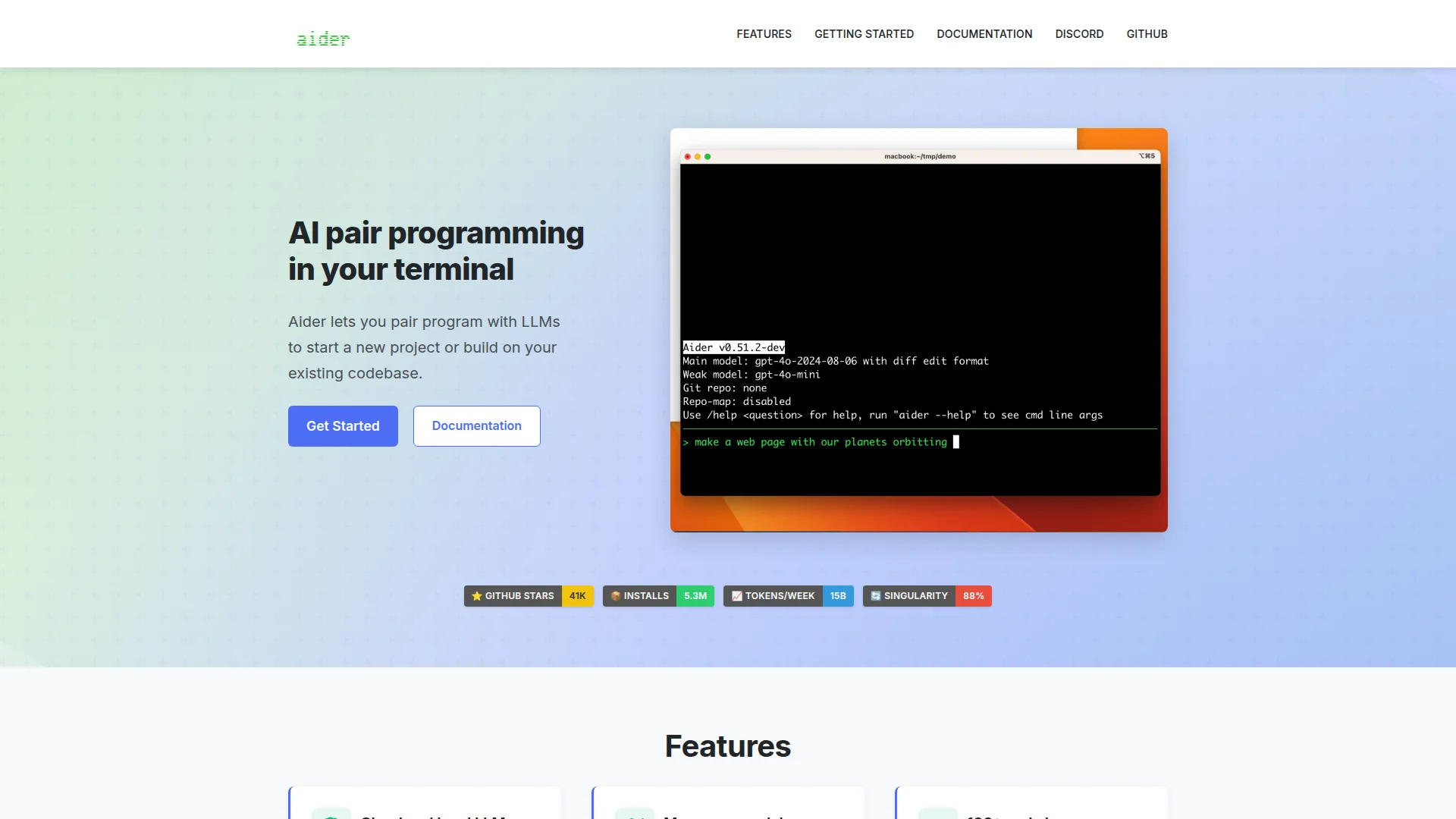
Model freedom: Aider connects to many hosted providers, OpenAI-compatible endpoints, and local Ollama models. You can change the main, architect, editor, and weak models separately.
Git discipline: Aider commits its edits by default, keeps pre-existing changes separate, and lets you revert the latest AI change with
/undo.Repository map: It sends the model a compact map of important classes, functions, types, and signatures instead of blindly pasting every file into the prompt.
Automation: Aider accepts one-shot messages from the command line, has a dry-run option, and can be driven from scripts. Its Python API exists too, though Aider says that API is not officially stable.
Local-first workflow: The client edits your local checkout and works beside Neovim, Emacs, VS Code, JetBrains, or any other editor.
The tradeoff is polish. Aider has an experimental browser interface, but no built-in equivalent to Cursor Tab.
File selection, model configuration, provider errors, and terminal permissions are your responsibility. A weak or poorly configured local model may also fail to produce edits in the format Aider expects.
Where Cursor is better
Cursor is better when the editor experience matters as much as the model. Its autocomplete, inline editing, visual diffs, code search, and agent controls live in one interface.
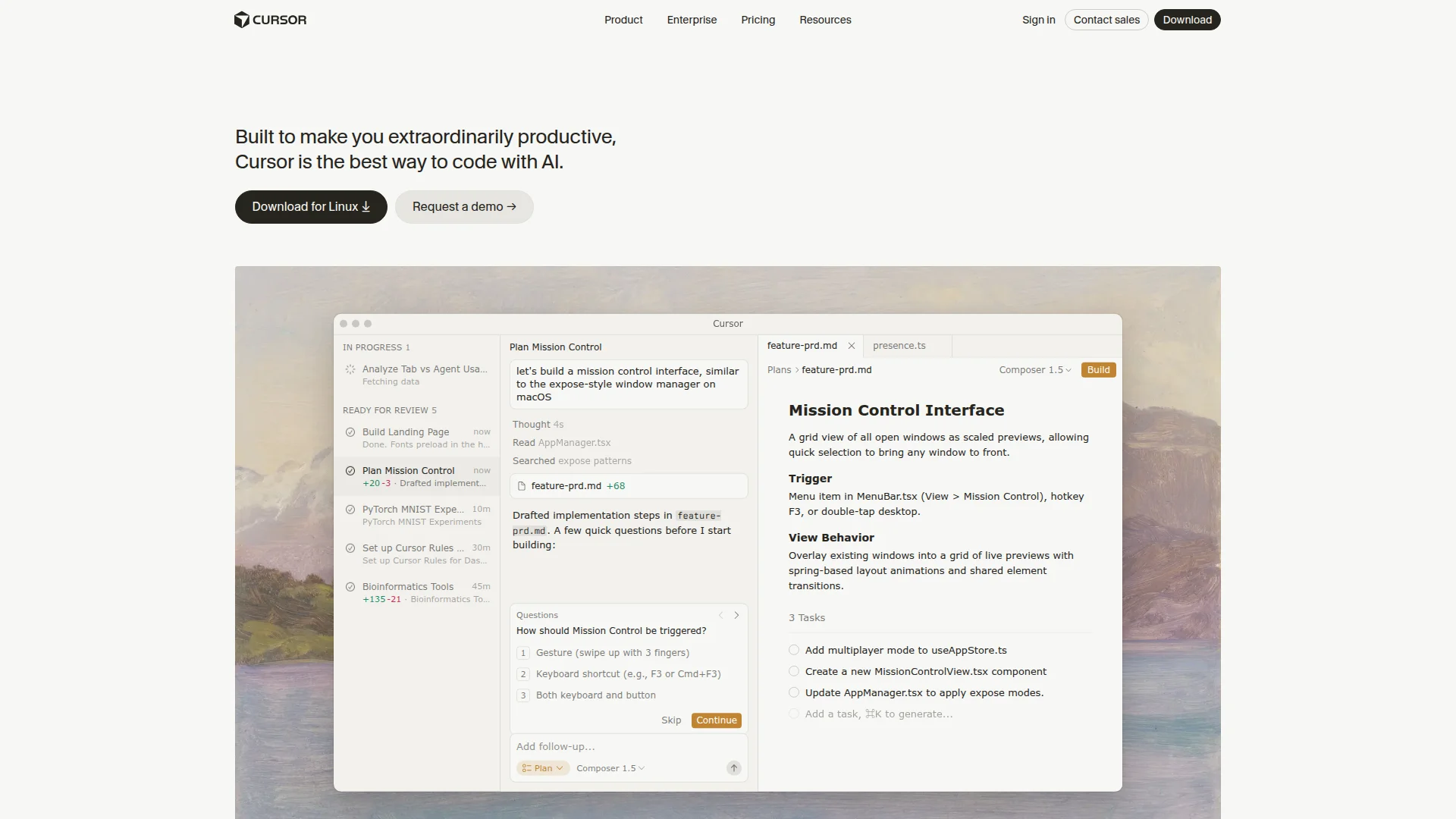
Tab completion: Cursor predicts multi-line edits while you type. Aider has no direct match for this part of the workflow.
Agent supervision: The Agents Window can run work locally, in worktrees, in the cloud, or over SSH. You can steer active agents and review their changes visually.
Remote execution: Cloud Agents can prepare branches and pull requests in the background. Automations can react to source-control events, schedules, Slack, Linear, PagerDuty, and webhooks.
More than an editor: Cursor now has a CLI, headless automation, web and mobile access, Bugbot reviews, integrations, and an early-beta Git host called Origin.
Team controls: Paid team plans add centralized billing, usage analytics, SSO, team-wide Privacy Mode, and a marketplace for internal rules, skills, and plugins.
Cursor's downside is dependence on Cursor's platform and billing. Even its CLI authenticates with Cursor, and choosing a third-party model draws from the relevant usage pool. The feature set also changes quickly, so teams need to watch release notes, plan limits, and security settings.
Codebase context, Git, and privacy
Aider and Cursor both avoid sending an entire repository with every request, but they do it differently. Aider builds a concise repo map and combines it with the files you add to the chat. Cursor indexes a codebase, searches that index for relevant context, and sends selected prompts and code context through its backend to model providers.
With Aider, the client runs locally, but your code context still goes to whichever hosted model provider you configure. A local model can keep that model traffic on your machine. Aider's optional analytics do not collect code or chat content, and users can disable analytics.
With Cursor, Privacy Mode means Cursor and its model providers do not use your code for training. It does not mean every feature runs offline.
Cursor says code context is sent to providers for AI requests, and its indexing flow uploads code chunks to compute embeddings. Teams can enforce Privacy Mode, and self-hosted machines can keep tool execution, build output, and secrets inside their network.
For Git, Aider favors small, automatic local commits. Cursor favors review inside the editor and can extend the workflow into branches, pull requests, Cloud Agents, and Origin. Choose the one that matches how your team already reviews and ships code.
Which tool should you choose?
Choose Aider if you want an open-source client, work comfortably in a terminal, need local models, or want to switch providers without changing tools. It is also a good fit when automatic Git commits and shell scripting matter more than autocomplete.
Choose Cursor if you want an easy visual workflow, rely on multi-line completion, or need several agents working across local and remote environments. It will feel simpler if you want one installed product for editing, agent work, reviews, and team administration.
You do not have to pick only one. Cursor can handle everyday editing and Tab completion while Aider runs focused terminal tasks with a provider or local model you choose. If you are comparing more editor-based options, see ChatGPT vs Cursor or our CatDoes vs Cursor comparison.
Aider vs Cursor vs Claude Code
Claude Code is no longer only a terminal tool. Anthropic now offers it in the terminal, supported IDEs, web, Slack, and other surfaces. It is included with paid Claude plans, starting with Pro at $20 per month, while Max offers higher usage at $100 or $200 per month.
Best fit | Why |
|---|---|
Aider | Open-source client, broad model choice, local models, and automatic Git commits |
Cursor | Editor workflow, Tab completion, multi-agent supervision, and cloud automation |
Claude Code | Anthropic-centered agent workflows across terminal, IDE, and remote surfaces |
Aider is the obvious pick when model freedom settles the decision. Cursor makes more sense when autocomplete and a visual control center matter most.
Claude Code belongs on the shortlist if you already pay for Claude and want its agent across several surfaces. Our Claude Code vs Codex guide covers that comparison in more depth.
FAQ
Is Aider free?
Yes. Aider is free, open-source software under the Apache 2.0 license. You still pay for a hosted model API unless you use a free provider allowance or run a compatible local model.
What is the latest Aider version?
The latest stable package on PyPI is aider-chat 0.86.2, released on February 12, 2026. Aider's main branch contains newer model settings and fixes, but development-branch features should not be confused with the stable package.
How much does Cursor cost in 2026?
Cursor's Hobby plan is free. Current monthly prices are $20 for Pro, $60 for Pro+, $200 for Ultra, $40 per user for Teams Standard, and $120 per user for Teams Premium. Taxes and on-demand model usage can add to those prices.
Does Aider have a GUI?
Aider is designed for the terminal, but aider --browser launches an experimental browser interface. It does not provide Cursor's full editor, inline diffs, or Tab autocomplete.
Can Aider run local models?
Yes. Aider supports Ollama and OpenAI-compatible local endpoints. Aider warns that smaller or less capable models may struggle with its structured edit formats, so local does not always mean equivalent quality.
Can Cursor run outside the Cursor editor?
Yes. Cursor has a CLI that works beside other editors and supports headless scripts and CI. Cursor also offers web, mobile, Cloud Agent, remote SSH, and self-hosted execution workflows.
Which is better for beginners, Aider or Cursor?
Cursor is usually easier for beginners because the chat, code, diffs, and autocomplete appear in one visual interface. Aider is easier to customize, but it assumes you are comfortable with Git, terminals, API keys, and model configuration.
If your real goal is to ship an app without managing an editor or terminal agent, an AI app builder may be the better category. You can also read our guide to vibe coding a mobile app.
Nafis Amiri
Co-Founder of CatDoes


