Blog
Insights
Best Website to App Converters Compared (2026)
I compared 7 website to app converters on price, output, and App Store approval. See which ones just wrap your site and which builds a real native app.

Nafis Amiri
Co-Founder of CatDoes

TL;DR: Most website to app converters wrap your site in a WebView. That is fast and cheap, but Apple's Guideline 4.2 rejects apps that do not go "beyond a repackaged website," and you never own what you paid for. CatDoes wins because it rebuilds your site as a real native iOS and Android app instead of wrapping it, with store deployment from $50/month and code export on Plus. If you already have an excellent mobile site and only want it in a shell, Median.co ($229 one-time) and WebViewGold ($109 per platform) are the best wrappers.
Table of Contents
What a Website to App Converter Actually Does
How I Compared These Converters
Website to App Converters Compared
1. CatDoes: Best Overall
2. Median.co: Best for Complex Web Apps
3. WebViewGold: Best One-Time Purchase
4. AppMySite: Best for WordPress and WooCommerce
5. GoodBarber: Best for Design Control
6. MobiLoud: Best Done-for-You Service
7. PWABuilder: Best Free Option
Why Apple Rejects Most Converted Websites
What Converting a Website to an App Really Costs
Which Converter Should You Choose?
Frequently Asked Questions
From Website to a Real App
You have a website that works, customers use it on their phones, and now you want it on the App Store. A website to app converter promises exactly that: paste a URL, get an app. Dozens of tools sell this, and nearly all of them do the same thing under the hood.
I checked the live pricing and documentation for every tool below in September 2026, because most comparison articles recycle numbers that no longer exist. MobiLoud is the clearest example: search results still quote a $399/month plan the company retired. Its current entry price is $1,499/month.
What a Website to App Converter Actually Does
A website to app converter takes your existing site and packages it for mobile app stores. Almost every tool in this category does it with a WebView, which is an embedded browser inside a native shell. Your app opens, loads your website, and displays it without the address bar.
That approach has real advantages. Site updates appear in the app instantly with no resubmission, and setup takes hours rather than months. Median.co states it plainly on its own site: "Yes, it's a wrapper app, but so much more!"
It also has three structural limits. The app can never be better than your mobile website. Most vendors never hand over the source code, so you rent the app for as long as you keep paying. And a thin wrapper is the most common reason a converted app gets rejected by Apple.
The alternative is to rebuild: generate an actual native app that talks to the same backend. That used to mean hiring developers, and AI builders changed the math, which is why CatDoes leads this list.
How I Compared These Converters
I scored every tool on four questions that decide whether you end up with an app you can actually ship and keep:
What does it produce? A WebView wrapper, or a genuinely native binary.
Can it reach both stores? Several tools are Android only on their cheaper tiers, which is easy to miss at checkout.
Do you own the output? Source code access decides whether you can leave.
Does it survive Guideline 4.2? Apple's minimum functionality rule is where repackaged websites die.
Every price below came from the vendor's live pricing page in September 2026. Where a vendor publishes in euros, I have kept euros rather than converting.
Website to App Converters Compared
Tool | Output | Starting price | Both stores | Source code |
|---|---|---|---|---|
CatDoes | Native iOS + Android rebuild | $50/mo (Starter) | Yes | Yes, on Plus |
Median.co | WebView wrapper | $229 once, then $179/yr | Yes | Yes, full |
WebViewGold | WebView source template | $109 once per platform | Yes | Yes, full |
AppMySite | WebView wrapper | $69/mo (iPhone from $129) | From Pro tier | No |
GoodBarber | Native Swift + Kotlin | EUR 36/mo (stores from EUR 70) | From Premium | No |
MobiLoud | Managed WebView | $1,499/mo | Yes, managed | No |
PWABuilder | TWA and WebView | Free | iOS experimental | Yes, open source |
1. CatDoes: Best Overall
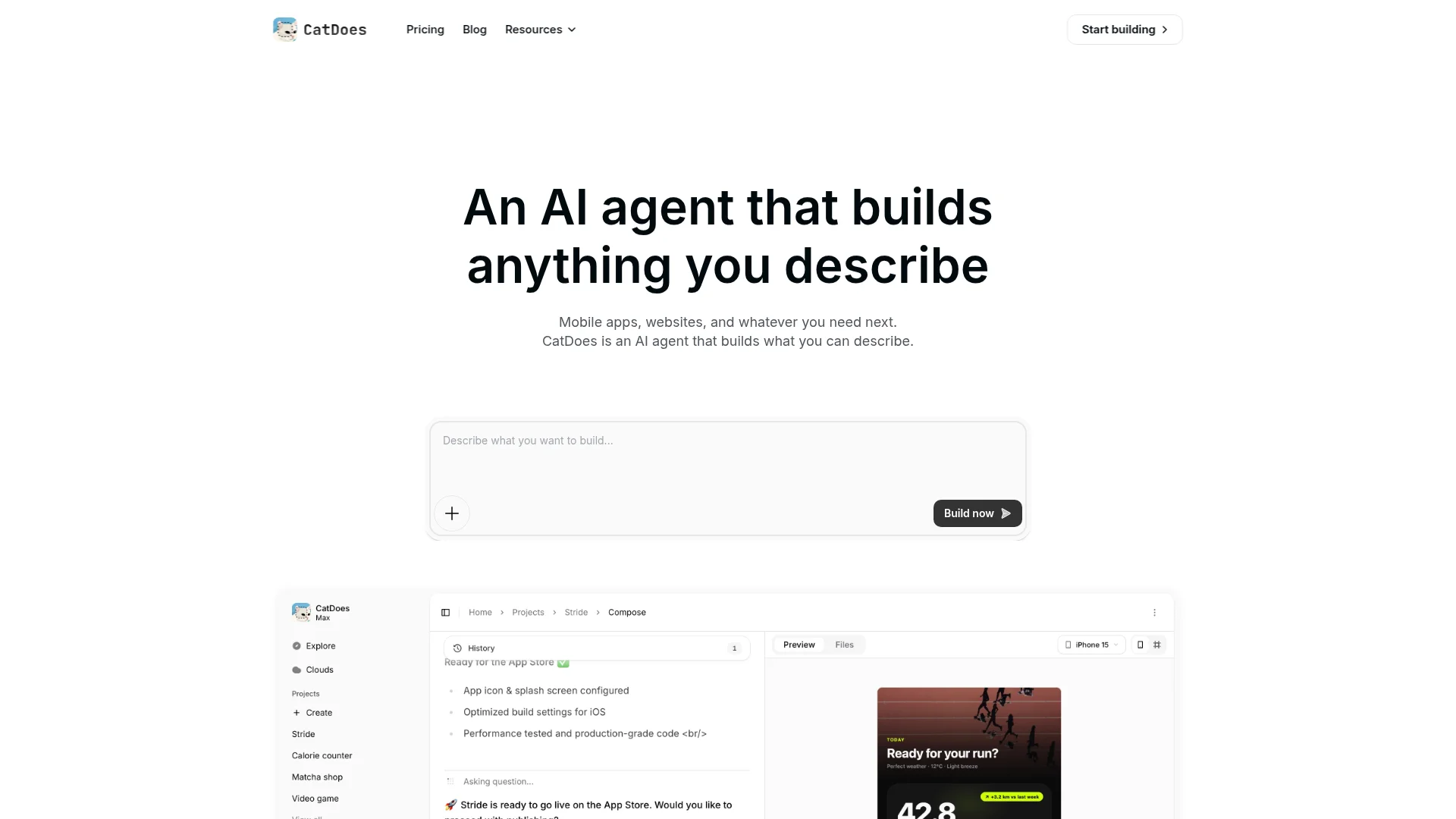
CatDoes is the only tool here that rebuilds your site rather than wrapping it. You point it at a live URL or connect the GitHub repo behind your site, describe how the screens and navigation should behave on a phone, and it generates native iOS and Android apps.
That difference matters most at App Store review. A wrapper has to argue it is more than a repackaged website. A native app with push notifications, biometric login, offline state, and camera access never has that conversation.
The free plan includes 15 one-time credits and deploys to the web only. App Store and Google Play deployment starts on Starter at $50/month, and code export plus GitHub sync arrive on Plus at $100/month. CatDoes Cloud, covering database, auth, storage, edge functions, and realtime, is included on every plan, so you are not bolting on a backend separately.
Best for: anyone who wants a real app on both stores rather than their website in a frame.
The honest trade-off: rebuilding takes more thought than pasting a URL, and your app is a separate artifact, so a site change does not automatically appear in it. If you want a shell that mirrors your site and nothing more, a wrapper is the faster tool.
2. Median.co: Best for Complex Web Apps
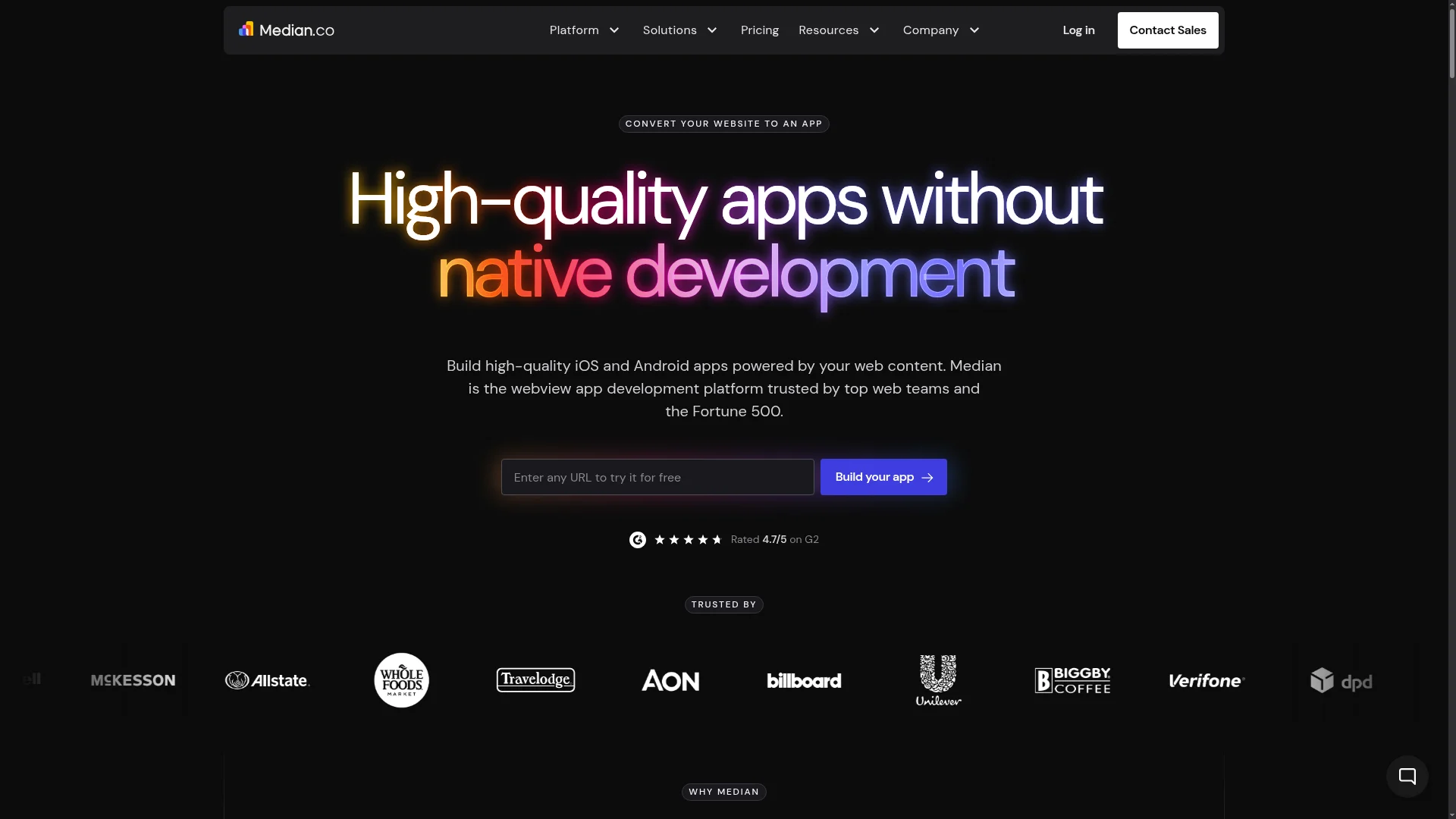
Median.co, formerly GoNative, is the most mature wrapper in the category. Its JavaScript Bridge lets your web code call native capabilities directly, which is why it handles authenticated dashboards and session state better than cheaper tools.
Licensing is one-time plus renewal: Starter is $229 to activate then $179/year, Essential is $590 then $399/year, and Plus is $990 then $669/year. One license covers one app across iOS and Android, bound to your bundle ID. A fully managed tier starts at $7,200/year.
The standout feature is ownership. Median gives you the full iOS and Android source code and permits you to modify it in Xcode and Android Studio. There is also a genuinely free tier for building and testing, though published free apps display a "Powered by Median.co" message and lose the JavaScript Bridge.
Best for: SaaS dashboards and logged-in web apps where session handling matters.
3. WebViewGold: Best One-Time Purchase
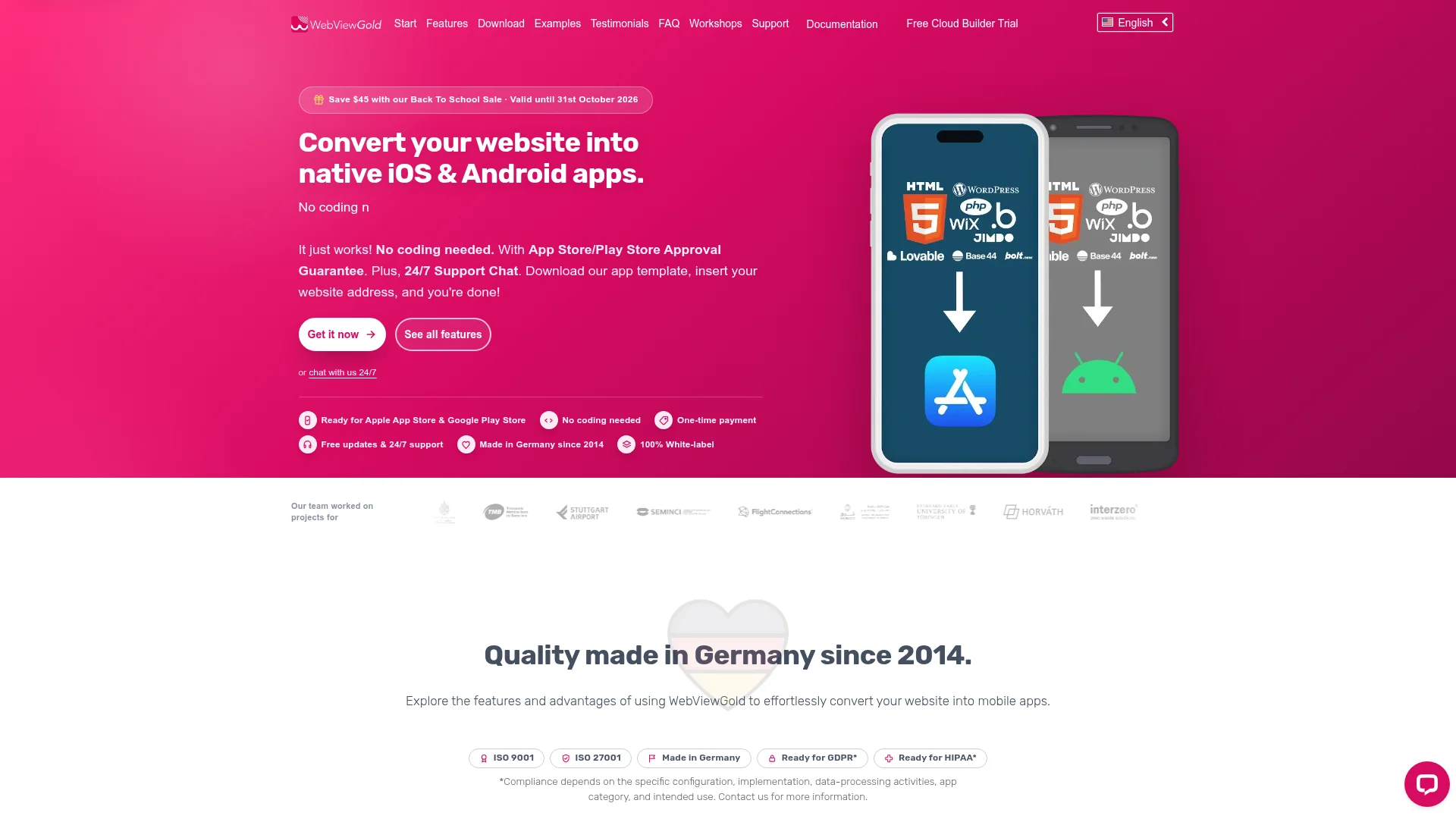
WebViewGold sells you the template rather than a subscription. An iOS license is $109 and an Android license is $109, both one-time, so $218 covers both platforms with no renewal. A Full Service option where they build and submit for you is $349.
You receive complete Xcode and Android Studio projects, so you own the source outright. It is also the only tool here with real offline handling, via an offline screen and a fallback HTML mode, so the app does not simply fail when the connection drops.
The catch is that a template assumes some comfort with development tooling. Their Cloud Builder add-on removes the Mac and Xcode requirement for another $349 one-time, which narrows the cost gap with subscription tools.
Best for: developers who want to own a wrapper permanently and never see a renewal invoice.
4. AppMySite: Best for WordPress and WooCommerce
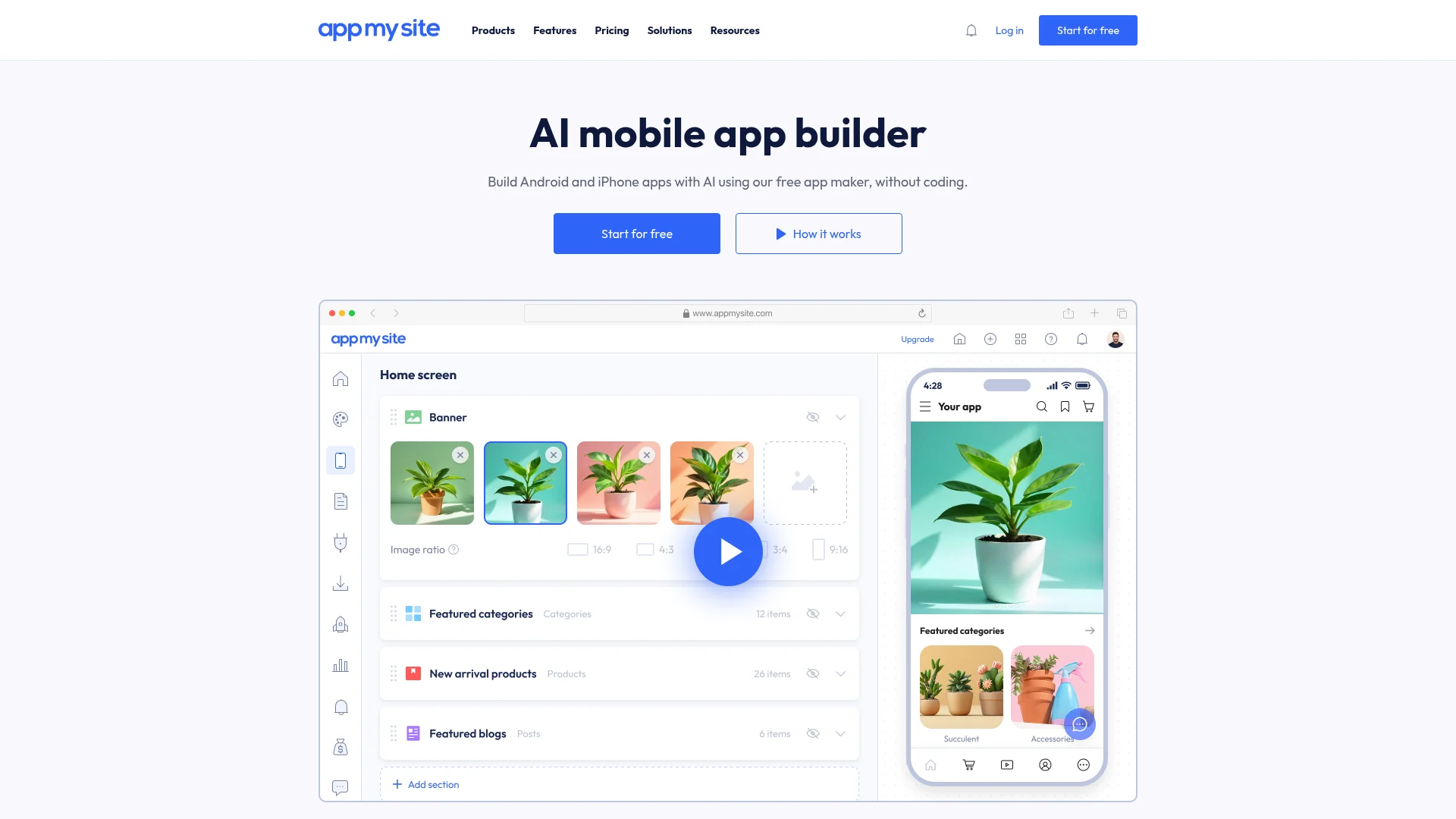
AppMySite runs identical pricing across its Web-to-App, WordPress, WooCommerce, and Shopify products, and the WordPress path is where it earns its place. Rather than only framing your site, it syncs posts, pages, categories, media, and products through the API.
Watch the tiers carefully. The free plan and Starter at $69/month are Android only. iPhone support begins on Pro at $129/month, or $99/month billed annually. Premium at $249/month adds offline mode, in-app purchases, and automated store publishing.
Source code is explicitly off the table. AppMySite's documentation states the code remains its exclusive property and is not available for purchase or included in any plan. At $1,672 for a first year on Pro, that is the most you can pay in this comparison without owning anything.
Best for: WordPress and WooCommerce owners who want content sync, not just a frame.
5. GoodBarber: Best for Design Control
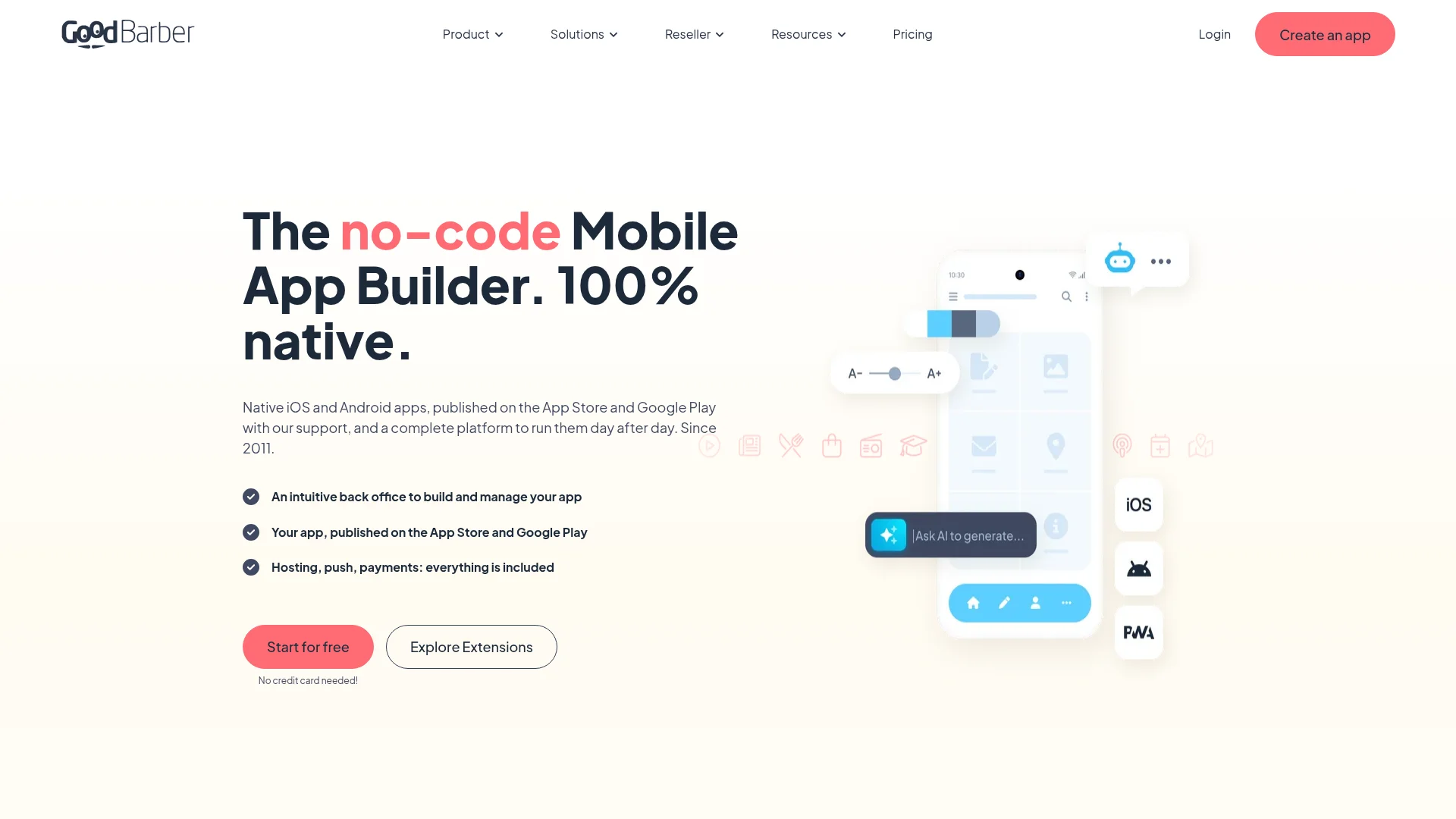
GoodBarber is the design-led option, and unlike most of this list it compiles to genuinely native Swift and Kotlin rather than a WebView. Content plans run EUR 36/month Standard, EUR 70 Premium, EUR 135 Pro, and EUR 280 Agency, with a separate and pricier eCommerce line starting at EUR 50/month.
There is one trap worth stating clearly: the Standard tier is a progressive web app only and cannot be published to either app store. Store publishing begins at Premium, EUR 70/month for content apps. The 30-day free trial requires no credit card.
Its publishing service, GoodBarber Takes Care, costs EUR 50 for five publication credits and submits under your own developer accounts. Note that it does not supply the testers Google requires for new individual Play accounts. There is no source code export.
Best for: brands that want native output and tight design control without touching code.
6. MobiLoud: Best Done-for-You Service
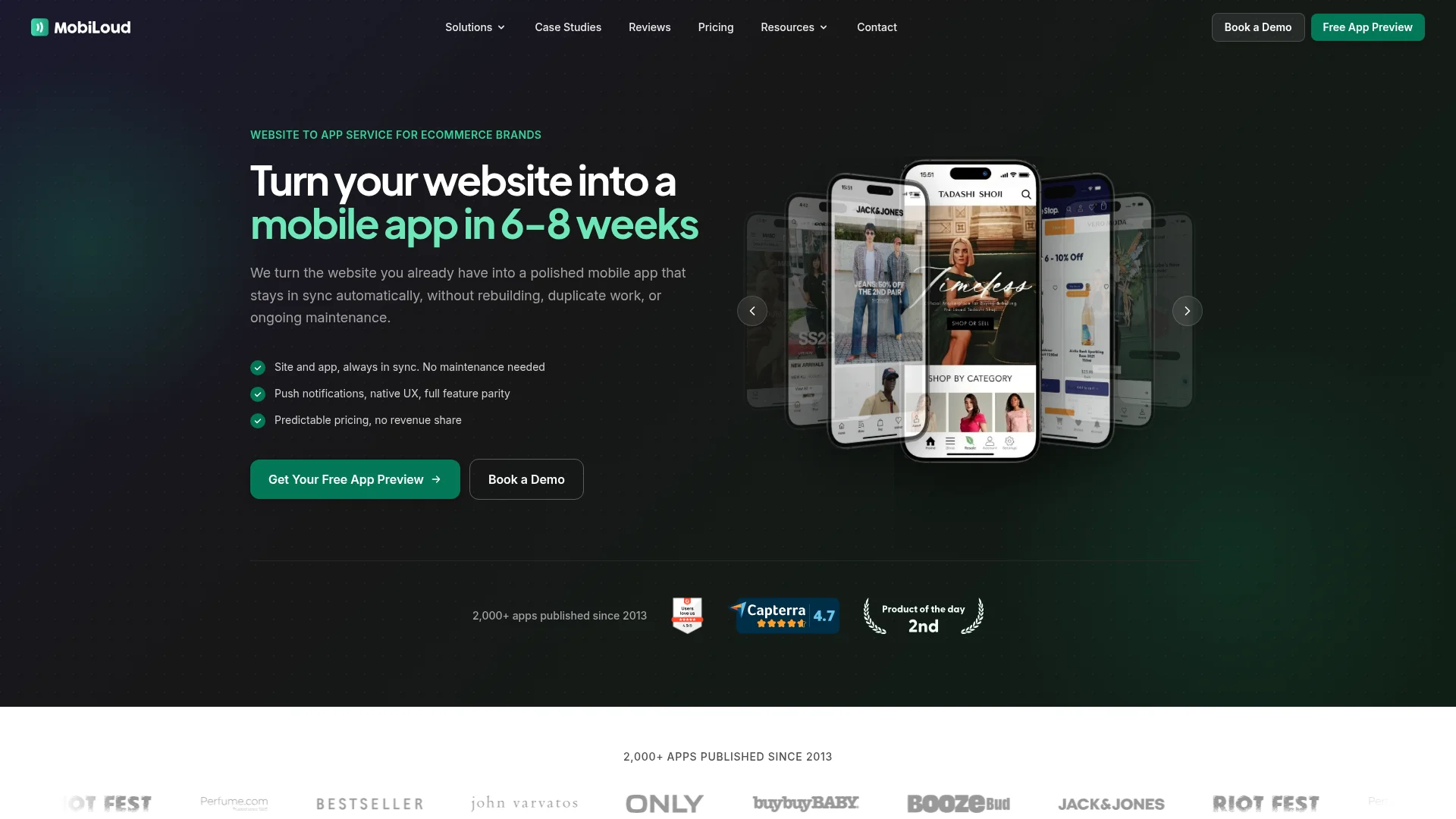
MobiLoud is not really a tool, it is an agency with software attached. Its team builds, tests, and submits the app for you, typically going live in six to eight weeks, and publishes under your own Apple and Google accounts so the listings and ratings stay yours.
Business is $1,499/month, or $1,274/month billed annually, covering up to 10,000 monthly active users, with additional usage at $50 per 1,000. There is also a separate one-time development and submission fee the company does not publish, so budget for an unknown on top. Ignore the $399 and $799 tiers still circulating in search results, because those plans no longer exist.
There is no source code. On exit, MobiLoud returns an export of configurations and build settings within 30 days, not the app itself.
Best for: established ecommerce brands that would rather buy the outcome than manage the build.
7. PWABuilder: Best Free Option
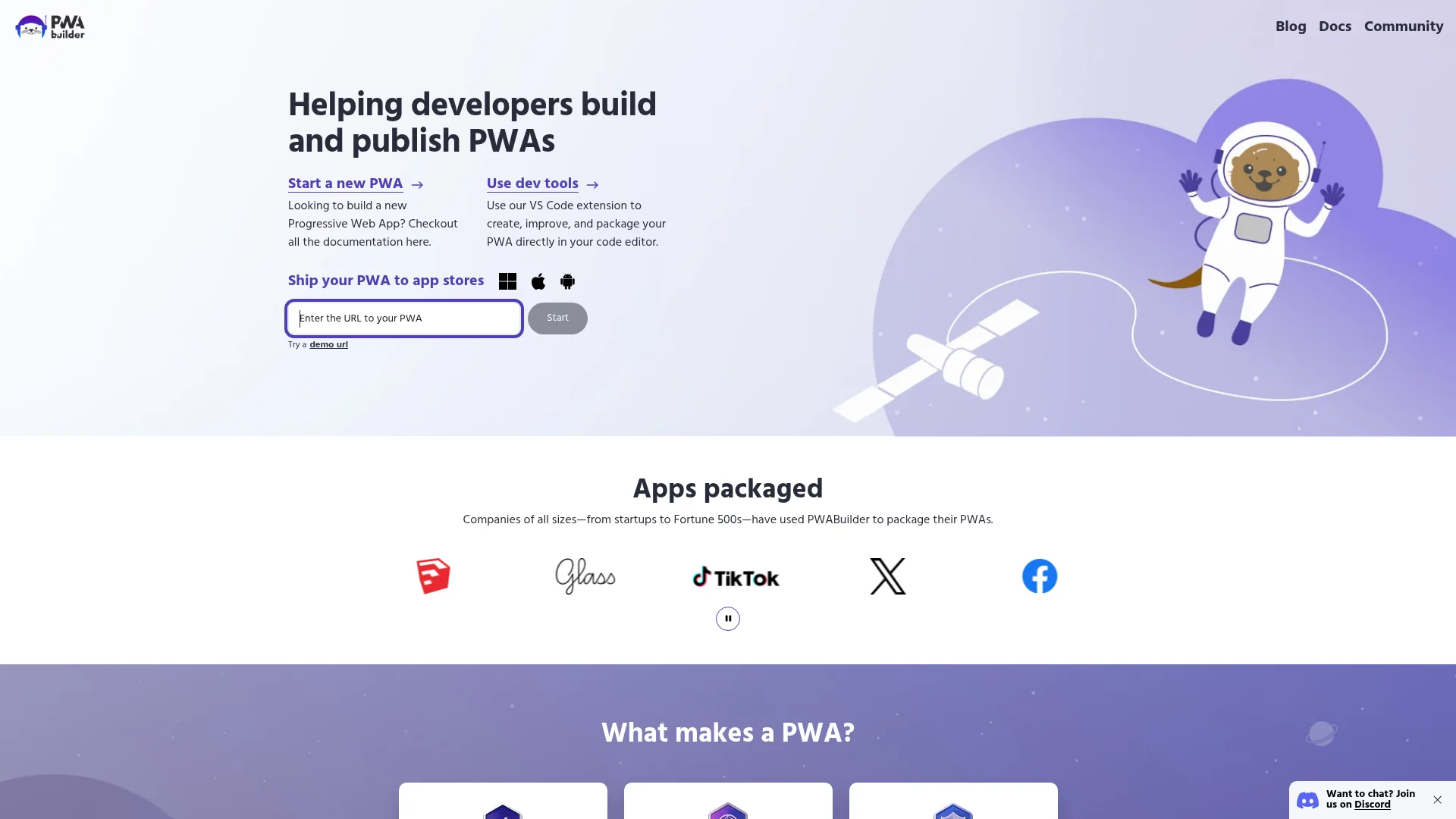
PWABuilder is Microsoft's open-source packager, and it is free under an MIT license. On Android it works well, using Bubblewrap to generate a Trusted Web Activity that installs from Google Play and renders your site full screen with ownership verified through Digital Asset Links.
iOS is the weak half, and PWABuilder says so itself. Its documentation carries a warning that packaging PWAs for iOS is experimental and that App Store acceptance depends on your app's use of native capabilities such as push notifications and in-app purchases. You also need a Mac with Xcode to complete an iOS build.
Worth knowing before you pay anyone: since iOS 26, WebKit removed installability requirements entirely, so any site added to the Home Screen opens as a web app. If your goal is a phone icon rather than a store listing, you may not need a converter at all. Our guide to PWAs versus native apps covers that trade-off in depth.
Best for: Android-first launches and anyone validating demand at zero cost.
Why Apple Rejects Most Converted Websites
This is the part vendor comparisons skip. Apple's App Store Review Guidelines, last updated June 8, 2026, open Guideline 4.2 with this: "Your app should include features, content, and UI that elevate it beyond a repackaged website. If your app is not particularly useful, unique, or 'app-like,' it doesn't belong on the App Store."
Guideline 4.2.2 goes further, ruling out apps that are "primarily marketing materials, advertisements, web clippings, content aggregators, or a collection of links." A WebView pointed at a brochure site is all of those things at once.
There is a second rule that explains a pattern you will notice while shopping. Guideline 4.2.6 says apps created from "a commercialized template or app generation service will be rejected unless they are submitted directly by the provider of the app's content." That is why every tool here, including the managed ones, publishes under your developer account rather than their own. It applies to AI builders too, so expect to submit as yourself whichever route you take.
Google is more permissive. Its Spam policy targets webviews of sites you do not own, and its Functionality policy rejects apps that "lack engaging content" or adequate utility. Wrapping your own site is allowed, but a thin one still risks the quality bar.
The practical fix either way is native capability the browser cannot reach: push notifications, biometric login, offline support, camera access. Our breakdown of the most common App Store rejection reasons covers how reviewers actually apply these rules.
What Converting a Website to an App Really Costs
Store fees are separate from every tool on this list. The Apple Developer Program is $99 per membership year, and Google Play charges a $25 one-time registration fee. Budget both regardless of which converter you pick. For three-year totals that include agency rebuilds and PWAs, see our website to app cost breakdown.
Here is the first-year total, tool plus both store fees:
Option | First year | Year two |
|---|---|---|
PWABuilder | $124 | $99 |
WebViewGold (both platforms) | $342 | $99 |
Median.co Starter | $353 | $278 |
CatDoes Starter | $724 | $699 |
AppMySite Pro (annual) | $1,312 | $1,287 |
MobiLoud Business | $18,112 | $18,087 |
CatDoes is not the cheapest option and I am not going to pretend otherwise. WebViewGold and Median.co both undercut it, and over several years a one-time license is the lowest-cost way to keep a wrapper alive. What the cheaper tiers buy you is a frame around your website. What $724 buys is a native app on both stores with a backend included.
One more cost that catches people: if you register a new personal Google Play account, Google requires a closed test with at least 12 testers opted in continuously for 14 days before you can apply for production access. That is two weeks of calendar time no converter can shorten.
Which Converter Should You Choose?
You want a real app on both stores: CatDoes, from $50/month.
You have a complex authenticated web app: Median.co, $229 one-time.
You want to own a wrapper forever: WebViewGold, $218 for both platforms.
You are testing the idea cheaply: PWABuilder, free.
You run WordPress or WooCommerce: AppMySite, iPhone from $129/month.
You want someone else to do all of it: MobiLoud, $1,499/month.
If you are still deciding between wrapping and rebuilding, our step-by-step guide to converting a website to a mobile app walks through each method in order.
Frequently Asked Questions
What is the best website to app converter?
CatDoes is the best choice if you want a real native app on the App Store and Google Play, starting at $50/month for store deployment. If you only need your existing site in a native shell, Median.co at $229 one-time is the strongest wrapper, and WebViewGold at $109 per platform is the best value if you are comfortable with Xcode.
Can I convert my website to an app for free?
You can build and test for free with PWABuilder or Median.co's free tier, but neither gets you onto both stores for nothing. Free tiers typically block store publishing, restrict you to Android, or add vendor branding. You will also still owe Apple $99 per year and Google $25 once.
Will Apple approve an app made from my website?
Only if it does more than display your site. Guideline 4.2 requires apps to go beyond a repackaged website, and a plain WebView is the most common version of that rejection. Adding push notifications, biometric login, offline support, or camera access is what clears the bar. Building natively avoids the argument entirely.
Do I need my own Apple and Google developer accounts?
Yes, in essentially every case. Apple's Guideline 4.2.6 requires apps built from an app generation service to be submitted by the owner of the content, so even done-for-you services like MobiLoud and GoodBarber publish under your accounts rather than their own.
Is a converted app as fast as a native app?
No. A WebView app is limited by your mobile site's performance, and it usually needs a connection to show anything at all. Appilix, for example, states that its apps cannot display content offline. Native apps render locally and keep working without a signal.
From Website to a Real App
The website to app converter market is mostly one product sold at seven price points. Wrappers are genuinely useful when your mobile site is already strong and you want it on a home screen quickly, and Median.co and WebViewGold do that job as well as anyone.
But a wrapper is a rental with a rejection risk attached. Apple has been explicit since long before 2026 that a repackaged website is not an app, and no amount of configuration changes what is inside the shell. Rebuilding used to be the expensive answer. It is not anymore.
Point CatDoes at your URL, describe how it should feel on a phone, and get native iOS and Android apps you can actually ship. Start building free, no credit card required.
Nafis Amiri
Co-Founder of CatDoes


