
Blog
Tutorials
Build Without Code: Your Guide to a No Code AI Platform
Discover how a no code AI platform empowers you to build powerful AI solutions without writing a single line of code. Start innovating today.

Nafis Amiri
Co-Founder of CatDoes
Ever felt like building with artificial intelligence was reserved for PhDs and teams of expensive developers? For a long time, it was. But that's changing fast, and the key is something called a no-code AI platform.
Think of it less like writing complex code and more like snapping together digital LEGO blocks. These platforms give you a visual environment where you can drag, drop, and connect pre-built AI modules to create powerful applications. You're not programming; you're designing.
Your Guide to Building AI Without Code
The core promise here is simple: imagine building a sophisticated AI-powered tool with the same ease as putting together a slideshow. That's what these platforms are making possible. They’re tearing down the technical walls that kept AI locked away, making it accessible to everyone.
Now, the people with the actual business problems, like marketers, entrepreneurs, and operations managers, can build their own solutions. They can assemble AI components using intuitive graphical interfaces to solve the specific challenges they face every day. This isn't just a fleeting trend; it’s a real shift in who gets to innovate with technology.
The Power of Democratized AI
The main goal of any no-code AI platform is to put powerful technology into the hands of more people. When you remove the coding requirement, you empower the subject matter experts, the ones who understand the business problem inside and out, to build the exact tool they need. The result is faster innovation and far more practical, relevant applications.
And the market is responding to this shift in a big way. Valued at roughly USD 4.06 billion in 2025, the no-code AI platform market is on track to hit USD 10.43 billion by 2030. That’s a compound annual growth rate of 20.78%, driven almost entirely by non-technical users bringing their ideas to life.
To really get a feel for what’s possible, it helps to understand the breadth of what AI generated content can be, from simple text generation to incredibly complex 3D models.
Key Benefits of No Code AI Platforms
So, what does this mean for your business? Adopting a no-code approach offers some immediate, tangible advantages that can help you move faster and compete more effectively, no matter your size.
The table below breaks down the core benefits and what they actually mean for your day-to-day operations.
Key Benefits of Using a No Code AI Platform
Benefit | Impact On Your Business |
|---|---|
Accelerated Innovation | Quickly prototype, test, and launch AI-powered ideas without waiting for development resources. |
Reduced Costs | Dramatically lower development expenses by minimizing the need for specialized programming talent. |
Empowered Teams | Enable non-technical employees to solve their own problems, fostering a culture of creativity. |
Increased Agility | Adapt to market changes faster by rapidly modifying or creating new AI workflows as needed. |
Ultimately, these platforms allow you to focus on the what, which is solving a customer problem, instead of getting bogged down by the how of traditional software development.
What's Really Under the Hood?

To really get what makes a no-code AI platform tick, you have to peek behind the curtain at its core components. These aren't just simple tools; they're complete workshops designed to hide all the gnarly machine learning complexity. They hand you a structured toolkit so you can focus on the business problem you're trying to solve, not on wrestling with algorithms.
The beating heart of every platform is a visual workflow builder. Think of it as a digital whiteboard where you map out the entire logic of your application. Instead of typing code, you drag and drop different building blocks and connect them, creating a flowchart that shows exactly how your AI process works from start to finish.
This visual-first approach makes building AI feel intuitive. You can literally see how data flows from one step to the next, which makes designing, fixing, and changing your app massively easier. You don't need a computer science degree to get it.
Your AI Building Blocks
One of the biggest wins of any solid no-code AI platform is its library of pre-built models and templates. These aren’t just generic, one-size-fits-all gadgets. They are sophisticated, pre-trained AI models built for common business needs, acting as powerful shortcuts so you don't have to build foundational models from the ground up.
This feature is a total game-changer for speed. Instead of spending months training a model, you can get something working almost instantly.
A 2025 report on professional work highlighted that AI could lead to productivity gains of up to 12 hours per week by 2029. Pre-built models are a key driver of this efficiency, allowing teams to deploy solutions faster.
Here are a few common templates you'll find:
Sentiment Analysis: Instantly scan customer reviews or survey responses to see if people are happy or frustrated.
Sales Forecasting: Look at past sales and market data to get a solid prediction of future revenue.
Image Recognition: Automatically tag product photos for an e-commerce site or spot defects on a factory line.
Connecting Your Data, Minus the Headache
An AI model is only as good as the data it learns from. The best no-code platforms understand this and make data integration a top priority. They offer simple connectors that let you pull information from all sorts of sources with just a few clicks.
You can effortlessly link your project to where your data already lives, whether that's a simple spreadsheet, a complex SQL database, or a cloud service like Google Drive. These connections are managed through clean, secure interfaces that handle all the complicated backend work for you. Diving into the role of backend services in AI no-code apps can give you a much deeper appreciation for how this all works so smoothly.
Real World No-Code AI Applications
Theory is great, but seeing how these tools solve actual business problems is where it all clicks. No-code AI isn't just for side projects; it's actively driving real results for teams who need to move fast.
Let's look at a few mini-stories that show this technology in the wild. This decision tree can help you picture which path might be the right fit for your own goals.
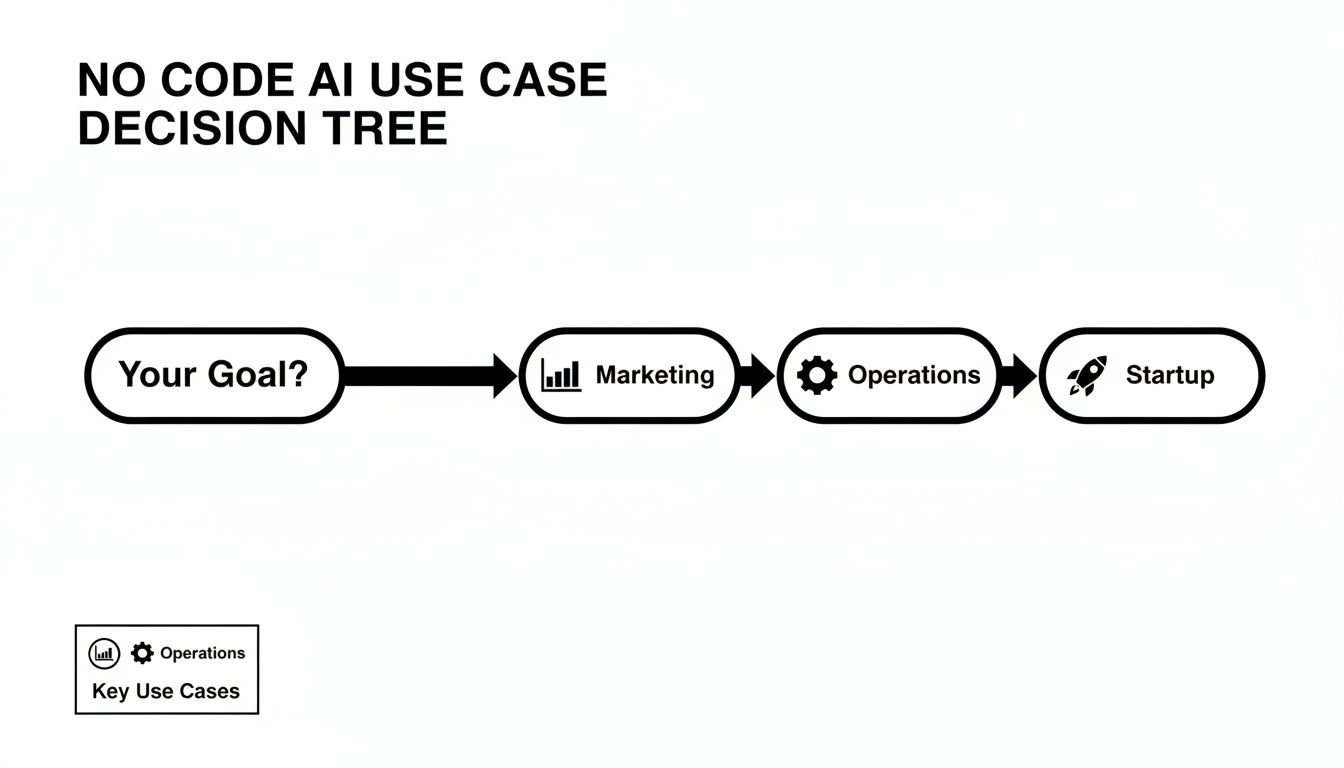
As you can see, whether you're in marketing, operations, or getting a startup off the ground, there's a clear path to a solution. The tools are that adaptable.
Saving Customers in Marketing
Picture a marketing team at a subscription company struggling with customer churn. They had tons of data but no simple way to spot at-risk accounts before they hit "cancel."
Using a no-code AI platform, a marketing manager with zero coding background built a churn prediction model. She connected their CRM data, usage logs, and support ticket history. With just a few clicks, she trained a model to find the subtle patterns that signaled a customer was about to leave.
The model now automatically flags those accounts, letting the team step in with proactive support or an incentive. The result? They cut churn by 18% in a single quarter. To see more ways this works, you can explore how to use AI in marketing to sharpen your own strategy.
Automating Tedious Operations
An operations manager at a mid-sized logistics firm was drowning in paperwork. His team was spending hundreds of hours every month just keying in data from PDF invoices into their accounting system. It was slow, tedious, and full of expensive mistakes.
He brought in a no-code AI tool with Optical Character Recognition (OCR). In an afternoon, he built a workflow that could "read" documents and pull out key info like invoice numbers, dates, and line items.
Now, the AI processes over 90% of their invoices without anyone touching them, freeing up the team for more important financial analysis.
Launching a Startup MVP
A founder needed to build a Minimum Viable Product (MVP) to land her first round of funding. Her idea was a mobile app with a smart recommendation engine for local events, but she didn't have a technical team.
She turned to a no-code AI platform to bring the idea to life. In just two weeks, she had a working prototype. It pulled event data from public APIs and used a pre-built AI model to give users personalized suggestions.
The ability to quickly build an app with AI meant she could walk into investor meetings with a real, working product, which made all the difference in securing her seed round.
These stories are just the start. The market for no-code AI platforms is set to explode from USD 6.7 billion in 2025 to an incredible USD 72.9 billion by 2035. With 65% of all apps in 2025 expected to be built with no-code tools, businesses are crushing their launch times and seeing huge returns, all while sidestepping the massive shortage of specialized AI talent.
How to Choose the Right No Code AI Platform
With so many tools flooding the market, picking the right no-code AI platform can feel like a shot in the dark. It's easy to get lost in marketing hype. The secret isn't finding the "best" tool; it's finding the right tool for your specific goal.
This isn’t just a feature comparison. It’s about finding a genuine partner for your idea. The market is exploding, with estimates projecting growth from USD 4.9 billion in 2024 to USD 24.8 billion by 2029, a staggering 38.2% compound annual growth rate. That growth means more options, making a clear decision-making process more critical than ever.
Define Your Core Needs First
Before you even glance at a platform's website, you need a clear definition of what you're trying to accomplish. Stop and ask yourself: what does a "win" look like for this project?
Are you building a quick proof-of-concept to show investors? An internal tool to fix a frustrating workflow for one department? Or a full-blown, customer-facing app?
Your answer will immediately slash the list of potential candidates. A simple internal tool just needs to be fast and easy to set up. A public-facing app, on the other hand, needs rock-solid security, the ability to handle growth, and deeper customization.
To get started, answer these three questions honestly:
What is the one primary problem I’m trying to solve? Get specific.
Who is actually going to use this? Think about your builders and your end-users.
What are my real-world budget and timeline? Your constraints are your best filter.
Evaluate Key Platform Criteria
Once you have a clear objective, you can start weighing your options against a consistent set of criteria. You're looking for that sweet spot between power and simplicity that matches what you're building. The right platform should feel like it's giving you superpowers, not boxing you in.
Think of it like choosing a vehicle. You wouldn't buy a sports car to haul furniture, and you wouldn't buy a cargo van for your daily commute. Each no-code AI platform is engineered for a different kind of journey. For a deeper look at what separates the good from the great, check out our guide on finding the best AI app builder.
To help you map your project needs to the right kind of tool, it's useful to understand the main categories of platforms out there.
Comparing No Code AI Platform Types
The no-code AI space isn't monolithic. Platforms generally fall into a few different buckets, each designed for a different type of job. The table below breaks down two of the most common types to help you see where your project might fit.
Platform Type | Best For | Key Features | Scalability |
|---|---|---|---|
The All-in-One Suite | Building complex, multi-faceted applications or managing multiple projects within one ecosystem. | Wide range of pre-built models, extensive integration options, and advanced workflow automation. | High; designed to grow with your business from prototype to enterprise-level deployment. |
The Specialist Tool | Solving a specific, well-defined problem with high accuracy, like OCR or sentiment analysis. | Deep functionality in one area, highly optimized models, and a simple, focused user interface. | Varies; often excellent for its core task but may require integration with other tools to scale. |
Ultimately, an All-in-One Suite gives you a broad toolkit for building almost anything, while a Specialist Tool is like having a master craftsman for one specific job. Choosing correctly comes down to knowing which approach your project demands right now.
Common Pitfalls to Avoid

While a no-code AI platform can feel like a superpower, it's not a magic wand. Jumping in without a clear plan is a fast track to wasted effort and frustration. If you know the common traps ahead of time, you can sidestep them and get your project on the right path from day one.
One of the biggest mistakes we see is trying to make a platform do something it was never designed for. These tools are incredibly powerful for a specific set of problems, but they do have limits. Forcing a tool to solve the wrong kind of problem just leads to fragile, overcomplicated workarounds that are bound to break.
That’s why the first step is always to have a crystal-clear, well-defined problem. A focused goal helps you pick the right platform and use it the way it was intended.
The Garbage In, Garbage Out Principle
Another classic mistake is underestimating the importance of data quality. Your AI model is just a reflection of the data you train it on. If you feed it messy, incomplete, or irrelevant information, you'll get back unreliable and inaccurate results. It's the timeless "garbage in, garbage out" rule, and it's ten times more important in the world of AI.
Before you even think about building your model, you have to get your data in order.
Your AI is only as good as your data. Investing time in data preparation isn't an optional step; it is the most critical factor for building a trustworthy and effective AI model.
Here’s how to avoid this trap:
Audit Your Data Sources: Before you connect anything, confirm your data is accurate, complete, and up-to-date.
Define a Clear Data Structure: Make sure all your data follows a consistent format. This makes it much easier for the AI to understand.
Start Small: Test your model with a small, clean dataset first. This lets you validate your logic before you try to scale it up.
The Risk of Vendor Lock-In
Finally, think about the long game. When you build your entire AI workflow on a single no-code platform, it can be a real pain to move everything somewhere else if your needs change down the road. This is called vendor lock-in.
To protect yourself, look for platforms with clear and accessible data export policies. You want the ability to pull out your models, your data, and your workflows. That freedom gives you the flexibility to migrate to another system in the future without having to start over from scratch. It’s a smart move that pays off later.
What's Next for No-Code AI?
The world of app development is changing fast, and no-code AI platforms are right at the heart of it. The future isn’t about making developers obsolete. Far from it. It's about empowering a whole new wave of creators to get their ideas out into the world faster than ever before. This shift is sparking some incredible collaboration between the folks who run the business and the teams who build the tech.
One of the biggest trends we're seeing is much deeper integration. A no-code AI platform won't just be another tool in your toolbox; it'll become the central hub that connects to every part of your business. Picture an AI that can automatically pull data from your CRM, figure out what your sales numbers really mean, and then draft marketing copy based on those insights, all from one place. This level of connection is what will make AI a non-negotiable part of how modern companies operate.
Specialized Tools and Empowered Experts
As the market grows up, we’re also seeing more specialized, industry-specific platforms pop up. These tools will arrive ready to go, pre-loaded with models and workflows designed for specific fields like healthcare, finance, or logistics. That means you get a powerful, relevant solution right out of the box, cutting down the setup time and learning curve dramatically.
Ultimately, this whole evolution is about closing the gap between a great idea and a finished product. It lets the experts, the people who actually understand the business problems, build their own solutions without having to get in line for the development team. The message is simple: technology is no longer the barrier.
The real promise of the next generation of no-code AI is this: it turns business experts into builders. It lets innovation happen at the speed of thought, not the speed of code.
There has never been a better time to see what these platforms can do for you. The tools are more powerful, easier to use, and better connected than ever. They’re not just a convenience anymore; they're a real strategic advantage for any organization looking to innovate and grow.
Still Have Questions?
Jumping into no-code AI can feel like a big step, so it's natural to have a few questions. Here are some straight answers to the things we hear most often.
Can I Actually Build Something Complex with This?
Absolutely, but it’s about picking the right tool for the job. You can build some incredibly sophisticated applications. Think predictive analytics dashboards, apps that understand natural language, and complex automated workflows that would normally take a team of engineers months.
Where’s the line? If you’re inventing a completely new type of AI algorithm from scratch, you’ll still want a traditional coding setup. But for the vast majority of real-world business problems, from launching an MVP to building powerful internal tools, no-code AI platforms are more than up to the task.
How Do I Know My Data Is Secure on a Platform I Don't Own?
This is a big one, and any platform worth its salt takes it seriously. The top no-code AI providers invest huge amounts of money into security. We're talking about enterprise-grade measures like data encryption at rest and in transit, strict access controls, and compliance with major standards like GDPR and SOC 2.
Before you commit to any platform, do your homework. Dig into their security documentation and data privacy policies. Make sure their certifications line up with your company's standards.
For businesses working with extra-sensitive information, many platforms also offer private cloud or on-premise deployments. This gives you another layer of control, keeping your data within your own environment.
What Happens if We Get Big and Outgrow the Platform?
Smart question. Planning for success is crucial. The best no-code platforms are built to scale right alongside you, designed to handle bigger datasets and more users without breaking a sweat.
When you're evaluating options, look for a few key things:
A Clear Path to Scale: Does the platform explain how it handles growth, both technically and in its pricing?
Transparent Pricing: You don’t want to be surprised by a massive bill. Look for predictable pricing tiers.
An Exit Strategy: This is critical. Make sure you can easily export your data and your AI models.
Some of the more advanced platforms even give you the option to export the underlying code. This creates a super smooth off-ramp if you ever reach a point where a fully custom-coded solution makes more sense.
Does This Mean I Don't Need My Data Scientists Anymore?
Not at all. No-code doesn't replace data scientists; it frees them up to do more valuable work. Instead of getting bogged down in the repetitive tasks of building and deploying standard models, they can focus on the really hard problems.
Think of it this way: no-code handles the 80%, letting your data experts focus on the challenging 20%. They can now spend their time on strategic initiatives like developing highly specialized algorithms, overseeing data governance across the company, or interpreting the subtle nuances of the most complex model outputs. It’s a force multiplier for your technical team.
Ready to turn your app idea into reality without writing a single line of code? CatDoes uses AI agents to build, design, and deploy production-ready mobile apps from simple text descriptions. Start building for free today.
Nafis Amiri
Co-Founder of CatDoes


