Blog
Insights
Manus vs CatDoes Review (2026): Which to Use?
Manus vs CatDoes compared for 2026: real pricing, credits, and app store publishing. See which AI agent builds your app and which one actually ships it.

Nafis Amiri
Co-Founder of CatDoes

TL;DR: Manus and CatDoes are both AI agents you drive in plain English, but they aim at different finish lines. Manus is a general-purpose agent: it runs research, builds spreadsheets and slide decks, designs, and also builds websites and mobile apps. CatDoes is narrow on purpose: it builds mobile apps and websites, then ships them to the App Store, Google Play, and the web for you, backend included. Manus can package a mobile app and push it to TestFlight, but by its own documentation the final store submission is still your job. Pick Manus if you want one agent for every kind of knowledge work. Pick CatDoes if you want your app actually live in the stores.
You have an idea, and you would rather describe it than code it. Search for an AI agent to do that and two very different products come up. Manus is the general agent that went viral for doing entire jobs unattended. CatDoes is the agent built specifically to turn a prompt into a published app.
They overlap just enough to be confusing. Both build websites. Both build mobile apps. Both run in the cloud, both charge in credits, and both start around $20 a month. This comparison covers what each one actually does, their real pricing as of September 2026, how credits and limits differ, and the question that settles it for most people: which one gets your app into the store?
Table of Contents
What Is Manus?
What Is CatDoes?
Manus vs CatDoes: The Core Difference
Feature Comparison
Pricing: Manus vs CatDoes in September 2026
Credits, Limits, and What You Actually Get
Can Either One Publish to the App Store?
Is Manus Still Owned by Meta?
Which One Should You Choose?
Frequently Asked Questions
The Bottom Line
What Is Manus?
Manus is a general-purpose autonomous AI agent. You give it a task in plain English, and it works through the task on its own inside a cloud Linux machine with a real browser, then hands back the finished output. It was built by the team behind the Monica browser extension, launched in March 2025, and now runs out of Singapore.
The range is the point. Manus does multi-source research and long reports, competitive and market analysis, spreadsheets and financial models, slide decks, images, design work, games, websites, and web apps. Its headline feature, Wide Research, fans a job out across a large number of parallel sub-agents so a wide task finishes in one pass. It also connects to tools you already use, including Gmail, Google Calendar, Notion, and Slack, and it can run tasks on a schedule.
One detail worth knowing: Manus is an orchestration layer, not a foundation model. It coordinates third-party models underneath rather than training its own. If the distinction between a model, an agent, and general intelligence is fuzzy, our explainer on AGI vs AI agents untangles it.
What Is CatDoes?
CatDoes is an AI agent that builds mobile apps and websites from natural language. You describe what you want, the agent runs in the cloud, spins up its own subagents, writes the code, and ships the result to the App Store, Google Play, or the web with a custom domain. There is no IDE to install and no code you are required to touch.
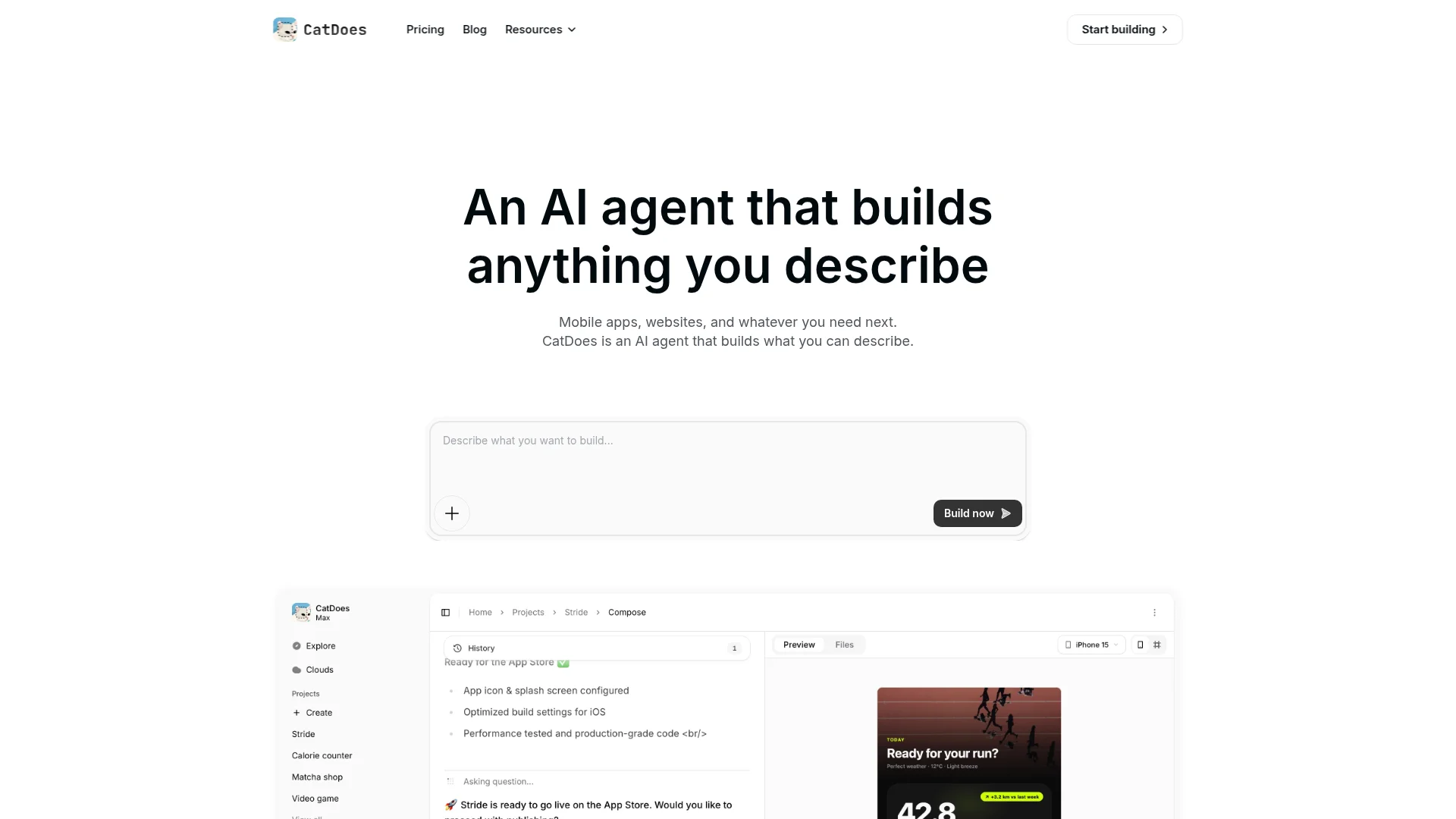
Every plan includes CatDoes Cloud, a built-in backend with database, authentication, storage, edge functions, and realtime, because a real app needs data and logins rather than just screens. Developers can import a GitHub repo and export the code; non-technical founders can go from idea to a downloadable app without opening an editor. For the wider landscape, our roundup of the best AI app builders puts it in context.
Manus vs CatDoes: The Core Difference
The cleanest framing: Manus is a generalist that can build apps. CatDoes is a specialist that ships them.
Manus is wide. On any given day you might use it to summarise a market, produce a board deck, clean a spreadsheet, and spin up a landing page. App building is one skill among many, and it was added to an already broad agent.
CatDoes is deep on one workflow. It does not write your slide deck. It takes an app from prompt to store listing, which means it also owns the parts nobody enjoys: the backend, the builds, the signing, and the submission. That narrowness is the trade. You give up breadth and you get the last mile.
Feature Comparison
Feature | Manus | CatDoes |
|---|---|---|
What it is | General-purpose AI agent | AI agent for apps and websites |
Coding required | No | No |
Runs in | The cloud (browser) | The cloud (browser) |
Research, slides, spreadsheets | Yes | No |
Builds websites | Yes | Yes |
Builds mobile apps | Yes, iOS and Android | Yes, iOS and Android |
Backend included | Database, auth, file storage | CatDoes Cloud on every plan |
Custom domains | Yes | Yes |
Code export | Full codebase download | Code export and GitHub import |
Packages an Android build | Yes (AAB you upload) | Yes, handled for you |
iOS distribution | Uploads to your TestFlight | Full App Store submission |
Publishes to the stores for you | No, submission is your job | Yes |
Developer accounts needed | Your own Apple and Google accounts | Handled by CatDoes |
Billing model | Monthly credits | Monthly credits |
Pricing: Manus vs CatDoes in September 2026
Both tools sell credits on a monthly subscription, and both offer a free tier. The figures below were taken from each pricing page on 8 September 2026.
Manus lists three consumer tiers. Every paid tier includes 300 refresh credits per day, 20 concurrent tasks, and 20 scheduled tasks, and annual billing saves 17%. The $40 and $200 tiers let you pick a larger monthly credit allowance from a dropdown.
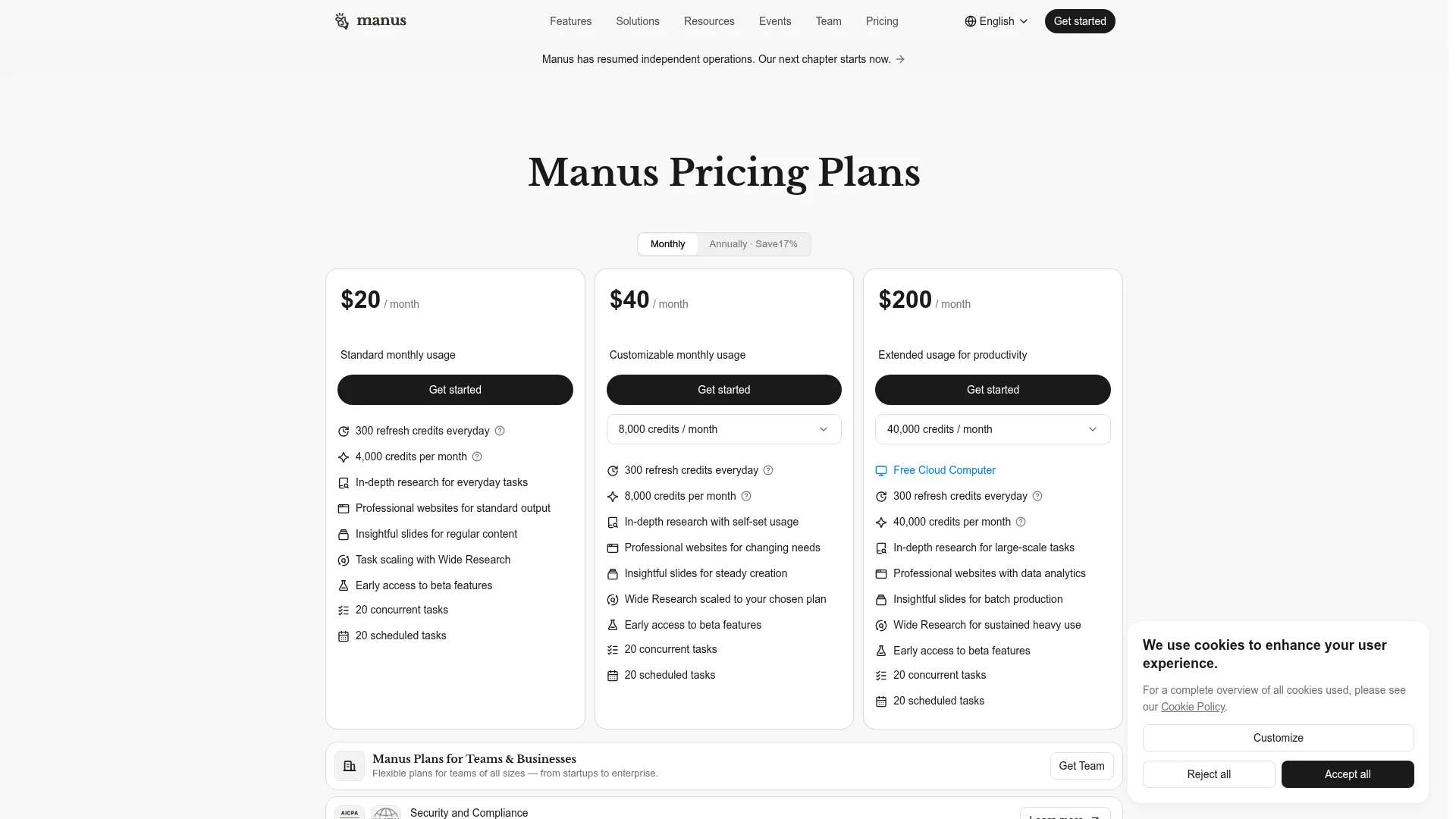
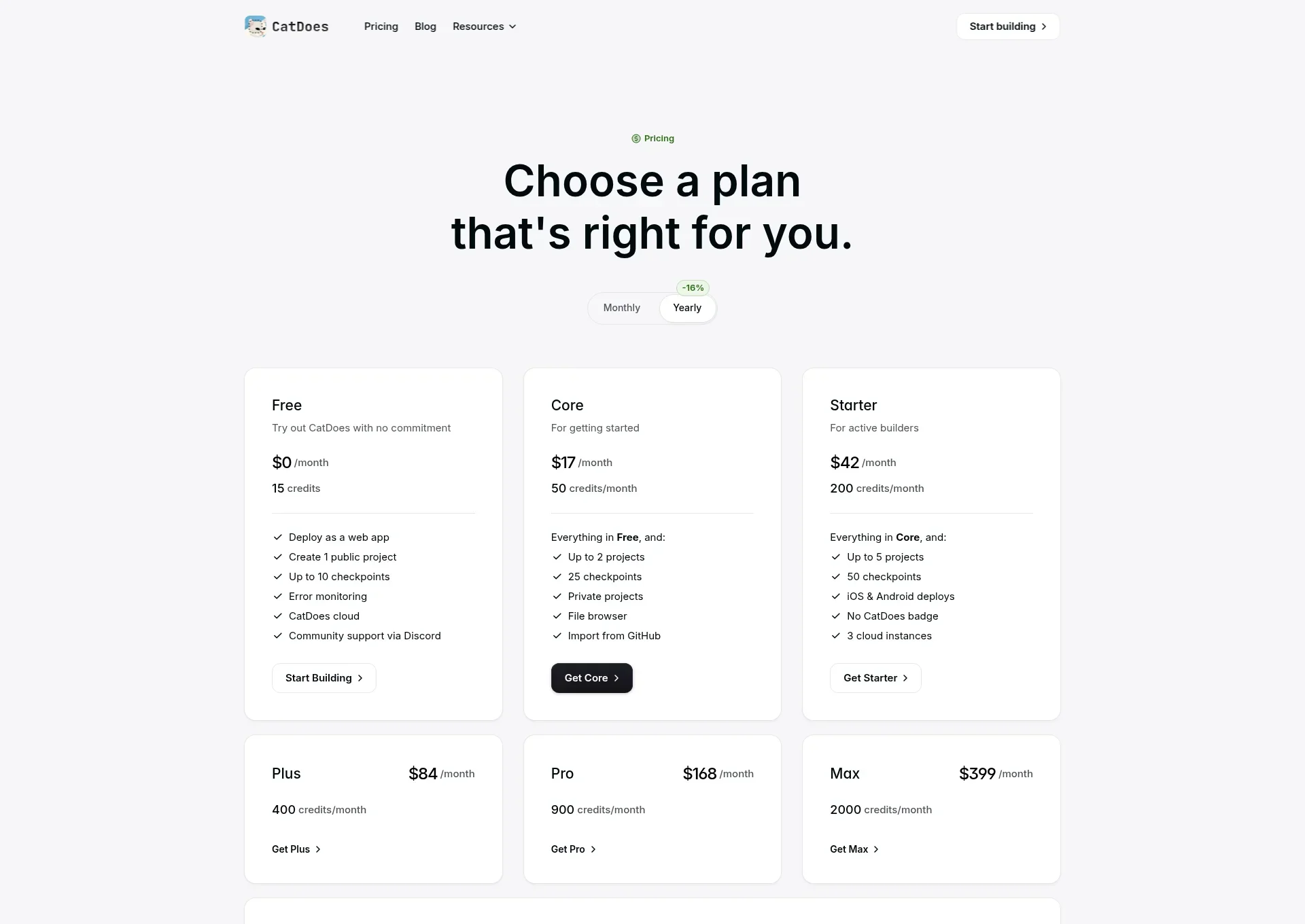
Here is how the two ladders line up at comparable price points:
Price | Manus | CatDoes |
|---|---|---|
Free | 300 daily refresh credits, one concurrent task | 15 credits, 1 project, web deploy, CatDoes Cloud |
$20 / month | 4,000 credits | Core: 50 credits, 2 projects, web deploy |
$40 to $50 / month | $40: 8,000 credits | Starter $50: 200 credits, 5 projects, iOS and Android deploys |
$100 / month | Not offered | Plus: 400 credits, 10 projects, GitHub and code export |
$200 / month | 40,000 credits | Pro: 900 credits, 20 projects, priority support |
Above $200 | Team and business plans | Max $399: 2,000 credits. Team $299: 5 seats |
Read that table carefully, because the credit columns are the easiest thing in this comparison to get wrong.
Credits, Limits, and What You Actually Get
Manus credits and CatDoes credits are not the same unit. Manus gives you 4,000 a month at $20 and CatDoes gives you 50, and that gap tells you almost nothing, because a single credit buys a very different amount of work in each product. Comparing the raw numbers is the classic mistake. Compare what a tier lets you do instead.
On Manus, every action draws down the balance: browsing, reasoning, writing, retrying. The company does not publish a per-task price list, and the agent does not quote you a cost before it starts, so spend is hard to predict in advance. That is the most common complaint in user reviews, and it gets worse when a long task fails partway and the credits are already gone. Manus credits do not roll over month to month.
CatDoes allocates credits monthly and lets you pick from four agent tiers (Low, Medium, High, and Max), so routine steps run on a cheaper tier and you save the top tiers for hard problems. The honest expectation with any agentic builder is the same on both sides: iteration costs money, so scope your first build, review each step, and assume a complex app costs more than a simple one.
On limits, Manus is generous with parallelism (20 concurrent and 20 scheduled tasks on every paid tier) because it is designed to run many jobs unattended. CatDoes limits projects instead of tasks, from 2 on Core up to 20 on Pro, because the unit of work is an app rather than an errand.
Can Either One Publish to the App Store?
This is the question that decides the comparison, and the answer is genuinely different for each tool.

Manus: no. It gets impressively close. For Android it packages your app into an Android App Bundle, then gives you a link to Google Play Console where you upload it yourself. For iOS it goes further, creating the app in your Apple Developer account, packaging the build, and uploading it to App Store Connect so it lands in TestFlight. That is real automation and it saves genuine hours. But Manus's own help centre is explicit that this is not a one-click publish to store button, and that final submission is the user's responsibility. TestFlight is testing, not release.
You also need your own paid developer accounts before any of it works: Apple Developer Program at $99 a year, and Google Play at a $25 one-time fee.
CatDoes: yes. Store submission is the product. The agent builds the native app, handles the build and signing, prepares the listing, and submits to the App Store and Google Play, so you never open Xcode or a developer console. Store deployment starts on the Starter plan. Our walkthrough on how to publish an app to the App Store and Google Play shows how much work that normally is, which is the whole reason to hand it to an agent.
Neither tool can shorten Apple's or Google's review. Nobody can. The difference is who prepares and files the submission.
Is Manus Still Owned by Meta?
No, and if you researched Manus earlier this year you may be working from stale information. The short version: Meta agreed to acquire Manus in December 2025 in a deal reported at around $2 billion. In April 2026 Chinese regulators blocked the transaction and ordered it revoked. Manus announced it would return to standalone operation in August 2026 and formally resumed independent operations on 1 September 2026, describing itself as an independent agent lab.
Two practical consequences. First, the separation was messy: some user data created during the Meta period was deleted as the two companies untangled their systems, and Manus has kept a restoration portal open for affected accounts. If you had a Manus account through that window, check your projects. Second, reporting on the post-deal ownership structure is still unsettled, so treat any confident claim about who controls Manus today with caution.
None of this makes Manus a bad tool. It does make it a fair thing to weigh if you are choosing a vendor for work with data-governance requirements attached.
Which One Should You Choose?
Choose Manus if your work is broader than apps. If in one week you need a research brief, a competitor teardown, a financial model, a deck, and a quick site, Manus is a single agent that covers all of it, and nothing in the app-building category comes close on range. It is also the better pick if you want to run many unattended jobs in parallel or on a schedule.
Choose CatDoes if the goal is a published app. If you want a native iOS and Android app with a real backend, live in the stores, without opening Xcode or managing developer accounts, that is the workflow CatDoes is built around. It is the better fit for founders, solo builders, and non-developers who want a finished product rather than a codebase.
The deciding question is what you want at the end: a body of knowledge work, or an app in the store. "Do this job for me" points to Manus. "Get my app published" points to CatDoes.
Frequently Asked Questions
Can Manus build mobile apps?
Yes. Manus builds iOS and Android apps from a natural-language description, with live preview and access to native device features. The limit is distribution: it prepares and uploads builds for testing, but it does not file the store submission for you.
Can Manus publish my app to the App Store?
Not for you. Manus uploads your build to App Store Connect and puts it in TestFlight, which is Apple's testing channel. Its documentation states that the final submission is the user's responsibility. CatDoes handles App Store and Google Play submission end to end.
How much does Manus cost in 2026?
As of September 2026, Manus lists $20 a month for 4,000 credits, $40 for 8,000, and $200 for 40,000, plus a free tier with 300 daily refresh credits. Annual billing saves 17%. Team and business plans are quoted separately.
Is Manus cheaper than CatDoes?
They start at the same $20 price point, so the honest answer is that it depends on the work. Credit counts are not comparable between the two, because a credit buys different amounts of work in each. Compare what each tier unlocks rather than the credit numbers.
Do Manus credits roll over?
Monthly plan credits do not roll over. Unused allowance is lost at the end of the billing period, and there is no cost estimate shown before a task runs, which is why users often report spending more than they expected.
Does Manus include a backend?
Yes. Manus web apps come with a database, authentication, and file storage, and it supports custom domains and full codebase download. CatDoes bundles CatDoes Cloud, with database, auth, storage, edge functions, and realtime, on every plan.
Is Manus owned by Meta?
No. Meta agreed to buy Manus in December 2025, Chinese regulators blocked the deal in April 2026, and Manus resumed independent operations on 1 September 2026.
What is a good Manus alternative for building apps?
If app building is the reason you are looking at Manus, CatDoes covers the same build step and adds store submission, native deployment, and a managed backend. If you want a general research and documents agent, the closest alternatives to Manus are other generalist agents rather than app builders.
Can I use Manus and CatDoes together?
Yes, and it is a reasonable setup. Use Manus for research, analysis, and documents, and use CatDoes for the app you intend to ship. Both let you export code, so neither locks you in.
The Bottom Line
Manus vs CatDoes is not really a fight over who builds a better app. It is a choice between breadth and the last mile. Manus is one of the most capable general agents available, and if your work spans research, analysis, documents, and the occasional site, it earns its place. Its app building is real, and it stops at TestFlight and an unfiled Play Console upload.
CatDoes gives up all that breadth to own one workflow completely: prompt to native app, backend included, submitted to the App Store and Google Play. If you are comparing agents for coding work more generally, our Claude Code vs Codex breakdown covers that side of the market.
If what you want is an app that people can actually download, try CatDoes free and describe your first one. The agent takes it from there.
Nafis Amiri
Co-Founder of CatDoes


