Blog
Tutorials
Custom Software vs Off The Shelf A Practical Guide
Explore our guide on custom software vs off the shelf solutions. We analyze cost, scalability, and ROI to help you choose the right software for your business.

Nafis Amiri
Co-Founder of CatDoes
Custom Software vs Off The Shelf A Practical Guide
Here's the essence of the choice: off-the-shelf software gets you started fast and cheap for common problems, while custom software is your ticket to a solution that fits your business like a glove. The real question is whether you need a quick fix now or a long-term competitive weapon.
Choosing Your Software Path: A Strategic Overview
Picking between custom and off-the-shelf software is one of the most critical tech decisions you'll make. This isn't just about buying a tool; it's about deciding how your company will run, innovate, and scale.
An off-the-shelf product can have you operational in days. It's perfect for standard functions like accounting or project management, giving you a proven, ready-made system. For a startup or a business with conventional workflows and a tight initial budget, this is often the smartest path.
On the other hand, building custom software is a direct investment in your company's future. You go this route when your operations are unique, when you have a secret sauce that generic software just can't handle. It gives you an edge your competitors can't easily copy. The upfront cost is higher and it takes longer, absolutely, but you end up with a proprietary asset that works exactly the way you do.
At a Glance Comparison
To make the right call, you need to see how these two paths stack up across the factors that actually matter to a business. The best choice is always situational, a trade-off between today's needs and tomorrow's ambitions.
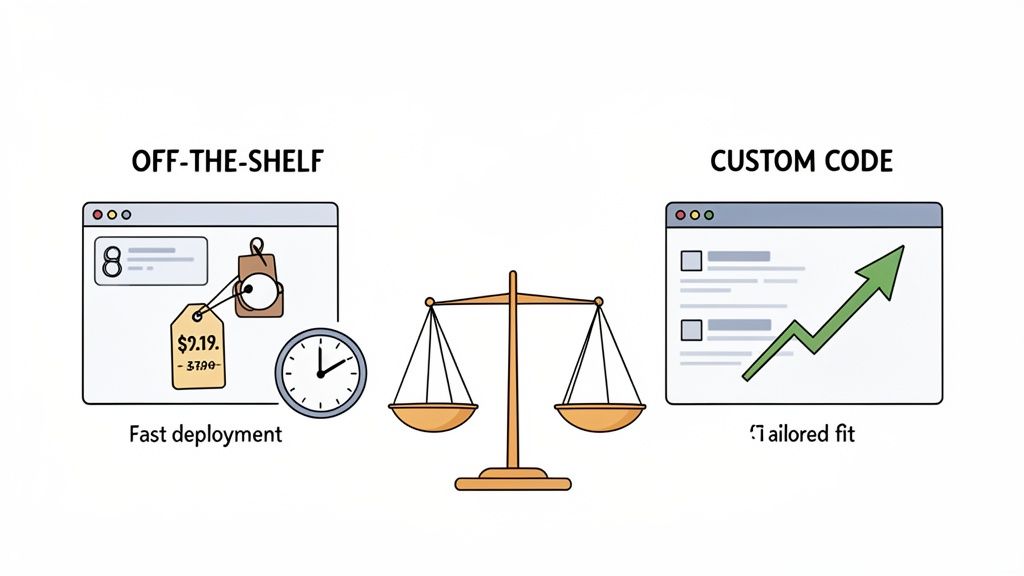
Here’s a quick snapshot of what you can expect from each.
Feature | Custom Software | Off-The-Shelf Software |
|---|---|---|
Initial Cost | High (development investment) | Low (license or subscription fee) |
Deployment Speed | Slower (months of development) | Fast (days or weeks) |
Process Fit | Perfectly aligned with your unique workflows | Requires adapting your workflows to the software |
Scalability | Built to grow with your business needs | Limited by vendor's predefined tiers |
Ownership | You own the intellectual property | You license the software from a vendor |
Competitive Edge | High (creates a unique operational advantage) | Low (uses the same tools as competitors) |
This isn't just a "build vs. buy" decision; it's about your entire software strategy. This guide explores the strategic imperatives in software and asset management to help you place this choice within your bigger business goals. Ultimately, what you decide on today will define your company's ability to innovate and operate efficiently for years to come.
Analyzing The Total Cost Of Software Ownership
When you’re weighing custom software against an off-the-shelf option, the sticker price is just the beginning of the story. The real financial picture emerges when you look at the Total Cost of Ownership (TCO), which includes every dollar you’ll spend over the entire life of the software.
Off-the-shelf software is tempting because it looks cheaper upfront. It usually comes with a low monthly or annual subscription, making it easy to get started. But those recurring fees add up fast, turning what felt like a small operational cost into a major long-term expense.
Custom software is the opposite. It requires a significant capital investment to get going, covering everything from discovery and design to the actual coding and launch. That initial hurdle can feel high, but it frees you from the endless cycle of subscription payments that define the off-the-shelf world.
Unpacking The Hidden Costs Of Off-The-Shelf Software
Ready-made solutions are notorious for hidden expenses that seem to pop up just as your business starts to gain momentum. These costs often scale right alongside your success, creating a financial drag when you can least afford it.
The most obvious cost is the recurring subscription fee, which is almost always billed per user, per month. As your team grows, so does this bill. Growth starts to feel expensive. For a lot of businesses, these fees can easily eat up 20-25% of the initial purchase price every single year.
But it doesn't stop there. Be ready for these other financial drains:
Integration Fees: Need the software to talk to your other systems? That often requires paid third-party connectors or hiring a developer for custom API work.
Mandatory Upgrades: To get new features or even just maintain support, vendors might force you to jump to a more expensive plan, whether you need the extra bells and whistles or not.
Training and Support: Basic support might be included, but if you need a dedicated account manager or specialized training for your team, expect to pay a premium.
"Off-the-shelf lures with low initial outlay and days-to-weeks deployment, ideal for cash-strapped startups, but recurring licenses...plus add-ons for growth...mean TCO falls post-break-even, around 33 months for mid-markets."
This slow, steady financial creep is what catches most businesses by surprise. For a deeper look at what goes into building software from scratch, our guide on the mobile app development cost breakdown lays it all out.
Calculating The Long-Term Value Of Custom Software
Custom software flips the financial model completely. You concentrate the spending at the beginning, but in doing so, you're building a company-owned asset that pays you back over time.
The single biggest financial win is the elimination of recurring license fees. Once the software is built and paid for, it’s yours. Period. You’re no longer renting the tools that run your business.
This ownership directly leads to a much lower TCO over a few years. You’ll still have maintenance and support costs, of course, but you control them. They aren't subject to a vendor's sudden price hikes. It’s a common myth that custom is always more expensive, but the numbers don't lie. Custom software often wins out after year three, just as subscription costs really start to balloon. Some analyses show businesses can see 35-40% operational gains with custom-built tools.
Getting a handle on the budget requires understanding the real React Native app development cost, which helps paint a complete picture of the upfront investment.
That initial build isn’t just an expense; it’s a capital investment in a digital asset that adds real value to your company. The break-even point, where your savings from avoided subscriptions finally cover the initial build cost, usually arrives much faster than you’d think. After that, the financial upside of custom software just keeps growing.
To make this crystal clear, let's map out what the TCO might look like for both models over a five-year period.
Financial Comparison: Custom vs Off-The-Shelf Software
This table breaks down the typical financial journey, showing how a high initial investment in custom software can lead to significant long-term savings compared to the escalating costs of a subscription model.
Financial Factor | Off-The-Shelf Software | Custom Software |
|---|---|---|
Initial Cost (Year 1) | Low ($5,000 - $20,000) annual subscription. | High ($50,000 - $250,000+) one-time development cost. |
Recurring Fees (Years 2-5) | Ongoing subscription fees, often increasing with user growth or feature needs. | None. The software is owned outright. |
Integration & Customization | Moderate to High. Often requires paid add-ons or developer work. | Included in the initial build, with future changes budgeted as needed. |
Maintenance & Support | Included in subscription, but premium support costs extra. | $10,000 - $50,000 annually (approx. 15-20% of initial cost). |
Scalability Costs | High. Costs increase directly with user count and feature upgrades. | Low. The system is built to handle planned growth. |
Estimated 5-Year TCO | $50,000 - $150,000+. Predictable but continuously escalating. | $110,000 - $450,000+. High initial cost, but stable and predictable long-term. |
As you can see, the break-even point often arrives around the third year. From that point forward, the custom solution becomes the more financially sound choice, transforming from a cost center into a valuable company asset.
Comparing Implementation Speed And Time To Market
How quickly can you get a new tool into the hands of your team? For any business, this is a critical question. When you’re trying to fix a broken process or get a new product out the door, deployment speed can be just as important as the features themselves. This is where the custom vs. off-the-shelf debate really heats up.
Off-the-shelf software is the undisputed champion of speed. These solutions are built to be used right away. You can often get one up and running in a few hours or days. The process is usually simple: sign up, tweak a few settings, import your data, and you’re good to go. For companies that can't afford to wait, this is a massive advantage.
In contrast, traditional custom software development is a marathon. It’s a meticulous journey that involves discovery workshops, UI/UX design, coding, rigorous testing, and finally, deployment. A typical project timeline can easily stretch from four to nine months, and for complex systems, even longer. This makes it a non-starter for businesses needing an immediate fix. Keeping that marathon on schedule is the hard part, and we cover it in managing software development projects.
Off-The-Shelf Wins The Race To Launch
When you absolutely need to move fast, off-the-shelf products give you an almost unbeatable head start. Their instant availability lets you plug operational gaps immediately, skipping the long planning and development cycles that custom work demands.
Think about a startup trying to launch its Minimum Viable Product (MVP). Time is everything. By choosing an off-the-shelf CRM or project management tool, they can pour their limited resources into their core product instead of building internal tools from the ground up. This dramatically shortens the runway needed to get to market and start getting real feedback and revenue.
The Rise Of Accelerated Custom Development
But the old, slow timeline for custom software isn't the only story anymore. The development world has evolved, and new approaches are closing the speed gap in a big way. Modern methods are making custom-like solutions faster to build than ever before.
The old choice was simple: speed or a perfect fit. Today, businesses can increasingly have both. The rise of new development platforms means you no longer have to sacrifice customization for a quick launch.
These newer methods are all about efficiency, but they don't compromise on the tailored results that make custom software so valuable. They pull this off with a few key strategies:
Modular Architecture: Using pre-built, solid components for common functions like user logins or payment processing. This lets developers focus only on the unique business logic that sets your app apart.
AI-Powered Coding Assistants: Tools that automate repetitive coding chores and help developers build, test, and debug much faster.
Low-Code and No-Code Platforms: Visual development environments that enable rapid application building with minimal hand-coding, perfect for internal tools and prototypes.
These advancements are changing the entire conversation. To get a better sense of how these modern techniques work, check out our guide on what is rapid application development, which breaks down how businesses can get tailored solutions off the ground faster.
The following chart shows how the long-term cost of ownership often shifts, making the initial time investment in custom software pay off financially over the years.
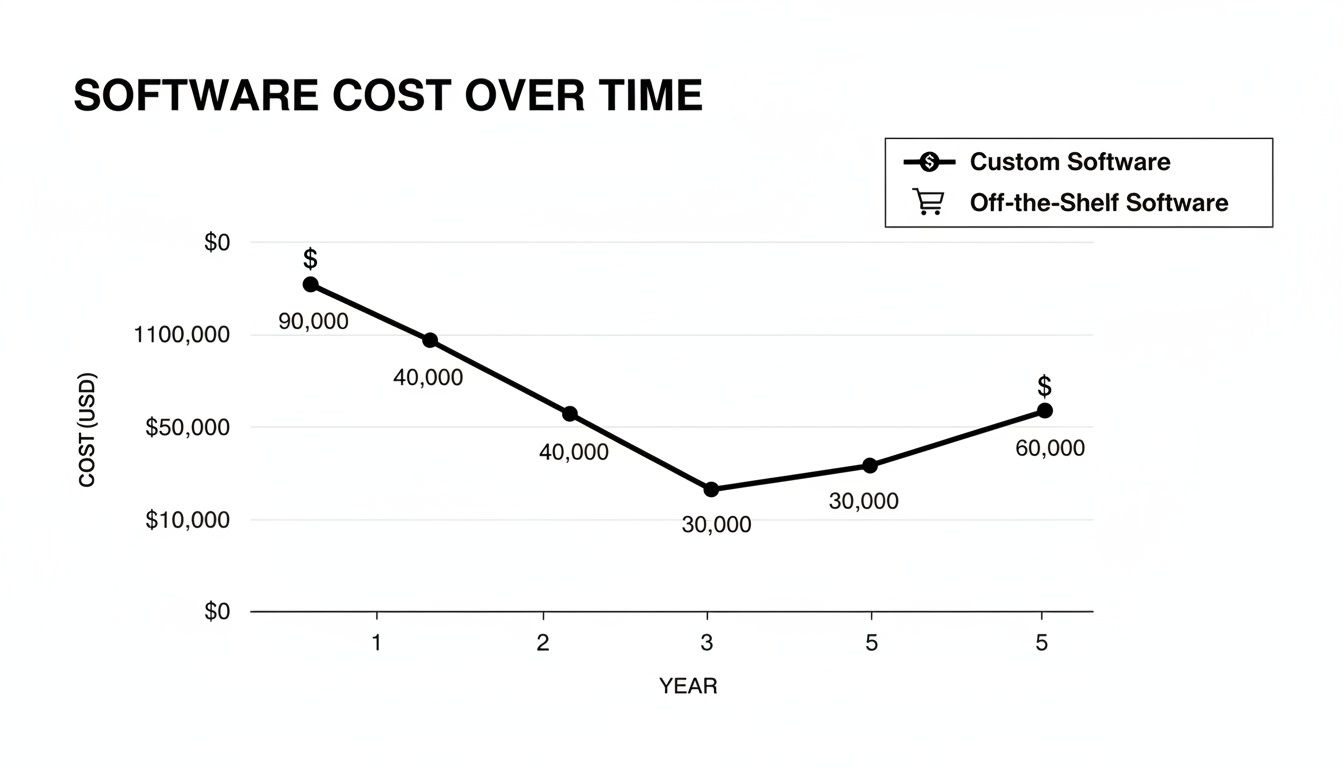
While custom software has a higher upfront cost, it can become more economical over time as off-the-shelf subscription fees pile up. Now that this long-term value is being paired with faster development cycles, it presents a powerful third option for businesses that want both speed and a perfect fit.
Planning For Scalability And Future Growth
When you're choosing software, you're not just solving today's problems. You're placing a bet on your future. As your business takes off, your software has to keep up. This is where the road forks, and your choice of custom vs. off-the-shelf becomes either a massive advantage or a serious operational drag.
Off-the-shelf software is built for the average user, not your specific growth plan. It might feel like a perfect fit when you're a small team, but it can quickly turn into a straitjacket as you scale. You’ll eventually hit invisible walls like user limits, workflow ceilings, or data processing caps that force you into clumsy, inefficient workarounds.
This is how you get stuck in vendor lock-in. You become so tangled in one vendor’s ecosystem that the cost and pain of switching are just too high. You're left paying for expensive upgrades to higher plans that might not even fix your real problems, all while your growth is being held hostage.
The Limits Of Off-The-Shelf Scalability
With off-the-shelf software, you scale on the vendor's terms, not yours. Growth usually means jumping up to the next pricing tier, which bundles users and features together. It’s a one-size-fits-all model, so you often end up paying for a bunch of functionality you don't need just to add more users or unlock one critical feature.
This rigid structure throws up several roadblocks:
Forced Process Changes: As your operations get more sophisticated, the software can't adapt. Instead of the tool supporting your new workflow, your team has to change how they work to fit inside the software's box.
Integration Hurdles: Trying to connect that off-the-shelf tool to other systems can be a nightmare. Bad integrations lead to data silos and manual data entry, which are direct hits to productivity and speed.
Performance Degradation: A system designed for a broad audience can bog down under the specific, heavy load your growing business creates, hurting both your user experience and operational efficiency.
Outgrowing a generic solution isn't just an inconvenience; it's a strategic risk. When your software can't keep up, you’re forced into a costly and disruptive migration, all while your competitors are pulling ahead.
This is a classic growing pain. The very tool that helped you get off the ground becomes the main thing holding you back.
Engineering Custom Software For Infinite Growth
Custom software, on the other hand, is built with your future in mind from the very first line of code. Because it's engineered around your unique operational DNA, scalability isn't an add-on; it's baked into the architecture. This means your app is designed to evolve right alongside your business, no matter which direction you take.
A custom application can pivot to meet new market demands, support new products, or handle a massive influx of users without needing a complete tear-down. The system is built to handle more data, more complex transactions, and more simultaneous users without breaking a sweat. That built-in agility keeps your tech as a powerful engine for growth, not an anchor.
This tailored approach also pays off financially over the long run. Research from 2025 shows that businesses running on custom software see an average 21% higher ROI within three years compared to those using off-the-shelf tools. A huge part of that is eliminating waste. Ready-made tools are often bloated with features you’ll never touch. Some estimates suggest as much as 80% of SaaS features are never used, costing the industry billions.
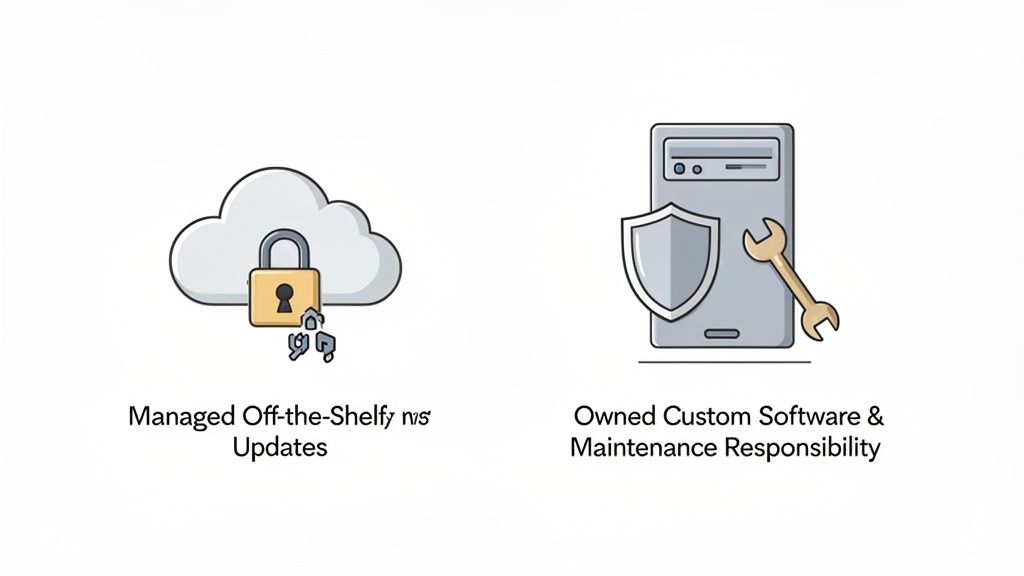
Beyond the initial price tag and launch date, the real value of your software is shaped by the long-term realities of who owns it, who maintains it, and who secures it. Choosing between custom and off-the-shelf software puts you on two completely different paths for managing these critical areas. One offers convenience but gives up control; the other demands full responsibility in exchange for total autonomy.
With off-the-shelf software, you’re not an owner. You’re a licensee, essentially renting access to a tool under the vendor's terms. This can be a huge plus for teams without a dedicated IT staff, as the vendor handles all the maintenance, bug fixes, and security patches.
But that convenience comes at a cost. You have zero say in the product’s future. If the vendor decides to kill a feature you depend on, overhaul their pricing, or pivot their entire business, you're forced to adapt or migrate. That can get expensive, fast.
The Responsibilities Of True Ownership
Going custom means your business owns the intellectual property, period. The source code becomes a tangible asset on your balance sheet, giving you complete and permanent control over your app’s destiny. You decide what to build, when to update, and how the software evolves with your business.
This ownership also means you're on the hook for keeping the app running smoothly. Ongoing maintenance isn't just a nice-to-have; it's an essential investment to keep your software secure, efficient, and aligned with your business needs as they change.
Owning custom software is like owning a commercial property instead of leasing it. The upfront investment is higher and you’re responsible for the upkeep, but you build equity in a valuable asset that you can adapt for any purpose.
A good rule of thumb is to budget 15% to 20% of the initial development cost annually for maintenance. This typically covers the essentials:
Bug Fixes: Stamping out any issues that pop up during regular use.
Security Patches: Protecting your app against new and emerging cybersecurity threats.
Performance Optimization: Making sure the software stays fast and responsive, even as user and data volumes grow.
Minor Feature Enhancements: Small tweaks and adjustments to improve workflows and make users' lives easier.
Comparing Security Postures
Security is where the two models really show their differences. Off-the-shelf products are massive, high-profile targets for cyberattacks precisely because so many companies use them. A single vulnerability found in a popular SaaS tool can expose thousands of businesses at once. In fact, Verizon’s research found that 52% of cyberattacks specifically exploit vulnerabilities in these widely used commercial products.
Sure, vendors work to patch these holes, but your business is exposed until that patch is developed and deployed. This creates a window of vulnerability that is completely out of your hands.
Custom software, on the other hand, presents a much smaller and less familiar attack surface. Because the codebase is unique to your organization, it’s not a target for the broad, automated attacks looking for common exploits.
Better yet, you can build security protocols directly into the software that are tailored to your specific needs, whether that's complying with HIPAA or GDPR. For any company handling sensitive data, this level of focused security is often non-negotiable. This direct control allows you to be proactive and build a security posture that generic software simply can't offer. A core part of this is managing the backend infrastructure; to get more context on this, you can learn about the role of a Backend-as-a-Service, which is how many modern custom apps handle these components.
Making The Right Choice For Your Business
Deciding between a custom app and an off-the-shelf solution really comes down to a clear-eyed look at your business needs, your budget, and where you're headed long-term. This isn't just about the initial price tag; it's about choosing a tool that will either accelerate your growth or become a frustrating roadblock down the line.
Off-the-shelf software is a great fit when your internal processes are pretty standard and you just need something that works right now, without a huge upfront cost. But if your unique way of doing things is your competitive edge, then a custom solution is almost always the right call. The higher initial investment is justified by getting a perfect fit that can scale with you.
That said, the conversation is no longer a simple either/or choice. A third, smarter path has opened up, blending the best of both worlds.
The Rise Of The Hybrid Model
Modern development platforms are completely changing the old custom software vs off the shelf math. They've introduced a hybrid model that marries the speed and lower cost of pre-built solutions with the tailored fit of something made from scratch. These platforms are engineered to deliver custom-feeling apps without the brutal timelines and costs of traditional development.
How do they do it? By starting with a foundation of pre-built, battle-tested components for common features like user logins or payment gateways. This lets the development focus entirely on the unique features that actually solve your specific business problems.
This new generation of tools offers the best of both worlds. It allows companies to define their precise needs and get a product that feels custom-built but is delivered with the efficiency of an off-the-shelf solution.
This approach slashes development time from months to just a few weeks. Suddenly, truly tailored software is on the table for a much wider range of businesses, including startups and SMBs that were previously priced out of the custom market.
A Smarter Path To Customization
Platforms like CatDoes are the perfect example of this evolution. By using AI-native agents that translate business needs directly into production-ready mobile apps, they tear down the old barriers to custom development. You can simply describe what you need in plain English and get a functional, tailored app in a fraction of the time.
This path has some very clear advantages:
Accelerated Delivery: You can launch a custom-feel app faster than ever before. This means you get to test your ideas and get real user feedback in weeks, not months.
Reduced Costs: Automating big chunks of the design and coding process brings the initial financial hit way down compared to a traditional custom build.
True Custom Fit: The app is built around your specific workflows and goals, not some generic template that forces you to change how you work.
Full Ownership Potential: Unlike renting an off-the-shelf product, you can own the intellectual property and have total control over your app’s future.
For any business that needs a unique solution but can’t afford the risk, time, or capital of a conventional build, these modern platforms are the intelligent choice. They offer a direct route to a custom-fit tool that supports your company's identity and growth, without the traditional trade-offs.
Common Questions, Answered
Choosing between custom and off-the-shelf software always brings up a few key questions. Here are some straight answers to the most common ones we hear, drawing on the ideas we've covered.
When Is Off-The-Shelf Software The Smarter Choice?
Off-the-shelf software is the clear winner when your business needs are pretty standard and a tool already on the market does the job well. It's an especially good fit for startups and businesses on a tight initial budget because the upfront cost is so much lower.
This is your best bet if you need to get a solution up and running fast for common tasks like CRM, accounting, or project management. Go this route if your team can adapt its current workflow to the software's structure without causing a major headache.
How Do I Actually Calculate The Long-Term ROI Of Custom Software?
Figuring out the long-term return on investment for custom software means looking way beyond the initial price tag. You need to put a number on the financial benefits that pile up over time to see the full picture.
Start by measuring the gains in how your team operates.
Time Saved: How many hours does your team get back from automated workflows and ditching manual tasks?
Reduced Errors: Calculate the money saved by preventing operational mistakes that lead to rework or unhappy customers.
Eliminated Subscriptions: Add up the annual cost of every off-the-shelf license you're replacing.
Finally, think about the value of owning the intellectual property and the competitive edge you get from features your rivals can't just go out and buy. When you weigh these compounding benefits against the total development and maintenance costs over three to five years, you’ll find your true ROI.
Can I Switch From An Off-The-Shelf Tool To A Custom One Later?
Absolutely. Moving from a pre-built product to a custom solution is a natural, and very common, step as a company grows. Many businesses start with an off-the-shelf tool to get moving quickly, then invest in a custom app once their processes get more specific or they simply hit the limits of what the first tool can do.
The real challenge isn't deciding to switch; it's the nuts and bolts of migrating your data. A poorly planned data transfer can create serious downtime and operational chaos.
Planning the move is everything. You need a structured process to carefully export all your historical data from the old system and map it correctly into the new one. This careful groundwork is what ensures you can make the transition without losing valuable information or disrupting your business.
Ready to build a mobile app that fits your business perfectly, without the traditional costs and delays? CatDoes uses AI-native agents to turn your ideas into production-ready mobile apps, delivering a custom fit with the speed of an off-the-shelf solution. Launch your app with CatDoes and see how fast you can bring your vision to life.
Nafis Amiri
Co-Founder of CatDoes