Blog
Business
API Integrations Platform A Guide to Business Automation
Discover how an API integrations platform can streamline operations, automate workflows, and accelerate growth. Learn to choose the right tools.

Nafis Amiri
Co-Founder of CatDoes
API Integrations Platform A Guide to Business Automation
An API integrations platform is the digital glue that holds your tech stack together. It is the invisible force that lets all your different software applications talk to each other, share data, and automate work without you lifting a finger. Think of it as a universal translator that allows your CRM, marketing tools, and payment systems to communicate flawlessly.
The Digital Glue Connecting Modern Business
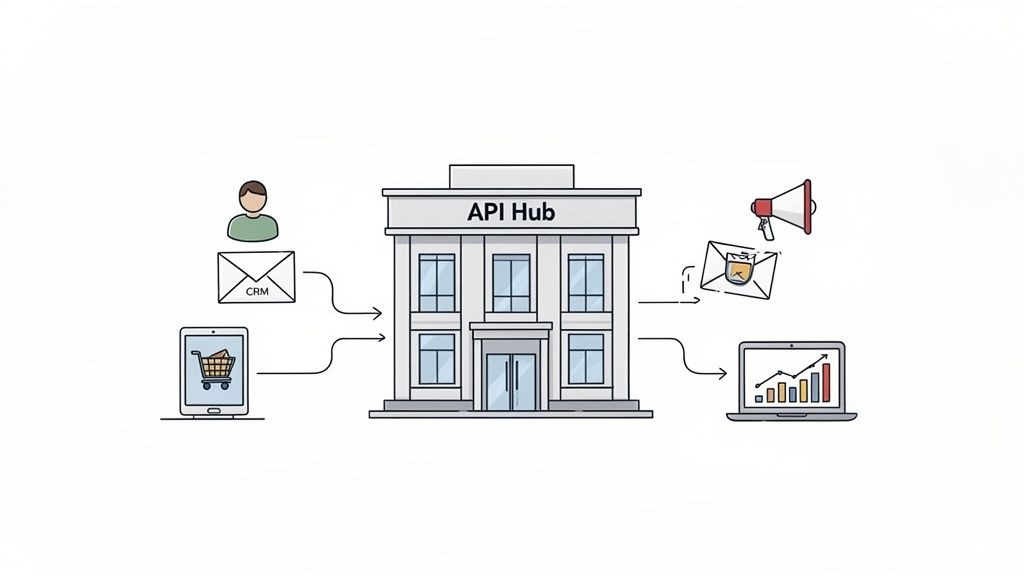
If you're running a business today, you're almost certainly using a collection of specialized software. Your customer data lives in a CRM, sales are processed on your e-commerce platform, and campaigns are managed by your email marketing software. Each tool is a powerhouse on its own, but they often operate in isolation, creating disconnected islands of information.
This separation forces your team into tedious and error-prone busywork, like manually exporting customer lists from one system to import them into another. This doesn't just waste precious time; it introduces data mistakes and leads to huge missed opportunities. The real magic happens when these systems can talk to each other automatically.
Why System Connectivity Is a Business Imperative
The headache of getting different software to communicate isn't new, but it's become a much bigger problem. As companies adopt more and more cloud-based tools, their software ecosystem gets incredibly complex. Without a central way to manage all these connections, you end up with operational bottlenecks and data silos that actively slow down your growth.
For startups and small businesses, this pain is especially sharp. Building custom, one-off integrations for every new tool is expensive and demands specialized developers who are often already stretched thin. This is exactly where an api integrations platform becomes a game-changer.
An API integrations platform acts as a central post office for your digital tools. It standardizes how information is sent, received, and processed between different applications, ensuring every piece of data reaches its correct destination securely and efficiently.
These platforms come with pre-built connectors and visual tools that empower anyone, not just developers, to build powerful automated workflows. This shift democratizes integration, making businesses more agile and responsive. Instead of waiting weeks for a developer to free up, you can connect a new marketing tool to your sales pipeline in minutes, creating a seamless flow of information that drives real business results.
So, what exactly is an API integration platform?
Think of it as the central hub for your entire software toolbox. It's the one place that allows all your different applications, from your CRM to your marketing automation tool, to talk to each other and share data seamlessly. It is like a universal translator and switchboard operator rolled into one.
Without a platform like this, connecting your tools is messy. You'd need a developer to write custom code for every single connection. That's slow, expensive, and creates fragile links that break the moment one of the apps gets an update. An integration platform gets rid of that tangled, point-to-point mess and replaces it with a clean, manageable system.
This isn't just a niche trend; it's a massive shift in how businesses operate. The market for these platforms is exploding, growing from USD 8.82 billion in 2026 and projected to hit a staggering USD 24.69 billion by 2032. Companies everywhere are racing to connect their systems, and you can dig into the drivers behind this growth over at Research and Markets.
The Core Components of an Integrations Platform
So, what is under the hood? These platforms are powerful because they bundle a few key components that do all the heavy lifting for you.
Pre-Built Connectors: These are basically ready-made plugs for popular software like Salesforce, Shopify, or Slack. Instead of figuring out the technical guts of each app's API, you just plug it in and get started.
Data Mapping and Transformation Tools: Your CRM might call it a "Lead," while your email tool calls it a "Subscriber." Data mapping tools give you a simple, visual way to draw a line between the two, ensuring information lands in the right place, in the right format.
Workflow Automation Engines: This is where the real magic happens. The workflow engine lets you build simple "if this, then that" rules. For example: "When a customer buys a product on our website, automatically create a new contact in our CRM and add them to our 'Welcome' email sequence."
An API integrations platform is the digital nervous system of a modern business. It doesn't just connect apps; it orchestrates how data moves between them, automating entire processes and giving you a unified view of everything that's happening. Integration work is one of several businesses worth starting now, which we list in the best business to start in 2026.
How Is This Different From iPaaS?
You'll often hear the term iPaaS (Integration Platform as a Service) thrown around, and it's easy to get them confused. They are very, very similar.
Think of it this way: iPaaS is simply the cloud-based version of an API integration platform. Instead of you buying, installing, and maintaining the software on your own servers, an iPaaS provider hosts it all for you. You just pay a subscription and get access to all the tools. This model has made powerful integration technology affordable and accessible for everyone, especially small businesses that do not have a dedicated IT department.
Core Features That Power Seamless Connectivity
Picture your tech stack as a busy train station. Each application sits on its own platform, waiting to board data trains bound for other services. An API integrations platform lays the tracks, signals, and switches so information flows without crashes or delays.
At the heart of these platforms are three pillars:
Pre-Built Connectors that plug into popular services
Data Mapping And Transformation for cleaning and reshaping data
Workflow Automation to choreograph multi-step processes
Combined, they shift complex coding challenges into visual workflows you can build in minutes.
Essential Features Of An API Integrations Platform
Below is a quick table that highlights each core feature alongside the direct business advantage it delivers:
Feature | Primary Business Benefit |
|---|---|
Library of Pre-Built Connectors | Cuts integration time from weeks to minutes |
Visual Workflow Builder | Empowers non-technical teams to automate processes |
Data Mapping and Transformation Tools | Ensures reliable data consistency across systems |
Automation Engine | Streamlines repetitive tasks and reduces errors |
robust authentication | Safeguards data exchange and builds customer trust |
These components form the backbone of a central hub that keeps your applications talking without a hitch.
Connectors: The Universal Adapters
Imagine plugging a power cord into any outlet with no rewiring needed. That is what a library of pre-built connectors feels like when you are integrating systems such as Salesforce, Shopify, or Slack.
You simply choose the connector for the service you need, configure a few credentials, and you are live. This approach slashes both development effort and time-to-value, empowering teams to focus on outcomes instead of boilerplate setup.
Intuitive Workflow Automation
If connectors are the outlets, the visual workflow builder is the electrical grid. Drag, drop, and link steps to build automations that react to events in real time without writing a line of code.
A simple example: whenever a customer places an order in your e-commerce store, the platform can:
Create a new record in your CRM
Notify your warehouse team via Slack
Kick off an email sequence in your marketing tool
It is all laid out in a flowchart-like canvas. To dive deeper into the tech behind these event-driven processes, see our explainer on what is serverless architecture.
The real magic lies in how a visual builder bridges your business goals with the underlying technical steps required to make them happen.
Data Transformation And Security
Moving data is one thing. Making sure it arrives in the right shape and remains protected is another.
Data mapping and transformation tools let you visually match fields between different systems, so a “First Name” tag in one app seamlessly fills the “Given Name” field in another. You can even apply formulas, filters, or lookups on the fly to clean and enrich data before it lands.
On the security side, managing robust authentication is critical. From API keys and tokens to granular permission controls, these platforms lock down every exchange, ensuring sensitive information moves safely across your ecosystem.
Key Benefits For Startups And Growing Businesses
For a startup or a growing business, speed isn't just a nice-to-have; it's a survival mechanism. An API integrations platform is a massive accelerator, tackling the biggest hurdles you face every day: not enough people, tight budgets, and the relentless pressure to build faster than everyone else.
Instead of sinking months and a huge chunk of your capital into custom development, a platform lets a small team connect critical tools and launch new features in a tiny fraction of the time. This isn't just a small improvement; it's a genuine competitive edge that lets you test ideas, get real user feedback, and pivot on a dime.
Think about a founder building a new mobile app. Manually coding every connection to a payment gateway, an analytics service, and a customer support tool could tie up a developer for weeks. With an integrations platform, you can wire up these essential services in a couple of days.
Fueling Growth While Slashing Costs
One of the first things you'll notice is the dramatic drop in what you spend on development and upkeep. Building custom integrations from scratch is a constant drain. Each connection needs to be built, maintained, patched when bugs pop up, and completely updated every single time a connected app changes its API.
An API integrations platform just absorbs all that mess. You're essentially outsourcing the tedious, expensive work of maintaining digital plumbing by using pre-built connectors and managed infrastructure. This frees up your best technical minds to focus on what actually makes your business unique, not on keeping the pipes clean.
The financial impact is huge. The market for Integration Platform as a Service (iPaaS) is expected to explode from USD 17.64 billion in 2025 to a staggering USD 292.9 billion by 2035. According to Precedence Research, this growth is largely fueled by small and medium-sized businesses that are sidestepping traditional development costs altogether.
An API integrations platform levels the playing field. It gives startups and SMBs the kind of powerful automation and connectivity that used to be reserved for huge companies with massive IT budgets.
Enhancing Operational Efficiency And Data Accuracy
Beyond the cost savings, these platforms deliver a massive boost to how your business actually runs. When you automate routine tasks, you get rid of the manual, error-prone work that slows everyone down.
Here is what that looks like in the real world:
Automated Sales Workflows: A new lead fills out a form on your website. Instantly, their info is in your CRM, assigned to a sales rep, and dropped into an email sequence without anyone lifting a finger.
Synchronized Customer Data: Customer information stays perfectly consistent across your help desk, billing system, and marketing tools. You finally have a single, reliable source of truth.
Streamlined Onboarding: A new customer signs up and it automatically triggers a welcome email, creates their user account, and notifies your support team. The experience is smooth and professional from day one.
This kind of automation doesn't just save time; it dramatically improves the quality of your data. When you remove manual data entry, you slash the risk of human error. That means cleaner data, more reliable reports, and smarter business decisions. It's a foundational step in any successful digital transformation for a small business.
Common Use Cases Across Industries
The real magic of an API integrations platform isn't in the technical jargon; it's in what it actually does for a business. These platforms aren't just for Silicon Valley startups. They've become the operational glue for businesses in every field imaginable, from online retail and marketing to your own internal HR department.
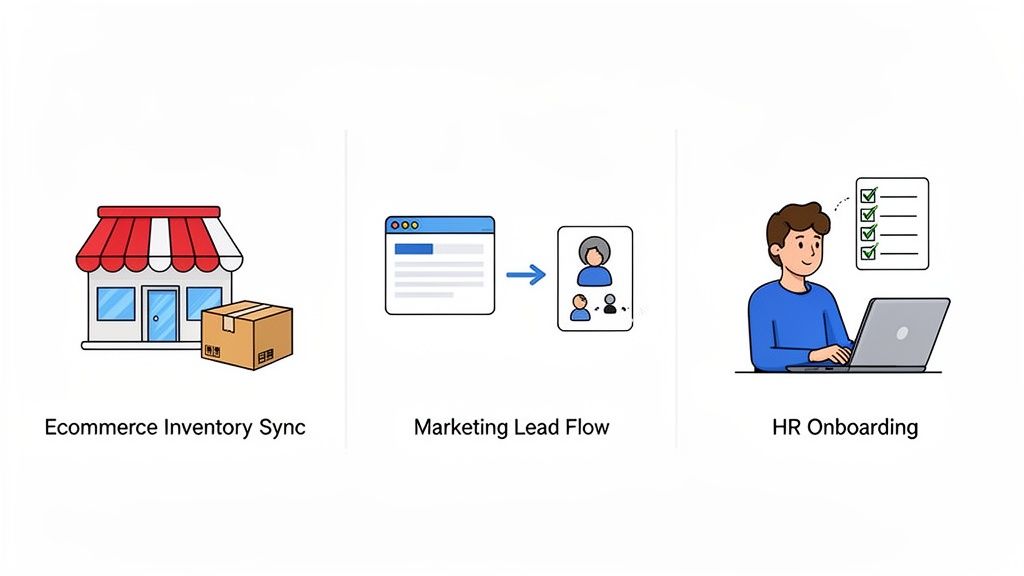
They solve real, everyday headaches by automating the tedious, manual workflows that slow you down and create errors. Every single integration tells a story of a business taking a frustrating process and turning it into a smooth, automated advantage.
Streamlining E-commerce Operations
Let's picture an online store selling handmade leather goods. Before they had an integration platform, every time an item sold out, someone had to log in and manually update the inventory in their warehouse system. This little delay was a big problem, often leading them to oversell popular items, which meant canceled orders and frustrated customers.
Now, with an API integrations platform in place, a simple workflow connects their e-commerce site directly to their warehouse software. When a customer makes a purchase, inventory is updated instantly across both systems. No more overselling. This real-time sync keeps customers happy and frees up the team to focus on things that actually grow the business. It is no surprise that e-commerce makes up 28% of all API data flow services.
By connecting disparate systems, an API integrations platform turns a series of isolated actions into a single, cohesive business process that runs on its own.
This kind of automation is quickly moving from a "nice-to-have" to a "must-have." While financial services currently leads the pack with 32% of API data flow usage, the entire market is projected to explode from USD 2.84 billion in 2024 to USD 10.93 billion by 2034. That growth tells you everything you need to know about how vital these connections have become for running a modern business efficiently. You can dig into more of these trends with these API market insights from IntelMarketResearch.com.
Automating Marketing And Sales Funnels
In marketing, speed is the name of the game. Think about a company generating leads from a form on its website. Without automation, a marketer has to manually download a CSV file of new leads, clean it up, and then upload it into the company's CRM and email marketing platform.
That manual shuffle is slow and creates a costly delay in following up with someone who is actively interested in your product. That is why one of the most common use cases is connecting a CRM with various marketing tools, including top-tier email marketing software, through an integration platform.
This single connection unlocks a few critical wins:
Instant Lead Nurturing: As soon as a lead comes in, they're automatically added to a welcome email sequence.
Sales Team Alerts: The right salesperson gets a real-time notification that a new prospect is ready to talk.
Data Consistency: Customer information stays accurate and perfectly synced across all your tools.
A connected system like this ensures no lead ever falls through the cracks and every potential customer gets a timely, professional response.
How To Choose The Right Platform For Your Needs
Picking the right API integrations platform is a huge decision. It directly impacts how fast your business can move and grow. The market is crowded with options, and each one plays to different strengths. The best way to make a smart choice is not to start by looking at platforms, but by looking inward at your own business.
Before you even start comparing features, take a moment to map out your most critical business workflows. Pinpoint the exact processes you need to automate, the specific apps you have to connect, and what data needs to flow between them. This simple blueprint will be your most powerful tool in the evaluation process, helping you cut through the marketing noise and zero in on platforms that actually solve your problems.
Your Evaluation Checklist
Once you have your workflow map handy, use a structured checklist to compare the contenders. This makes sure you are judging every option against the same set of criteria that actually matter to your business. For startups and small businesses, these factors are especially critical.
Connector Library: Does the platform have a deep library of pre-built connectors for the apps you are already using? A rich library means you can get up and running fast, without needing custom development work for common tools like your CRM, e-commerce store, or marketing software.
Ease of Use: How intuitive is the platform for your non-technical team members? Look for a clean, visual workflow builder that lets people create and manage integrations without having to write a line of code. Most platforms offer free trials, which are perfect for getting a firsthand feel for the user experience.
Scalability and Performance: Will this platform grow with you? As your business scales, your data volume and the complexity of your integrations will inevitably increase. You need to be sure the platform can handle much heavier loads down the road without sputtering.
Choosing an api integrations platform is like hiring a key employee. You need to ensure they have the right skills (connectors), can handle the workload (scalability), and fit well with your team's culture (ease of use).
Security, Compliance, and Pricing
Finally, it is time to focus on the non-negotiables: security and cost. Your integration platform is going to handle sensitive business and customer data, so rock-solid security is not just a feature, it is a requirement. Look for platforms that are transparent about their security measures and comply with data protection laws like GDPR or CCPA.
Pricing models can also vary wildly, from consumption-based tiers to flat monthly fees. Make sure the pricing structure aligns with how much you expect to use it to avoid sticker shock later. And if you are exploring how managed infrastructure can simplify your operations even further, you might find our guide on what is Backend as a Service helpful. Taking a thoughtful, systematic approach like this ensures you end up with a partner that will empower your business for years to come.
Got Questions? We've Got Answers
Let's clear up a few common questions that pop up when people start exploring API integration platforms.
What's The Difference Between An API And An API Integration Platform?
It's a great question, and the analogy I always come back to is messengers.
An API (Application Programming Interface) is like a single, specialized messenger who only knows how to carry messages between two specific people. It is a direct, one-to-one connection. Think of a dedicated line between your CRM and your email marketing tool.
An API integration platform, on the other hand, is the central post office for all your messengers. It is a full-blown communication hub, staffed with universal translators and logistics experts. It doesn't just connect two apps; it gives you the tools, pre-built connectors, and workflows to manage hundreds of connections at once. It is the infrastructure that orchestrates everything, making sure the right data gets to the right place at the right time.
Do I Need To Be A Coder To Use One Of These Platforms?
For the most part, no. That's the real beauty of modern API integration platforms. They are built with non-technical users in mind, featuring visual, drag-and-drop interfaces that let you map out complex workflows without writing a single line of code.
These platforms do the heavy lifting behind the scenes, handling all the complicated technical details. This empowers business owners, marketers, and operators to automate their own processes, for example, automatically syncing a new lead from a website form directly into a CRM and a separate email list. While developers can definitely dig in for more advanced custom jobs, the core experience is designed for everyone.
How Does An API Platform Actually Help With App Development?
An API platform is a massive accelerator for app development. Instead of developers spending weeks manually coding every single connection to third-party services like payment gateways such as Stripe, analytics tools, or social media logins, they can use pre-built connectors to get these services up and running in a matter of hours.
This speed is a game-changer. It means teams can build and launch a Minimum Viable Product (MVP) much faster, getting crucial user feedback sooner. It also slashes development costs and frees up your engineers to focus on building the unique, core features of your app, not managing digital plumbing.
Ultimately, this efficiency gets your app to market faster and makes it much easier to adapt and add new features as you learn what your users really want.
Ready to turn your app idea into a real product without the development headaches? With CatDoes, our AI agents handle the design, coding, and backend setup for you. Start building your app for free today!
Nafis Amiri
Co-Founder of CatDoes


