Blog
Tutorials
A Practical Guide to Digital Transformation for Small Business
Unlock growth with our guide to digital transformation for small business. Learn to plan, prioritize, and implement AI and low-code tools for real results.

Nafis Amiri
Co-Founder of CatDoes
A Practical Guide to Digital Transformation for Small Business
For a small business owner, "digital transformation" sounds like a complicated, expensive corporate buzzword. Let's be real: it's not about buying fancy software or overhauling your entire company overnight.
It’s about making smart, targeted upgrades that solve real problems. Think of it as integrating modern tech into your daily operations to make things run smoother, keep customers happier, and find new ways to grow. This is how you stay competitive and build a more resilient business.
Why This Matters for Your Small Business
Digital transformation has gone from a "nice-to-have" to a core part of survival and growth. For a small business, this isn't about chasing the latest tech trend. It's about practical results.
A local boutique using a simple mobile app for a loyalty program that keeps people coming back? That's digital transformation. A plumbing contractor using an automated scheduling tool to cut down on phone tag and book more jobs? That's it, too. So is a general contractor moving daily site reports off paper and into a construction company app. These are the tangible wins we're talking about.
Before we dive into the how, let's quickly frame the core areas where these changes make the biggest impact.
Core Pillars of Small Business Digital Transformation
Thinking about "digital transformation" can feel overwhelming. To simplify it, I've broken it down into three core pillars. This table shows what each one means in a practical sense for a small business like yours.
Transformation Pillar | Primary Goal | Example Implementation |
|---|---|---|
Operational Efficiency | Automate repetitive tasks and reduce manual work. | Using an automated invoicing system that sends reminders, freeing up hours each week. |
Customer Experience | Make it easier and more enjoyable for customers to interact with you. | Launching a simple mobile app for easy ordering and loyalty rewards. |
Growth & Innovation | Find new revenue streams and make data-driven decisions. | Analyzing sales data from your online store to identify your most profitable products and customers. |
Each of these pillars supports the others. When you improve efficiency, you have more time to focus on your customers. When you delight your customers, they come back more often, driving growth.
Leveling the Competitive Playing Field
Not long ago, powerful technology was locked away for big companies with massive budgets. That's completely changed. The rise of accessible AI, no-code, and low-code platforms has put incredible power into the hands of small business owners.
These tools let non-technical founders and small teams build serious solutions without needing a team of software engineers. You can finally compete on a more even footing.
You can automate the boring stuff, get real insights from your customer data, and create professional digital experiences that were once out of reach. For instance, building a custom mobile app for your small business is no longer a six-figure, year-long project. You can now launch one for a fraction of the cost and time.
The big idea here is to work smarter, not harder. Digital tools automate the mundane so you can get back to what you do best: serving your customers and growing your business.
Meeting Modern Customer Expectations
Let's face it, your customers live online. They expect convenience, personalization, and a smooth experience whether they're buying from Amazon or the local shop down the street. A smart digital strategy helps you deliver exactly that.
Here are a few areas where tech can make a huge difference:
Better Customer Service: An AI-powered chatbot on your website can answer common questions 24/7. This frees up your team to handle the more complex stuff that really needs a human touch.
Smarter Marketing: A simple Customer Relationship Management (CRM) system helps you track interactions and send targeted offers that people actually want to see.
Smoother Operations: Integrating your online store with your inventory software means stock levels are always accurate. No more telling a customer you're out of something they just paid for.
This isn't just a trend; it's quickly becoming the standard way of doing business. A recent report from the U.S. Chamber of Commerce shows that by 2026, a staggering 96% of U.S. small and medium-sized businesses (SMBs) plan to adopt new technologies like AI. This isn't optional anymore, it's essential.
Building Your Digital Roadmap with Quick Wins
Real digital transformation doesn't happen by just buying new software. It starts with a clear plan. The best roadmaps I've seen connect every single piece of technology directly to a real business outcome, avoiding vague tech jargon in favor of specific goals.
It's a subtle but powerful shift in thinking. Instead of saying, "we need a new CRM," a better goal is, "we need to boost repeat customer sales by 20%." Suddenly, the conversation isn't about software features; it's about solving a business problem. A CRM might be the answer, but the goal always comes first. This ensures every dollar you invest has a clear purpose.
Start with Where You Are Now
Before you can figure out where you're going, you have to get brutally honest about where you are today. This isn't some complex, formal audit. It's just a straightforward look at the gaps that are holding your business back right now.
Think about these key areas:
Customer Engagement: How easy is it for people to find you, buy from you, and get help? Are you still stuck managing everything with phone calls and manual emails?
Operational Efficiency: What internal tasks are eating up the most time or are most prone to human error? I'm talking about things like invoicing, employee scheduling, or managing inventory.
Data and Insights: Are you making decisions based on gut feelings, or do you have actual data to back them up? Do you know who your most profitable customers are or which products are your top sellers?
Just answering those questions will shine a bright light on the most critical areas for improvement. This simple self-evaluation becomes the bedrock of a focused digital transformation for small business plan.
The journey usually breaks down into three core phases: streamlining what you already do, enhancing how customers interact with you, and finally, unlocking brand new ways to grow.
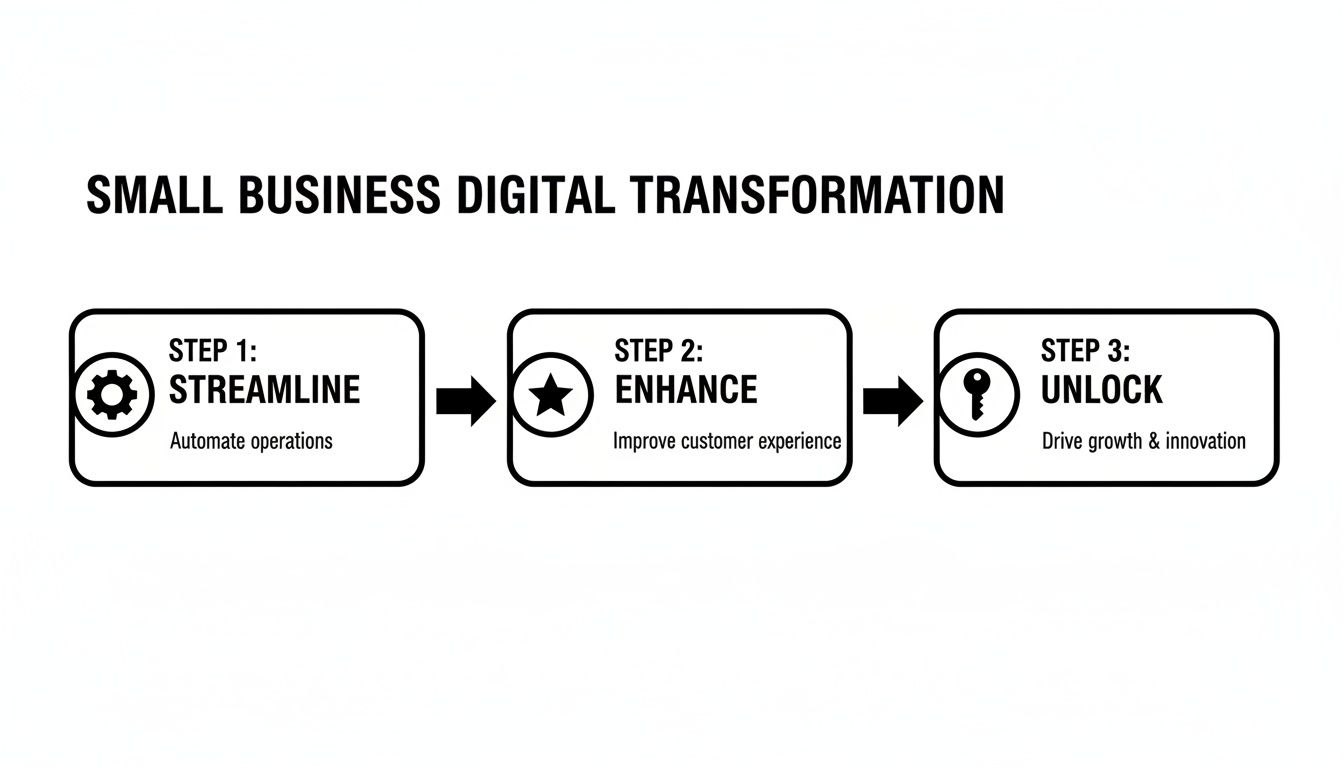
As you can see, a winning strategy almost always starts by fixing internal problems before you move on to bigger, customer-facing projects and future innovation.
Prioritize Quick Wins for Momentum
Trying to change everything at once is a classic mistake and a surefire recipe for burnout. The secret to getting things moving and proving that new digital tools are worth it is to go after "quick wins." These are small, high-impact projects that deliver measurable results in a very short amount of time.
A quick win builds confidence across your team and demonstrates a clear return on investment early on. It turns skepticism into enthusiasm and makes it easier to get buy-in for larger projects down the line.
A good quick win is something you can knock out in a few weeks, not months. For small businesses looking at custom mobile apps, for example, there are efficient ways to get started. Some developers speed things up by using a React Native boilerplate for faster app development, which gives them a solid foundation to build on.
This same logic applies perfectly to no-code tools. You could launch a simple customer feedback app or an internal sales dashboard in a weekend using an intuitive platform. These kinds of projects are less about heavy engineering and more about quickly solving a specific pain point. It helps to think of these initial projects as experiments. You can learn more about this iterative method in our guide on understanding what a Minimum Viable Product (MVP) is.
Creating Your Simple Roadmap
Your roadmap doesn't need to be some 50-page document nobody reads. A simple checklist or spreadsheet is often far more effective. It just needs to clearly outline your path from those initial quick wins to your more ambitious, long-term goals.
Here's a practical way to structure it:
Define Your Goal: State the business outcome in plain English. (e.g., "Reduce appointment no-shows by 30%.")
Identify the Solution: Pinpoint the specific tool or process change needed. (e.g., "Implement an automated SMS reminder system.")
Set a Timeline: Give it a realistic deadline. (e.g., "Launch within four weeks.")
Assign Ownership: Make one person on your team responsible for it. (e.g., "Office Manager leads implementation.")
Measure Success: Define the one key metric you'll track. (e.g., "Track no-show rate before and after launch.")
By focusing on just one or two of these targeted projects at a time, you create a powerful cycle of success. Each win gives you the resources and the confidence to take on the next one, building a cumulative effect that truly transforms your business, one smart step at a time.
Choosing the Right Low-Code and AI Tools
The software world is overflowing with buzzwords like "low-code," "no-code," and "AI-native." For a small business owner, it can all sound like a foreign language. The trick is to ignore the hype and focus on what these tools actually do for you.
Low-code and no-code platforms are essentially sophisticated toolkits that let you build apps and automate workflows without writing a single line of traditional code. Think of it like using visual building blocks. Instead of hiring a developer, you use drag-and-drop interfaces to create everything from a customer-facing mobile app to an internal inventory tracker.
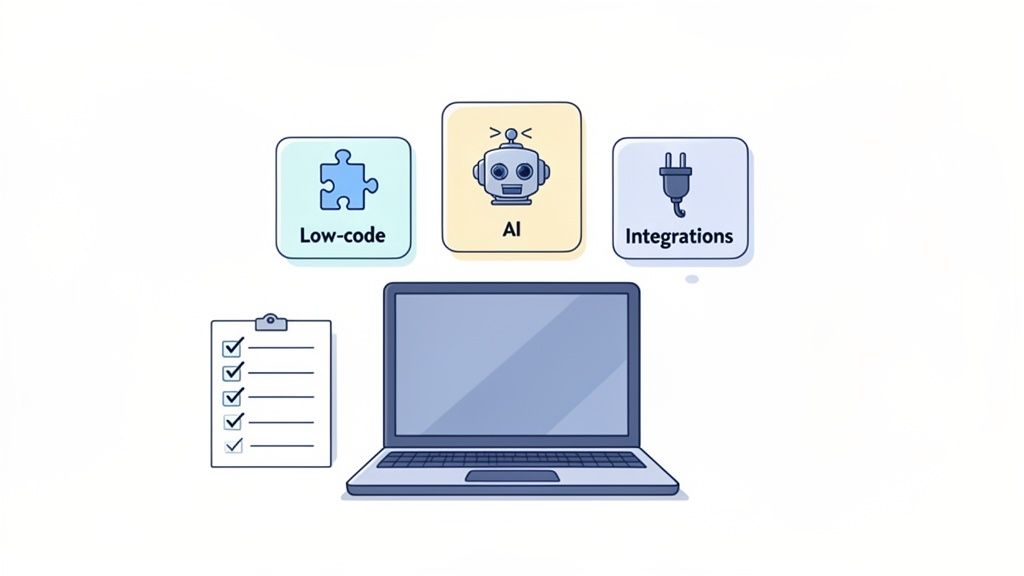
AI-native tools take this a massive step further. They don't just help you build; they help you think. An AI-native platform can take a simple description of your app idea, generate the user interface, and even write the business logic behind it automatically. This means you can build smarter, more powerful solutions in a fraction of the time.
A Practical Framework for Evaluating Tools
Picking the right software is a strategic investment, not just another line item on your expense report. Before you commit to any platform, you need a simple gut check focused on what really matters for a small business.
Your goal is to find a tool that solves a specific problem without creating three new ones. A platform with a million features is completely useless if your team finds it too confusing to use or if it doesn't play well with the software you already depend on.
Here are the four key areas I always scrutinize:
Ease of Use: Can you and your team actually figure it out quickly? Look for tools with clean interfaces and good documentation. A new tool should feel like it's taking work off your plate, not adding to it.
Scalability: Will this tool still work when your business is ten times bigger? A solution that’s great for your first ten customers needs to handle a thousand without breaking a sweat. You don't want to get boxed in.
Integration Options: Does it connect to your existing software? Your tools have to talk to each other. A platform that easily integrates with your accounting software, email service, or CRM is infinitely more valuable.
True Cost: What are you really going to pay? Look past the shiny monthly subscription fee. You have to account for hidden costs like extra users, premium features, or necessary add-ons.
This simple framework helps you cut through the marketing fluff and focus on practical value. It ensures every tool you bring on board is a smart move for your digital transformation for small business.
Low-Code and AI in Action
Okay, let's get out of the theory and into the real world. Imagine a small catering company drowning in custom orders coming from every direction: emails, phone calls, and text messages. It's a manual, chaotic process that’s slow and full of mistakes.
Using a no-code platform, the owner could build a simple mobile ordering app in a single weekend. Suddenly, customers can browse the menu, submit detailed orders, and pay right from their phones. The platform instantly confirms the order and adds it to a central dashboard. Just like that, hours of admin work disappear, and costly errors are eliminated. To see what's out there, you can explore our guide on the best low-code platforms for small businesses.
Now, let's sprinkle in some AI.
An AI-powered chatbot integrated into that same app could answer common customer questions 24/7. "Do you have gluten-free options?" or "What's your delivery range?" The chatbot handles it, freeing up the owner to focus on what they do best: making incredible food.
This is the real power of modern tools. They handle the repetitive stuff and provide intelligent help, letting you deliver a top-notch customer experience, even with a tiny team.
Navigating the AI and Data Privacy Landscape
As you start using these powerful tools, you absolutely have to think about data privacy and compliance. AI systems, especially those interacting with customers, are constantly handling personal information. This makes understanding your legal responsibilities non-negotiable.
The global digital transformation market is set to hit $1,009.8 billion in 2026, with AI being a massive driver. With 82% of companies already using or planning to use AI and over 80% of enterprises expected to deploy generative AI apps, the stakes have never been higher. This explosive growth means customers and regulators are watching how businesses handle data like hawks.
When you're looking at AI tools, it’s critical for small businesses to consult a practical AI GDPR compliance guide to make sure you're deploying them ethically and legally. Being proactive about privacy isn't just about avoiding fines; it's about building trust with your customers. Always choose vendors who prioritize security and are transparent about their data policies. It should be a non-negotiable part of your decision.
Tying It All Together: Systems, Data, and Your Team
Grabbing a few slick new tools is a great first step, but the real magic happens when they work together. A successful digital transformation for small business isn't just about the tech. It's about connecting your systems and, just as importantly, bringing your team along for the ride.
Think about it. If your shiny new online store doesn't automatically talk to your inventory software, you're setting yourself up for disaster. You'll inevitably sell products you don't have, leaving you with unhappy customers and a logistical mess to clean up. This is exactly why getting your systems integrated is a non-negotiable.
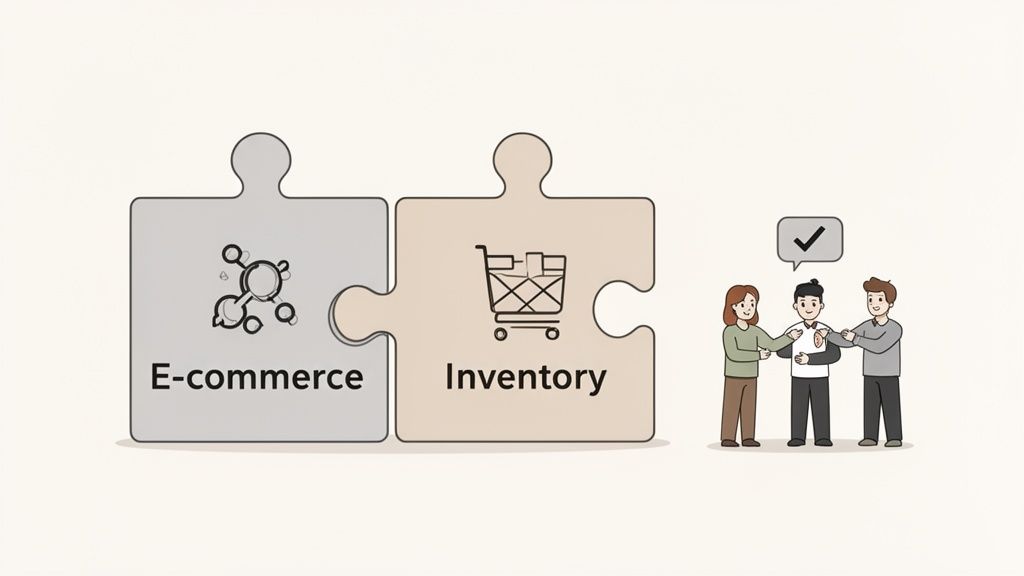
Real efficiency is born from seamless data flow. When a customer clicks "buy," that single action should instantly update your inventory, ping your accounting software, and alert your shipping station. No manual entry needed.
Connecting Your Digital Dots
"System integration" can sound intimidating and expensive, but for a small business, it's often as simple as choosing tools designed to play well with others. Most modern, cloud-based platforms come with built-in connections, often called "integrations" or "APIs", that make this surprisingly straightforward.
A classic example is linking your e-commerce platform to your email marketing tool. This allows you to automatically send a welcome email or a special offer to a customer right after their first purchase. It’s a simple, automated workflow that can do wonders for customer loyalty without you lifting a finger.
The end goal is to build a single, unified command center for your entire operation.
Kill Manual Data Entry: When systems are synced, you eliminate the soul-crushing task of copying info from one spreadsheet to another. This saves time and drastically cuts down on human error.
Create a Single Source of Truth: Your whole team, from sales to fulfillment, works from the same up-to-the-minute information, whether it’s a customer's address or how many widgets are left on the shelf.
Make Smarter Decisions: Connected data lets you pull reports that show the full picture, helping you spot trends and make choices based on facts, not guesswork.
The Human Side of the Equation
Let's be honest: the technology is the easy part. The real challenge in any digital shift is the people. Change is uncomfortable, and employees often worry that new tools will make their jobs harder or, even worse, unnecessary. As the leader, your job is to steer your team through this uncertainty with a clear vision and a lot of empathy.
A successful rollout is always a people-first mission. You have to frame the new technology not as a replacement for your team, but as a sidekick that helps them do their best work with less friction.
Don't just drop a new piece of software into their laps and expect a standing ovation. Bring your team into the decision-making process. Ask them about their biggest daily headaches and show them exactly how this new tool is the cure.
When your team feels heard and can see the "what's in it for me," resistance melts away and you start building genuine momentum.
Getting Your Team On Board
Just buying the software isn't enough; you need a game plan for adoption. Tossing a new tool at your team without context is a surefire way to see it fail. Instead, you need to be deliberate about communication, training, and celebrating progress.
Here are a few strategies that actually work:
Hammer Home the "Why": Don't just talk about features. Clearly and repeatedly explain the problem you're solving. Frame it in terms of tangible benefits, like, "This will cut our invoicing time by 75%," so everyone understands the mission.
Make Training Hands-On: Nobody learns from a dusty PDF manual. Schedule real, interactive training sessions. Set up a practice environment where your team can click around and even try to break things without any real consequences.
Find and Empower Your Champions: In every group, there are a few people who get excited about new tech. Identify them early, give them extra training, and make them your "super-users." They'll become the go-to resource for their colleagues, which takes a huge load off you.
Listen, Adapt, and Improve: Your initial setup won't be perfect. Actively ask for feedback and be ready to tweak things based on what your team is experiencing on the front lines.
This approach flips the script. It's no longer something you're doing to your team; it's something you're all building together. That shared ownership is the secret ingredient to making sure your changes actually stick.
Measuring Success and Planning Your Next Move
Rolling out new technology is just the starting line. The real test is whether those investments are actually paying off. How do you know if that slick new CRM is deepening customer relationships, or if your automated inventory system is truly saving you money? Gut feelings won't cut it.
The answer is in the data. By setting up clear metrics and a constant feedback loop, you turn your digital tools from expenses into strategic assets. This approach lets you make smarter, faster decisions, ensuring every move you make is a step in the right direction.
Setting Up Your Key Performance Indicators
Before you can measure success, you have to define what it looks like. This is where Key Performance Indicators (KPIs) come in. A good KPI isn't just a random number; it's a measurable value that shows exactly how you're tracking against a core business objective.
Forget vague goals. You need specific, trackable metrics. For example:
Goal: Improve customer loyalty. Your KPIs should be Customer Lifetime Value (CLV) and repeat purchase rate. A rising CLV is proof that you're building more valuable, long-term relationships.
Goal: Boost operational efficiency. Measure your cost per acquisition or time to fulfill an order. If these numbers are dropping, your new systems are working.
Goal: Increase online sales. Keep a close eye on your website conversion rate and average order value. These tell you if your digital storefront is effectively turning visitors into buyers.
The most effective KPIs are tied directly to your bottom line. They translate digital efforts into tangible business outcomes like more revenue, lower costs, and happier customers who keep coming back for more.
Choosing just a few of these vital signs gives you a clear dashboard for your business's health. You'll see what's working so you can double down, and what isn't so you can pivot without wasting more time or money.
Building a Data Feedback Loop
Once your KPIs are in place, it's time to create a continuous improvement cycle. This is your data feedback loop: you collect information from your new tools, analyze it for insights, and then use those insights to refine your operations.
Let’s say your new e-commerce platform shows that customers frequently abandon their carts right after seeing the shipping costs. That's a critical piece of data. The insight? Your shipping fees are a major roadblock. The action? You could test a flat-rate shipping offer or a "free shipping over $50" promotion. Then, you measure the impact on your cart abandonment rate to see if the change worked.
This loop turns your business into a learning machine. It helps you pivot quickly, adapt to customer behavior, and constantly optimize every part of your operation based on real-world evidence, not guesswork.
Cybersecurity as a Pillar of Trust
As you gather more customer data and connect more of your systems, cybersecurity transforms from an IT problem into a fundamental pillar of customer trust. For a small business, a single data breach can be devastating, destroying your reputation and leading to crippling financial losses.
In fact, Verizon's 2025 Data Breach Investigations Report found that small businesses face nearly four times as many data breaches as large organizations, often because they're seen as softer targets.
Your commitment to protecting customer information is now a core part of your brand promise. Simple steps like enforcing strong password policies, using multi-factor authentication, and ensuring your cloud tools offer robust encryption are non-negotiable. Strong security isn't just a defense; it’s a competitive advantage that shows customers you take their privacy seriously.
Scaling and Planning Your Next Phase
Your digital transformation journey doesn't have an end date; it’s a continuous process of evolution. As your initial projects prove their worth, it's time to think bigger. Use the momentum from your quick wins to tackle more ambitious projects.
This confidence is already fueling a powerful trend. In 2026, American small businesses are set to outpace their global counterparts, with 80% of owners feeling confident and 79% forecasting an average sales growth of 7.9%. This optimism is largely driven by aggressive digital adoption, where 48% of U.S. SMBs name operational efficiency as their top priority, achieving 15-25% efficiency gains with the right tools. You can discover more insights about small business digital adoption on simplifiedcapital.com.
Look at your most successful project. Can you scale it to other parts of the business? If that automated scheduling system worked wonders for your service team, can you roll it out to your sales department? This approach of scaling proven solutions ensures your transformation builds on a solid foundation, turning your business into an agile competitor ready for whatever comes next.
Common Questions Answered
Jumping into a digital overhaul can feel like a huge step, and it’s natural to have questions. Here are some straightforward answers to the things small business owners ask us most.
I Have a Tiny Budget. Where Do I Even Start?
Forget trying to overhaul everything at once. The smartest first move is to pick one specific, high-annoyance problem and solve it with a low-cost tool.
Start by sketching out a key process, like your customer journey or how you manage inventory. Where's the biggest headache? Is it the endless back-and-forth of appointment scheduling? Or maybe it's the clunky way you handle customer returns.
Once you’ve identified that one pain point, find a no-code or low-code tool built to fix exactly that. For instance, a simple online booking system can immediately free up hours of phone time. An AI-powered tool can help you build a basic customer loyalty app to keep people coming back. This "quick win" delivers an immediate return, proves the value of the tech, and builds the confidence to tackle bigger projects. It's the core of a practical digital transformation for small business.
How Do I Make Changes Without Grinding My Business to a Halt?
The key is to roll things out in phases, not all at once. Never launch a brand-new system for everyone overnight because that’s a recipe for chaos.
Start with a small pilot group. Pick a few of your more tech-friendly employees and let them be the first to test the new tool. They'll find the bugs and quirks while the stakes are low.
For anything that touches your customers, like a new mobile app, do a beta launch. Invite a handful of your most loyal customers to try it out first. Their feedback is pure gold and will help you polish the experience before the big reveal.
Throughout the process, communication is everything. Keep your team in the loop on the timeline, give them plenty of training, and make sure support is available when you go live. Think of it as a gradual evolution, not a sudden revolution.
Do I Need to Be a Tech Genius to Pull This Off?
Absolutely not. You're the expert on your business, your customers, and your problems. That’s what truly matters.
Your job is to know the 'what' and the 'why.' What problem are we solving? Why will this make things better for our customers or our team? The technology is just the hammer; your business knowledge is what tells you where to swing it.
Today’s tools, especially in the no-code and AI-native space, are built for people who don't write code. You can either use these user-friendly platforms yourself or find an expert who can help you pick the right tech. Don't let a lack of coding skills stop you.
How Long Is This Whole Digital Transformation Thing Going to Take?
Here's the truth: there's no finish line. The goal isn't a one-and-done project but a mindset of continuous improvement. That said, your first wins should show results in weeks, not years.
A realistic timeline for a single project might look something like this:
Weeks 1-2: Nail down one specific problem and research a few low-code tools that can solve it.
Weeks 3-4: Get the tool set up and run your pilot program with a small group.
Weeks 5-6: Based on feedback, roll out the new solution to the rest of the team or your customers.
From there, you just repeat the process with your next priority. By thinking in small, manageable sprints instead of a giant marathon, the whole journey becomes far less daunting and way more effective. It's all about making steady progress, not achieving instant perfection.
Ready to turn your app idea into reality without the technical headaches? With CatDoes, you can describe what you want in plain English and let our AI agents handle the design, coding, and deployment. Go from concept to a production-ready mobile app faster than ever before. Start building for free.
Nafis Amiri
Co-Founder of CatDoes


