Blog
Insights
What Is Multi Agent System Essential Guide
Explore what is multi agent system with clear examples, architecture patterns, real world applications, benefits and challenges to master MAS implementation.

Nafis Amiri
Co-Founder of CatDoes
What Is Multi Agent System Essential Guide
Here’s the quick answer: think of a multi agent system as a squad of autonomous agents - each one owning a slice of work and chatting through a shared channel until they hit their collective target. It’s like spreading tasks on a project board, where every agent picks its card, updates progress, and seamlessly hands off to teammates.
Understanding Multi Agent System Basics
Multi agent systems tackle everything from web crawling to personalized recommendation engines. They break a big problem into bite-sized tasks, assign each to a specialist agent, and keep everyone in sync via a common communication layer. When the environment shifts, agents negotiate on the fly, reprioritize, and keep the system on track.
In this guide, we build your MAS mental model step by step, peppered with concrete examples and practical tips before you dive into advanced designs.
Key Topics Covered:
History: from early Distributed AI (DAI) experiments to today’s sprawling networks
Core Components: agents, environment, middleware
Coordination Strategies: auctions, shared memory, blackboard models
Real-World Use Cases: web crawlers, recommendation systems, robotic fleets
Benefits: modularity, parallelism, fault tolerance
Summary Of Multi Agent System Key Points
Before you explore the details, here’s a quick reference of the core MAS elements:
Aspect | Description |
|---|---|
Definition | A network of autonomous agents collaborating on shared goals |
Primary Components | Agents, environment, communication middleware |
Coordination Models | Auctions, shared memory, blackboards |
Major Benefits | Modularity, parallelism, fault tolerance |
Typical Use Cases | Web crawling, recommendation engines, robotic fleets |
Keep this snapshot nearby as you move through each section.
Key Elements At A Glance
Below is the official Wikipedia illustration of how agents, environments, and middleware interconnect:
Agents, environments, and middleware form the backbone of distributed decision-making in a MAS.
This diagram makes it clear how each layer supports decentralized problem solving.
Why Multi Agent System Matters
Grasping what a multi agent system is lays the foundation for crafting scalable, resilient architectures. As you read on, you’ll trace the evolution of MAS, explore varied architectures and coordination techniques, and see how these ideas play out in live systems.
By the end, you’ll have a solid framework to spot MAS patterns in your own projects and the confidence to design systems that adapt, recover, and deliver under real-world pressure.
Let’s dive in and unlock the full potential of multi agent systems - get ready to learn!
Understanding Multi Agent System Evolution
In the early days of AI, a lone agent tackled tasks from start to finish. Researchers quickly realized that complex, real-world problems demanded more than a single mind.
Imagine a relay race. Each runner carries the baton for a stretch before passing it on. In a multi-agent system, agents do the same - they handle a piece of the puzzle and then share results. This handoff model accelerates problem solving by breaking down work into manageable chunks.
Key Milestones In Evolution
1970s: The emergence of Distributed Artificial Intelligence (DAI) introduced the idea of cooperative agent networks.
1980s: Agent communication and negotiation protocols matured, enabling richer interactions.
1990s: MAS moved into the mainstream with web crawling, recommendation engines, and automated data retrieval transforming everyday tasks.
Multi agent systems trace their formal roots to the 1970s and 1980s emergence of Distributed Artificial Intelligence (DAI), with conceptual origins as a way to solve problems in distributed environments and mainstream adoption in the 1990s for web crawling, recommendation systems and automated information retrieval. Learn more about DAI origins on iieta.org page
In the 1970s, DAI pioneers experimented with simple rule-based agents. By the 1980s, those agents could negotiate tasks, trade offers, and even form temporary alliances. Come the 1990s, these concepts were at work indexing millions of web pages and powering the first recommendation systems.
Shifting Challenges And Solutions
As agent populations grew, message overload became a real bottleneck. Designers needed ways to keep coordination lean.
Contract Nets: Agents broadcast tasks, peers bid, and a manager assigns the winner - ideal for dynamic workloads.
Blackboard Architecture: A shared data store where agents post partial solutions and pick up new work on demand.
Think back to 1990s web crawlers. By exchanging minimal metadata - just enough context to coordinate - they kept bandwidth usage low and indexing fast. That same lean-coordination principle underpins today’s recommendation engines.
Design Patterns That Enable Scale
Pattern | Strength | Typical Use Case |
|---|---|---|
Blackboard | Dynamic info sharing | Collaborative planning |
Peer-to-Peer | Fault tolerant | File distribution networks |
Client-Server | Central control | Enterprise applications |
These blueprints help architects build MAS that adapt, recover, and grow. When agents self-manage their tasks, the overall system gains resilience and scales gracefully.
Looking forward, MAS research is digging into emergent behaviors - simple local rules giving rise to complex group intelligence. Today’s learning agents tweak their own strategies over time, pointing to networks that evolve in real time.
“When agents pass information like runners in a relay, they create a chain of trust and efficiency.”
– Veteran MAS Practitioner
That insight captures the high-level goals of MAS: decentralization, transparency, and adaptability. Tracing this journey shows why modern architectures favor modular design and adaptive coordination.
The evolution of MAS mirrors a broader shift toward distributed intelligence. Teams of agents now tackle everything from web search to complex scheduling. Every baton handoff in our relay analogy drives better performance.
At CatDoes, for instance, a Requirements agent identifies needs, a Designer agent drafts interfaces, and Software agents generate code. They share context at each stage, turning ideas into deployable solutions - one smooth handoff at a time.
Through these milestones and design patterns, MAS have moved from academic labs to browser apps. Today’s frameworks bake in MAS principles for fault tolerance and scalability, equipping you to build networks that can grow and adapt.
In the next section we examine how agents sense environments with autonomy and perception.
Core Components And Architecture
At the heart of every multi-agent system lie three essential elements: the autonomous Agents, the Environment they interact with, and the glue that ties it all together - Middleware.
Agents aren’t just software snippets; they carry their own goals, sense the world, and take action. The Environment holds the backdrop, from physical space to a shared database. Meanwhile, Middleware orchestrates communication, handles message queuing, and even spins agents up or down as demand shifts.
Agents: Independent entities that perceive inputs and act on their own.
Environment: The shared state or world the agents explore.
Middleware: The communication layer managing data flow and agent lifecycles.
Together, these components let simple interactions blossom into complex, coordinated behaviors.
Agent Autonomy And Perception
True autonomy means an agent charts its own course. It decides, without constant human guidance, how to respond to new or unexpected events.
Perception is the translation of raw data into actionable insight. A drone agent, for instance, might use camera feeds to detect obstacles and recompute its path on the fly. Some agents follow basic rule sets - an “if this, then that” approach - while others learn from experience, using machine learning to refine decisions over time.
Communication Layers And Shared Environments
For agents to work together, they need a way to exchange information. Communication layers solve this by routing messages, ensuring reliability, and handling data formats.
Consider these common patterns:
Direct Messaging: Simple peer-to-peer updates.
Publish-Subscribe: One agent broadcasts events to many listeners.
Shared Memory: A central store where agents read and write data.
Shared environments come in all shapes: virtual maps for robots, in-memory blackboards for problem solvers, or databases for software agents. They serve as the common ground where agents synchronize their view of the world.
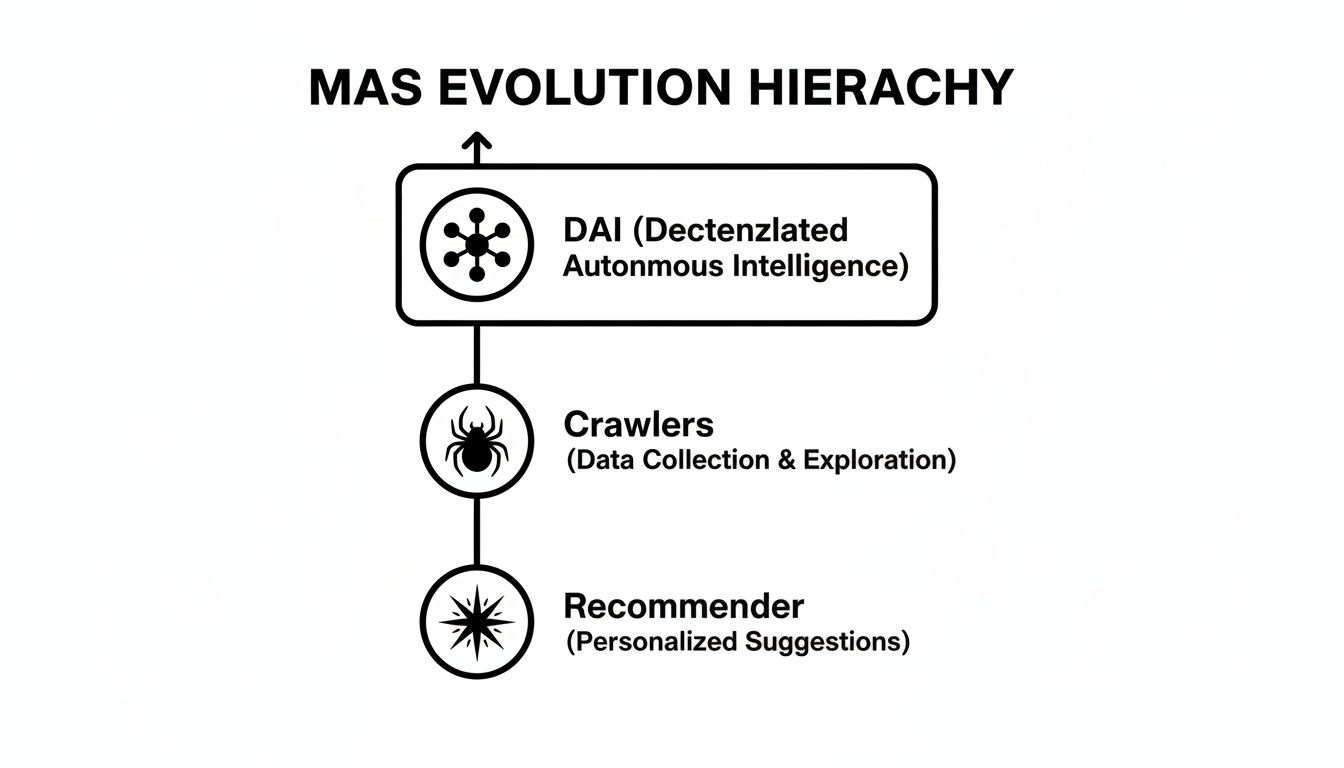
The diagram above traces the evolution from Distributed AI (DAI) to crawler-based systems, up to today’s recommender engines. It highlights how each generation of agents built on the last.
Comparison Of Common MAS Architectures
Below is a quick side-by-side look at three popular MAS architectures. Use this guide to pick the style that fits your team’s scale and resilience goals.
Architecture | Connection Style | Scalability | Use Case |
|---|---|---|---|
Blackboard | Shared data store | Medium | Collaborative problem solving |
Peer-to-Peer | Direct agent links | High | Swarms, decentralized file sharing |
Client-Server | Central coordinator | Low to Medium | Enterprise management dashboards |
Each pattern carries trade-offs: a peer-to-peer mesh scales out effortlessly, while a blackboard keeps everyone on the same page. Meanwhile, a client-server setup offers centralized control at the cost of potential bottlenecks.
Fleet Example With Delivery Drones
Picture a network of delivery drones, each acting as an independent agent but syncing tasks on a shared board.
Perception Agents pull in GPS, weather, and traffic feeds.
Decision Agents pick routes, juggle priorities, and resolve conflicts.
Action Drones fly to pick-up and drop-off points, updating status in real time.
Coordination Layer reassigns missions if a drone’s battery runs low or it encounters trouble.
Behind the scenes, middleware also checks live weather feeds and enforces no-fly zones. That way, routes adjust before the drones ever leave the hangar.
Design clear contracts between agents and the environment.
Learn more about integrating backend services into MAS in our article on the Role of Backend Services in AI No Code Apps.
Coordination And Communication Strategies
When multiple agents share a common mission, they need clear rules for divvying up tasks and keeping each other in the loop. In real-world deployments, three coordination styles stand out: contract nets, auction mechanisms, and stigmergy.
Contract Net: A manager agent broadcasts a task and waits for bids.
Auction Mechanism: Agents place competitive offers; the highest bidder wins the job.
Stigmergy: Agents leave signals in their environment - much like ants with pheromone trails - to guide one another.
Imagine a fleet of warehouse robots. They quickly publish pick-up requests, collect bids from nearby bots, and assign tasks without human intervention. That sort of dynamic, flexible approach prevents bottlenecks and keeps the work flowing smoothly.
Coordination Mechanisms In MAS
Think of the Contract Net Protocol as a digital job board. A coordinator agent posts a task description, complete with criteria and deadlines. Worker agents calculate their own cost and capability before submitting bids.
Contract Net Protocol: Manager posts tasks; agents bid.
Auction-Based: Parallel bidding rounds; winner takes the task.
Stigmergy: Environment-driven cues; agents react to indirect signals.
When an agent wins a contract, it commits to completing the job and reporting back. Auction-based methods work similarly but focus on price or priority. Meanwhile, stigmergy relies on persistent markers - like virtual breadcrumbs - for agents to detect and follow.
On a busy factory floor, you might see contract nets balancing heavy-lift robots and auctions handling urgent deliveries. Stigmergy kicks in for routine mapping or maintenance chores, shaving off communication overhead and letting agents self-organize.
Communication Patterns And Examples
Effective coordination also depends on choosing the right messaging style. Here’s a quick comparison:
Pattern | Use Case | Strength |
|---|---|---|
Direct Messaging | Task handoff in small swarm | Fast low overhead |
Publish-Subscribe | Event notifications | Scalable to many agents |
Shared Memory | Blackboard models | Centralized consistency |
Key Insight Indirect coordination like stigmergy can cut message traffic by up to 50% in large swarms.
In our warehouse scenario, robots might tag shelf locations with digital notes to signal pick-up status. It’s a lot like teams jotting reminders on a whiteboard before diving into their tasks.
Perception agents scan aisles and log obstacle coordinates.
Planning agents reserve clear corridors and calculate detours.
Execution agents move goods and confirm completion.
Direct messaging shines when you need instant, one-to-one exchanges. Publish-Subscribe is your go-to for broadcasting updates across hundreds of agents. Shared memory offers a single source of truth - just watch out for bottlenecks.
Best Practices For MAS Coordination
Well-crafted coordination schemes can boost system throughput and slash resource conflicts. Here are a few hard-won tips:
Define and version message schemas to prevent misinterpretation.
Limit each message’s context so agents process only what they need.
Incorporate retries, acknowledgments, and timeouts for reliability.
Blend auctions with stigmergy markers to adapt to both urgent and routine tasks.
Monitor latency and queue lengths through real-time dashboards.
Test against failures: simulate dropped agents, network jitter, and message loss.
Takeaway A robust coordination strategy can improve MAS efficiency by 40%.
By applying these tactics, you’ll keep your multi-agent system nimble, resilient, and ready for real-world challenges.
Real World Applications
Picture a team of specialists, each focused on one part of a larger project. That’s the essence of how multi-agent systems break down complex tasks. By assigning distinct jobs to different agents, these networks adapt on the fly and keep performance steady, even when demands spike.
Across industries, you’ll find MAS powering solutions such as:
Web Crawler Swarms that split page-finding duties to index content at scale.
Recommendation Engines where agents trade insights on clicks and ratings to sharpen suggestions.
Automated Trading Systems using negotiation agents to carry out split-second financial moves.
Web Crawler Swarms
When search platforms need to scan billions of pages, they turn to crawler swarms. Each agent fetches a set of URLs, feeds new links back to its peers, and logs metadata in a central store.
This teamwork can boost throughput by over 30% in some infrastructures. And if one agent drops off, others simply pick up its queue - no manual intervention required.
“Web crawler swarms show how a multi-agent system can transform data retrieval at scale.”
Recommendation Engines
Streaming and e-commerce sites often rely on cooperative filtering agents. These little workers share signals about what users click, buy, or rate, then adjust suggestions accordingly.
On average, this method nudges engagement up by 12%. The secret lies in distributing the heavy math across an agent pool rather than a single server.
Automated Trading Systems
Financial firms break down trade execution into specialized roles:
Market Data Agents that stream real-time prices and volumes.
Strategy Agents evaluating patterns and crafting buy/sell calls.
Execution Agents placing orders in milliseconds and tracking fills.
Together, they can pare latency to under 5 milliseconds and shield against runaway positions. Risk checks baked into each agent ensure compliance with market rules.
“Agent negotiations in trading deliver both speed and resilience in volatile markets.”
Enterprise Automation Platforms
Organizations are embedding MAS into everything from support desks to supply chains. Check out our guide on building mobile apps with AI for businesses: Guide on Building Mobile Apps with AI for Businesses.
Customer Support Agents triage tickets using priority queues and sentiment analysis.
Workflow Agents handle approvals, notify stakeholders, and escalate when needed.
Cloud Vendor Agents monitor spend, negotiate scaling, and enforce SLAs.
Recent surveys show enterprises piloting MAS projects for cloud cost controls and automated workflows, with OAuth 2.1 support and agent-to-agent messaging fast becoming table stakes.
Emerging Industry Use Cases
Multi-agent systems are also at work behind the scenes in smart grids, autonomous fleets, and city simulators.
Smart Grid Agents balance supply and demand to cut waste and avoid blackouts.
Autonomous Vehicle Fleets share maps and traffic alerts in real time.
Simulation Agents model disaster responses or urban traffic before a shovel hits the ground.
In urban planning tests, pedestrian and vehicle agents help designers spot bottlenecks and safety gaps without ever clogging real streets.
Use Case Comparison
Use Case | Key Benefit | Common Metric |
|---|---|---|
Web Crawler Swarms | Fast indexing | Pages per second |
Recommendation Engines | Engagement lift | Click-through rate |
Automated Trading Systems | Low-latency execution | Milliseconds per trade |
Implementing a multi-agent system calls for clear logging and monitoring. Track each agent’s throughput, task latency, and error rate to fine-tune performance. With the right metrics in hand, MAS can deliver tangible impact at scale.
Benefits And Limitations
When you bring autonomous agents together, they self-organize around specific tasks - almost like a team where each member knows their role. This setup offers a level of modularity that makes tweaking or expanding the system feel like swapping out a single piece, not rebuilding the whole machine.
You get:
Modularity: Isolated modules mean you can scale up by adding new agents without halting existing ones.
Parallelism: Tasks run side by side, speeding up heavy workloads.
Resilience: If one agent falters, others pick up the slack.
Adaptability: Agents renegotiate priorities when conditions shift.
Of course, you trade simplicity for complexity; more moving parts demand more thoughtful design.
Key Benefits You Gain
Break a big job into smaller chunks and watch parallelism shine. A web-crawling MAS, for example, can index pages about 30% faster than a monolithic crawler.
And when one agent hits a snag, the rest keep rolling. In critical operations - say, automated trading or supply chain tracking - this kind of resilience can be the difference between smooth uptime and costly downtime.
“Each agent is like a linchpin player: if one sits out, the game still goes on.”
Common Limitations
More agents mean more chatter. Coordination Overhead can swamp the network and slow everything down.
Then there’s Emergent Behavior - unexpected patterns that pop up when simple rules intertwine. Spotting and fixing these quirks takes time.
Testing Complexity: Every new agent multiplies the interaction paths you have to check.
Scalability Thresholds: Beyond a point, message traffic grows faster than capacity.
Context Drift: Without strong state sharing, agents can lose the thread.
Resource Contention: Agents may battle over CPU or bandwidth.
Balancing Trade Offs
Think of it as a busy kitchen: too many cooks without roles spelled out can spoil the soup. A clear messaging schema and a broker or middleware layer help keep conversations on point.
Follow these best practices to keep your MAS lean and effective:
Define tight agent responsibilities to avoid overlap.
Monitor message queues so bottlenecks don’t sneak up on you.
Route communications through a central controller to reduce peer-to-peer noise.
Use checkpoints or snapshots for easy recovery when things go off-script.
Read our guide on AI in app development to unlock faster results.
Frequently Asked Questions
When you’ve dug into multi-agent systems (MAS), questions inevitably arise. This FAQ tackles the most practical ones so you can move forward with confidence.
What Makes An Agent Different From A Regular Program
You’ll spot an agent by its ability to think and act independently. Unlike a traditional program that waits for instructions, an agent watches its environment, makes decisions, and takes action on its own.
Autonomy: Agents set and pursue their own goals.
Communication: Agents exchange messages and updates with peers.
Adaptivity: Agents adjust their behavior in real time as conditions change.
How Do Agents Negotiate Conflicts
Picture a busy workshop where every robot wants the same tool. Agents resolve these disputes using structured coordination methods - think auctions or environmental cues (stigmergy). This keeps chatter minimal and outcomes clear.
Contract Net Auction: Agents bid for tasks, then commit once they win.
Stigmergy: Agents leave signals in the shared workspace to request or confirm actions.
Key Insight: Agents can achieve up to 40% efficiency gains by using auction-based task allocation.
Once an agent secures a contract, it notifies its peers and gets to work, eliminating overlap and keeping everyone in sync.
Which Tools And Frameworks Support MAS Development
Several platforms make MAS prototyping and deployment far easier. Pick one that matches your language preference and scalability needs:
JADE A Java-based agent framework with full messaging standards.
SPADE Python-friendly, using XMPP for agent communication.
Microsoft Autogen Integrates conversational agents into existing workflows.
OpenAI Swarm An experimental library for building collaborative agents.
Most of these frameworks include simulators, logging tools, and debugging utilities so you can test coordination under varied scenarios.
How To Get Started With A Simple Prototype
You can spin up a basic MAS in just a few steps:
Define Agent Roles
Outline each agent’s perceptions, actions, and goals.Select A Framework
Install your chosen MAS toolkit and dependencies.Implement Agents
Code the sensor-decision-action loop for each role.Test And Iterate
Run scenarios to validate coordination logic, then refine.
Follow this path, and you’ll have a working prototype in hours. From there, layer in monitoring, logging, and error handling.
What Are Common Pitfalls To Avoid
Beginners often trip over fuzzy responsibilities and oversized messages. Make sure each agent has a clear contract and stick to compact message formats.
Ambiguous Roles Lead To Duplicate Efforts
Excessive Data Sharing Can Cause Performance Bottlenecks
Can MAS Scale To Large Systems
Absolutely. A well-designed MAS can coordinate hundreds of agents. Key strategies include:
Publish/Subscribe Models To decouple senders and receivers
Message Brokers To maintain low latency and high throughput
Profiling Tools To spot bottlenecks before they become critical
Ready to build your next real world app with intelligent coordination? Try CatDoes today at https://catdoes.com
Nafis Amiri
Co-Founder of CatDoes


