
Blog
Business
Reducing Technical Debt: Free Budget for Innovation
Discover how reducing technical debt frees budget for innovation. Learn proven strategies to diagnose, manage, and prevent tech debt from slowing you down.

Nafis Amiri
Co-Founder of CatDoes
Reducing Technical Debt: Free Budget for Innovation
Technical debt isn't just a buzzword developers use; it’s a silent tax on your business. Think of it as an invisible force that slows your company down, inflates your costs, and quietly stifles growth.
Every time a team takes a shortcut to hit a deadline, they’re basically taking out a small loan against the codebase. You get the feature out the door faster, which feels like a win. But the "interest" on that loan always comes due later.
That interest payment shows up in ways that frustrate everyone:
Slower Time-to-Market: Simple updates suddenly take weeks instead of days because developers have to navigate a maze of brittle, patched-together code.
Inflated Maintenance Costs: A huge chunk of your development budget gets diverted from building cool new things to just keeping the lights on. You end up paying talented engineers to fix the same old problems, over and over again.
Reduced Team Morale: Nobody enjoys working on a fragile, confusing system. Good engineers get frustrated, and that can lead to high turnover.
The Real Business Impact of Neglected Debt
When you let this debt pile up, it creates a nasty cycle. The more debt you have, the harder it is to innovate. Your team spends its days firefighting bugs and figuring out workarounds instead of building the features your customers are actually asking for. This directly kneecaps your ability to compete.
It’s a massive problem. A recent report from KPMG's 2026 Annual US Technology Survey revealed something shocking: a staggering 56% of US companies can't invest in critical technologies like AI because their budgets are completely eaten up by fixing technical debt. You can read the full KPMG survey analysis on byteiota.com.
This isn't just a technical issue; it's a fundamental business constraint that limits your potential. As more of your budget goes toward upkeep, less is available for growth. If you want to see how these expenses snowball, check out our guide on understanding mobile app maintenance costs.
Connecting Technical Debt Symptoms to Business Impact
It’s crucial for founders and business leaders to spot the warning signs. Too often, what seems like a minor technical hiccup is actually a symptom of a much larger problem with serious business consequences.
This table bridges the gap, connecting the technical jargon you might hear from your team to the real-world impact on your bottom line.
Connecting Technical Debt Symptoms to Business Impact | |
|---|---|
Technical Symptom | Business Consequence |
"This part of the code is too risky to touch." | Key features can't be improved or updated, leaving you vulnerable to competitors. |
"We spend most of our time fixing bugs." | Your innovation budget is spent on maintenance, not growth. Customer satisfaction drops. |
"A small change requires updating five other places." | Development slows to a crawl. Your time-to-market for new features becomes painfully long. |
"Onboarding new developers takes months." | High turnover and training costs. Team knowledge is concentrated in a few people, adding risk. |
"We keep hitting performance bottlenecks." | Poor user experience leads to customer churn and lost sales. |
When you can draw a straight line from a slow-loading feature to lost revenue, the conversation changes. It's no longer about a "technical nuisance" but a strategic business priority.
Technical debt is the unseen friction that grinds innovation to a halt. It transforms agile teams into slow-moving maintenance crews, one shortcut at a time.
Understanding this connection is the first step. Suddenly, the cost of doing nothing becomes too high to ignore, making the case for a dedicated repayment plan clear, compelling, and urgent.
How to Diagnose and Measure Your Technical Debt
You can't fix a problem you can't see. Shifting the conversation from a vague feeling of "things are slow" to a concrete action plan starts with a clear diagnosis of your project's health. Identifying and actually quantifying your technical debt is the only way to build a real strategy for paying it down and getting your team's momentum back.
For a lot of non-technical founders, this part feels like a black box. It doesn't have to. There are practical ways to get a handle on the scale of the problem, and doing so gives you the language and data you need for a productive conversation with your engineering team.
This flowchart perfectly illustrates how small, seemingly harmless shortcuts snowball into a cycle of debt and drag.
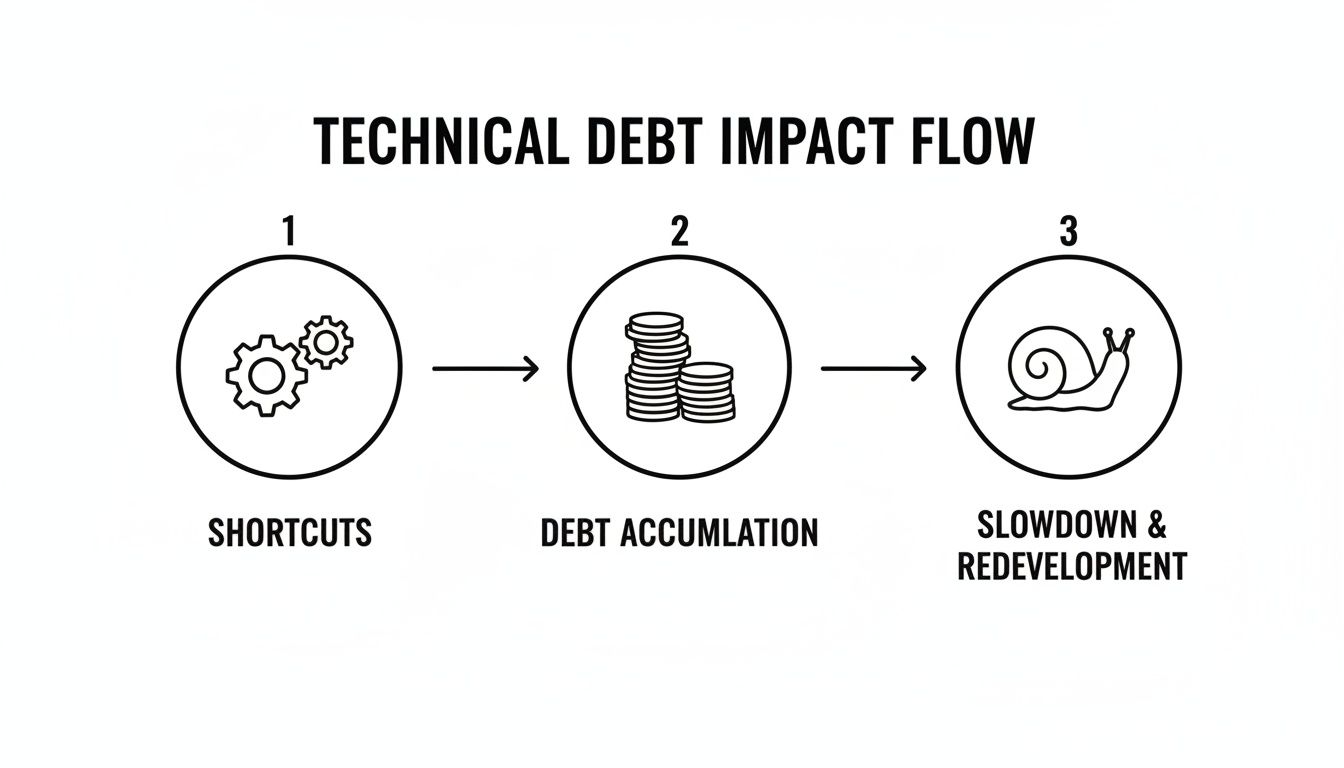
It’s a simple but brutal feedback loop: every shortcut adds to the debt, which acts as a brake on everything that comes next.
Start With Simple Code Quality Metrics
Before you get lost in complex formulas, just ask your development team about a few key indicators. These metrics give you a high-level snapshot of your codebase's health without you needing to be a software engineer.
Think of these as the vital signs for your application. They're the first clues that point toward deeper issues.
Common metrics include:
Code Complexity: This is a measure of how tangled and hard-to-understand parts of the code are. High complexity is a huge red flag because it usually means the code is fragile. Touch one thing, and something else breaks.
Code Duplication: How much copy-pasted code is floating around? Duplication is a classic shortcut that creates massive headaches later. A change that should take five minutes now has to be manually repeated in every single place the code was copied.
Code Coverage: What percentage of your code is actually covered by automated tests? Low coverage (anything below 70% is often a warning sign) means every change is a gamble and bugs are far more likely to sneak out to your users.
These numbers are usually easy to get from automated tools that plug right into the development workflow, giving you a continuous pulse on quality.
Create a Strategic Debt Log
A less technical but equally powerful method is to keep a technical debt log. This is just a simple, living document where the team jots down instances of technical debt as they happen or as they're discovered. The goal isn't to assign blame; it's to create visibility.
A good debt log is more than a list of problems. For each item, the team should capture:
The specific issue: A quick description of the shortcut taken or messy code.
The reason it was introduced: Was it a crazy deadline? A gap in knowledge?
The estimated cost to fix: A rough guess in hours or days.
The business impact of not fixing it: This is the most important part. Does it slow down new feature work? Hurt performance? Create a security risk?
An entry might look like this: "Hardcoded API keys in the payment module. Done to hit the Q4 launch deadline. Fixing it will take two days, but leaving it is a major security vulnerability." That context immediately turns a technical task into a clear business risk.
By framing debt in terms of business impact, you shift the conversation from "cleaning up code" to "protecting revenue" or "accelerating feature delivery." This makes prioritization a strategic exercise, not just a technical one.
Calculate Your Technical Debt Ratio
If you want a hard number to anchor the conversation, you can work with your team to calculate the Technical Debt Ratio (TDR). The TDR simply compares the cost of fixing the debt (the remediation cost) to the cost of building the entire system from scratch (the development cost).
A lower TDR is obviously better, signaling a healthier codebase. A high TDR, on the other hand, suggests that it might be almost as expensive to fix the current mess as it would be to just rebuild it. This single metric is an incredibly powerful tool for showing stakeholders just how big the problem has become.
To really nail this down, check out A Practical Guide to the Technical Debt Calculation Formula. This guide offers a clear breakdown of how to approach the calculation. Once you measure your debt, you're armed with the data needed to make informed decisions and turn a vague problem into a manageable project with clear goals.
Practical Ways to Start Paying Down Your Tech Debt
Once you’ve got a handle on what your technical debt looks like, it’s time to create a repayment plan. This isn’t about hitting pause on all new features for a massive, all-or-nothing rewrite. That almost never works. Instead, the best strategies mix quick, tactical fixes with bigger, long-term improvements to build sustainable momentum.
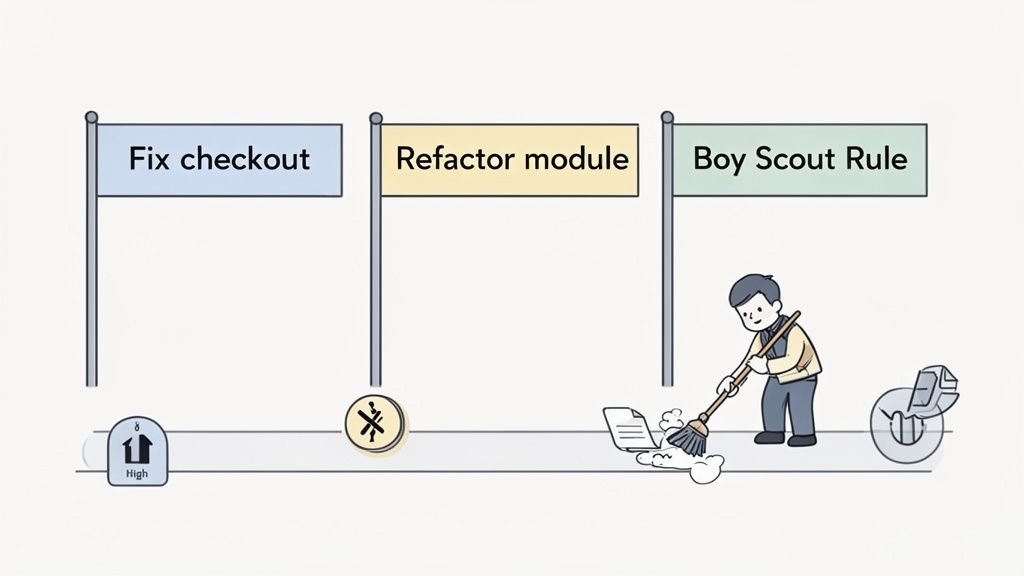
Think of it like paying off a loan: you make consistent, manageable payments over time. You don't wait for the interest to compound until it’s completely overwhelming.
The Boy Scout Rule: Your First Line of Defense
One of the most effective habits any dev team can adopt is the "Boy Scout Rule." The idea is simple: always leave the codebase cleaner than you found it.
This doesn't mean you need to refactor an entire module every time you touch it. It's about making small, incremental improvements. For instance, if a developer is adding a new feature and spots a poorly named variable or a bit of duplicated logic nearby, they take a few extra minutes to clean it up right then and there.
These tiny cleanups are like making small, extra payments on your loan. One by one, they don't feel like much. But over hundreds of commits, they collectively stop the codebase from getting worse and slowly, but surely, improve its overall health.
Prioritize Debt Through a Business Lens
Not all debt is created equal. The secret to a winning strategy is ruthless prioritization based on business impact, not just how messy the code is. A complex, tangled module that nobody ever touches is way less urgent than a slightly flawed but critical part of your user's journey.
To figure out what to tackle first, ask these questions for every item on your debt log:
How does this debt impact our users? Does it cause bugs, kill performance, or just make the app a pain to use?
How does this debt affect revenue? Is it lurking in a critical flow, like checkout or signup?
How much does this debt slow down new development? Does it make building the next big feature more difficult and expensive?
Fixing a clunky checkout process that directly costs you sales should always win over refactoring a rarely used admin panel, even if the admin code is technically a disaster. Tying your cleanup efforts to tangible business value is how you get buy-in and make a real difference.
A McKinsey report on technical debt found that organizations can free up engineers to spend up to 50% more time on new, value-generating work simply by tackling their existing debt. The payoff is direct and substantial.
Schedule Targeted Refactoring and Modularization
For the bigger chunks of debt, you need a more focused effort. This is where targeted refactoring comes into play. Instead of trying to fix everything at once, you identify the most problematic modules (the ones that are a constant source of bugs or a bottleneck for development) and schedule dedicated time to improve them.
Refactoring means restructuring existing code without changing what it does on the outside. The whole point is to improve its internal quality, making it easier to understand, change, and build upon. This could involve anything from simplifying complex logic to boosting performance.
Another powerful long-term play is modularization. If you're dealing with a massive, monolithic app where everything is tightly coupled, breaking it down into smaller, independent components or microservices can be a game-changer. Each module can be developed, tested, and deployed on its own, which dramatically cuts down on complexity and lets teams work in parallel without tripping over each other. It’s a major undertaking, but it's one of the best ways to reduce technical debt at an architectural level.
Building a Culture That Prevents Future Debt
Fixing the technical debt you already have is a necessary battle, but it's only half the war. The real victory is changing how your team operates so you stop creating new debt in the first place. This isn't about adding a few rules; it’s a cultural shift away from the "we'll fix it later" mindset toward a proactive culture of quality.
When prevention becomes the default, you finally break the expensive cycle of accumulating and then remediating debt. Your team's energy shifts from constant maintenance and firefighting to innovation and building what's next.
Automate Your Quality Gates
One of the best ways to enforce quality is to remove human error and subjectivity from the equation wherever possible. Automated processes are your single greatest ally in the fight against accumulating new technical debt.
A Continuous Integration/Continuous Deployment (CI/CD) pipeline is the foundation here. Think of it as an automated checkpoint that inspects every single piece of code before it gets merged into your main project. No exceptions.
This pipeline can automatically handle the critical checks that often get skipped under pressure:
Run Automated Tests: This ensures that a new feature doesn't silently break something else. A good test suite is a safety net that catches regressions when they are cheapest and easiest to fix, which is right now.
Perform Static Code Analysis: These tools are like an ever-vigilant reviewer, scanning code for common mistakes, potential security holes, or deviations from your team’s coding standards before a human even sees it.
Check Code Coverage: You can configure your pipeline to verify that new code is actually tested, preventing the slow creep of "test debt" that makes every future change a gamble.
By automating these gates, you establish a consistent quality baseline for every single commit. Bad code simply doesn't get in.
Make Quality a Team Responsibility
While automation creates the guardrails, a true cultural shift only happens when the entire team feels ownership over the codebase's health. This means fostering practices that value long-term stability just as much as short-term speed.
The peer code review is non-negotiable. Before any code is merged, at least one other developer should review it. This simple step is invaluable for catching logic errors, spotting better implementation patterns, and spreading knowledge across the team. It turns coding from a solo activity into a collaborative effort.
Just as important are clear coding standards. When everyone on the team agrees on how to format code, name variables, and structure files, the entire codebase becomes more predictable. Anyone can jump into any part of the code and understand what's going on, which directly reduces the cognitive load that leads to accidental mistakes.
Building a preventative culture means treating technical debt not as an inevitable side effect of development, but as a deliberate choice. Every decision must weigh the immediate benefit of a shortcut against the long-term cost of future rework.
Allocate Time for Repayment
Let's be realistic: some debt is unavoidable. The key is to manage it intentionally instead of letting it fester. One of the most powerful things you can do is formally set aside time in every single development cycle specifically for maintenance and debt reduction.
This could be 10-20% of your team's capacity in each sprint, dedicated to tasks like refactoring a messy module, improving documentation, or upgrading a critical library. By making this a recurring part of your planning, you treat debt repayment as a first-class citizen, just like feature work. It’s a clear signal from the organization that a healthy, sustainable codebase is a business priority. If you're looking for frameworks to help structure this, our deep dive on agile software development methodology offers some great starting points.
This isn't just a technical decision; it's a financial one. Technical debt is a margin killer. High-debt organizations spend 40% more on maintenance and ship features 25-50% slower than their peers. By preventing its accumulation, you're directly protecting your budget and your ability to compete.
Leveraging AI to Avoid the Debt Trap
While paying down existing technical debt is a necessary chore, the real win is to stop creating it in the first place. This isn’t about just trying harder; it requires a fundamental shift in how we build software. Modern AI-native platforms completely change the development equation, offering a direct route to sidestepping the very pitfalls that lead to tangled, unmanageable codebases.
Instead of relying on manual coding where tight deadlines and pressure inevitably force shortcuts, these systems introduce a new way of working. The focus moves from meticulously writing every line of code to clearly defining the outcomes you want. From there, intelligent agents take over the implementation.
From Ideas Directly to Clean Code
At the heart of this new approach is a multi-agent system built to translate natural language ideas directly into production-ready code. Imagine describing a user registration screen. An AI agent doesn't just spit out a generic snippet; it builds a complete, functional React Native component that already follows established best practices.
This process inherently sidesteps the number one cause of technical debt: human compromise under pressure. The AI agents are trained on massive datasets of high-quality code, so their output is consistent, clean, and predictable from day one.
This automation goes way beyond simple components.
Consistent UI Crafting: An AI designer agent makes sure every screen, button, and form follows a cohesive design system. This prevents the gradual visual mess that plagues so many long-term projects.
Automated Best Practices: Software agents implement business logic using standardized patterns, avoiding the "clever" but confusing shortcuts individual developers might take to save time.
Managed Submissions: Even the final steps, like preparing and managing app store submissions, are automated. This enforces a rigorous, repeatable process that kills last-minute manual errors.
By baking these standards directly into the workflow, the system acts as a constant quality gate, making it incredibly difficult for debt to even get a foothold.
The most effective strategy for reducing technical debt is to build systems that make it hard to create in the first place. AI-driven development replaces inconsistent manual effort with standardized, high-quality automation.
Preventing Architectural Missteps from Day One
A huge chunk of technical debt doesn't come from messy code, but from poor architectural decisions made in the frantic early days of a project. Choosing the wrong database, implementing a brittle authentication system, or failing to plan for scale can create massive, expensive problems that are a nightmare to fix later.
AI-native platforms tackle this by integrating and configuring backend services intelligently. When you specify the need for user authentication, an AI agent doesn't just write the frontend code; it provisions and configures a secure, scalable authentication service on the backend.
This integrated approach prevents those foundational mistakes.
AI-Configured Authentication: Instead of a developer manually wrestling with a complex auth flow, the platform handles it. This guarantees security protocols and best practices are implemented correctly every single time.
Smart Database Setup: The system can select and configure the right database structure based on your app's actual data needs, avoiding the performance bottlenecks that come from a bad match.
Scalable by Default: By using managed cloud infrastructure, the backend is built for scalability from the start. You won't need a costly and disruptive re-architecture down the road when your user base explodes.
This means that from the moment you start building, your app rests on a solid, professional-grade foundation. For a closer look at how this technology is reshaping development, you can learn more about why AI is unlocking faster results in app development.
The New Standard for Sustainable Development
Ultimately, using AI to build applications is about changing the default outcome. In traditional development, the default path often leads straight to accumulating debt because of deadlines, budget cuts, and human variability. Shortcuts become the norm. Quality becomes an extra task that requires constant, dedicated effort to maintain.
With an AI-native platform like CatDoes, the default path leads to a clean, maintainable, and scalable application. It doesn't depend on every developer on the team having the discipline to always "leave the code better than they found it." Instead, it builds that principle directly into the creation process itself.
This shift doesn't just speed up your initial launch; it ensures your application stays agile and easy to update for years to come. By avoiding the debt trap from the outset, you free up your team to focus on what actually matters: innovating and delivering value to your users, not endlessly paying interest on past compromises.
A Few Common Questions About Technical Debt
If you're a founder, manager, or developer, you've probably run into some tricky questions about technical debt. Let's clear up a few of the most common ones with some straightforward, practical answers.
Is All Technical Debt Bad?
Absolutely not. Sometimes, taking on intentional technical debt is a smart business move. Think about launching a Minimum Viable Product (MVP). You might cut a few corners on purpose to get to market faster than a competitor, capture early users, and get that all-important feedback.
The real difference-maker is having a plan. This kind of calculated debt is fine as long as you document it and have a clear strategy to pay it down later. The real trouble starts with unintentional or reckless debt, the kind that piles up from messy code, no standards, or just ignoring problems until they become massive headaches.
How Often Should We Tackle This Stuff?
Dealing with technical debt isn't a one-and-done project. It needs to be a steady, continuous part of your development rhythm. The best practice is to build it right into every sprint or development cycle.
A simple and effective way to do this is the 80/20 rule. Spend 80% of your team's time on new features and dedicate the other 20% to maintenance, refactoring, and chipping away at existing debt.
This keeps debt from spiraling out of control and turning into its own monster project down the road. It's about keeping the codebase healthy and your team moving at a consistent pace, not lurching from crisis to crisis.
What’s the Difference Between Refactoring and Rewriting?
This is a huge one. Getting this wrong can lead to some very expensive mistakes.
Refactoring is like a surgical procedure. You're restructuring existing code to improve its internal quality (making it cleaner, more efficient, or easier to understand) without changing what it actually does for the user. It's an incremental, low-risk way to make things better.
Rewriting is the nuclear option. You're throwing out a whole system or component and starting from scratch. It's incredibly high-risk, almost always takes way longer than you think, and often introduces a whole new set of bugs.
In nearly every situation, targeted refactoring is the way to go. It delivers value much faster and with a fraction of the risk of a full rewrite.
Can We Ever Get to Zero Technical Debt?
Short answer: no. And honestly, you shouldn't even try.
Chasing zero technical debt is like trying to keep your kitchen perfectly spotless while you're in the middle of cooking a five-course meal. It's just not practical. Software is always evolving. Business needs shift, new tech comes out, and what seemed like a great idea last year might look clunky today. A little bit of manageable debt is just a natural side effect of building something real.
The goal isn't elimination; it's smart management. You want to keep technical debt at a low, manageable level so it never gets in the way of building great features, responding to the market, or giving your users a solid product.
Ready to build mobile apps without accumulating technical debt from day one? With CatDoes, our AI agents translate your ideas directly into clean, production-ready code, enforcing best practices automatically. Start building for free on CatDoes.com.
Nafis Amiri
Co-Founder of CatDoes


