Blog
Insights
Your Guide to a No-Code AI Platform
Discover how a no-code AI platform transforms business. This guide explains key benefits, use cases, and how to choose the right tools for your team.

Nafis Amiri
Co-Founder of CatDoes
A no-code AI platform is a software environment that lets you build and launch artificial intelligence applications without writing any code. Think of it like a drag-and-drop website builder, but instead of websites, you're creating smart systems that can analyze data, make predictions, or automate complex jobs.
Your Guide to a No-Code AI Platform
Imagine building a powerful AI model with the same ease as putting together a slide deck. That's the entire promise of a no-code AI platform. These tools swap out complex programming languages for intuitive, visual interfaces and pre-built components, fundamentally changing who gets to create with AI.
Instead of needing a team of specialized data scientists or developers, people on the front lines, including business analysts, marketers, and operations managers, can now build the tools they need themselves. This is a critical shift, especially when a December 2025 report shows that 80% of professionals expect AI to seriously change how they work in the next few years. By knocking down the technical walls, no-code gives the power to the people who actually understand the business problems.
Making Advanced Tech Available to Everyone
The real mission here is democratization. A no-code AI platform is designed to make sophisticated technology accessible to everyone in a company, no matter their technical skill set. When that happens, a few things follow:
Faster Innovation: Teams can go from a simple idea to a working AI model in days, not months.
Wider Adoption: More people can experiment with AI, leading to creative solutions for all sorts of departmental challenges.
Reduced Costs: It cuts down the reliance on expensive, hard-to-find AI talent for many common projects.
A no-code AI environment is really about empowerment. It hands non-technical professionals the tools to build their own custom AI solutions, completely changing how a business can approach both software and strategy.
Ultimately, this isn't just about avoiding code. It's about creating a culture where anyone can jump in and solve real problems using artificial intelligence. In the sections that follow, we'll dig into what these platforms can actually do and how you can use them to drive real growth.
Exploring Core No-Code AI Capabilities
So, what’s really going on under the hood of a no-code AI platform? Below the simple, friendly surface is a powerful engine with some seriously sophisticated features. These are the core capabilities that turn the abstract idea of "AI for everyone" into real-world business results. They do all the heavy lifting, so you can focus on the problem you want to solve, not the complex math behind the solution.
One of the most important pieces of the puzzle is Automated Machine Learning (AutoML). Think of AutoML as an expert data scientist built right into the platform. It automatically handles the tedious and highly technical tasks, like cleaning up your data, picking the best predictive model, and training it to be as accurate as possible. This one feature massively lowers the barrier to entry.
It means you can sidestep the need for a deep background in statistics and just focus on the outcome. Your marketing team, for example, could build a model to predict which customers are likely to churn, all without writing a single line of Python.
Connecting Your Data and Designing Workflows
For an AI model to make smart predictions, it needs data, and lots of it. In any modern business, that data is scattered everywhere, from your CRM and marketing tools to plain old spreadsheets. A key capability of any top-tier no-code AI platform is seamless data integration. These platforms offer pre-built connectors that make it a breeze to pull information from all those different sources, creating a single, unified dataset for your model to learn from.
Once your data is connected, you need a way to tell the AI what to do with it. This is where visual workflow builders come in. They give you a drag-and-drop canvas where you can map out the entire AI process from start to finish.
Input: You define where the data comes from.
Processing: You can add steps to clean, transform, or enrich the data.
Modeling: You apply the AutoML engine to build and train your model.
Output: You decide what happens with the prediction, like sending an alert to a sales rep or updating a customer record in your CRM.
You can see how visual interfaces simplify the whole creation process in our guide on using a no-code app builder. This visual approach makes the entire AI lifecycle easy to understand and manage, even for non-technical users.
Understanding Human Language with NLP
A huge amount of business data isn't in neat rows and columns; it’s unstructured text like customer emails, product reviews, and support tickets. This is where Natural Language Processing (NLP) capabilities become essential. NLP tools give the AI the ability to understand, interpret, and even generate human language.
This concept map shows how these core components, from the visual builders to rapid deployment, create a powerful ecosystem that empowers people who don't write code.
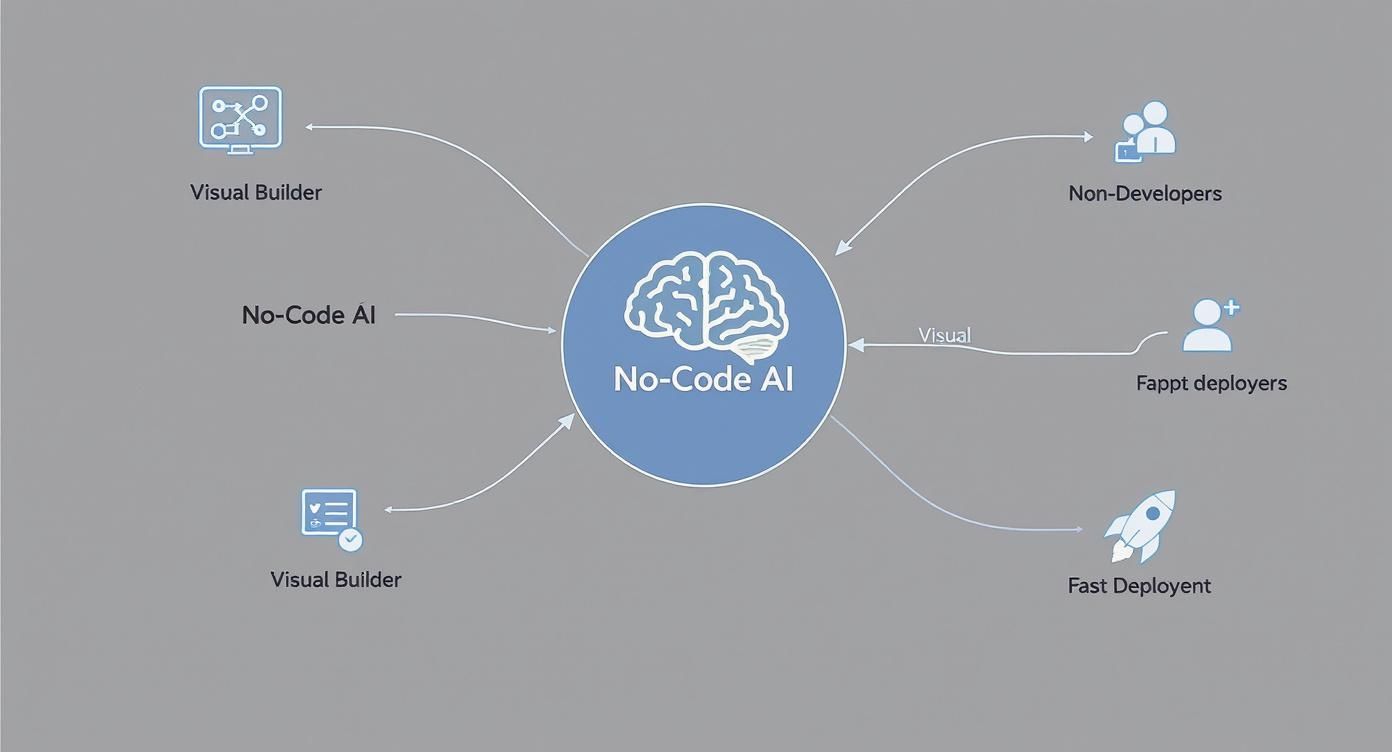
As the diagram shows, the real value comes from connecting user-friendly tools with the ability to get real solutions out the door quickly.
In fact, NLP technology commands a 35% share of the no-code AI platform market, which tells you just how important conversational AI and language analysis have become. This focus helps make advanced features accessible to users who don’t have a background in machine learning. These are the tools that power applications like sentiment analysis on customer feedback or intelligent chatbots that can resolve user issues automatically.
To give you a clearer picture, here’s a breakdown of the essential features you should look for when evaluating a no-code AI platform.
Key Features of a No-Code AI Platform
Capability | Description | Business Application Example |
|---|---|---|
Automated Machine Learning (AutoML) | Automatically handles model selection, feature engineering, and training, making predictive modeling accessible to non-experts. | A retail company uses AutoML to build a sales forecasting model based on historical data without needing a dedicated data science team. |
Visual Workflow Builder | Provides a drag-and-drop interface to design and manage the entire AI process, from data input to model deployment. | A marketing team creates a workflow that pulls lead data from a CRM, scores each lead with a predictive model, and sends high-priority alerts to Slack. |
Seamless Data Integration | Offers pre-built connectors to easily pull data from various sources like databases, cloud storage, CRMs, and spreadsheets. | An e-commerce business connects its Shopify store and Google Analytics data to analyze customer behavior and personalize product recommendations. |
Natural Language Processing (NLP) | Includes tools for text analysis, sentiment analysis, and entity recognition to derive insights from unstructured text data. | A support team analyzes thousands of customer support tickets to identify the most common product issues and categorize them by urgency. |
One-Click Deployment | Allows users to easily deploy trained AI models into production applications or as APIs with minimal technical effort. | A logistics company deploys a model that predicts delivery times and integrates it directly into their customer-facing tracking app. |
Ultimately, these capabilities work together to create a cohesive system. You can connect your data, design a logical process, build a powerful predictive model, and deploy it, all within a single, visually-driven environment.
The Real Business Benefits of Going No-Code
Switching to a no-code AI platform isn't just a tech upgrade; it's a strategic move that delivers real, measurable results for your business. The first thing most organizations notice is a massive jump in speed. Teams can go from a simple idea to a working AI solution in days, not the months or even years that traditional development demands.
This speed completely changes the game for innovation. Instead of sitting in a long IT queue, a marketing manager can build their own lead scoring model. An operations lead can create a predictive maintenance system on their own. This kind of agility means you can react to market shifts and customer needs faster than ever before.
Driving Down Costs and Sparking Innovation
Beyond speed, the financial impact is huge. A no-code AI platform cuts down your reliance on highly specialized and expensive AI talent. While you'll still need data scientists for the really complex, custom projects, no-code tools empower your existing team to handle a ton of common AI tasks.
When you give non-technical employees the tools to solve their own problems, you kickstart a culture of innovation across the whole company. They're the ones on the front lines, closest to the business challenges, and they often have the most practical ideas. Letting them experiment and build creates a more engaged workforce and uncovers efficiencies you might have otherwise missed.
By removing the coding barrier, a no-code AI platform transforms employees from passive users of technology into active creators of business value. This shift is critical for building a truly data-driven and agile organization.
Unlocking Tangible ROI and a Real Market Edge
Put all these benefits together, and you get a powerful return on investment. The numbers speak for themselves. Today, 65% of applications are built without code, delivering an average ROI of 362%. These solutions also get to market 90% faster than those built the old way. The ability for everyday business users to build AI-powered tools is a huge part of this trend, completely reshaping how companies think about technology. You can dig into more of the data on no-code market growth on Adalo.
This translates directly into a competitive advantage. Companies that embrace no-code AI can innovate faster, run leaner, and solve problems more creatively. They're simply better prepared to handle industry changes and deliver a better experience to their customers. In the end, no-code AI isn't just about building apps without code; it's about building a stronger, more innovative, and more profitable business.
Practical Use Cases for No-Code AI
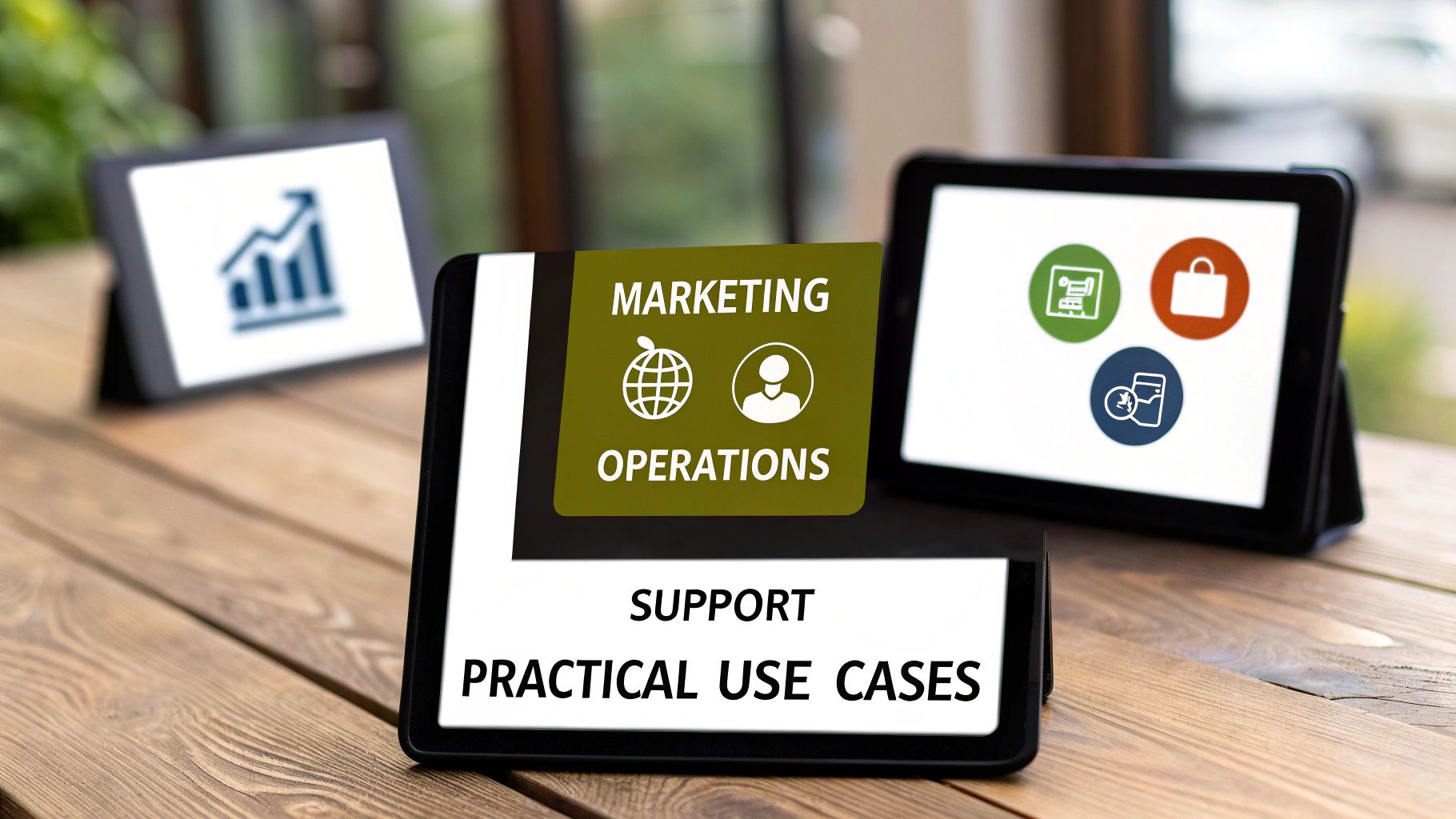
The real magic of a no-code AI platform isn't some abstract, futuristic idea. It's what happens when you put these tools into the hands of the people who actually run the business. You start seeing immediate, tangible results.
From marketing and sales to the factory floor, no-code AI is already changing how teams solve their own problems without waiting in line for the IT department.
Marketing and Sales Get a Major Boost
Think about a marketer who needs to pinpoint high-value leads. Before, this meant begging the data science team for help and waiting weeks. Now, they can drag and drop their CRM data into a visual builder, define what a "qualified lead" looks like, and train a predictive model themselves.
That model runs in the background, automatically flagging the best leads in real-time. It’s a direct line to better sales efficiency.
The same goes for customer segmentation. A marketing team can build an AI that groups customers by their actual buying habits and engagement, not just generic demographics. This creates dynamic, super-targeted campaigns that actually work, all without a single line of code. For more ideas, check out these five ways to leverage artificial intelligence in e-commerce.
Streamlining Operations and Logistics
Operations is another area where no-code AI shines. Imagine a manufacturing plant where unexpected equipment failures cost a fortune in downtime. An operations manager can use a no-code platform to build a predictive maintenance system.
They feed the AI historical data from machine sensors, and the model learns to spot the subtle warning signs that come before a breakdown. The system then sends an alert to the maintenance crew, letting them fix the issue before it becomes a crisis. It's a game-changer for minimizing downtime.
A Smarter Way to Handle Customer Service
In customer service, a no-code AI platform can completely transform response times and satisfaction scores. A support manager could build and launch an intelligent chatbot that handles all the common questions instantly. This frees up human agents to tackle the truly complex problems.
And these aren't the clunky, frustrating bots of the past. They understand intent, pull answers from a knowledge base, and know exactly when to escalate a conversation to a human. Another powerful use is automated ticket routing, where an AI analyzes incoming requests, categorizes them, and sends them to the right person automatically.
By applying AI to everyday business functions, a no-code platform turns departmental experts into problem solvers. They can build, test, and deploy solutions that directly address their biggest challenges, leading to immediate gains in efficiency and performance.
This is the whole point of building with no-code AI. You create custom, focused apps that solve your specific problems. It's the core idea behind platforms like CatDoes, where you can learn how to build an app with AI and turn your vision into reality without hitting technical roadblocks.
How to Choose the Right No-Code AI Platform

With a flood of powerful tools hitting the market, picking the right no-code AI platform has become a critical decision. This isn’t just about comparing feature lists. It's about finding a true partner that gets your business goals, fits your budget, and doesn't demand a team of engineers to run.
Get this choice right, and you'll have a tool that solves today’s problems and scales with you. Get it wrong, and you'll be stuck with a clunky, expensive system that creates more friction than it removes.
The first thing to look at is the most obvious: is it actually easy to use? A platform's interface and the overall user experience are everything. If the dashboard is a confusing mess of menus and jargon, it completely misses the point of "no-code."
You're looking for an intuitive visual builder, clear tutorials, and helpful documentation. The goal is to find something your team can pick up and run with, turning their ideas into working AI apps without a month-long training course.
Evaluating Integrations and Scalability
A no-code AI platform is useless if it’s a walled garden. Its real power comes from connecting to the tools you already use every day, such as your CRM, marketing software, databases, and cloud storage. Before you commit to anything, dig into its integration capabilities.
A few key questions to ask:
Pre-built Connectors: Does it have plug-and-play integrations for popular tools like Salesforce, HubSpot, or Google Sheets?
API Access: Can it talk to your custom-built systems or less common apps through a flexible API?
Data Handling: How painless is it to get data in and out from different sources?
Beyond just connecting things, you have to think about the future. The platform you choose needs to grow with you. It has to handle more data, more users, and more apps without slowing down. The solution that works for a small pilot project must be robust enough for an enterprise-wide rollout.
Assessing Support and Total Cost
Finally, don't forget the human element. Solid customer support is a lifeline, especially when your team is just starting out. Look for platforms that offer help through live chat, email, and a deep knowledge base. Good support can be the difference between a quick fix and a week of frustration.
When you're comparing options, it's crucial to look beyond the sticker price. Reviewing transparent pricing models is just the start. Think about the total cost of ownership. This includes hidden fees for extra users, more data storage, or premium features you'll inevitably need.
Comparison of Platform Evaluation Criteria
To help you organize your thoughts, here’s a breakdown of what to look for when comparing different no-code AI platforms. Use this as a checklist to make sure you're covering all your bases.
Evaluation Criterion | What to Look For | Why It Matters |
|---|---|---|
User Experience (UI/UX) | Intuitive drag-and-drop builder, clear navigation, and helpful tutorials. | A confusing interface defeats the purpose of no-code and slows down adoption. |
Integration Capabilities | Pre-built connectors for your key tools (CRM, databases) and flexible API access. | The platform must fit into your existing tech stack to be truly useful. |
Scalability | Ability to handle growing data volumes, user loads, and application complexity without performance issues. | Your chosen tool needs to support your business as it grows, not hold it back. |
Customer Support | Responsive support channels (live chat, email) and a comprehensive knowledge base. | Good support is essential for troubleshooting and getting the most value out of the platform. |
Total Cost of Ownership | Transparent pricing, including costs for additional users, data, and premium features. | The initial price is only part of the story; understand the full investment required. |
Security & Compliance | Adherence to industry standards like GDPR or HIPAA, plus robust data protection features. | Protecting your company and customer data is non-negotiable. |
By carefully weighing these factors, you can move beyond the marketing hype and choose a platform that delivers real, long-term value. For a deeper dive into specific tools, our guide on the best AI app builder offers more detailed comparisons.
Got Questions About No-Code AI?
Whenever a new technology comes along, it’s smart to be skeptical and ask questions. When it comes to something like a no-code AI platform, business owners and their teams usually have a few common concerns like security, what it can't do, and what skills you actually need to pull it off.
Let's clear those up, because getting these answers is the first step to feeling confident and making a smart decision.
How Secure Is My Data?
This is usually the first question, and it's the right one to ask. Any serious no-code AI platform is built with enterprise-grade security from the ground up. Think features like fine-grained access controls, complete audit trails for compliance, and powerful data encryption.
For businesses in finance, healthcare, or other regulated fields, many platforms even offer on-premise or hybrid cloud options. This means your most sensitive data never has to leave your own secure network.
What Are the Real Limitations?
As powerful as they are, no-code AI tools aren't a silver bullet for every single problem. They are absolutely brilliant for solving 80-90% of common business use cases, such as predicting customer churn, analyzing sentiment from reviews, or scoring sales leads.
But if you're trying to invent a brand-new type of neural network or do fundamental AI research, you'll still need a dedicated team of data scientists writing custom code. The trick is to see no-code for what it is: a way to put proven, powerful AI into the hands of more people, not a replacement for R&D.
What Skills Do I Actually Need?
So, do you need a PhD in statistics or a deep background in data analysis?
Nope. Not at all. The whole point of a no-code AI platform is to handle the complicated math for you. The most valuable skills you can bring are a deep understanding of your business and a healthy dose of curiosity.
If you know your customers, your operations, and what you’re trying to achieve, you have everything you need to build incredibly effective AI models. The platform takes care of the technical side, so your business expertise can finally take center stage.
Ready to turn your app ideas into reality without writing a single line of code? CatDoes provides an AI-native platform that builds, designs, and prepares your mobile app for launch, all from simple text prompts. Start building for free and see your vision come to life.
Nafis Amiri
Co-Founder of CatDoes


