Blog
Tutorials
How to Monetize an App: 9 Proven Strategies
Learn how to monetize an app with the 9 best ways to make money, with or without ads. Includes ad earnings, pricing tips, and the KPIs that grow revenue.

Nafis Amiri
Co-Founder of CatDoes
Learning how to monetize an app is what turns a good idea into a real business. The hard part is not picking a single money-maker, it is choosing the revenue model that fits your product, your users, and your stage, then layering a second one once the first works. This guide breaks down the nine proven ways to monetize an app, how to make money with or without ads, how much apps actually earn, and the technical setup behind each model.
Key takeaways:
There are nine proven ways to monetize an app, but four do most of the work: in-app purchases, subscriptions, advertising, and paid downloads.
In-app purchases generate roughly 55% of global app revenue, advertising about 30%, and subscriptions around 15%.
You can monetize an app with ads (rewarded video pays best) or without ads (subscriptions, IAPs, and premium pricing).
A free app with ads usually beats a paid app for new developers because it removes the barrier to entry.
Launch with one model, measure for 30 days, then add a second layer. Do not stack three at once.
Table of Contents
The 9 Best Ways to Monetize an App
How to Monetize an App With Ads
How Much Do Apps Make From Ads?
How to Monetize an App Without Ads
How to Monetize a Free App
How to Monetize an App Idea Before You Build It
The Technical Setup Behind App Monetization
How to Choose the Best Way to Monetize Your App
How to Optimize Pricing and Track Performance
Frequently Asked Questions
The 9 Best Ways to Monetize an App
The mobile app market is enormous. In 2025, global app revenue reached an estimated $935 billion. In-app purchases brought in around $514 billion (roughly 55% of total revenue), advertising accounted for about $281 billion (30%), and subscriptions added another $140 billion (15%). Almost every app on the top-grossing charts uses one of the nine strategies below, and most combine two or three.
Strategy | Best For | Revenue Potential |
|---|---|---|
1. In-App Purchases | Games, content apps, digital goods | Very high |
2. Subscriptions | Streaming, productivity, content | High and predictable |
3. In-App Advertising | Free utilities, casual games | Moderate to high |
4. Freemium | SaaS, tools, productivity apps | High |
5. Paid Downloads | Niche tools, premium games | Lower, unpredictable |
6. Affiliate Marketing | Content, review, deal apps | Low to moderate |
7. Sponsorships | Niche apps with loyal audiences | Moderate |
8. Selling Goods | Brand, community, creator apps | Varies |
9. Hybrid | Most scaled apps | Highest |
1. In-App Purchases (IAPs)
In-app purchases drive the biggest share of app revenue. You offer the app for free to pull in a large user base, then earn from a smaller, engaged group. IAPs come in two flavors. Consumables are single-use items bought repeatedly, like extra lives, in-app currency, or content boosts. Non-consumables are permanent unlocks bought once, like removing ads or unlocking a pro feature. A language app could sell consumable "streak freezes" alongside a one-time purchase for an advanced course, covering both casual and committed users.
2. Subscriptions
Subscriptions produce stable, recurring revenue and fit apps that deliver ongoing value: content libraries, productivity tools, or continuous services. A subscription is a commitment, so users expect regular updates or fresh content to justify the charge. A fitness app cannot launch with 10 workouts and expect to retain subscribers, it has to add routines on a predictable cadence. Tiered plans help: a genuinely useful free tier alongside a paid tier that removes real friction converts best.
3. In-App Advertising
Advertising lets you keep the app free and earn from impressions and clicks. It is the main revenue engine for casual games and high-volume utilities. The format matters more than the placement count: rewarded video ads, where users opt in to watch in exchange for a reward, perform far better than banners and barely dent retention. We cover ad formats, networks, and earnings in detail below.
4. Freemium
Freemium gives away a useful core product and charges for advanced features, more usage, or a better experience. It powers most modern SaaS and productivity apps. The trick is the line between free and paid: the free tier has to deliver real value so users stick around, while the paid tier solves a problem they feel often enough to pay for. Freemium pairs naturally with subscriptions, which is why so many tools run both.
5. Paid Downloads (Premium)
Paid is the simplest model: users pay once to download. It is now a niche play that fits apps with a clear, high-value proposition that sells itself on the store page, like professional tools, specialized utilities, and premium ad-free games. The hurdle is convincing users to pay before they try the product, and revenue depends entirely on new downloads, which makes it far less predictable than subscriptions.
6. Affiliate Marketing and Partnerships
If your app sends users toward products or services, you can earn a commission on what they buy. Review apps, deal finders, travel planners, and content apps all use affiliate links and partner referrals. It works best when the recommendation is genuinely useful, because pushing irrelevant offers erodes the trust that makes the app worth opening.
7. Sponsorships
Apps with a focused, loyal audience can sell sponsorships directly to brands that want to reach that audience. Think a sponsored challenge in a running app or a branded segment in a niche newsletter app. Sponsorships pay more than network ads per impression because the brand is buying relevance, but they require an audience large or specific enough to be worth a direct deal.
8. Selling Physical Goods and Merchandise
Brand, community, and creator apps can sell physical goods or merchandise straight through the app. A fitness community might sell branded gear, a recipe app might sell a cookbook. This turns engaged users into customers and sidesteps the app stores' cut on physical goods, but it only works when your audience already feels a connection to the brand.
9. Hybrid Monetization
You are not locked into one model. Most of the highest-earning apps layer two or three to capture different user types. A free-to-play game might sell cosmetic IAPs and also offer rewarded ads that pay non-paying users in-game currency. A content app might show ads to free users and sell a subscription that removes them. The rule for a good hybrid model: every paid element should add value, not remove it.
A good hybrid model raises revenue without pushing users away. If a monetization element makes the app worse to use, it will cost you more in churn than it earns.
How to Monetize an App With Ads
To monetize an app with ads, you integrate an ad network, pick formats that fit your app flow, and add a mediation layer so networks compete for each impression. Done well, advertising generates predictable income without pushing users out. Done badly, it tanks retention. The difference comes down to formats, networks, and the metrics you watch.
For a quick primer before you commit, watch AppsFlyer's 8-minute walkthrough: How to Make Money With Your Free App (8:22).
Choose the Right Ad Formats
Static banners are no longer your only option, and the modern formats integrate into the app flow far more naturally.
Rewarded video ads: The format users and developers prefer. You offer something valuable, like extra lives or premium features, in exchange for watching a short video. The trade is voluntary, which keeps users in control.
Interstitial ads: Full-screen ads at natural breaks, like between game levels. Timing is everything. A poorly timed interstitial feels intrusive, one placed at a natural pause does not.
Native ads: Ads styled to match your content. In a news feed, a native ad looks like another article, which lifts engagement because it reads as part of the flow.
Use Ad Networks and Mediation
Ad networks like Google AdMob, Meta Audience Network, and AppLovin connect you with advertisers bidding for your audience. Relying on one network is risky: if their demand drops, so does your revenue. The metric to watch is fill rate, the percentage of ad requests that actually serve an ad. A low fill rate means empty slots and lost money.
Ad mediation solves this. A mediation platform acts as an auctioneer, calling multiple networks to fill each request and serving whichever bids highest. You stop depending on one partner and create a bidding war for your ad space, which lifts both revenue and fill rate.
How Much Do Apps Make From Ads?
An app with 100,000 monthly active users can earn anywhere from $5,000 to over $100,000 per month from ads alone, depending on category, geography, and format. The spread is that wide because ad revenue is driven by eCPM, the effective revenue per 1,000 impressions. If you earn $100 from 20,000 impressions, your eCPM is $5.
Format and platform move eCPM the most. Rewarded videos on iOS routinely pull eCPMs of $10-$50, while standard banners often sit under $1. Global in-app ad spending reached an estimated $390-400 billion in 2025, so the demand is there. Your job is to capture more of it per impression with the right format mix and a mediation layer keeping bids competitive.
How to Monetize an App Without Ads
To monetize an app without ads, lean on subscriptions, in-app purchases, freemium upgrades, or a paid download. These models trade ad income for a cleaner experience, which is often the better long-term bet for productivity tools, premium content, and professional apps where ads would cheapen the product.
The trade-off is conversion. Ads earn a little from everyone, while paid models earn a lot from a few. A content app might convert 2-5% of users to a subscription, but each of those is worth far more than an ad impression. If your app delivers ongoing value and your audience expects a polished experience, an ad-free model usually wins on both revenue per user and retention. Many apps start ad-supported to build an audience, then introduce a paid ad-free tier as the next layer.
How to Monetize a Free App
A free app is not a free business, it is a funnel. Free removes the barrier to entry so you can build an audience fast, then you earn from that audience through ads, IAPs, or a freemium subscription. The model you layer on depends on how people use the app.
High-frequency, casual use (games, utilities): lead with rewarded ads and small IAPs.
Ongoing value (productivity, content): lead with freemium plus a subscription.
Engaged niche audience (community, creator): lean on sponsorships, affiliates, or merchandise.
Whatever you layer on, establish the app's core value before you ask for anything. A paywall or ad wall on the first open is the fastest path to an uninstall.
How to Monetize an App Idea Before You Build It
You can validate the money side of an app idea before writing a line of code. The goal is to confirm that real people will pay for the thing you plan to build, so you do not invest months into a model the market rejects.
Study what your category already charges. If competitors run subscriptions at $5-10/month, that is your signal for both model and price range.
Pre-sell or collect intent. A landing page with a price and a waitlist tells you whether the offer lands before you build it.
Pick the model first, then design around it. An app built for subscriptions looks different from one built for IAPs. Deciding early saves a rebuild later.
If you have not pressure-tested the demand behind your idea yet, start with our guide on how to validate a business idea.
The Technical Setup Behind App Monetization
A monetization strategy is only as good as its technical setup. Once you pick your models, you connect the pieces: payment flow, entitlement checks, receipt validation, and analytics. Getting it right keeps revenue moving without drops or refunds.
Integrate In-App Purchases and Subscriptions
When a user taps "buy" or "subscribe," the app talks to the App Store or Google Play, the store handles payment, and your server verifies the purchase before unlocking the feature. The flow has three steps:
Configure products: Define every sellable item in App Store Connect or Google Play Console, each with a unique ID, price tier, and description.
Handle transactions: Start the purchase, process payment through the native store checkout, and handle errors like declined cards gracefully.
Validate receipts: After a purchase, validate the store's digital receipt on your own server before granting access. Server-side validation confirms the transaction is real and blocks fraud.
Rely on a Solid Backend
The app stores handle payment. Your backend handles everything after: entitlements, purchase history, subscription status, and analytics. It is the source of truth, and it matters most for subscriptions, where the server checks status on every app open. Without a reliable backend you are guessing about who paid for what. Read our guide on what a Backend-as-a-Service is for a deeper look at how a managed backend simplifies this.
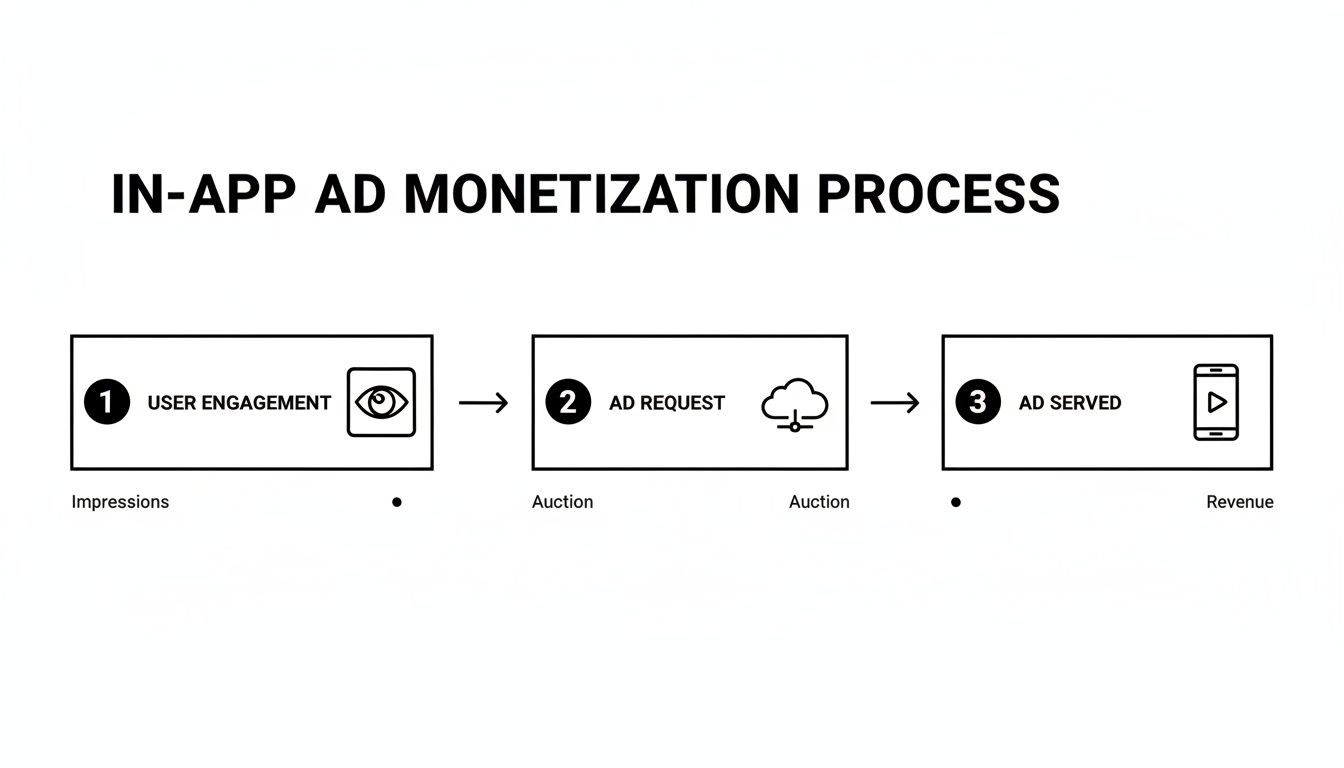
For advertising, the setup starts with an SDK from a network like AdMob or Meta Audience Network, then most developers add a mediation SDK on top. Every ad served triggers a real-time request, so speed matters: an ad request that takes two seconds to fill causes visible lag. Smooth integration keeps the app from stuttering on ad load.
How to Choose the Best Way to Monetize Your App
The best way to monetize an app is the model that matches your app's core function, your audience, and how often people use it, not the one that looks biggest on the revenue chart. Match the model to the behavior:
Used daily, casually: advertising plus small IAPs.
Delivers ongoing value: subscriptions or freemium.
One clear high-value job: paid download or a one-time IAP unlock.
Loyal niche audience: sponsorships, affiliates, or merchandise.
If you are building on a flexible platform, you can experiment and swap models without rewriting the app. That freedom to test is exactly how you find the best fit. See the CatDoes pricing options to compare how each plan supports different monetization setups.
How to Optimize Pricing and Track Performance
Launching monetization is the start of the real work. The apps that grow revenue treat their model as a living system: tested, measured, and tuned. From here, data beats intuition.
Set Your First Prices
Your first price should be an informed guess. Look at direct competitors and successful apps in your category to find a realistic range, then position within it: price above the median if your app does more, slightly below if you are new and want early adopters. Pricing is a signal of what you believe your product is worth, so aim for a number that feels fair and reflects the value you deliver. Then treat it as version 1.0.
A/B Test Your Revenue Touchpoints
A/B testing shows two versions to two groups and measures which performs better. You can test almost every revenue touchpoint:
Price points: Offer $4.99/month to one group and $5.99 to another. Does the lower price drive enough volume to win on total revenue?
Ad placements: Show an interstitial after three levels versus five. Find the point that maximizes revenue without pushing users to quit.
Paywall design: Test headlines, CTAs, or feature order on your subscription screen. Small changes often drive surprising jumps in conversion.
The rule: change one thing per test, so you know what caused the result.
Track the KPIs That Matter
A handful of metrics are the vital signs of your app's revenue health.
Metric (KPI) | What It Measures | Why It Matters |
|---|---|---|
ARPU | Total revenue divided by total users over a period. | Shows whether monetization is getting more efficient. Rising ARPU means something is working. |
ARPDAU | Revenue per daily active user. | Measures how well you monetize your most engaged users. Key for daily-use apps. |
LTV | Predicted total revenue from one user over their lifetime. | Sets your acquisition budget: how much you can spend to win a user and still profit. |
Conversion Rate | Share of users who take a desired action, like subscribing. | Directly measures paywall and offer effectiveness. A low rate flags something to test. |
Frequently Asked Questions
How much money can my app realistically make?
The range is wide and depends on category, user base, engagement, and model. A casual game with 100,000 monthly active users might earn $5,000-$15,000 a month from ads and small IAPs. A niche business tool with 10,000 subscribers at $10/month is a $100,000-a-month business. The difference is not user count, it is matching the model to what your audience will actually pay for.
Is a free app with ads better than a paid app?
For most apps starting out, yes. Going free removes the biggest barrier to entry and lets you build an audience fast, after which you can layer ads, IAPs, or a freemium subscription. A paid app has to convince someone to pay before they have tried it, which is a tough ask in a crowded market. Paid-upfront works only when the app has a strong, pre-existing value proposition, like a specialized professional tool.
When is the right time to start monetizing?
As soon as monetization feels natural in the experience, but never before your app delivers real value. Establish core value first, present offers at moments of high engagement (after a completed level, a finished project, a milestone), then start with one simple mechanic and watch your analytics before layering on more.
Can I change my monetization model later?
Yes, but handle it carefully. Switching from free to subscription, or paid to free-to-play, can anger existing users if you get the transition wrong. Communication matters most, and the best move is to grandfather in early adopters with permanent access to new premium features. A well-managed transition can revive an app, a clumsy one shows up in the reviews for months.
Monetization only matters once you have picked something worth monetizing. If you are still deciding what to build, our rundown of the best business to start in 2026 ranks twelve options by startup cost and time to first revenue.
Ready to turn your app idea into a shipped product without getting stuck on the technical side? CatDoes uses AI to build, design, and launch production-ready mobile apps from simple text prompts. Go from concept to App Store faster than before. Learn more and start building for free.
Nafis Amiri
Co-Founder of CatDoes