Blog
Business
How to Validate a Business Idea: 5 Proven Steps
Learn how to validate a business idea in 5 proven steps: customer interviews, demand testing, MVP building, and pricing analysis, before you spend a dime.

Nafis Amiri
Co-Founder of CatDoes
TL;DR
To validate a business idea, test your riskiest assumptions with real-world evidence before you build anything. Confirm a genuine problem through customer interviews, prove demand with a landing page and smoke tests, build a minimum viable product (MVP), then validate your pricing and business model. This 5-step framework gives you the data to confidently persevere, pivot, or walk away, before you spend serious time or money.
So what does "validating a business idea" actually mean? It's the process of rigorously testing your concept in the real world before you sink a ton of time and money into building it.
Think of it as a series of small, smart experiments designed to gather cold, hard evidence. You're trying to confirm you've found a genuine problem for a specific group of people who are actually willing to pay for your solution.
This approach saves you from building in a vacuum, cuts down on risk, and dramatically boosts your odds of launching something people want.
Table of Contents
Why Most Startups Fail (And How to Beat the Odds)
Adopt a Validation Mindset
Step 1: Find a Real Problem for a Specific Audience
Step 2: Test Demand Without Building a Product
Step 3: Build and Test Your Minimum Viable Product
Step 4: Validate Your Pricing and Business Model
Step 5: Analyze Your Results and Decide What Comes Next
Frequently Asked Questions About Idea Validation
Why Most Startups Fail (And How to Beat the Odds)
The path from a brilliant idea to a thriving business is a minefield. Too many founders spend months, or even years, perfecting a product, only to launch to the sound of crickets.
They guess wrong on market demand, build a solution for a problem nobody has, or simply burn through their cash before they find their footing. This isn't just an entrepreneur's nightmare; it's a statistical reality.
Around 90% of startups fail, and roughly 10% of all new businesses don't make it past their first year. According to CB Insights' analysis of startup post-mortems, the single biggest reason is "no market need", which accounts for 42% of failures. A huge driver behind that number is a simple lack of validation, especially around proving market need and a customer's willingness to pay.
Adopt a Validation Mindset
Instead of seeing validation as a one-time checklist, treat it as a continuous mindset. Your initial idea isn't a fact; it's just a collection of educated guesses.
You're assuming there's a painful problem, you're assuming you know who has it, and you're assuming your solution is the best one. The entire point of validation is to methodically swap those assumptions for evidence.
The hard truth is that 42% of business and product failures happen for one simple reason: there was no market need. Proper validation is your insurance policy against becoming another statistic.
This guide gives you a practical, step-by-step framework to test every one of your core assumptions. It's designed to arm you with the data you need to make smart decisions, whether that means charging ahead with confidence, making a strategic pivot, or saving your resources by killing a flawed idea early.
Before we dive deep, here's a quick overview of the core validation stages this guide covers, with the main question and critical action for each.
Validation Pillar | Question to Answer | Critical Action |
|---|---|---|
Problem | Is the problem real, urgent, and worth solving? | Conduct customer interviews and problem discovery sessions. |
Demand | Will people actively seek out this solution? | Run smoke tests with landing pages, ads, and email sign-ups. |
Product | Does our solution effectively solve the problem? | Test an interactive prototype or MVP with real users. |
Model | Are people willing to pay for this solution? | Perform pricing tests to confirm a sustainable business model. |
Each pillar builds on the last, making sure you don't commit to building a full product or defining a business model until you have solid proof that you're on the right track.
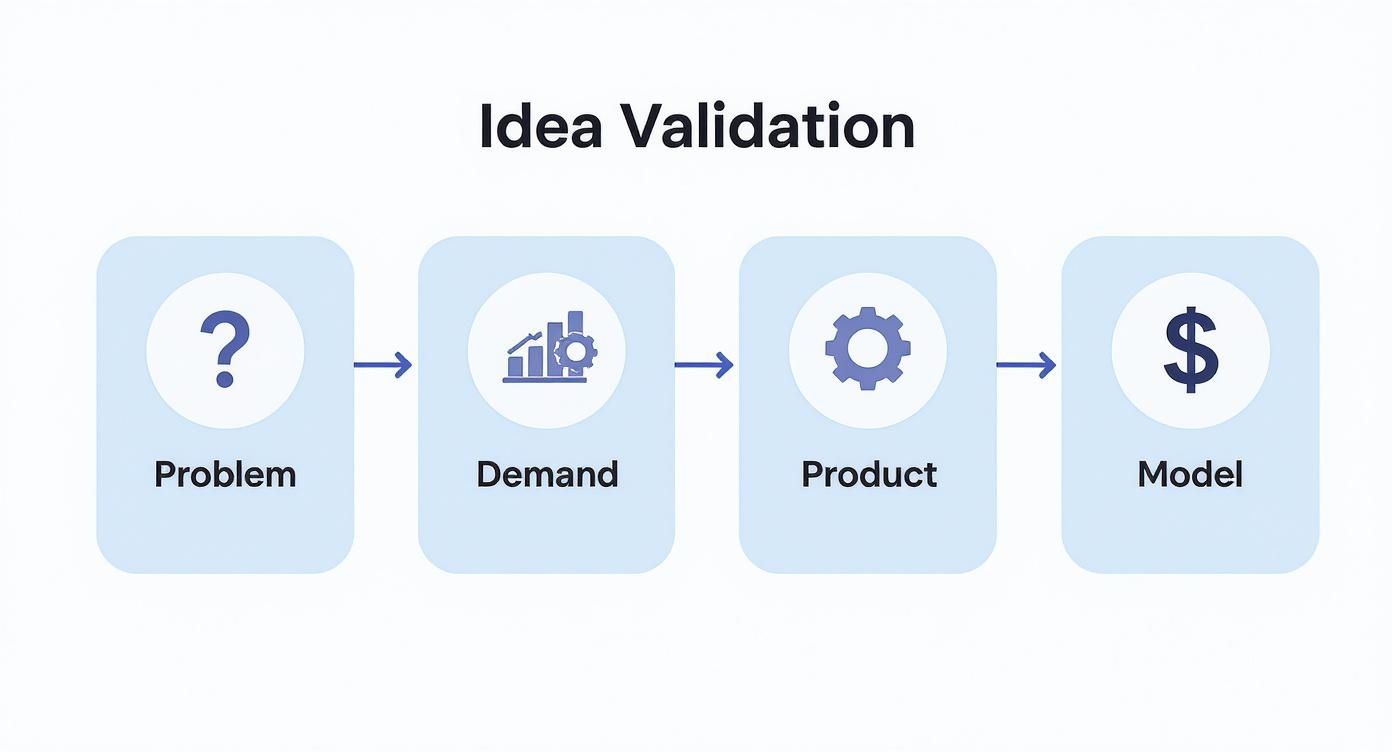
This four-part framework keeps you grounded in reality. You start by confirming the problem exists, then prove people want a solution, then test your specific solution, and only then figure out how to build a business around it. It's a logical progression that keeps you from getting ahead of yourself.
Step 1: Find a Real Problem for a Specific Audience
Every great business idea starts with a problem. Not a solution, not a clever feature, but a genuine, nagging problem that a specific group of people is wrestling with.
It's tempting to get excited about an app idea and dive straight into building it, but that's a classic startup mistake. Before you even think about code or design, your only job is to become an expert on the pain you want to solve.
You have to get out of your own head, because your assumptions are your biggest enemy right now. You might think you've found a great idea, but until you've heard people describe the problem in their own words, it's just a hypothesis.
Specificity is your best friend here. "Helping small businesses" is way too broad, but "helping independent coffee shops manage their bean inventory to reduce waste" is a problem you can actually investigate. If you're still brainstorming, take a look at some of the best app ideas for inspiration to see how they zero in on one clear user problem. If you are still short of a starting point, our roundup of the best business to start in 2026 gives you somewhere to aim.
Create Detailed Customer Profiles
To really get inside your audience's head, you need to go beyond basic demographics. A good customer profile, often called a persona, is a short, vivid description of your ideal user.
It's not just an exercise in creative writing; it's a research-backed tool that captures their goals, frustrations, and daily routines. A strong persona should answer questions like:
What are they trying to accomplish? What's their main goal related to the problem you're exploring?
What are their biggest headaches? Where do they get stuck? What wastes their time or money?
What does their day look like? Walking through their workflow helps you spot the exact moments of friction.
What tools are they using now? Knowing their current solutions (even if it's just a messy spreadsheet) shows you what they value and where the gaps are.
Let's imagine you're building a project management tool. A persona could be "Maria, a freelance graphic designer who juggles 5-7 client projects at a time."
Her big challenge? She loses track of feedback buried in endless email threads and Slack DMs, which leads to missed revisions and delayed payments. By painting such a clear picture of Maria, you can immediately see what a valuable solution would look like for her.
Conduct Effective Customer Discovery Interviews
The single best way to find out if you've found a real problem is to talk to people, not to sell them anything, but to listen. These are called customer discovery interviews, and their only purpose is to learn.
Please avoid the trap of only talking to your friends and family, because their opinions are almost always biased. You need to find real, impartial potential customers.
Look for them where they already hang out: online communities, industry forums on Reddit or LinkedIn, or local meetups. When you reach out, be direct and honest, because you're doing research, not selling. A simple message like, "Hi, I'm researching the challenges freelance designers face with client feedback. Would you be open to a 15-minute chat to share your experience?" works wonders.
During the conversation, ask open-ended questions about things they've actually done, not what they might do in the future.
People are notoriously bad at predicting their own behavior. Instead of asking, "Would you use an app that did X?" ask, "Tell me about the last time you dealt with Y." The stories they share will reveal genuine pain points.
Here are a few powerful questions to get the conversation rolling:
Can you walk me through how you currently handle [the specific task]?
What's the most frustrating part about doing [the task]?
Have you tried to solve this problem before? What did you do?
If you could wave a magic wand and fix one thing about this process, what would it be?
Listen for emotion. When someone describes their frustration with a current tool or a workaround they've cobbled together, you're onto something.
If they've already spent time or money trying to fix the problem, that's a massive signal that you've found a pain worth solving. This groundwork is what stops you from building a solution in search of a problem.
Step 2: Test Demand Without Building a Product

You've confirmed the problem is real and urgent. The temptation to jump straight into building the solution is immense, but don't do it. Sinking hundreds of hours and thousands of dollars into development at this point is a massive, unnecessary gamble.
Before you write a single line of code, you need real, tangible proof that people will actually seek out and sign up for what you're proposing. This is where you shift from problem discovery to demand validation.
The goal here is to get your first "yes" from the market, not with words, but with actions. It's time to run a few simple, low-cost experiments to see if strangers will give you their email address, or even a pre-order, based on your idea's promise alone.
Build a High-Impact Landing Page
Your most powerful tool for this phase is a simple landing page. Think of it as a digital storefront for a product that doesn't exist yet.
Its one and only job is to communicate your value proposition so clearly that visitors are compelled to take a single action: sign up to be notified when you launch. This page doesn't need to be fancy; simpler is almost always better. Just focus on these core elements:
A Killer Headline: State the main benefit, not the feature. Instead of "A New Project Management Tool," try "The First PM Tool That Manages Your Client Feedback for You."
A Clear Sub-headline: Quickly explain who it's for and how it works. For instance, "Designed for freelance designers to stop chasing revisions and get paid faster."
Three Key Benefits: Use bullet points to list the top three outcomes your user will get.
A Single Call to Action (CTA): Make your CTA button impossible to miss. "Request Early Access" or "Get Notified at Launch" are great places to start.
Tools like CatDoes make it dead simple to build a professional-looking landing page in a few hours, no technical skills required. This is your first real test of how well your idea translates to someone who has never heard of you.
Run Smoke Tests to Gauge Real Intent
That landing page with its email signup form is your smoke test. You're creating the "smoke" of a real product to see if anyone comes looking for the fire.
The number of people who sign up is your first piece of hard, quantitative data on market interest. This moves you beyond the "my friends said it was a good idea" stage and into "strangers are actively asking for this."
The difference between someone saying they would use your product and someone actually giving you their email address is enormous. The first is a polite opinion; the second is a micro-commitment that signals genuine interest.
A good conversion rate varies by industry, but a solid benchmark to aim for is 5-10% of visitors signing up. If you're hitting numbers in that range from relevant traffic, that's a powerful signal that you're onto something.
If your sign-up rate is hovering below 1%, it might be time to rethink your messaging, or question whether the problem is as urgent as you believed.
Use Paid Ads to Find Your Audience
So how do you get people to your shiny new landing page? While sharing it in relevant online communities is a good start, running small, targeted ad campaigns is the fastest way to get truly unbiased data.
Platforms like Meta (Facebook and Instagram) or LinkedIn let you zero in on the exact customer profile you identified earlier. You don't need a huge budget, either. An investment of just $100-200 is often enough to drive sufficient traffic for meaningful results on two critical metrics:
Click-Through Rate (CTR): This tells you how compelling your ad and its core message are.
Cost Per Lead (CPL): This shows you exactly how much it costs to acquire one email signup.
For example, you could run a small campaign targeting "freelance graphic designers" on LinkedIn. If your CPL comes in at a reasonable $5, you know you can acquire potential customers efficiently. But if it's a staggering $50, you might have a serious business model problem before you've even started.
These early experiments are invaluable. They give you the first concrete evidence for your business case: whether your value prop resonates, whether you can actually reach your target audience, and what it might cost to acquire them, all before you've built anything.
Step 3: Build and Test Your Minimum Viable Product
Your landing page and smoke tests are showing real demand. That's the green light you were waiting for, but it doesn't mean it's time to disappear for six months to build a masterpiece.
The next move is to build a Minimum Viable Product (MVP), a lean, functional version of your solution that gets the job done. The entire point of an MVP is to get a real product into the hands of your first users as fast as possible.
This is the moment you shift from testing interest to testing your actual solution. You're no longer asking if people want it; you're finding out if your product actually delivers on its core promise.
It's easy to get this wrong. An MVP isn't just a buggy, half-finished product, it has to be viable. That means it must solve the user's primary problem, even if it's missing all the extra bells and whistles you've dreamed up.
Prioritize Features Ruthlessly
The hardest part of building an MVP is deciding what to leave on the cutting room floor. Every feature will feel essential, but your success hinges on being absolutely ruthless.
Your goal is to build only what is necessary to solve the one core pain point you've identified. For every single feature on your list, ask yourself these questions:
Is this absolutely essential for solving the user's main problem? If the product works without it, cut it for now.
Can a user complete their main goal without this? Your MVP needs to support a full, successful journey for one critical task.
Is this a "nice-to-have" or a "must-have"? Be brutally honest.
Say you're building an app for freelancers to track their hours. The "must-haves" are creating a project, starting a timer, and seeing a report.
Fancy invoicing integrations, team features, or custom branding? Those are classic "nice-to-haves" that can wait. We dig deeper into this mindset in our guide on what is a minimum viable product.
Build and Validate Your MVP Fast with CatDoes
Back in the day, an MVP meant hiring a team of engineers and waiting months. Not anymore. With CatDoes, you just describe your idea in plain English and it builds a real, production-ready mobile app for you, generating everything from the UI to the backend logic, in hours instead of months.
That speed is exactly what makes CatDoes a validation machine, not just a build tool. You can take the problem you confirmed in Step 1 and the demand signals from Step 2, describe the solution, and have a working app in your hands the same day. Then you do what actually validates an idea: get it in front of real people. Run a few ads to it, share it in the communities where your audience hangs out, and hand it to the folks who signed up on your landing page.
From there, the market tells you the truth. If people sign up, keep coming back, and ask for more features, you've validated demand with an actual product, not a mockup or a promise. If they shrug and bounce, you've learned the exact same lesson for a tiny fraction of the cost and time. That's the whole point: building fast with CatDoes lets you market and validate a real product before you bet months of your life on it. And because you go from idea to clickable prototype to app store submission on one platform, there's no rebuild when validation turns into a real launch.
Your only goal at this stage is to maximize learning while minimizing effort. A CatDoes MVP is the perfect vehicle for this. It lets you build, ship, market, and iterate based on what real users are telling you, not what you assume they want.
Gather Feedback and Track User Behavior
Once your MVP is live, get it in front of all those people who signed up on your landing page. These early adopters are your feedback goldmine.
Set up structured usability tests where you just watch them use the product for the first time. Pay attention to where they struggle, what confuses them, and what makes them light up. Ask for their unfiltered thoughts: the good, the bad, and the ugly.
But you can't just listen; you also have to watch. Integrate analytics tools like Mixpanel or Hotjar to track what users are actually doing inside your app. Focus on a few key metrics:
User Engagement: Are people actually using the core features you built?
Retention Rate: Are they coming back? Day after day, week after week?
Task Completion Rate: Can they successfully finish the main workflow you designed?
This blend of qualitative and quantitative data paints a clear picture of what's working and what isn't. This build-measure-learn loop is the engine that drives you toward product-market fit, so don't skip it.
Step 4: Validate Your Pricing and Business Model

Up to this point, you've confirmed a painful problem and built a solution people find valuable. Those are huge wins, but they don't make a business.
An idea only becomes a business when someone is willing to pay for it. This is the final, most critical piece of the puzzle, where you shift from building a cool product to building a sustainable company. It all comes down to one brutal question: can this thing actually make money?
Test What Customers Will Actually Pay
Pricing is notoriously hard for founders. It's too easy to undervalue your solution or just pick a number that "feels right."
Instead of guessing, run experiments to see what the market will truly bear. The goal is to find that sweet spot between what customers see as fair value and what keeps your business afloat. You can test this with a few straightforward techniques:
A/B Test Your Prices: On your landing page, show different prices to different people. For instance, Group A sees a $29/month plan, while Group B sees $49/month. Measure the conversion rate for each to find a data-backed answer.
Use a Pricing Page Survey: Add a simple, one-question survey for visitors who don't sign up. Ask them, "What did you expect the price to be?" This gives you direct, unfiltered insight into perceived value.
Offer Pre-Orders: This is the ultimate test. Ask for money upfront, offering a discount for customers who pre-order before launch. A credit card commitment is the strongest validation signal you can possibly get.
Choose the Right Pricing Model
Beyond the number itself, you have to validate your pricing model. How you charge can have a massive impact on revenue and customer loyalty.
The two most common paths are a one-time fee or a recurring subscription. For a deeper look, you can explore various mobile app monetization strategies to see what fits your product. Here's a quick comparison to get you thinking:
Model Type | Best For | Pros | Cons |
|---|---|---|---|
One-Time Fee | Tools, digital downloads, courses | Simple for customers; cash flow is front-loaded. | No recurring revenue; constant need for new customers. |
Subscription | SaaS, content platforms, services | Predictable recurring revenue; builds long-term relationships. | Higher churn risk; requires continuous value delivery. |
Your choice depends entirely on the value you provide. If your product solves a continuous, ongoing problem, a subscription just makes sense. If it solves a single, specific problem, a one-time fee might be a better fit.
Build a Basic Financial Forecast
All this financial validation boils down to one simple but powerful calculation: can you make more money from a customer than it costs to get them? This is where you connect the dots from all your experiments.
Your ad tests gave you your Customer Acquisition Cost (CAC). Your pricing tests help you estimate your Lifetime Value (LTV). A sustainable business requires your LTV to be significantly higher than your CAC; a ratio of 3:1 or more is a healthy benchmark.
For example, a niche SaaS tool for architects calculated they needed 50 customers at $100 per month to break even. Using targeted ads, they confirmed their CAC and signed up their first 50 users in weeks, proving financial viability early.
This simple LTV-to-CAC analysis is your moment of truth. If the numbers work, you have a validated business model. If they don't, you have critical data telling you to adjust your pricing, find cheaper acquisition channels, or pivot before you run out of cash.
Step 5: Analyze Your Results and Decide What Comes Next
After weeks of interviews, landing page tests, and MVP demos, you're sitting on a mountain of data. This is the moment of truth, where all that grinding leads to a single decision: looking at the cold, hard evidence and deciding what to do.
This isn't about wishful thinking or falling in love with your own idea. It's about letting the data tell you which path to take. Your options are simple: persevere, pivot, or pull the plug.
Reading the Signals: Green Lights and Red Flags
The first job is to sort through your findings. What's telling you to floor it, and what's screaming at you to hit the brakes?
When you lay out all the evidence, the picture becomes surprisingly clear. Here are the signs of a green light to persevere:
Strong Conversion Rates: Your landing page is consistently turning visitors into email signups. A rate of 5% or higher is a fantastic signal.
Positive MVP Feedback: Early users get it. They're actively using your prototype to solve their problem and, even better, asking for more features.
A Path to Profitability: The math works. Your estimated customer acquisition cost (CAC) is clearly lower than the projected lifetime value (LTV).
Willingness to Pay: A solid number of people have pre-ordered, put down a deposit, or verbally committed to paying once you launch.
If you're seeing these signs, your core assumptions were likely on the money. The problem is real, your solution hits the mark, and the business model looks sound.
Knowing When and How to Pivot
Don't panic if your results aren't a slam dunk, because most aren't. A pivot isn't a failure; it's a smart, strategic adjustment based on real-world feedback. It means one of your core hypotheses was off, but the opportunity itself might still be huge.
A pivot is a change in strategy without a change in vision. You're not abandoning the destination; you're just realizing you need to take a different road to get there.
Look for these clues that a pivot is in order:
Users are Confused: Testers don't understand the purpose of your product or can't complete the main task. This is a classic sign that your solution needs a rethink, not necessarily the problem you're solving.
Nobody Wants to Pay: People love your free version but disappear the moment you mention a price. This could mean you need to pivot your business model, or target a different customer segment with a bigger budget.
Engagement is Weak: Users sign up but never come back. This suggests your solution isn't compelling enough, and you might need to pivot toward a more painful, urgent problem for the same audience.
If the data gives you a clear green light, your next steps are straightforward: build a product roadmap based on what users told you, line up any initial funding you need, and get ready for a full launch.
If the results are mixed, a pivot is probably your best move. But if every experiment, from interviews to smoke tests, points to a dead end, the bravest thing you can do is pull the plug and save your time, money, and energy for the next great idea.
Frequently Asked Questions About Idea Validation
The road to validating a business idea is paved with questions. Here are some of the most common ones founders ask, with straight answers to help you move forward.
How Much Does It Cost to Validate a Business Idea?
Honestly, it can range from practically nothing to a few thousand dollars, depending on how you approach it. Customer interviews and simple online surveys cost only your time.
If you decide to run a few targeted ad campaigns on a test landing page to gauge interest, you might spend a few hundred dollars to get enough clicks for a clear signal. Think of validation not as an expense, but as an investment that helps you avoid the real cost: sinking tens of thousands of dollars and months of your life into something nobody was ever going to buy.
How Long Does the Validation Process Take?
There's no magic number, because the timeline depends on your idea's complexity and who you're trying to reach. A straightforward B2C app idea could be validated with four to six weeks of focused work, while a more intricate B2B platform might take a few months to line up enough interviews and properly test an MVP.
The goal isn't to race through a checklist; it's to learn. You keep testing until you have undeniable evidence to either pivot or confidently hit the accelerator.
What If Someone Else Is Already Doing My Idea?
Good. Competition is often a sign that you've found a real market with a real problem.
Your goal isn't to be the first person to ever think of this; it's to be different and demonstrably better for a specific group of people. Zero in on what you can do that the existing players don't, whether that's a far superior user experience, a more affordable price, or features that serve a niche they've ignored. That unique angle is exactly what you'll be testing throughout the validation process.
Ready to turn your validated idea into a real mobile app, without the painful costs and delays of traditional development? With CatDoes, you can build a functional, production-ready app using simple, natural language. Go from a proven concept to a clickable prototype and all the way to app store submission faster than you thought possible. Start building for free on catdoes.com and bring your vision to life.
Nafis Amiri
Co-Founder of CatDoes


