Blog
Tutorials
What is a native mobile application? A Beginner's Guide to Native Apps
What is a native mobile application? Explore its benefits, performance, and cost, and learn how to choose the right development path.

Nafis Amiri
Co-Founder of CatDoes
What is a native mobile application? A Beginner's Guide to Native Apps
A native mobile application is an app built from the ground up for a single operating system, either Apple's iOS or Google's Android. Developers use the platform’s official programming language, like Swift for iOS or Kotlin for Android, to create an experience that feels perfectly at home on your device.
This lets the app perform with maximum speed and reliability, because it's literally speaking the device's native tongue.
Unlocking Peak Performance with Native Apps
Imagine a key built for one specific lock. It slides in effortlessly and turns without a hitch. That's the whole idea behind a native mobile application. Instead of trying to be a one-size-fits-all solution, it's meticulously crafted for a single environment, giving it a huge advantage.
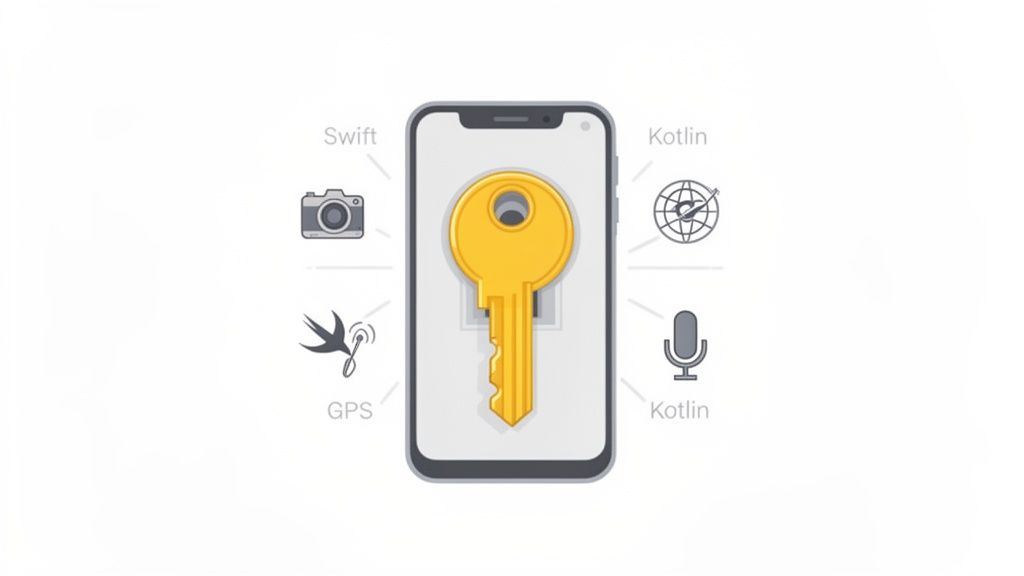
This specialized design means the app can "talk" directly to your phone's hardware. It can tap into the camera, GPS, accelerometer, and microphone without any middleman slowing things down.
The result? A fast, snappy, and deeply intuitive experience that feels like it belongs on your phone. Think about your phone’s default camera or calculator app. Their seamless performance is a dead giveaway of native design.
Why Direct Access Matters
That direct line to the hardware isn't just a technical detail; it translates into benefits you can actually feel. When an app communicates directly with the operating system, everything just works better.
Here’s what that looks like in practice:
Superior Speed: Actions feel instant because the code is running in its natural habitat, fully optimized for the device's processor.
Enhanced Reliability: Native apps are typically more stable and less prone to crashing since they're built following the strict rules of the ecosystem.
Familiar User Interface: They use the operating system’s standard buttons, menus, and gestures, so the app looks and feels like a natural part of your phone.
This tight integration is precisely why businesses go native for apps where performance is non-negotiable. A smooth, lag-free experience is everything for keeping users happy and engaged, which directly impacts customer retention and the bottom line.
Ultimately, this tailored approach ensures the app doesn't just work. It excels, setting the gold standard for how a mobile app should perform.
The Rise of Native Apps in the Mobile World
To really get what a native mobile app is, you have to go back to the beginning. The mobile world we live in didn't just happen overnight; it was kicked into gear by one single, game-changing event that set the stage for everything that followed.
Before 2008, "mobile apps" were mostly clunky, slow, and frustrating experiences controlled by the wireless carriers. That all changed on July 10, 2008, with the launch of the Apple App Store. This wasn't just another feature. It was a full-blown revolution in how software was distributed, and it immediately established native development as the industry benchmark. It started with just 500 native iOS apps but exploded to 250,000 by 2010, proving people were starved for high-quality mobile software. You can find more great insights on the history of the app market on CMarix.com.
Setting a New Standard for Mobile
The App Store did way more than just sell apps. It created an entirely new economy for developers and, more importantly, it completely redefined what users expected from their phones.
Suddenly, apps had to be fast, reliable, and deeply connected to the device's hardware: its camera, its location services, its notifications. The only way to deliver that was through native development. This shift permanently changed user behavior. We all got used to apps that felt instant, intuitive, and just worked with our phones. Anything less felt like a step backward.
The App Store’s success created a "gold standard" for mobile performance. It taught users to expect a seamless experience, a benchmark every developer has aimed for ever since. This is why, even with countless development options available today, achieving that native-level performance remains a primary goal for any successful app.
Of course, Google quickly followed with its own marketplace, now the Google Play Store, creating the iOS vs. Android rivalry that still drives so much innovation today. Each platform developed its own design language and best practices, cementing the idea that the very best apps are the ones built from the ground up for the specific device in your hand.
This history is the reason why a native mobile application is still considered the pinnacle of performance and user experience.
Comparing Native, Hybrid, and Web Applications
Deciding how to build your app is one of the most critical choices you'll make. It affects everything from user experience to your budget and timeline. To keep things simple, let's think of it in terms of vehicles.
A native mobile application is like a high-performance race car, custom-built for a specific track, either iOS or Android. It's engineered for pure speed, responsiveness, and squeezing every ounce of power from the hardware.
A hybrid app, on the other hand, is more like an all-terrain vehicle. It's versatile and can handle different environments (both iOS and Android) with a single build, but it's not a master of any specific one. It trades a bit of specialized performance for flexibility.
Finally, a web app is like a convenient rental car. You can access it from anywhere with a web browser, but it's not going to have the power, features, or seamless feel of a purpose-built machine.
Each path comes with its own set of trade-offs. The right one for you depends entirely on your project's goals, your budget, and the kind of experience you want to give your users. For a much deeper look at this, we have a whole guide comparing the native mobile app vs web app approaches.
This journey toward the modern app ecosystem really kicked off with the launch of the App Store back in 2008, creating the competitive landscape we know today.
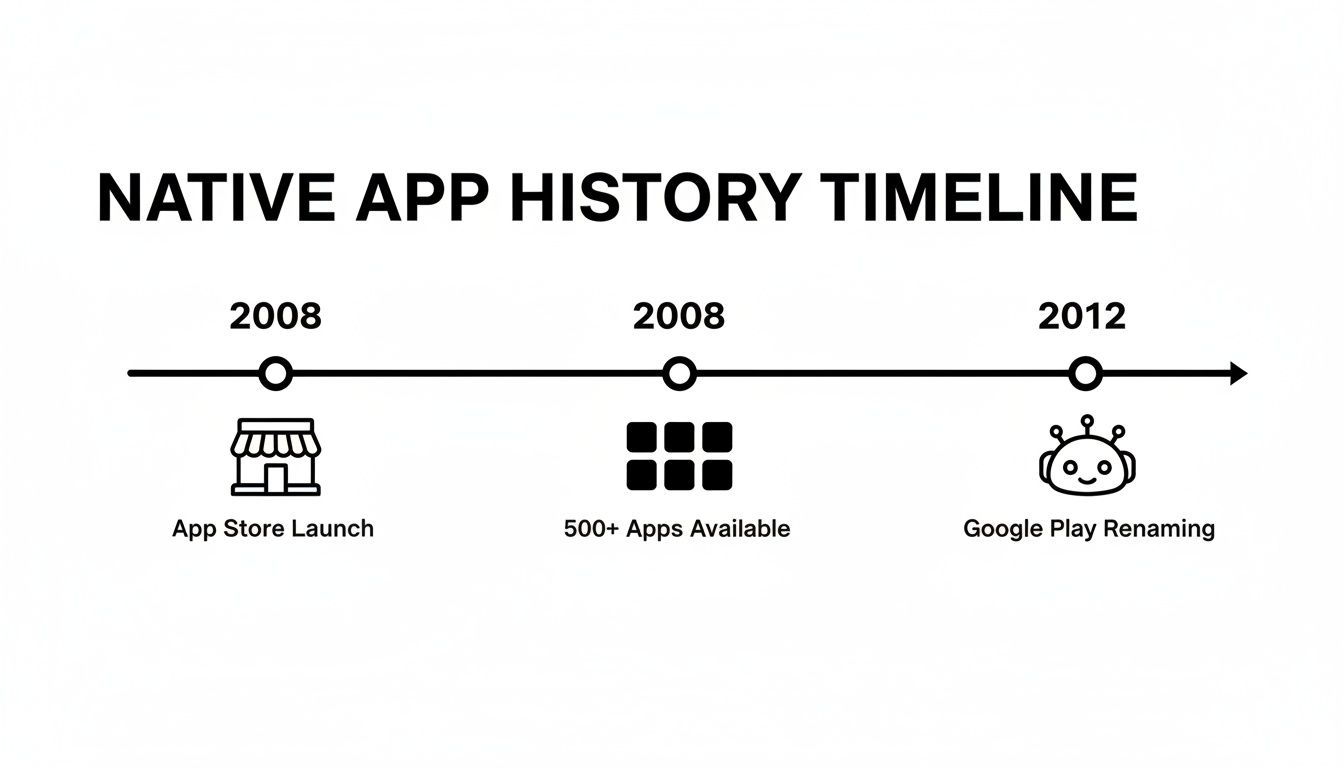
This history shows why native apps became the gold standard for performance and user experience. They were born from a rivalry where only the best would stand out.
Native vs Hybrid vs Web App Comparison
To make the decision clearer, let's put these three approaches side-by-side. Understanding these practical differences in performance, user experience, and cost is the key to matching your technical strategy with your business goals.
Characteristic | Native App | Hybrid App | Web App |
|---|---|---|---|
Performance | The fastest, most responsive experience possible. | Good performance, but a step behind native. | Speed depends heavily on the browser and network. |
User Experience (UX) | Seamless and intuitive, feels perfectly at home on the device. | Can feel slightly less polished or a bit "off." | Limited by what a web browser can do. |
Device Access | Full access to camera, GPS, contacts, and all hardware. | Limited access through plugins and APIs. | Very restricted; little to no hardware access. |
Development Cost | Highest, as you need separate teams for iOS and Android. | Moderate, thanks to a single codebase for both platforms. | Lowest, since it builds on standard web technologies. |
Installation | Required from an app store. | Required from an app store. | Not required; just visit a URL in a browser. |
The takeaway is pretty clear: native apps deliver the best possible performance and user experience but demand the biggest investment. Hybrid apps strike a balance between cost and performance, while web apps are the most accessible but also the most limited.
Making the Right Choice for Your Project
So, which path should you take? It all comes down to what you need your app to do.
Choose Native If: Performance is everything. Go native if you need full access to device features like advanced camera controls, push notifications, or the GPU for a high-fidelity game. It's the only choice for complex applications where a buttery-smooth user experience is non-negotiable.
Choose Hybrid If: Your main goals are getting to market on both iOS and Android quickly and on a tighter budget. This is a fantastic middle ground for many apps, especially those that don't need intense graphical power or deep hardware integration.
Choose Web App If: Your app is mainly for consuming content or handling simple tasks. It's perfect when you need the widest possible reach without forcing users to download a thing.
The most successful apps are the ones where the development strategy aligns perfectly with the core purpose. A banking app, for instance, will almost always choose a native build for its unbeatable security and reliability. A simple online magazine, however, might be perfectly happy as a web app.
Why Businesses Invest in Native App Development
Despite the higher price tag upfront, the world’s most successful companies consistently choose to build native mobile applications. This isn’t just a tech preference; it’s a strategic bet on quality that pays off in the long run. The reason is simple: native development delivers a superior product that users can actually feel.
That quality translates directly into real business results. A fast, snappy app keeps users engaged and drives much higher retention rates. When an app just works, smoothly and intuitively, people come back, make purchases, and become loyal to the brand.
Unlocking a Competitive Edge with Device Features
One of the biggest game-changers with native development is getting full, unrestricted access to a device's hardware and software. This is where you can build truly innovative features that make your app stand out in a crowded market. Think of a social media app with incredible camera filters or a banking app that uses your fingerprint for instant, secure logins.
These aren’t just nice-to-haves; they’re powerful differentiators made possible by the app’s direct line to the phone's core functions. This includes:
Advanced Camera Controls: Gaining total control over the camera for high-quality photo and video features.
Biometric Security: Using Face ID or fingerprint scanners for security that feels both effortless and trustworthy.
Push Notifications: Sending reliable, interactive alerts that bring users back into your app.
GPS and Geolocation: Building precise location-based services for navigation or finding things nearby.
This deep integration lets companies create experiences that aren't just functional but genuinely useful.
By sticking to the official design guidelines from Apple and Google, native apps also feel instantly familiar and trustworthy. Buttons, menus, and swipes work exactly how people expect, which builds confidence and makes your brand feel solid and reliable.
The Business Case for Superior Performance
The investment in native apps is clearly justified by their performance in the market. Recent analysis shows native mobile apps holding a dominant 52.30% share of the mobile app development market in 2025, which is valued at over USD 145 billion. This isn't an accident. Their market leadership is built on incredible speed, seamless integration with device features, and a polished feel that keeps users coming back. You can discover more insights on the mobile app market from SNS Insider.
Ultimately, choosing to build a native mobile application is a deliberate business decision. It’s a clear signal that you’re committed to quality, security, and delivering the absolute best experience for your users. For any company serious about leading its market, the payoff in performance, security, and user satisfaction creates a powerful foundation for growth.
The Realities of Building and Maintaining Native Apps
Let's be clear: deciding to build a native mobile application is a serious commitment. It’s a major investment of time, money, and specialized talent. Unlike simpler web or hybrid routes, going native means you’re essentially signing up to build two distinct apps: one for iOS, and a completely separate one for Android.
This two-track reality is the core of native development. Each platform speaks its own language and uses its own tools. That means you’ll likely need separate developers or even entire teams. One group will be experts in Apple's world, writing in Swift, while the other will focus on Android, using Kotlin. This specialization immediately drives up project complexity, extends timelines, and inflates your budget.
The Ongoing Commitment of Maintenance
The real work doesn't stop at launch. In fact, it’s during the maintenance phase that the true cost and effort of native development really sink in. Every single update, bug fix, or new feature has to be developed, tested, and deployed twice.
This parallel workload effectively doubles your operational overhead. Think about the day-to-day tasks:
Platform Updates: When Apple or Google drops a new OS version, both of your apps will need updates to stay compatible and maybe even tap into cool new features.
Bug Fixes: A user reports a bug on Android. Your team fixes it. Now, they have to investigate if the same bug exists on the iOS version and fix it there, too.
Feature Parity: You roll out a killer new feature on your iOS app. To keep your user experience consistent, you now have to build that same feature from scratch for your Android users.
This constant, dual-track maintenance is a huge factor you need to bake into your budget and team planning from day one.
The core challenge of native app maintenance isn't just about writing code twice; it's about the coordination. Keeping both versions of your app perfectly in sync demands disciplined project management and a crystal-clear roadmap.
Navigating the App Store Submission Process
Finally, getting your app to your users means you have to go through the official gatekeepers: the app stores. Both Apple's App Store and the Google Play Store have their own unique submission rules and review processes, and this step alone can add weeks to your launch.
Apple is particularly known for its rigorous review, where they scrutinize everything from your app's core function and design to its privacy policies. Google’s process tends to be quicker, but both platforms demand careful preparation of store listings, screenshots, and compliance documents.
Understanding and successfully navigating these two separate ecosystems is a critical, and often underestimated, part of the native app journey. You can learn more by exploring common mobile app development challenges in our detailed guide.
Achieving Native Performance with Modern Tools
What if you could get all the power of a native mobile app without the traditional headaches? A new breed of development tools is making that possible, offering a much smarter way to build high-performance apps. These frameworks let developers write a single codebase that runs beautifully on both iOS and Android.
This approach is a huge win for startups and businesses that need to move fast and keep costs in check. Instead of juggling two separate, expensive projects, teams can focus on one unified development process and launch on both major platforms at the same time.
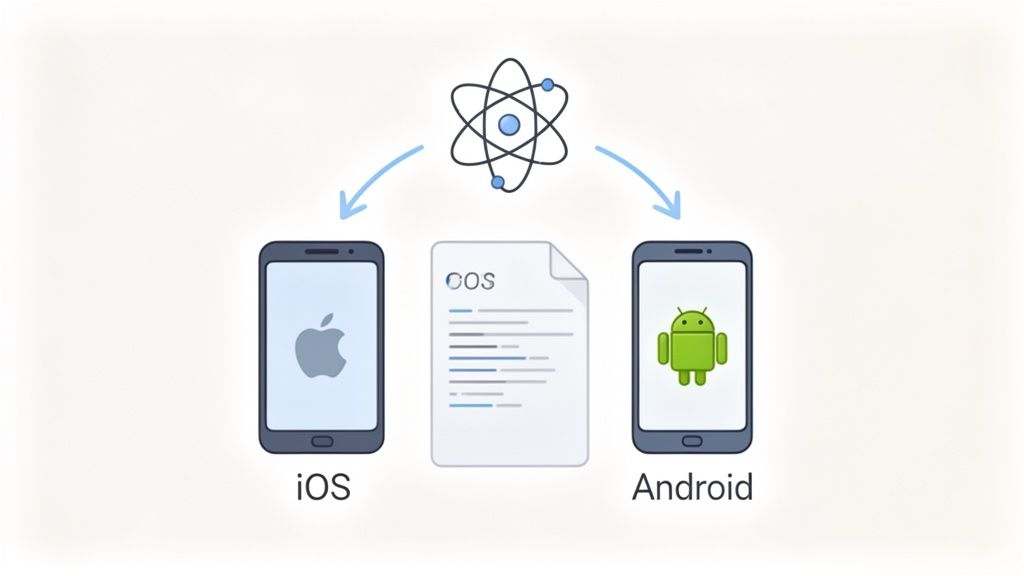
Cross-Platform Native Development
Frameworks like React Native are built on a simple but game-changing idea: write once, run anywhere. A developer uses a single language, usually JavaScript, to build the app’s logic and interface. The framework then acts like a universal translator, converting that code into the actual native UI components for each operating system.
This is worlds apart from a hybrid app, which is basically just a website stuffed inside a native shell. With a cross-platform native tool, the final product is a true native application.
The end-user gets an app that looks, feels, and performs exactly like it was built just for their phone. The business gets there faster and with way fewer resources, putting native-level quality within reach for a much wider range of projects.
How These Tools Bridge the Gap
This method really does give you the best of both worlds. You get the efficiency of building one app without giving up the snappy, polished experience users demand. For a deep dive into how the top technologies stack up, check out our guide on https://catdoes.com/blog/flutter-vs-react-native-2025.
Here’s a quick rundown of the main advantages:
Faster Time-to-Market: Launching on iOS and Android at the same time can cut your development cycle nearly in half.
Reduced Costs: Maintaining a single codebase requires a smaller, more focused team. Simple as that.
Consistent User Experience: The core features, design, and feel of your app will be consistent, no matter what device someone is using.
Of course, to really deliver top-tier performance, it’s vital to keep an eye on key mobile app performance metrics. These modern tools give you a massive head start, but ongoing analysis is what keeps the experience flawless for your users.
Common Questions About Native Applications
Even when you get the concept, the practical questions always follow. Let's tackle some of the most common ones that business owners and creators run into when they're weighing their options.
Are Native Apps Really That Much More Expensive to Build?
Yes, the upfront cost for a native app is almost always higher. You're not just building one app; you're building two distinct products, one for iOS and one for Android. That means you need specialized developers for each, which naturally drives up the time, complexity, and budget.
But it’s best to think of this as a long-term investment. The slick performance, tighter security, and better user retention that native apps deliver can generate a much stronger return over the life of the product.
Can Users Actually Feel the Difference?
Absolutely. The difference between a native app and its hybrid or web counterparts is something you can literally feel in your fingertips. Native apps are faster, the scrolling is smoother, and everything just feels more responsive because the code is running in its natural environment.
It goes beyond just speed, though. Native apps follow the specific design rules of the operating system. Buttons, menus, and swipes work exactly how an iPhone or Android user expects them to. This creates a sense of familiarity and trust. A hybrid app, in contrast, might have tiny, almost imperceptible delays or UI elements that feel just a little bit... off.
A seamless and predictable user interface isn't a small detail; it directly impacts user satisfaction and how professional your brand feels. A clunky experience can erode trust and lead to higher abandonment rates.
So, When Should a Business Go Native?
You should choose to build a native mobile application when performance and user experience are your absolute non-negotiables. It’s the undisputed champion for apps that need to get the most out of the device's hardware.
Consider going native for:
Complex Applications: Think high-performance games, sophisticated photo or video editors, and augmented reality experiences. These all demand native power.
Core Business Apps: If speed and reliability directly impact your revenue or user trust, like in banking or major e-commerce apps, native is the safest bet.
Hardware-Intensive Features: If your app relies on advanced camera controls, precise GPS tracking, or heavy graphics processing, native development is the only way to guarantee it works flawlessly.
If your main goal is to display content or handle simple tasks, a hybrid app or even a progressive web app might be a smarter, more cost-effective starting point.
Ready to turn your idea into a production-ready mobile app without the traditional costs and complexity? With CatDoes, you can describe your app in natural language and watch our AI agents build, design, and prepare it for the App Store. Start building for free today and bring your vision to life.
Nafis Amiri
Co-Founder of CatDoes