Blog
Insights
Flutter vs React Native vs CatDoes (2026)
Flutter vs React Native in 2026: compare performance, language, ecosystem, and cost, and see how CatDoes builds and ships React Native apps for you, no coding.

Nafis Amiri
Co-Founder of CatDoes

Choosing between Flutter and React Native in 2026 used to come down to a simple performance argument. It doesn't anymore. Both frameworks are now mature, production-ready, and close enough on speed that the harder question is whether you should be hand-coding a cross-platform app at all.
This guide compares Flutter vs React Native on the things that actually decide real projects (performance, language, ecosystem, hiring, and cost), then adds a third option most comparisons skip: CatDoes, an AI agent that writes and ships the app for you. By the end you'll know which framework fits your team, and when it makes more sense to let AI build the app instead of writing it.
TL;DR: In 2026, Flutter (built with Dart) and React Native (built with JavaScript or TypeScript) are both production-ready, and the performance gap between them is small. Flutter wins on graphics-heavy, pixel-perfect UIs and multi-platform reach; React Native wins on smaller app size, native feel, JavaScript hiring, and startup speed. Either way, you still write the code, set up the build tooling, and handle app-store submission yourself. CatDoes is the third path: you describe the app in plain English and its AI agent generates production React Native code, connects a backend, and ships to the App Store, Google Play, and the web, with no framework knowledge required.
Table of Contents
Flutter vs React Native vs CatDoes at a Glance
What Are Flutter, React Native, and CatDoes?
Flutter vs React Native in 2026: The Framework Comparison
Frameworks vs AI App Builders: A Different Way to Ship
Can You Build an App Without Coding?
Which One Should You Choose?
How CatDoes Writes React Native for You
Frequently Asked Questions
The Bottom Line
Flutter vs React Native vs CatDoes at a Glance
Here's the short version: Flutter and React Native are cross-platform UI frameworks you code by hand, while CatDoes is an AI app builder that generates and ships the app for you. The table below compares all three across the factors that matter most in 2026.
Factor | Flutter | React Native | CatDoes |
|---|---|---|---|
What it is | UI framework | UI framework | AI app builder (agent) |
Language you write | Dart | JavaScript / TypeScript | Plain English (no code) |
2026 release | Flutter 3.47 (Dart 3.13) | React Native 0.87 | Always-updated cloud agent |
Rendering | Impeller (its own engine) | Native components (Fabric) | Generates React Native |
Backed by | Meta | CatDoes Inc. | |
Backend | Bring your own | Bring your own | Included (CatDoes Cloud) |
App-store publishing | You handle it | You handle it | Built in |
Learning curve | Learn Dart and Flutter | Learn JavaScript and RN | None |
Best for | Pixel-perfect, animation-heavy, multi-platform | JS teams, native feel, big ecosystem | Shipping fast without coding |
What Are Flutter, React Native, and CatDoes?
Before comparing them, here's what each one actually is.
What Is Flutter?
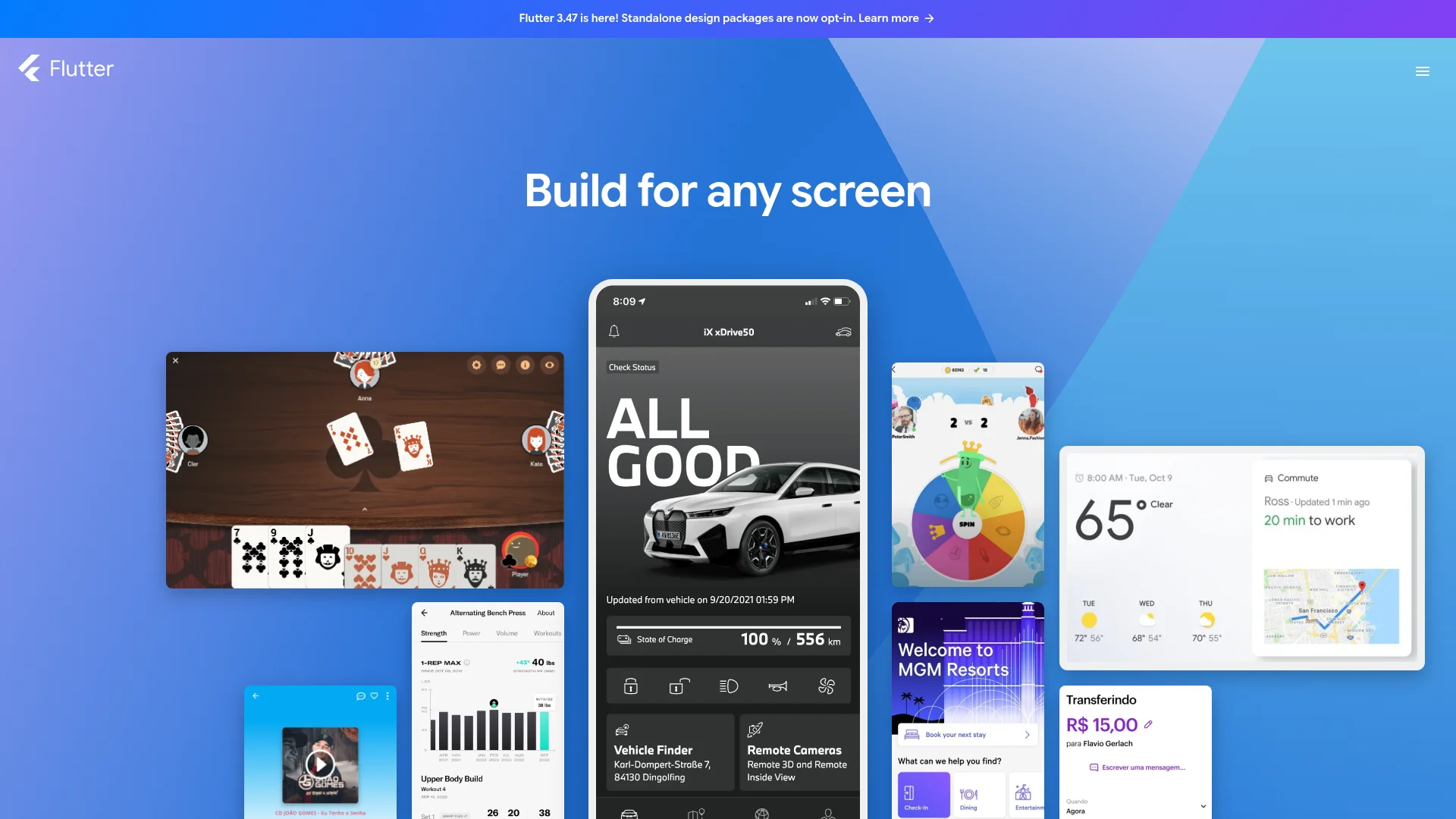
Flutter is Google's open-source UI framework for building cross-platform apps from a single Dart codebase. It renders every pixel itself through its Impeller graphics engine, so an app looks identical across iOS, Android, web, desktop, and embedded devices. The current stable release is Flutter 3.47, bundled with Dart 3.13, and Impeller is now the default renderer on every platform.
What Is React Native?
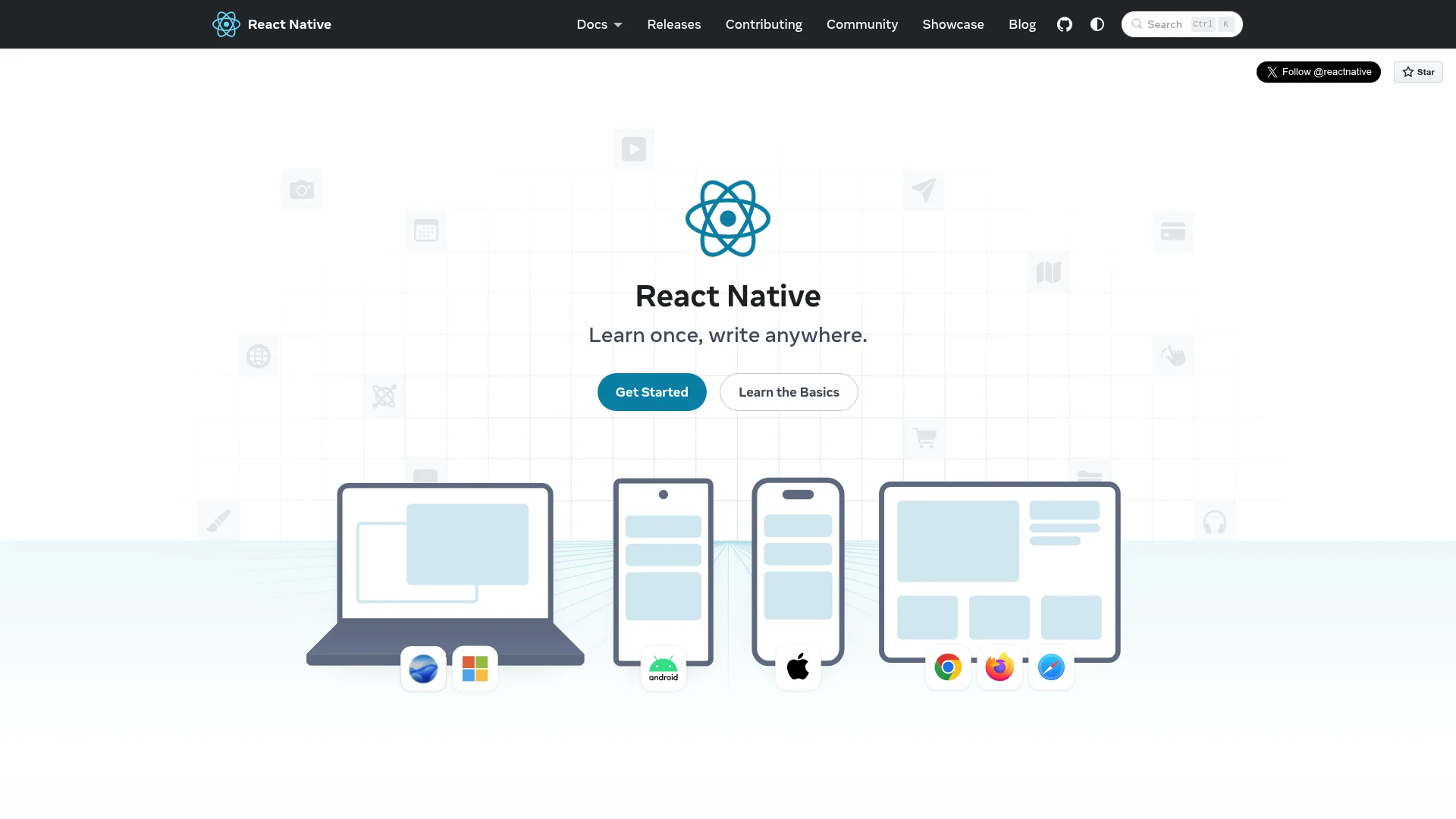
React Native is Meta's open-source framework for building native mobile apps with JavaScript or TypeScript and React. Instead of drawing its own pixels, it renders real native UI components, so apps feel at home on each platform. The 2026 stable release, version 0.87, ships the New Architecture (Fabric, TurboModules, and JSI) by default, which removed the old asynchronous bridge and closed most of the performance gap with native code.
What Is CatDoes?
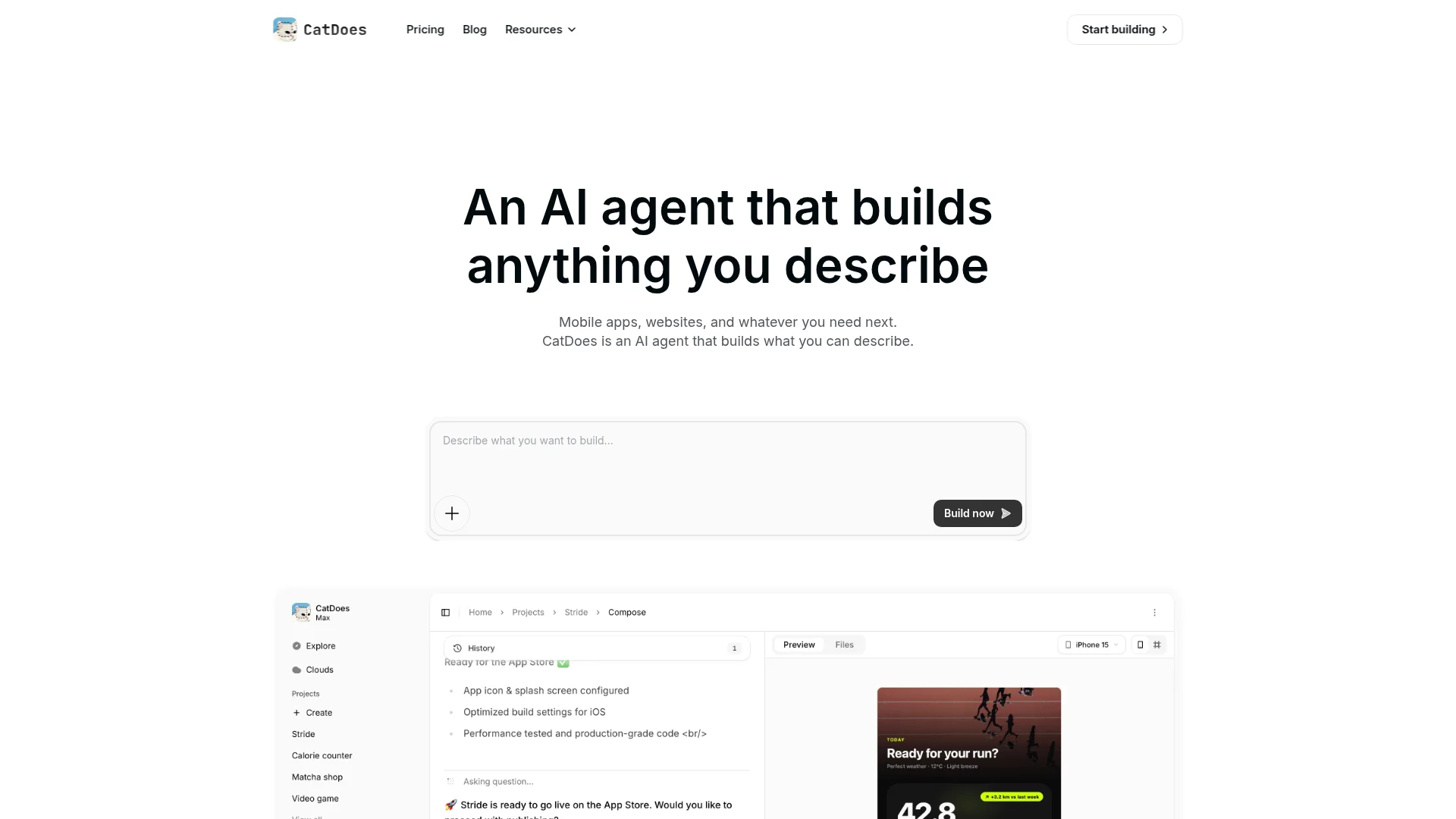
CatDoes is an AI app builder: an AI agent that turns a plain-English description into a working mobile app or website, with a backend already connected, then ships it to the App Store, Google Play, or the web. It isn't a framework you code in; it's a teammate you brief. Under the hood it generates real React Native code for mobile and standard web code for sites, so you own a genuine app, not a locked-in prototype. Here's a full breakdown of what CatDoes is and how it works.
Flutter vs React Native in 2026: The Framework Comparison
In 2026, Flutter and React Native are both mature and production-ready, and the performance difference is small enough that your team's existing skills usually matter more than any benchmark. Flutter holds a slight edge on heavy graphics and animation; React Native holds a slight edge on app size, memory, and startup time.
Performance
Flutter compiles Dart ahead-of-time to native ARM code and draws the UI itself with Impeller, which gives it a steady frame rate on long lists and complex animation. Independent 2026 benchmarks put it around 58 to 60 FPS on heavy UIs. React Native renders with real native components, and one 2026 test suite found it cold-starts roughly 200ms faster and uses about 12% less battery, partly because it doesn't bundle a whole rendering engine. Treat these numbers as directional; independent benchmarks don't always agree.
Metric | Flutter | React Native |
|---|---|---|
Rendering | Impeller (own engine) | Native components (Fabric) |
Heavy-UI frame rate | ~58 to 60 FPS | Slightly behind |
Cold start | Slightly slower | ~200ms faster (2026 test) |
Battery use | Baseline | ~12% less (2026 test) |
App binary size | Larger (bundles engine) | Smaller |
Strong at | Animation and graphics | Native feel and startup |
Language and Learning Curve
Flutter uses Dart, a clean, easy-to-learn language that is nonetheless niche outside the Flutter world. React Native uses JavaScript or TypeScript, the same language millions of web developers already write every day. If your team already ships React or JavaScript for the web, React Native is the shorter on-ramp; if you're starting fresh and want one framework for mobile, web, and desktop, Dart and Flutter are a reasonable bet. Both offer hot reload, so you see UI changes almost instantly.
Ecosystem, Hiring, and the Job Market
This is where React Native's JavaScript roots pay off. The npm ecosystem is the largest in software, and JavaScript talent is far easier to hire than Dart talent, which matters when you're staffing a team. Flutter's package ecosystem on pub.dev is smaller but well-maintained and backed by Google. For the 2026 job market specifically, JavaScript and React Native roles still outnumber Flutter and Dart roles, though Flutter demand keeps climbing. If hireability is your top constraint, React Native is the safer pick.
What About Native Development (Android Studio and Xcode)?
There's a baseline option behind both: fully native development, meaning Kotlin in Android Studio for Android and Swift in Xcode for iOS. Native gives you maximum control and performance, but you build and maintain two separate codebases, which roughly doubles the work. That's the real "Android Studio vs Flutter vs React Native" trade-off: native offers the most control, while the two cross-platform frameworks give up a little raw performance in exchange for one shared codebase.
Frameworks vs AI App Builders: A Different Way to Ship
Flutter and React Native both answer the question "which framework should I code in?" An AI app builder answers a different one: "do I need to write the code at all?" Instead of learning Dart or JavaScript and wiring up a build pipeline, you describe the app in plain English and an AI agent builds it, a category often called no-code or AI app builders.

This is the fastest-growing corner of AI mobile app development. The best AI app builders don't just generate a screenshot or a throwaway prototype, they produce a real, running app with a backend, and some handle app-store submission for you. If you want a wider look at the category, see our roundup of the best AI app builders.
Factor | Flutter / React Native | AI app builder (CatDoes) |
|---|---|---|
Who writes the code | You do | The AI agent |
Skill required | Dart or JavaScript plus mobile tooling | Describe it in plain English |
Time to first working app | Days to weeks of setup | Minutes |
Backend, auth, storage | You configure it | Included |
App-store submission | You handle it | Built in |
Do you own the code | Yes | Yes (real React Native) |
Best fit | Engineering teams | Founders, SMBs, and devs who want speed |
It isn't strictly either-or. Because CatDoes writes standard React Native, a developer can let the agent do the heavy lifting and still export the code to keep building by hand on higher-tier plans.
Can You Build an App Without Coding?
Yes. In 2026 you can build a real mobile app without writing any code by using an AI app builder. You describe what you want (the screens, the features, the data) in plain English, and the agent generates the app, connects a backend, and publishes it to the app stores. Instead of editing source files, you refine the app with follow-up messages.
The workflow looks like this:
Describe your app in plain English, for example "a habit tracker with reminders and a weekly chart."
Let the agent build a first version in the cloud, with screens, logic, and a connected backend.
Preview it on phone and desktop to see how it looks and behaves.
Refine with prompts like "make the header dark" or "add a login screen."
Publish it to the App Store, Google Play, or the web.
Most AI builders, including CatDoes, offer a free tier, so you can try building an app for free before paying for anything. The same approach works for a specific platform too, here's how to build an Android app with AI.
Which One Should You Choose?
The right choice comes down to who's building and what you're optimizing for. Use this as a quick decision guide.
Choose Flutter if your app is animation-heavy or needs pixel-perfect UI, you're also targeting desktop or embedded devices, or your team already knows Dart.
Choose React Native if your team writes JavaScript or React, you want a native feel with smaller app sizes, and easy hiring matters.
Choose CatDoes if you want a working app fast, you'd rather not manage code and build tooling, or you're a developer who wants React Native written and shipped for you.
In short: pick a framework when you have engineers and specific control requirements; pick an AI app builder when speed to a launched app matters more than owning every line from day one.
How CatDoes Writes React Native for You
CatDoes runs as a cloud agent. You send a request, it spins up its own machine, plans the work, and can launch subagents to build different parts in parallel, then it generates production React Native for mobile and standard web code for sites. You don't manage any of the tooling; you describe and review.
Every project comes with CatDoes Cloud, a backend that includes a database, authentication, file storage, edge functions, and realtime, so you're not stitching together separate services. When the app is ready, CatDoes publishes it: to the web with a custom domain, or to the App Store and Google Play with store submission handled for you. Because the output is real React Native, the apps look and behave like ones a developer would build. You can browse real React Native app examples to see the kind of thing that ships.
We build with all three approaches, and the pattern we keep seeing is simple: frameworks reward teams with time and engineering depth, while an AI agent wins when you need a launched app quickly and don't want to babysit a build pipeline.
Frequently Asked Questions
Is Flutter or React Native better in 2026?
Neither wins outright. Both are production-ready, and the performance gap is small. Choose Flutter for graphics-heavy, pixel-perfect apps and multi-platform reach; choose React Native for JavaScript teams, a native feel, smaller apps, and easier hiring.
Is Flutter or React Native better for the job market in 2026?
React Native has the larger job market because it runs on JavaScript, the most widely used programming language. Flutter and Dart roles are growing but still fewer in number. If hireability is your priority, React Native and JavaScript are the safer bet.
Does CatDoes use Flutter or React Native?
CatDoes generates React Native for mobile apps and standard web code for websites. You get real, ownable code, not a proprietary format, so your app is a genuine React Native app under the hood.
Can you build an iOS and Android app without coding?
Yes. An AI app builder like CatDoes generates a cross-platform app from a plain-English description and can publish it to both the App Store and Google Play. There's a free tier, so you can start without paying.
Is a PWA or a native app better?
Native apps, built with React Native, Flutter, or an AI builder, get full app-store distribution, push notifications, and device APIs. A PWA (progressive web app) is cheaper to ship but limited on iOS. For most product apps you plan to grow, a native app wins.
What about Kotlin Multiplatform?
Kotlin Multiplatform is a rising third option that lets you share business logic across platforms while keeping fully native UI. It's promising, especially for teams already invested in Kotlin, but its ecosystem is smaller than Flutter's or React Native's today.
The Bottom Line
Flutter vs React Native is no longer a battle with a clear winner. In 2026 both are mature, fast, and production-ready, so the decision comes down to your team's skills and your app's needs. Flutter is the pick for pixel-perfect, animation-rich, multi-platform apps; React Native is the pick for JavaScript teams that want a native feel and easy hiring.
But if your real goal is a launched app rather than a codebase to maintain, there's a faster path. CatDoes writes the React Native and ships it for you, backend and app-store submission included. Try CatDoes free and go from a plain-English idea to a published app without touching a build pipeline.
Nafis Amiri
Co-Founder of CatDoes