Blog
Insights
CatDoes vs Adalo: Best Adalo Alternative (2026)
CatDoes vs Adalo compared for 2026: real pricing, app store publishing, code export, and design control. See which no-code app builder fits your project.

Nafis Amiri
Co-Founder of CatDoes
TL;DR: CatDoes and Adalo are both no-code app builders, but they hand you different jobs. Adalo is a visual canvas where you design the screens, wire up the database, and assemble the app yourself, with an AI assistant helping alongside you. CatDoes is an AI agent that builds the whole thing from a plain-English description and ships it to the App Store, Google Play, or the web with the backend included. Adalo charges a flat monthly fee per published app and meters nothing. CatDoes charges monthly credits for the AI work and lets you export the code. Choose Adalo if you want to design it yourself. Choose CatDoes if you want the app built for you.
You want an app in the App Store, you do not want to write code, and you have narrowed it down to two tools that both promise exactly that. Adalo has been one of the best known no-code app builders for years. CatDoes takes a newer approach: describe the app, and an agent builds and ships it.
The trap is that both are marketed as "build an app without code," so the demos look interchangeable. They are not. One asks you to become the designer and the database architect. The other asks you to become the person who describes what they want and reviews the result. This guide covers what each one actually is, real 2026 pricing from both pricing pages, who publishes your app to the stores, and which one fits your situation.
Table of Contents
What Is Adalo?
What Is CatDoes?
CatDoes vs Adalo: The Core Difference
Feature Comparison
Pricing: CatDoes vs Adalo in 2026
Publishing: Who Gets Your App Into the Stores?
Design Control and Iteration Speed
Integrations and Extensibility
Which One Should You Choose?
Frequently Asked Questions
The Bottom Line
What Is Adalo?
Adalo is a visual no-code app builder. In its own words on the Adalo homepage, it is "The Visual No Code App Builder, Now Powered By AI," and it lets you "design native iOS, Android, and web apps on a visual multi-screen canvas with AI that builds alongside you."
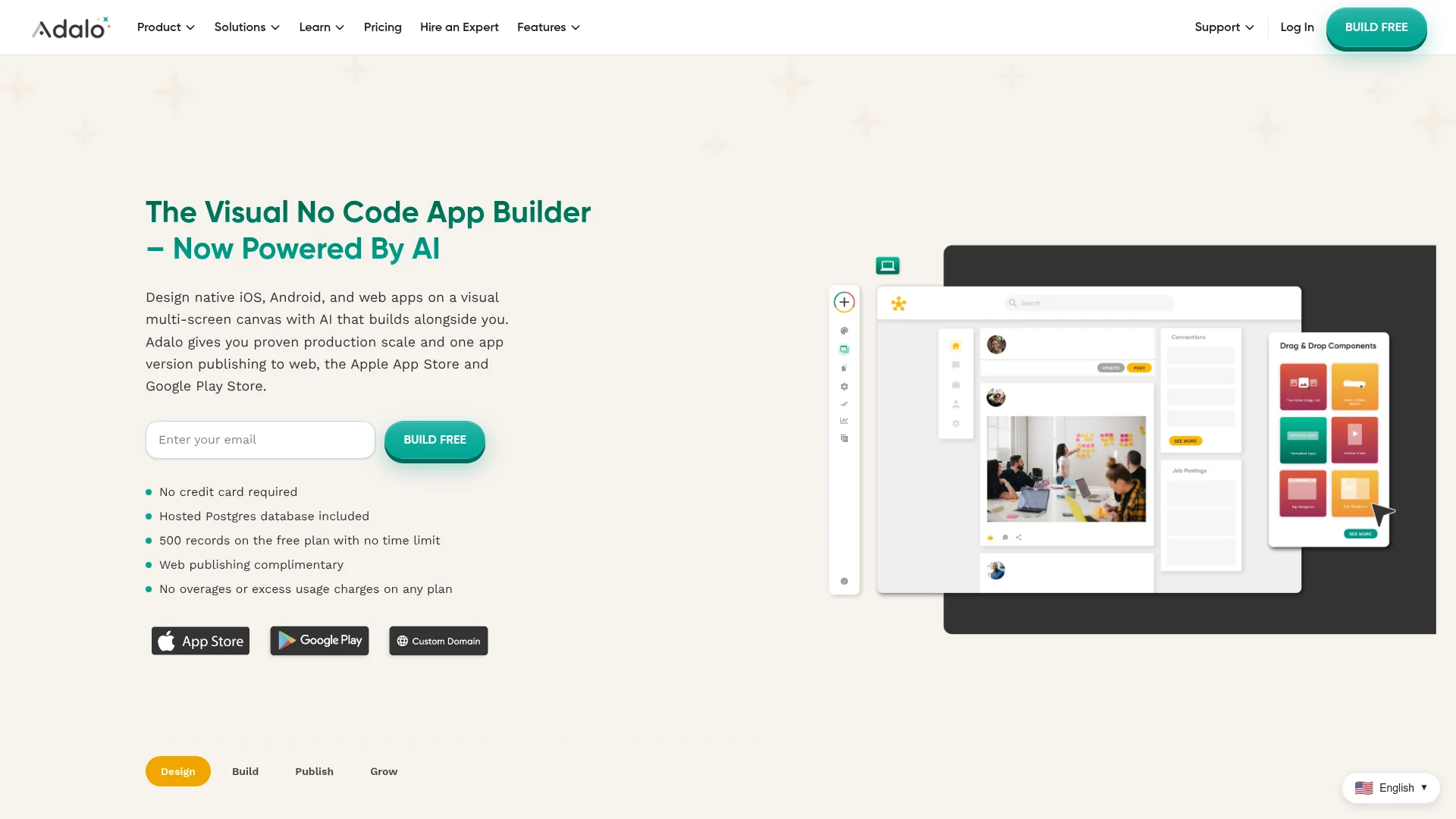
The canvas is the product. You drag components onto screens, define collections in a hosted Postgres database, and configure actions, relationships, and visibility rules yourself. A Component Marketplace adds free and premium widgets on top, and Ada, Adalo's AI assistant, can now generate and edit parts of the app from prompts.
That model gives you genuine control over every pixel and every rule. It also means the app is your assembly job. Most of the learning curve in Adalo is not the drag and drop, it is understanding how collections relate to each other and why a list is not showing the records you expected.
What Is CatDoes?
CatDoes is an AI agent that builds mobile apps and websites from natural language. You describe what you want, the agent runs in the cloud, spins up its own subagents to handle design, code, and release, and ships the result to the App Store, Google Play, or the web with a custom domain. There is no canvas to learn and no code you are required to touch.
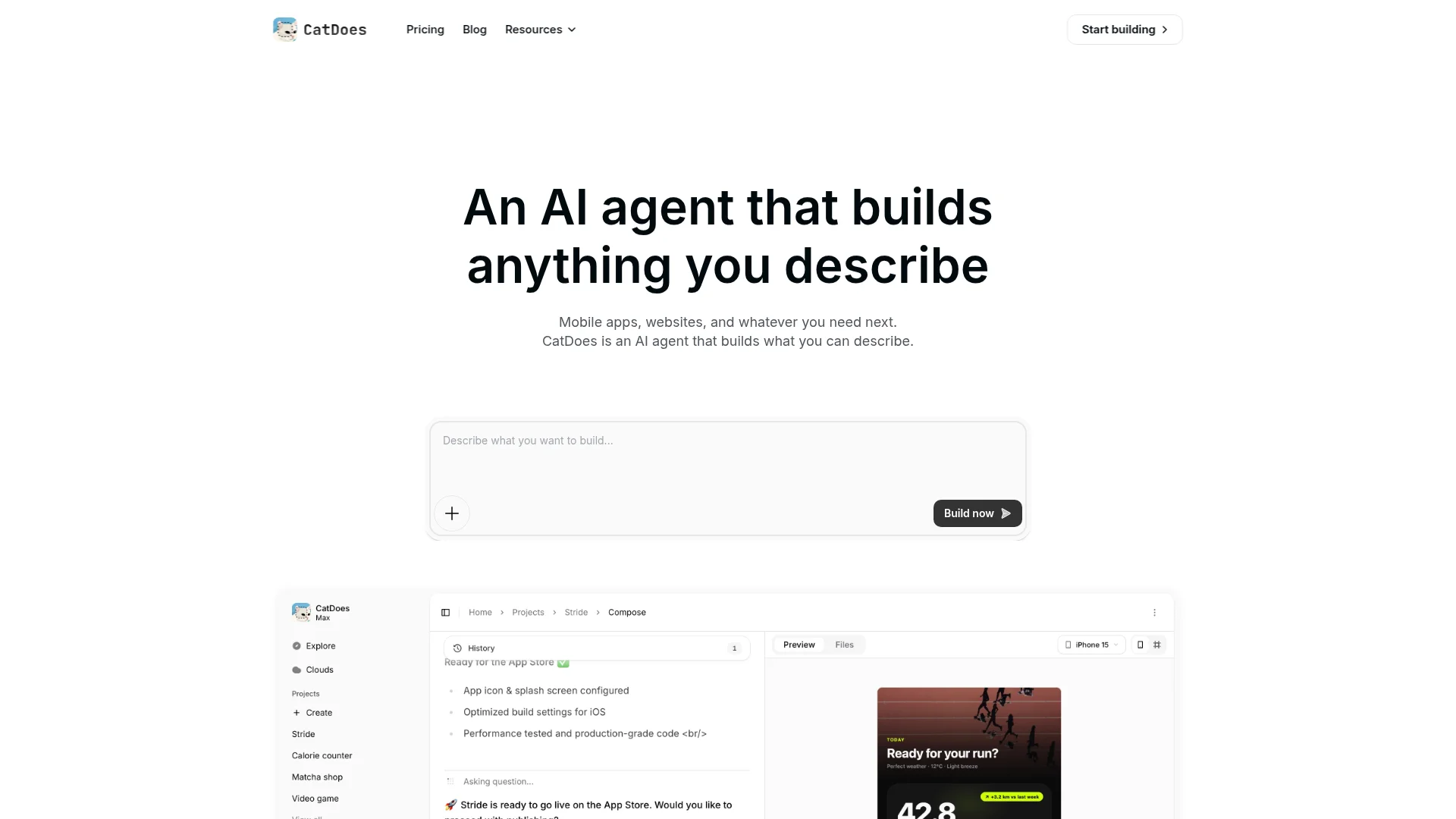
Every plan includes CatDoes Cloud, a built-in backend with database, authentication, storage, edge functions, and realtime, so a real app has its data and logins from day one. Checkpoints let you roll back to any earlier state, and developers can import a GitHub repo or export the code and keep working in their own editor. For the wider field, our guide to the best AI app builder options puts CatDoes in context.
CatDoes vs Adalo: The Core Difference
The cleanest way to see it: Adalo gives you the tools to build the app, and CatDoes builds the app.
Both now have AI, so that word alone no longer separates them. The difference is where the AI sits. Adalo's Ada is an assistant inside a visual editor, helping with a canvas that you still own and operate. CatDoes is agent-first: the agent writes the screens, the logic, and the backend, and your job is to describe the outcome and review what comes back.
That difference decides what your week looks like. On Adalo you spend it laying out screens and debugging visibility rules. On CatDoes you spend it describing features and testing builds.

Feature Comparison
Here is how the two line up on the things that decide whether you end up with a shipped app.
Feature | CatDoes | Adalo |
|---|---|---|
What it is | AI agent that builds and ships apps | Visual drag and drop builder with AI assist |
Primary interface | Describe it in plain English | Multi-screen visual canvas |
Coding required | No | No |
Native iOS and Android | Yes | Yes |
Web output | Websites with custom domains | Responsive web apps with custom domain |
App store publishing | Done for you, from Starter | Automated store publishing, from Starter |
Backend included | CatDoes Cloud: database, auth, storage, edge functions, realtime | Hosted Postgres database and collections |
Code export | Yes, plus GitHub import | No code export |
Component marketplace | No, the agent generates components | Yes, free and premium components |
Pricing model | Monthly credit allocation | Flat monthly fee, no usage charges |
Best for | Founders who want the app built for them | Builders who want to design it themselves |
Pricing: CatDoes vs Adalo in 2026
Adalo uses flat subscription pricing with nothing metered. These are the current plans from its official pricing page, shown at the annual rate:
Adalo Plan | Price | What you get |
|---|---|---|
Free | $0 | 500 records per app, unlimited App Actions, unlimited test apps, 1 editor |
Starter | $36/mo billed annually ($45 monthly) | 1 published app, 5GB storage, custom domain, automated app store publishing |
Professional | $52/mo billed annually | 2 published apps, 25GB storage, 5 editors, push notifications, geolocation |
Team | $160/mo billed annually | 5 published apps, 125GB storage, 10 editors, Xano integration, version history |
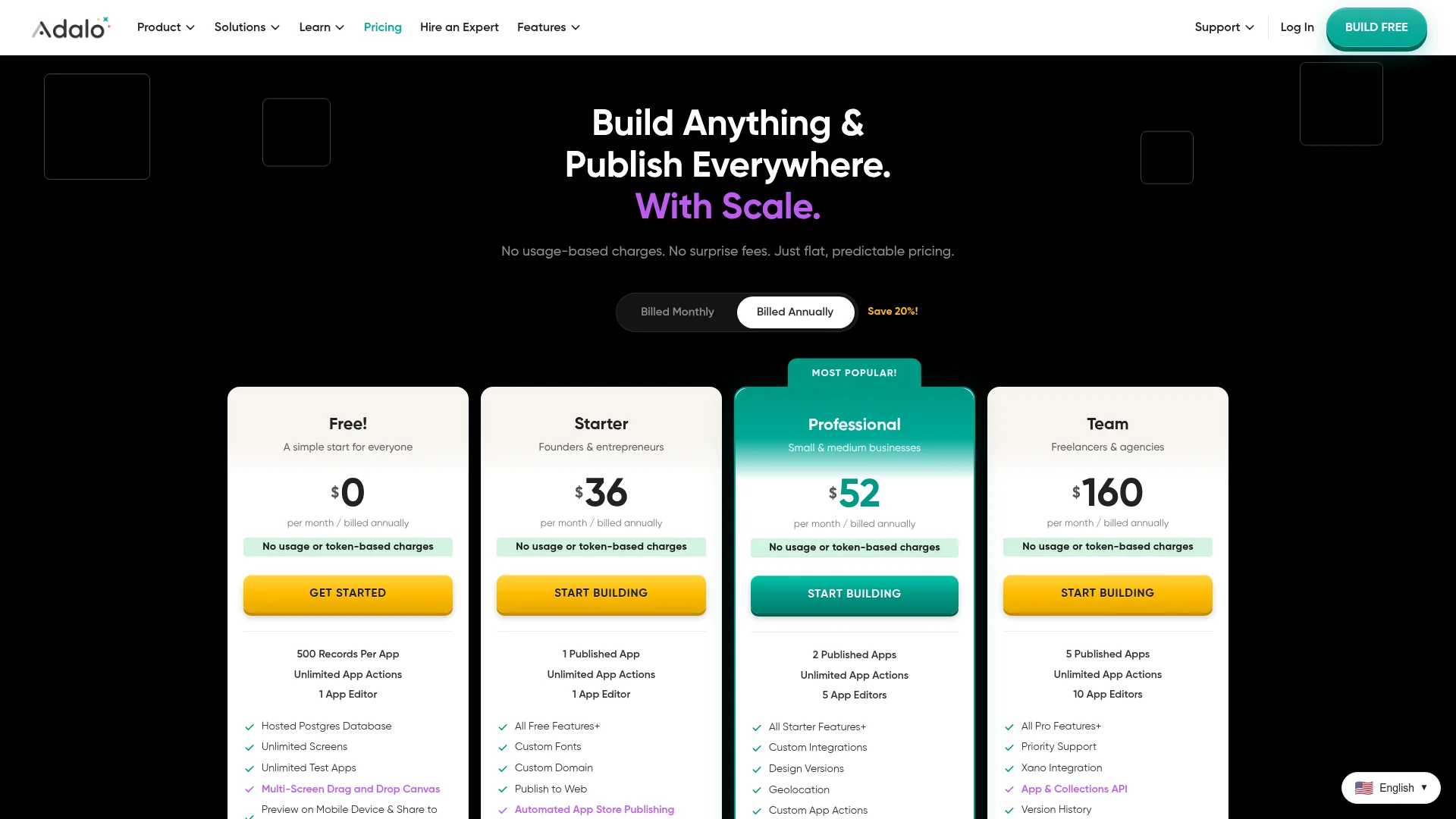
One thing worth correcting: if you have read older Adalo comparisons that warn about App Action limits and overage fees, that guidance is out of date. Every current plan, including the free one, lists unlimited App Actions, and Adalo states plainly that there are "no usage or token-based charges" on any tier. The real limit on Adalo is how many apps you can publish and how much storage your team gets, not how much traffic your app handles.
CatDoes prices by monthly credits, and every plan includes CatDoes Cloud:
CatDoes Plan | Price | Credits/mo |
|---|---|---|
Free | $0 | 15 (one-time) |
Core | $20/mo | 50 |
Starter | $50/mo | 200 |
Plus | $100/mo | 400 |
Pro | $200/mo | 900 |
Max | $399/mo | 2,000 |
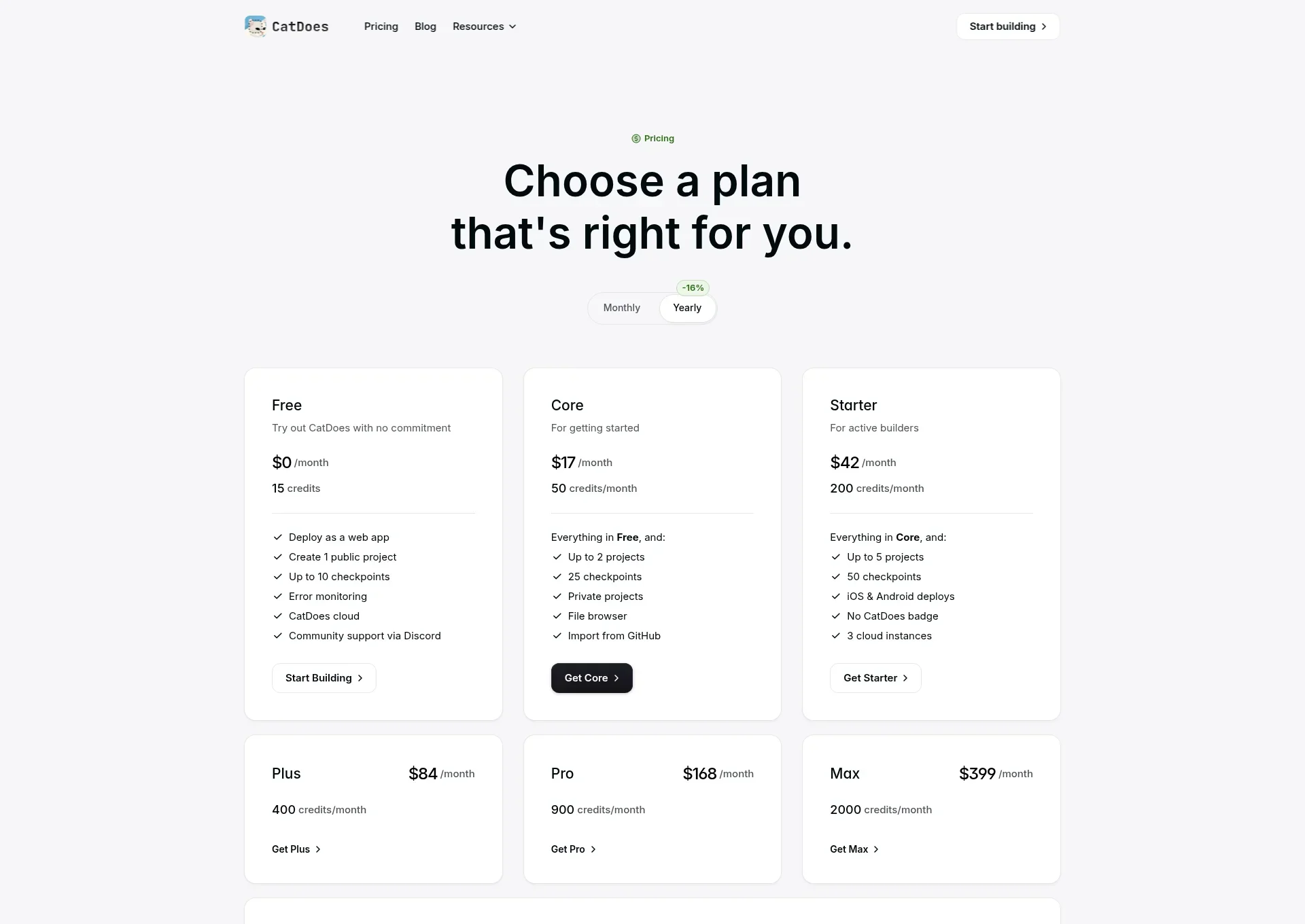
Those are monthly prices. Yearly billing takes about 16 percent off, which is the view in the screenshot above, so Core lands at $17 a month and Starter at $42.
The two models are charging for different things. Adalo's fee buys the right to publish and host a finished app, and it stays flat no matter how much you build or how many users you get. CatDoes credits buy AI build work, so a heavy month of feature changes uses more than a quiet one.
If your app is finished and stable, Adalo's flat fee is easy to predict. If you are still building, the honest comparison is not $20 against $45, it is the cost of the agent doing the work against the cost of your own hours on the canvas.
Publishing: Who Gets Your App Into the Stores?
Both platforms publish to the Apple App Store and Google Play, and on both the free plan is for building rather than shipping. Adalo includes automated app store publishing from the Starter plan. CatDoes includes iOS and Android deploys from Starter as well, while the free plan deploys your project as a web app.
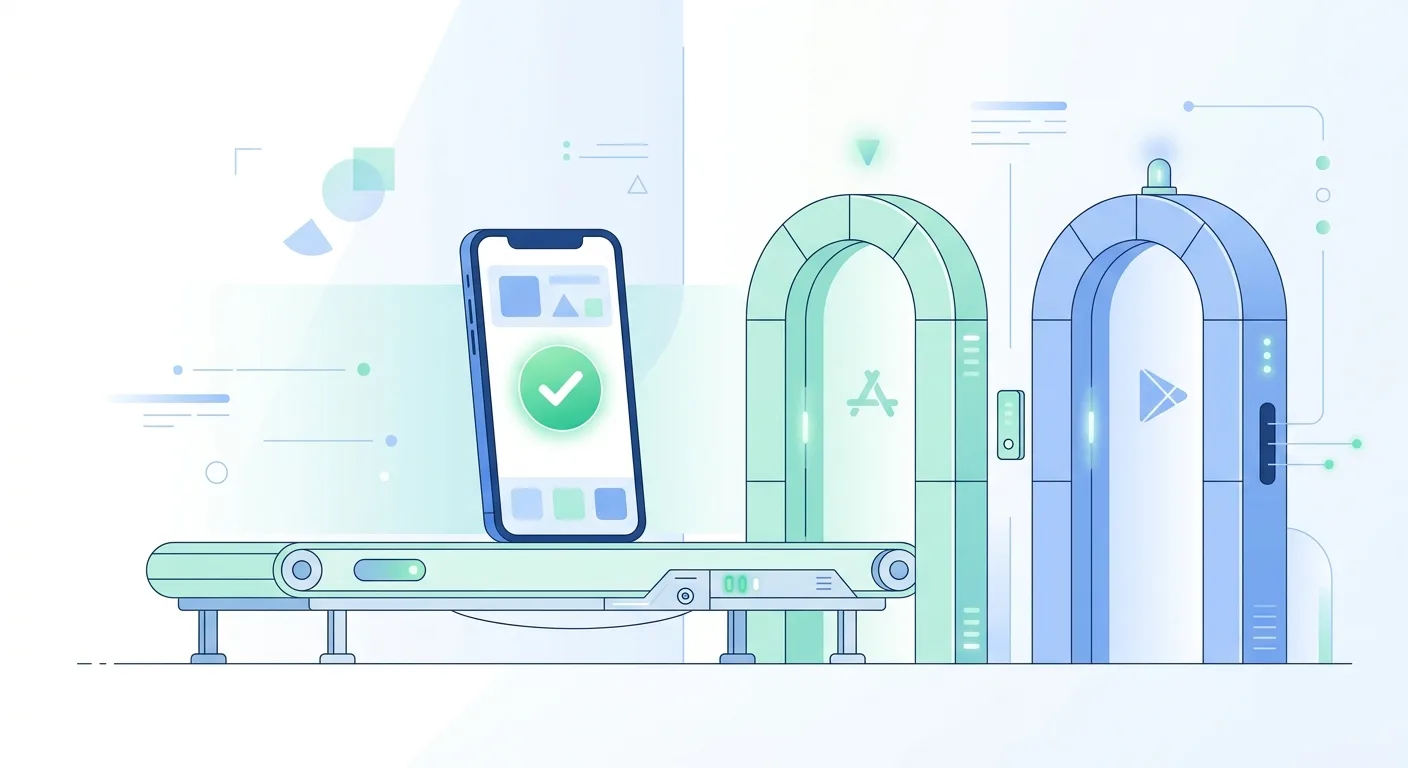
Neither tool exempts you from review. Every app on either platform still has to clear Apple's App Review guidelines, and that first submission is where most first-time makers lose a week. CatDoes runs an App Store review simulation before you submit, which surfaces the common rejection reasons while you can still fix them. If you want to see how much work the store pipeline normally involves, our walkthrough on how to publish an app on Google Play covers it end to end.
Design Control and Iteration Speed
Adalo gives you direct control. You position elements on a canvas, set styles per component, and see exactly what you built. If you have a strict brand spec and a clear picture in your head, moving a button yourself is faster than describing it.
CatDoes trades that direct control for speed of change. You describe the change, the agent regenerates the affected screens, and you check the result on a live preview. Checkpoints let you roll back if the new version is worse, so experimenting is cheap. That is a better fit when the design is still moving and you care more about shipping something testable this week than about controlling padding by hand.
The honest split: canvas control wins when you know exactly what you want and it is small. Agent iteration wins when the change is large or you are not sure yet.
Integrations and Extensibility
This is Adalo's strongest section. The Component Marketplace offers free and premium components you can drop in, and Adalo connects to Zapier and its 5,000-plus services, exposes a REST API, and reads external data from Airtable, Google Sheets, and Xano. If you need a specific prebuilt widget today, there is a good chance Adalo already has it.
CatDoes has no component marketplace, because the agent generates components instead of pulling them off a shelf. Its extensibility comes from two other places: CatDoes Cloud edge functions for custom server-side logic, and code export plus GitHub import, which means you can add any library or API directly in the codebase and keep the project even if you stop paying.
Adalo has no code export, so an Adalo app stays on Adalo. If you are still comparing the wider field, our roundup of Bubble alternatives covers the other major no-code platforms.
Which One Should You Choose?
Choose Adalo if you want to design the app yourself and enjoy it. It suits people who have a clear visual spec, want pixel-level control over every screen, value a mature component marketplace and Zapier integrations, and prefer a flat monthly bill with nothing metered. If your app is mostly finished and you just need it hosted and published, Adalo's pricing is very predictable.
Choose CatDoes if you want the app built rather than a tool to build it with. It suits founders and non-developers who would rather describe features than assemble screens, who want the backend, deployment, and store submission handled, who are building websites as well as apps, and who want the option to export the code and walk away with it. It also suits developers who want the pipeline handled and the repo in GitHub.
The two answer different questions. "Where do I design and publish my app?" points to Adalo. "How do I get my app built and launched?" points to CatDoes.
Frequently Asked Questions
Is Adalo free? Adalo has a free plan with 500 records per app, unlimited App Actions, unlimited test apps, and 1 editor. It is meant for building and previewing. Publishing an app to the app stores starts on the Starter plan at $36 a month billed annually.
Does Adalo charge for App Actions? No. Every current Adalo plan, including the free one, lists unlimited App Actions, and Adalo states there are no usage or token-based charges. Comparisons that mention App Action overage fees are describing older pricing.
Can Adalo publish to the App Store and Google Play? Yes. Automated app store publishing is included from the Starter plan, and Adalo publishes one app version to web, the Apple App Store, and Google Play.
Can you export your code from Adalo? No. Adalo does not offer code export, so the app stays on its platform. CatDoes supports both GitHub import and code export, so you can take the project with you.
Do I need to know how to code to use CatDoes? No. You describe the app in plain English and the agent builds it. Developers can go further with GitHub import and code export, but coding is optional.
Which is cheaper, CatDoes or Adalo? Both start free. The first paid CatDoes plan is $20 a month; Adalo's Starter is $36 a month billed annually, or $45 billed monthly. Adalo's fee is flat regardless of usage, while CatDoes credits scale with how much AI build work you do.
What is the best Adalo alternative? It depends on what you want to stop doing. If you want a different visual canvas, other no-code builders compete directly. If you want to stop assembling screens altogether and have the app built and shipped for you, CatDoes is the Adalo alternative worth trying.
The Bottom Line
CatDoes vs Adalo comes down to how much of the building you want to do. Adalo is a mature visual no-code app builder with a real component ecosystem, flat and predictable pricing, and full manual control of your screens. It is a good choice if designing the app is the part you want to own.
CatDoes is the Adalo alternative for people who want the outcome instead of the toolkit: an AI agent that turns a plain-English description into a native app or website, with the backend, deployment, and store submission included, and the code exportable if you want it.
If your goal is a finished app rather than an afternoon on a canvas, try CatDoes free and describe your first app. The agent takes it from there.
Nafis Amiri
Co-Founder of CatDoes